


Guest writer: Pilgrim
The nations will walk by its light, and the kings of the earth will bring their glory into it. …. People will bring into it the glory and the honor of the nations. (Revelation 21:24-26)
A recent essay titled “From Pantheon to Church: The Triumph of Catholicism” sparked controversy. For some, the word “triumph” names power masquerading as providence, imperial Christianity imposing its worldview by force. For others, it described the regeneration of dead stones, pagan beauty finding its purpose.
These weren’t just different readings of the same history; they were different stories about what history is. Every civilization lives within a “story” about what history means. These stories are not academic abstractions. They shape how societies interpret suffering, justify power, remember the past, and imagine the future. Whether a culture believes history repeats, advances, or redeems itself will determine whether the past is revered, discarded, feared, or healed.
Broadly speaking, three visions of history have dominated human thought. The ancient world largely understood history as cyclical: civilizations rise and fall, ages repeat, and the cosmos endlessly renews itself. Modernity replaced this with a linear narrative of progress, imagining history as a steady ascent driven by reason, science, and emancipation. Christianity offers a third vision. It understands history neither as repetition nor escape, but as redemption, a movement from lost unity toward a restored, transfigured unity.
History in the Christian understanding is neither a wheel that eternally turns nor a random walk of accidents, nor is it a straight upward line of inevitable improvement. Instead, it’s a drama marked by rupture, conflict, and paradox, whose end is consecration. This movement is best described as a chiasm: a drama that begins in unity, passes through rupture and conflict, and is resolved not by erasing the past but by consecrating it. History, in this vision, is a battlefield moving toward a City.
The Ancient Cycle and the Modern Escape
The ancient world, from the Stoics to Eastern cosmologies, largely understood history as circular, with the cosmos endlessly destroying and renewing itself through destruction. Time, in this vision, has no ultimate meaning, and wisdom lies in detachment. What was will be again.
The Enlightenment replaced this cyclical view with a linear one, seeing history as a march of progress. History was no longer repetition, but ascent. Science would tame nature, reason would tame religion, and education would tame violence. Salvation was emancipation from the constraints of nature and the ignorance of suspicion.
This view of history functioned as a secular eschatology. War, suffering, and injustice were reinterpreted as temporary setbacks on an otherwise upward trajectory. Evil became inherited limitations and would eventually dissolve under knowledge and technological advancement.
Both the cyclical and progressive visions share a common quiet despair. The cyclical view denies ultimate fulfilment; the progressive vision denies any necessity for redemption. Neither can explain why past patterns continue to haunt us, nor why human achievements so often decay into their opposites. Both ultimately leave human history unable to heal itself.
The World Wars and the Collapse of the Meta-Narrative
The First and Second World Wars detonated the illusion of progress. The most “advanced” societies in history, scientifically, philosophically, and bureaucratically, produced mechanized slaughter, total war, and industrialized human genocide. Auschwitz was not a medieval atrocity; it was the product of modern efficiency. Hiroshima was not barbarism; it was rational calculation.
After 1945, the moral credibility of the progress narrative lay in ruins. While the rhetoric of progress survived, especially in international law, economics, and human rights discourse, the deeper confidence that history guaranteed improvement did not. If reason led to gas chambers, if science culminated in nuclear annihilation, then history could no longer be trusted to bend toward the good.
Post-Modernism: From Progress to Suspicion
Post-modernity did not replace the narrative of progress with a better one; it dissolved meta-narratives altogether. Truth became power, history became construction, and meaning became subjective. Grand stories were now seen as tools of domination. What remained were fragments: identities, perspectives, and competing narratives with no shared horizon.
In this, post-modernism performed a necessary judgment. Its suspicion exposed real idolatries, instances where power had masqueraded as universal truth, where particular interests had claimed cosmic authority. The critique was often true. Both Christian and Enlightenment “universals” had frequently served imperial purposes; “objective” history had sometimes been written by victors to justify conquest.
Yet this intellectual shift, for all its diagnostic clarity, could only demolish. It couldn’t build. The cultural eruption that followed in the cultural revolutions and upheavals of the 1960s reflected this limitation.
This revolution, for all its energy, offered no teleology. Freedom was defined negatively as the removal of constraint rather than positively as the fulfilment of human nature. Post-modernism could tell us what was false, but it had no vocabulary for what was true.
The Christian Meta-Narrative: History as Drama, Not Illusion
Against this backdrop, the Christian vision of history is an explanation that makes sense of both progress and catastrophe. Where modernity saw a straight line and post-modernity sees only rubble, Christianity sees a chiasm: the movement from a lost community toward a restored and transfigured one. It sees the drama of two cities, of two loves that orient the human heart, as St. Augustine described it.
Christianity offers neither the optimism of progress nor the cynicism of post-modern suspicion. Instead, it presents history as a moral and spiritual drama, a struggle over what it means to recover what is human. At its core, it is the story of the restoration of the Image of God.
This drama revolves around what might be called a “binary”: a real opposition between good and evil, order and entropy, and between communion and rebellion. This is not a Manichaean dualism. This Christian “binary” is not a struggle between equal forces, nor a permanent stalemate. Evil is the absence of good; it will not endure as a rival to good, but be overcome through judgment and transformation.
The Cross reveals the mechanism where evil’s ultimate weapon, death itself, becomes the instrument of its own defeat. What appears as surrender is victory; what looks like weakness is power. The opposition between good and moral evil in human cultures remains real, driving history forward as genuine conflict, yet it is already resolved in principle. The resolution comes not through the annihilation of one side by the other, but through transfiguration. What is true in particular cultures is preserved, and what is false is overcome. This is why the battlefield ends in a Holy City and not a wasteland.
The Prologue: Genesis and the Loss of Centre
From the beginning, Scripture rejects the myth of inevitable progress. Genesis frames history as starting with a rupture. The Fall is a rebellion to be healed. It is not simply moral failure; it is the introduction of fragmentation between God, nature, and people into the human story.
This fragmentation is shown at Babel, where humanity dissolves into nations, tribes, and competing truths. History splinters into rival narratives as human reason attempts to find its way back to the truth without a map. Philosophy, myth, empire, and ritual emerge as searches, as partial attempts to recover what was lost.
Into this confusion, the Old Testament recounts not a theory but a vector. The covenant with Abraham, the law, the prophets, these are not expressions of tribal superiority but anchors of continuity within the labyrinth of history. Israel is not chosen because it is superior, but because history requires a line of continuity through which truth can be preserved amid error. The law and the prophets do not end the conflict; they orient it. Truth is revealed and then preserved amid a desert of error, not by force, but by fidelity.
The Pivot of History: Incarnation as Subversion
At the center of the chiasm stands the Incarnation; the moment when eternity intersects time. The Author enters the story not as a conqueror but as a victim. This is conquest in its most paradoxical form: He does not rewrite the story from above but enters it from within.
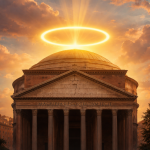
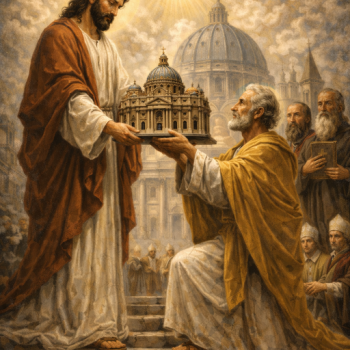
Irenaeus’ doctrine of recapitulation captures the scope of this. Christ gathers the entire human story into Himself. Every stage of life, every cultural fragment, every failed attempt at meaning, every stage of human life, birth, labor, suffering, death, is assumed and healed. He gathers not only human lives but human works; the dead stones of fallen civilizations become living stones in a new temple. The Pantheon stands in Rome still: pagan columns supporting Christian worship, Greek philosophy and Roman reason claimed and perfected rather than destroyed. What was built for false gods now houses the true God. Victory comes not through domination but through the Cross, redefining power, success, and triumph.
Here, the binary deepens rather than disappears. Crucially, Christ does not abolish the nations. He claims them as His inheritance. Pagan cultures are judged, purified, and reclaimed. What they created in their searching, their philosophy, their law, their art, was not all worthless groping but a preparation, however incomplete, for a splendor that would one day be brought into the City. The opposition between good and evil remains real, but it is no longer simplistic. The Cross becomes the great subversion of historical logic: victory through surrender, power through weakness, and sovereignty revealed in sacrifice.
Teleology as Integration: From Battlefield to City
The Book of Revelation is a vision of integration. It completes the arc of history not with annihilation but with consecration and transformation.
Revelation’s final image is not a return to Edenic innocence, nor a return to Eden as untouched wilderness, but to the New Jerusalem, a transformed world where nature, culture and mankind are reconciled with one another and with God. The nations walk by Christ’s light. The kings of the earth bring their splendor into the City.
This is the answer to Babel, to the Flood and to the Cities of the Plain. What was scattered in judgment is gathered in grace. The cultural achievements of history, the art and philosophy of Greece, the law of Rome, the music of later ages, are not discarded as “error” or “searching in darkness.” What is evil is purged; what is true is made eternal.
This is the ultimate synthesis. The war between good and evil ends not with the annihilation of history but with consecration. The battlefield is folded back into the garden, but the garden has become architectural, communal, and luminous with human meaning. This directly contradicts both secular progress, which believes culture needs no redemption, and post-modern despair, which believes culture cannot be redeemed.
The Arc of Christian History
At a glance, the Christian meta-narrative can be seen as a coherent arc:
- Genesis reveals separation and loss of unity.
- The Old Testament preserves truth amid fragmentation.
- The Gospels mark the pivot where eternity enters history in disguise.
- The Church slowly gathers and baptizes the nations.
- Revelation completes the synthesis: all is perfected by grace.
Unlike the secular progress narrative, which treats the past as something to be overcome, Christianity insists that nothing true is wasted. History is not a junkyard of failed experiments, nor a museum of relics, but a quarry from which God builds His City. The opposition between good and evil drives history forward, but it is not history’s final word.
Our Present Crossroads
Seen in this light, the twentieth century is not an embarrassment to Christian thought but a confirmation of it. The failure of progress, the collapse of grand secular narratives, and the exhaustion of revolutionary liberation all testify to the inadequacy of stories that deny sin, judgment, and redemption.
If history is indeed a drama moving toward redemption, then certain moments carry unusual weight, not because they lie outside the pattern, but because they crystallize it. The present age appears to be one such moment when multiple trajectories converge, and fundamental choices about human nature and destiny can no longer be postponed.
The Exhaustion of Competing Narratives
The fragmentation the essay describes has reached a kind of completion. Post-modernity’s project of dissolving meta-narratives has succeeded so thoroughly that the resulting epistemic chaos has become unbearable. People are hungry for coherence again, even if they no longer know where to find it. The progressive narrative, meanwhile, hasn’t recovered from its twentieth-century collapse; it merely runs on institutional momentum, repeating promises it can no longer make credible.
The result is a fourfold collapse of what makes human life coherent: crises of meaning, truth, community, and purpose. Most acute is the crisis of purpose. The “for what?” question that post-modernity could dismantle structures to ask but never answer. Without teleology, freedom becomes mere negation, and achievement becomes arbitrary.
The Technological Challenge to the Image
What makes this moment unprecedented is the technological dimension. Artificial intelligence, bioengineering, and transhumanism are not simple new tools; they embody assumptions about what the human person is. The technological project increasingly operates on the premise that human nature has no given structure, no telos, no sacred boundary. We are treating ourselves as raw material for optimization rather than as beings made in an Image that cannot be redesigned.
This is Babel in a new key: not “Can we reach heaven?” but “Can we remake the human?” The collision between two irreconcilable claims about what we are: whether human nature is given or constructed, whether our limits are obstacles to transcend or boundaries that constitute our dignity.
The stakes are clear. One path leads toward what might be called technological Gnosticism: the belief that embodiment is a problem to be solved, that mortality is a bug to be patched, that human limitations can and should be abolished through innovation and imagination. This is progressive amnesia carried to its logical extreme: the past, including the human past, becomes something to escape entirely.
The Global Interpenetration of Cultures
For the first time in history, the “nations bringing their splendor” is not merely a prophetic metaphor but a lived reality. Cultures interpenetrate with unprecedented speed and scale. This could result in permanent fragmentation, or it could provide the raw material for genuine catholicity that gathers without erasing.
The Clarification Through Marginalization
Paradoxically, the collapse of Christianity’s institutional dominance in the West may clarify its essential claims. When Christianity was simply “the establishment,” its proclamation about redemption versus power was muddled by entanglement with political authority. The Church’s own history is scarred by centuries when it wielded Babel’s grasping at power instead of embodying Jerusalem’s sacrifice, when it conquered rather than transfigured; an institution always composed of sinners as well as saints.
This is precisely why its current marginalization may be grace: exposure burns away pretense, leaving only what can survive fire. A Christianity that no longer controls culture must embody what it proclaims, or be revealed as one more tribal narrative among many.
The Three Paths Forward
The crossroads presents three paths with unusual clarity:
The first path doubles down on the progressive vision despite its failures. It places faith in technological salvation, the abolition of limits, and the eventual emergence of a post-human future that has overcome the embarrassments of embodiment, mortality, and given nature. This path treats history as something to be escaped.
The second path accepts fragmentation as permanent. It embraces tribalism, affirms that competing truths cannot be reconciled, and abandons the search for any shared horizon. Meaning becomes local, and the nations remain scattered with no possibility of gathering. This path treats history as a story that cannot be told, only endured.
The third path is the Christian claim: that integration without erasure remains possible, that unity without uniformity can be achieved, that both/and is not aspirational but the actual telos toward which history moves. This path insists that history is not something to escape or endure, but something to redeem.
The Weight of the Moment
What makes this a genuine turning point rather than simply another difficult period is that the choice between these paths is being forced. The technological capacity to remake or destroy human nature will not wait. The global interpenetration of cultures will not reverse. The exhaustion of post-modernity’s fragmenting project will not restore the progressive illusion. The inability to have coherent conversations about our inheritance is itself a symptom of the crisis. We’ve lost the ability to speak about redemption because we’ve lost the story that makes redemption intelligible. The question is no longer academic but immediate: which story about history is true?
For those who accept the Christian meta-narrative, this moment carries both promise and peril. The promise is that the hunger for synthesis, for meaning that doesn’t dissolve under scrutiny, for a story that accounts for both catastrophe and redemption, creates an opening for the Gospel that hasn’t existed in generations. The peril is that if the Church fails to embody the transfiguration it proclaims, if it fragments along the same lines as the surrounding culture, or simply retreats into nostalgia, then it will have squandered the clarifying gift of this historical moment.
Conclusion: The Choice Between Babel and Jerusalem
Modernity tried to escape the past. Post-modernity tried to dissolve it. Christianity insists on redeeming it.
The triumph at the end of history is not that one side obliterates the other, nor that all narratives dissolve into silence. The triumph is that truth proves large enough to absorb error without becoming it, to heal fragmentation, and preserve what is good.
History, in the Christian vision, is the long labor by which God takes the splendor of the nations, scarred, sinful, and incomplete and makes it eternal. What was scattered at Babel is gathered in Jerusalem. What was wounded is healed; what was human is made eternal.
We return, then, to the Pantheon. Was its transformation triumph or tragedy, appropriation or transfiguration? The question cannot be answered without first answering: which story about history is true? If progress, then Christianity’s claim on classical achievement was regression. If postmodern suspicion, then “triumph” is power’s self-justification. But if history is chiasm, a rupture moving toward restored unity, then the Pantheon reveals exactly what the Christian meta-narrative has always claimed: that human splendor, even when aimed at false gods, was never completely false. It was preparation, incomplete but real, waiting to be judged, purified, and brought into the City.
The debate about that building is the debate about everything.
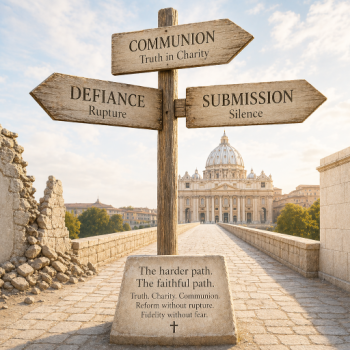
We stand now at a crossroads where the choice is unavoidable. One path leads back to Babel: the attempt to build unity through human power alone, whether technological or political, inevitably collapsing into fragmentation and confusion. The splendor we create becomes monuments to our pride, doomed to ruin.
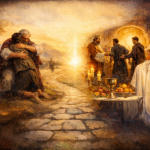
The other leads toward the New Jerusalem: the City where the nations bring their treasures not because they have been conquered, but because they have been transfigured. On this path, everything true we have made, our discoveries, our art, our longings given form, can be judged, purified, and brought through fire into the Holy City. This is why the work matters. This is why history is not a waste.
In a world haunted by the ruins of progress and exhausted by perpetual revolution, this remains the only meta-narrative that can account for both catastrophe and meaning without lying about either. The past is not something to escape, but something to redeem. And this present moment, for all its chaos and confusion, is not evidence of history’s meaninglessness but a sign of its dramatic intensity. The choices that have always been implicit are now becoming unavoidably explicit.
The question is no longer whether history has a direction, but which direction we will choose to follow. Will we scatter again at Babel, or will we at last bring our splendor home?
Thank you!
Read The Latin Right’s other writing here.
Please visit my Facebook page and IM your questions (and follow my page) or topics for articles you would like covered.








 Ad-Free & Subscriber Log-In