


Happy New Year!!! I hope everyone had a great Christmas.
Of the many wondrous works of antiquity, one stands as the culmination of natural reason in the pre-Christian world: the Pantheon. Built as a temple to “all the gods,” it reflects natural reason groping toward transcendence. Its architecture embodies order, proportion, harmony, and intelligibility. The great oculus opens to the heavens, symbolizing humanity’s intuition that reality points beyond itself.
In this way, the Pantheon gestures toward Natural Law. It declares that a higher order exists, that moral and metaphysical truth are real, and that man, by reason alone, cannot rightly name God or worship Him fully. Natural reason could reach upward, but it could not consecrate. The structure therefore remained incomplete—yearning for fulfillment it could not supply.
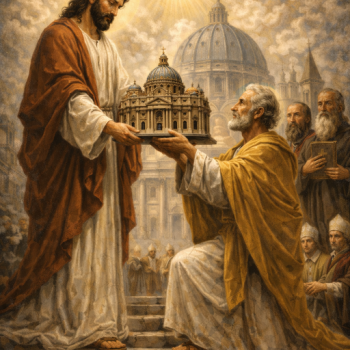
That fulfillment arrived in the early seventh century, when Pope Boniface IV consecrated the Pantheon as a Christian church dedicated to the Virgin Mary and the holy martyrs. In that moment, Natural Law did not disappear; Divine Revelation crowned it. What pagan reason sought imperfectly; Christ revealed definitively. The Pantheon’s conversion proclaimed not accommodation but triumph—the triumph of Catholicism over paganism.
As Western culture continues its steady secularization, the conversion of the Pantheon offers more than a historical curiosity. It provides a blueprint for evangelization and for the reclamation of Christendom. The task does not require novelty or compromise. It requires the courage of Catholics to do what conversion has always demanded: to baptize what is true, reject what is false, and consecrate the world to Christ.
Christianity Did Not Negotiate with Rome
Christianity began as a small Jewish sect on the margins of Roman society, often living as a persecuted minority. Rome persecuted Christians for a simple reason: they refused to compromise their faith to appease imperial authority. Christians would not acknowledge or sacrifice to idols, including the so-called “divine” emperor. By rejecting Rome’s gods, they also rejected Rome’s ultimate claims over conscience and worship—and the empire therefore judged them a threat to social order and civic harmony.
In short, Christianity did not “coexist” with pagan Rome. It endured Rome. It outlasted Rome. And in time, it replaced Rome. But it never negotiated its worship, diluted its doctrine, or surrendered its allegiance to Christ.
How Christ Conquered Rome: Apostles, Martyrs, and the Peace of Christ
A popular myth among anti-Catholics claims that Rome eventually conquered Christianity when Constantine legalized it in the early fourth century. According to this narrative, the Church merely absorbed the authoritarian spirit of the empire and began crushing dissent through councils and creeds. The story portrays Christianity not as a conquering faith, but as a conquered one.
History tells a very different story.
The Church did not conquer Rome through imperial favor, political force, or legal decree. She conquered Rome through the Gospel, through the witness of Saints Peter and Paul, and through the blood of martyrs. Long before Constantine, Christianity had already undermined Rome’s gods, exposed its moral failures, and built a new society within the old.
Pope St. Leo the Great describes this reality vividly in his Sermon 82 on Saints Peter and Paul:
Persecution does not diminish but increase the Church, and the Lord’s field is clothed with an ever-richer crop, while the grains which fall singly spring up and are multiplied a hundred-fold. Hence how large a progeny have sprung from these two heaven-sown seeds [Peter and Paul] is shown by the thousands of blessed martyrs, who, rivalling the Apostles’ triumphs, have traversed the city far and wide in purple-clad and ruddy-gleaming throngs, and crowned it, as it were, with a single diadem of countless gems.
St. Leo does not describe a Church reshaped by Rome. He describes a Rome reshaped by Christ. Christianity transformed the city not by imperial decree, but by apostolic witness and martyrdom. Saints Peter and Paul stand as the true founders of Christian Rome—not Constantine.
The Pantheon itself stands as a stone witness to St. Leo’s claim. Once dedicated to “all gods,” it now houses the relics of martyrs who refused to sacrifice to them. Rome did not tame Christianity. Christ conquered Rome—not by the sword, but by His peace.
The Modern Reversal: From Conquest to Coexistence
Many in the Church today no longer display the courage of their forebears. A faith that once turned temples into churches—and whose blood testified to truth—now too often absorbs secular assumptions, especially about the human person. In place of evangelization, it offers dialogue without conversion and accompaniment without repentance.
In other words, much of the modern Church seeks compromise with secular culture in ways the early Christians would have found unthinkable.
A Church that fears conflict and sacrifice cannot convert a culture. It can only reflect it.
What the Church Must Relearn to Conquer Secular Culture
What lessons can the Church draw from Rome’s conversion, symbolized by the Pantheon—now Santa Maria ad Martyres, dedicated to the Virgin Mary and the holy martyrs?
- Truth Converts Culture—Not the Other Way Around
The Church cannot accommodate falsehoods, especially about the human person, and still expect genuine conversion. She must not apologize for, or appear embarrassed by, the exclusive claims of the Gospel. Truth does not need permission to prevail; it needs proclamation.
- Witness Requires Sacrifice
Christianity spread through uncompromising and costly fidelity. The early Church accepted suffering rather than dilute doctrine or worship. Cultural approval and compromise have never served as engines of evangelization—and they never will.
- The World Can Be Converted
Pagan Rome proved far more hostile and aggressive toward Christianity than modern secular culture, yet the Gospel transformed it. The same principle holds today. Conversion requires confidence in Christ’s kingship and fidelity to the truth He revealed.
Final Thought—Christ Still Conquers
The Pantheon still stands in the heart of Rome. Tourists enter it every day to admire a masterpiece of pagan architecture, often unaware that they stand inside a monument to Christianity’s greatest historical claim: that Christ conquered the ancient world. Once dedicated to all the gods, it now honors the Virgin Mary and the martyrs—the very men and women Rome tried to silence. The empire that spilled Christian blood in defense of its idols unwittingly prepared the foundation of their replacement.
Rome did not fall to the Church because bishops learned to negotiate with power. It yielded because apostles preached, martyrs witnessed, and Christians lived a faith worth dying for. As St. Leo the Great proclaimed, the peace of Christ achieved what Roman legions never could. It subdued not merely territories, but hearts, consciences, and cultures.
The modern world resembles pagan Rome far more than Christian Christendom. It worships false gods, denies objective moral order, and treats truth as a threat to social harmony. The question, then, is not whether our age can be converted. The question is whether the Church still believes that it can.
The Pantheon answers from its altar. A Church that once consecrated the temples of paganism has no excuse for fearing the idols of modernity. Christ has not lost His power to conquer. Only His followers seem hesitant to wield it.
Thank you!
Read The Latin Right’s other writing here.
Please visit my Facebook page and IM your questions (and follow my page) or topics for articles you would like covered.








 Ad-Free & Subscriber Log-In