Worth a thousand words, Anglican edition

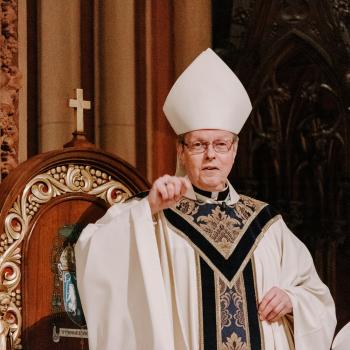
Behold, the 17 new Catholic deacons—soon to be priests—who were once Anglican priests in the UK.

They were ordained today for the Personal Ordinariate of Our Lady of Walsingham.

Ad multos annos!

In 2012, everything is a big production

Did we even have normal lives before YouTube and Vimeo?

We’ve had wedding processions go viral, and “Thriller” dances at weddings become worldwide phenomena.   Sometimes, entire cities have gotten into the act.

Now another entry in the “Can you top this for sheer video exhibitionism?” sweepstakes: a marriage proposal that includes everything—tossed flower petals, dancing Jews, a same-sex kiss, a marching band, and over 60 friends and family members willing to stage something outrageously over-the-top for online posterity.

Some will love it.  Some will hate it.  (Me, I’m a sucker for this kind of stuff.) But decades hence, it will stand—along with all those other examples above—as a video snapshot of our times.

In 2012, it seems, you haven’t really done anything until you’ve done it with dozens of other goofy people, set it to music, and uploaded it to the Internet.

Priest charged with abuse now works for the TSA in Philadelphia

Details, from the New York Daily News:

A Catholic priest removed from the ministry ten years ago for sexually abusing young girls has found another job — with the TSA.

Thomas Harkins, once a priest at churches throughout South Jersey, now works as a TSA supervisor at the Philadelphia International Airport, CBS Philly reports.

He was forced to leave the church in 2002, when the Diocese of Camden found him guilty of sexually abusing two young girls.

Now, a third alleged victim has come forward, according to the station.

In a new lawsuit, Harkins is accused of sexually abusing an 11-year-old girl as many as 15 times between 1980 and 1981. One of the alleged incidents occurred in Harkins’ bedroom at the rectory of Saint Anthony of Padua parish in Hammonton, N.J, where Harkins worked at the time.

CBS Philly tracked Harkins down at the airport to ask if the public should be concerned about his past.

“No, they should not be worried,” Harkins said. “I have nothing to say.”

But Karen Polesir, a spokeswoman for the Survivors Network of those Abused by Priests (SNAP) isn’t so tight-lipped.

“They should know who they are hiring,” Polesir told CBS Philly.

“As the public, we are screened to our underwear getting on a plane, and yet they hire a man like that.”

Read more.

“Rome sees the Eastern Catholic Churches in America as essentially inconsequential”

That’s the bitter assessment of one Ruthenian Catholic priest, and it provoked an interesting essay in First Things on a subject we in the Latin Rite don’t hear about very much:

Gathered for their ad limina, Eastern Catholic bishops from the U.S. were addressed last week by Prefect of the Congregation for the Oriental Churches, Leonardo Cardinal Sandri. His injunction—made not about abortion, the HHS mandate, war, wealth redistribution, or gay marriage—could have a critical influence on the Christian response to all of the above.

Among the Cardinal’s remarks was a tersely reiterated expectation of celibacy for priests serving the Eastern Catholic Churches in diaspora—in this case the U.S. The message may not have been carried directly from the hand of Benedict but the effect has been unpleasant to say the least.

Enter Thomas Loya, a Ruthenian Catholic priest of the Parma Ohio Eparchy, writing his eparch in response:

In addition to being chillingly reminiscent of the demeaning attitude of the Latin Rite bishops toward the Eastern Catholic Churches during the beginning of the last century in America, the Cardinal’s remarks about celibacy seem to confirm what so many Eastern Catholics in America have suspected for too long: Rome and the Latin Rite see the Eastern Catholic Churches in America as essentially inconsequential, perhaps even in the way of ecumenism between Rome and the Orthodox Churches.

The chilling reminiscence refers, in part, to an exercise in aberrant ecclesiology—more a power play—engineered by Archbishop John Ireland that resulted in an entire body of U.S. Eastern Catholics breaking communion with Rome.

I’m not about to jump into the trenches on the issue of celibacy (I would rather the comments box not turn into a Mixed Martial Arts cage). I’ll simply repeat the known fact that celibacy it is not a dogma of the Church but a discipline, and that its normative status in the Latin Church is not of ancient provenance. Moreover, Loya’s point is not about celibacy per se but ecclesial integrity and mutual respect.

What moves us onto this more sensitive landscape is his suggestion that Rome views the Eastern Catholic churches as “in the way” of relations between itself and the Orthodox Churches. I can certainly see why it would occur to him and he’s not the first to say it. For centuries, the existence of the so-called Uniate Churches has been a vexed point in those relations.

But I wonder how much help he can realistically expect from the Eastern hierarchs. Too many Eastern Catholic bishops behave as though their mandate actually is to allow their Churches to die a slow, palliated death.

Read more.

Kennedy widow: “It would be impossible to unravel my faith from the other aspects of my life”

She delivered the controversial commencement speech at Boston College today.

Details:

Victoria Reggie Kennedy called on Boston College law graduates Friday to seek change and justice by uniting people, invoking a practice she said her late husband Edward M. Kennedy embraced as a senator for 46 years.

Kennedy did not touch upon how another Catholic school, Anna Maria College, had rescinded an invitation for her to speak at its spring commencement amid pressure from a bishop, who said some of Kennedy’s personal views do not align with church teachings.

But she spoke of her Catholic faith as her guiding force.

“My husband described it well. ‘This faith,’ he wrote in his autobiography, ‘has been as meaningful to me as breathing.’ And I would add: as essential,” she said. “For me, it would be impossible to unravel my faith from the other aspects of my life, personal or professional. It’s all woven together.

Outside the campus gates, several anti-abortion protestors held signs saying ‘‘BC Honors Abortion Defender.’’ But at the ceremony inside Conte Forum, there were no visible signs of opposition to her appearance or speech.

The 300 degree recipients and their loved ones applauded warmly as she approached the podium, then gave her a standing ovation after she spoke.

Kennedy noted that she went to Catholic school for more than 12 years and hails from “a family so Catholic that our childhood jokes had Latin punch lines.”

“My whole family’s faith was rooted in feeding the hungry, in caring for the sick and the poor,” she said. “It was the creed of social justice. A responsibility we didn’t broadcast, but one we lived and were deeply committed to.”

The controversy at Anna Maria had put Kennedy in the spotlight.

In March, two months before commencement at Anna Maria College, Worcester Bishop Robert J. McManus pressured the small Paxton school to disinvite Kennedy. The bishop cited what he said were Kennedy’s views on abortion, health care coverage for contraception, and gay rights as reasons why she was an inappropriate choice for commencement speaker.

Boston College spokesman Jack Dunn said Kennedy had accepted the invitation to speak at BC before the controversy erupted at Anna Maria. BC reaffirmed its selection of Kennedy as speaker.

“A graduate of Tulane University Law School, Mrs. Kennedy practiced law for nearly 20 years and shares our graduates’ interests in public policy and the legal profession,” the school said in a statement. “She is also community to social justice, a fundamental aspect of a Boston College Law School education.”

Terrence Donilon, spokesman for Cardinal Sean P. O’Malley, the archbishop of Boston, declined to comment on BC’s decision to have Kennedy speak at the graduation.

Both Donilon and Dunn said such decisions should be guided by a statement the US Conference of Catholic Bishops issued in 2004 called “Catholics in Political Life.” That statement says in part that: “Catholic institutions should not honor those who act in defiance of our fundamental moral principles. They should not be given awards, honors or platforms which would suggest support for their actions.”

Kennedy did not receive an honorary degree Friday. Dunn said that the law school decided about one decade ago to end its practice of bestowing honorary degrees to commencement speakers to better focus on the graduates’ achievements.

Read more.

Homily for May 27, 2012: Pentecost Sunday

[Click here for the readings]

If you had to name one of the most quoted speeches of the 20th century, one near the top of any list would be the inaugural address of John F. Kennedy in 1961, with his call:

“Ask not what your country can do for you; ask what you can do for your country.”

Earlier in that same speech, he alerted the world that change was in the air, a generational shift, saying that the “torch had been passed to a new generation.”  And he began with a grand declaration:

“Let the word go forth.”

On this particular Sunday, those five words could also sum up the meaning of this feast we celebrate, Pentecost.

Let The Word go forth.

For in the dramatic events of that first Pentecost, when the bewildered and excited disciples poured into the streets, they had one purpose in mind: to let The Word go forth.

And it did.

The Word went forth from Jerusalem to Judea, and on to Corinth and Ephesus and Rome and Africa and Spain and even, eventually, to America.

What began with a few frightened people in a darkened room in Jerusalem has spilled out and touched every corner of the globe. You’ll find The Word preached in every language – just as on that very first Pentecost – and understood in billions of hearts.

And it all began on this day we celebrate, Pentecost: the birthday of the Church.

We need, especially now, to keep The Word going— to remind ourselves of the rugged beginnings of this rugged faith and to carry it on, just as the first believers did.

We need, quite simply, to throw open the windows of our fear and uncertainty — to let in the light — and to let The Word go forth.

It is a daunting prospect. But we do not undertake it alone.

We have the Holy Spirit.

We have the Spirit to keep the embers burning with His seven-fold gifts: wisdom, understanding, counsel, fortitude, knowledge, piety, and fear of the Lord.

We have the Spirit to uplift us when we are struggling…to strengthen us when we are weak…to console us when we are grieving…to comfort us when we are frightened.

Yes, it is a daunting prospect.

But we do not do this alone.

As we heard in John’s gospel:  “The Spirit of truth…will guide you to all truth.”  The Holy Spirit is our guide – and more than that, our model.  Paul’s letter to the Galatians calls us to “live in the Spirit.”  And he then reminds us what beautiful fruits that kind of living offers: love, joy, peace, patience, kindness, generosity, faithfulness, gentleness, self-control.

When you consider all that, you realize what living in the Spirit really means: it is, in fact, living in Christ – and by extension living not only in Christ, but in his Father.

The early Christians had a name for that – “The Way.”

This is our way.

You find it today in some surprising places.  You find it lived out in a hospital in Baghdad, where a Catholic nun cares for a Muslim mother and her child in the aftermath of war.

You find it in New Mexico, where members of the Catholic peace group Pax Christi – inspired by the Sermon on the Mount – stage a sackcloth and ashes prayer vigil for peace at Los Alamos.

You find it in churches from Brooklyn to Budapest, where faithful men, women and children offer their prayers to God—asking for healing, or reconciliation, or peace.

You find it anywhere a Christian strives to hold the hand of someone who is hurting, bring comfort to someone who is lonely, or restore faith to someone who has lost it.

We keep the flame of Pentecost burning and follow “The Way” when our greatest ambition is simply to be like Christ.

Or, to rewrite that most famous phrase from President Kennedy: we do it when we ask not what God can do for us, but what we can do for God.

Two thousand years ago, men and women who had followed Jesus asked themselves that question on the first Pentecost. And we are the beneficiaries of their answer. All of us who gather to pray and remember and rejoice on this Pentecost are heirs of that first Pentecost. Those first Christians cleared the path, and often died trying, so that we could walk in their footsteps —walk The Way—today.

So today, dare to ask the question: Where will those footsteps take us?

Who will be the beneficiaries of our choices?

Who will carry the flame, the torch of faith, as it is passed?

It is up to each of us.

This Pentecost, let us ask the Spirit to touch all of our hearts, as He touched the hearts of the disciples on the first Pentecost. Let the fire burn over you, so the flame can spread.

There’s a famous saying from St. Catherine of Siena: “If you are what you should be, you will set the world ablaze.”

This Pentecost, go shead.  Strike a match.  Set the world ablaze.

And let The Word go forth.

April 3, 33

According to some geologists, hat may be the date when Jesus was crucified.

And here’s how they know:

The International Geology Review investigated an earthquake that was said to have occurred the same date as Jesus’ crucifixion; which was most likely Friday April 3, 33 A.D.

In Gospel of of Matthew, Chapter 27 says: “And when Jesus had cried out again in a loud voice, he gave up his spirit. At that moment the curtain of the temple was torn in two from top to bottom. The earth shook, the rocks split and the tombs broke open.”

According to Discovery News, geologist Jefferson Williams of Supersonic Geophysical and colleagues Markus Schwab and Achim Brauer of the German Research Center for Geosciences, analyzed earthquake activity in the area by studying three cores from the Ein Gedi Spa beach.

The research confirmed that two major earthquakes have hit the area specified, one during the period between 26 BCE and 36 CE, and could be the one referred to in the Gospel of Matthew.

However, the earthquake data alone doesn’t fully confirm the date. Williams, Schwab, and Brauer admit that the earthquake implied in the gospel could be allegorical, referring to the earthquake that occurred sometime before or after the crucifixion.

Read the rest.

Ordination update: 29 new deacons for Peoria

It just may be one of the largest classes in the country this year, and the Catholic Post has details:

In the moments before his ordination to the permanent diaconate last Saturday, Deacon Tom Gainey lay face down on the floor of St. Mary’s Cathedral with 28 of his classmates.

As the assembly that filled every corner of St. Mary’s Cathedral chanted the Litany of the Saints, the candidate from Mary, Our Lady of Peace Parish in Orion was taking stock of his five years of preparation for this moment. He recognized it not as a culmination, but rather a beginning of years of ordained ministry to God’s people.

“Am I worthy to do this? To carry out what God is calling me to do? That was my main thought,” Deacon Gainey recalled of that private, spiritual moment during a nearly two-and-a-half hour liturgy filled with ancient rites.

In fact, Deacon Gainey and other members of the Diocese of Peoria’s ninth class of permanent deacons had already been declared worthy minutes earlier by Msgr. Charles Beebe, PA, episcopal vicar for the permanent diaconate, as he presented the class to Bishop Daniel R. Jenky, CSC, for ordination.

The assembly — comprised of wives, family, friends, priests, parishioners, and members of the deacon community — voiced their agreement with applause.

In his homily directed to the candidates, Bishop Jenky urged the new deacons to “do the will of God from the heart” and to “serve the people in joy as you would the Lord.”

Deacons are one of three orders of ordained ministers, the others being priests and bishops. Men who are ordained as deacons prior to priesthood are called “transitional deacons.” Those who are ordained deacons and remain in that state are referred to as “permanent deacons.”

Bishop Jenky listed the various sacramental and service roles of deacons in his homily, calling on the new deacons to “perform works of charity in the name of their bishop and pastor.”

Under the guidance of the Office of the Permanent Diaconate, the men and their wives have spent five years in the selection and formation process. Bishop Jenky called their ordination a moment of renewal not only for the candidates, their families, and their parishes, but for the entire church as well.

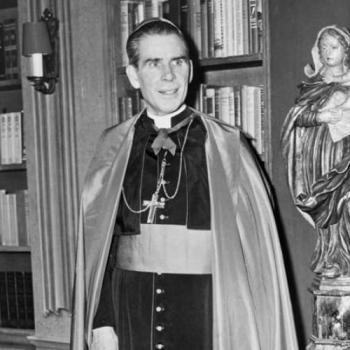
Entering the cathedral in a procession that included nearly 100 deacons and dozens of priests, the deacons sat in pews with their wives and families until being called by name for the ordination rites. Those rites included the deacons coming individually into the cathedral sanctuary and kneeling before the bishop three times — first for a series of promises to Bishop Jenky and his successors, next for the laying on of hands, and finally to symbolically receive the Book of the Gospels. The book used in last Saturday’s liturgy once belonged to Archbishop Fulton Sheen, whose cause for sainthood the diocese is promoting.

Check out the rest. Congratulations, brothers!  Ad multos annos!

This changes everything: a revolutionary ketchup bottle

Memorial Day cookouts may never be the same, if this sucker ever gets into the marketplace.

“It is something glorious”

That is how one woman described the historic celebration earlier this month, marking the first African priest ordained for the Diocese of Palm Beach.

Read more:

Leonard Dim wiped away tears as he witnessed his first-born son, Leonard Onyeukwu Dim, receive the sacrament of holy orders and become the first African priest ordained for the Diocese of Palm Beach.

His tears of joy shined upon his smiling face. “I am very happy,” said Dim. “This is a very happy day.”

Father Dim was ordained May 4 at the Cathedral of St. Ignatius Loyola during grand evening celebrations. Bishop Gerald M. Barbarito served as principal celebrant for the ordination, and clergy, seminarians, friends, family and acquaintanes traveled from near and far to support and rejoice with the newly ordained priest and his family.

“We wish to offer a warm welcome to the parents and family of Deacon Leonard Dim as we gather this evening to celebrate his ordination to the priesthood,” said Bishop Barbarito. “You have made a long journey to the Diocese of Palm Beach from Nigeria to be here for the ordination of Leonard, and we especially thank you, Mr. and Mrs. Dim, for the gift of your son to the Church and in particular to the Diocese of Palm Beach.”

Many Nigerian priests and Nigerian religious sisters were at the ordination and traveled from around the United States, showing great support.

“I have come for the ordination of our brother from Nigeria,” said Sister Rose Henry from Hollywood in the Archdiocese of Miami. “It is something glorious. It is something that is really great. In my country, Nigeria, and especially in my tribe, Igbo, most of the people are Catholics. They like to worship God in spirit and truth.

“The initiative to become a priest or a nun is a call that is glorious, a vocation,” Sister Henry continued. “It is a great thing. It is something from God, and that is why we are happy and come to pray, honor and praise God.”

People sitting in the pews wore colorful clothing and ornate headpieces, representing the culture of Nigeria and the people there to whom the Dim family is linked. Father Dim grew up in Amike, situated in the state of Imo, one of 36 Nigerian states. Igbo people there have their own unique language, dress, music and culture, and at one time, young Igbo men faced societal and cultural obstacles. In years past, the first son of a family was regarded as the immediate family heir, and the first son held responsibilities at birth to carry on the family name and the culture.

“My vocation journey would have been impossible some years ago in Igbo land and cultures,” said Father Dim. “My father would have been ridiculed and termed a failure to the community for allowing this to happen. Thanks to God that it is not the same today.”

Continue reading. Ad multos annos!