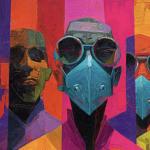
Jim West often has a bee in his bonnet about atheists, but he doesn’t always seem to have actually observed any, and so I thought I would share this to help him out. From The Far Left Side.
The Blog of Dr. James F. McGrath, Clarence L. Goodwin Chair in New Testament Language and Literature at Butler University, Indianapolis

Jim West often has a bee in his bonnet about atheists, but he doesn’t always seem to have actually observed any, and so I thought I would share this to help him out. From The Far Left Side.
Rachel Held Evans wrote a beautiful post on Huck Finn and the need to listen to our conscience rather than texts at times, even when those texts are considered sacred. Richard Beck concurred.
Tony Jones and Bob Cornwall were among those who emphasized that it is not only allowable but important that our views evolve on subjects like this one.
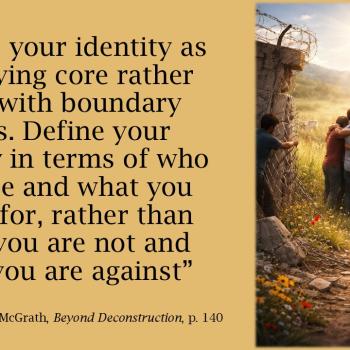
Bob Cargill made this image and shared some reflections on it:

Jay Michaelson discussed traditional marriage in its various permutations.
Eric Reitan emphasized why the issue of same-sex marriage must be personal.
Chaplain Mike blogged about what the Bible does and does not say about homosexuality. I felt he did a much better job than Daniel Helminiak’s recent piece.
Mark Osler offered a Christian case for gay marriage. Al Mohler tried to pretend that he and others like him focus equally on adultery, injustice, and other issues along with homosexuality, as well as citing the account of Peter’s vision in Acts without realizing that the claim that the ritual code of the Jewish Law was being set aside was embraced by Christians before those writings in which the case was made were considered Scripture. Fred Clark offered a response to Mohler that highlights the real message of Peter’s vision in Acts, thus exposing one of many problems with Mohler’s reasoning. Jim West accused Mohler and the SBC of abandoning their Baptist heritage.
There’s a new blog at Patheos, Coming Out Christian.
Morgan Guyton blogged about the sons of hell and the black hole of damning.
Charles W0rley’s comments were responded to by many, including John Shore, Bo Sanders, Fred Clark, and Bruce Reyes-Chow. SFL offered a modest counter-proposal to Worsley’s.
Unreasonable Faith discussed the terminology of “marriage” (a response to the sort of view reflected here) as well as loving one’s neighbor (the source of the image at the bottom of this post).
Tobias Haller brought in John Chrysostom to help frame some questions.
A German cardinal called for the Catholic Church to rethink its stance on the topic of same-sex relationships.
Leah Libresco asks what if anything is really wrong with same sex marriage.
Don Rogers offered this thought:
IF the essence of Jesus is summed up in words that John’s Gospel attributes to him, “I have come that they may have life and have it abundantly,” then our choice is clear. Homophobia diminishes life; it does not make it more abundant. It must be ended; it cannot be tolerated.
Ian Ebright highlighted the problem of a church willing to use force to coerce others.
John Shuck argues that the anti-gay stance is not faithful to the Reformed tradition.
Colin Powell and the NAACP came out in support of marriage equality.

I got back from my trip to Israel yesterday, just in time for Towel Day, in honor of Douglas Adams. Some are calling this “Super Towel Day” since 5+25+12=42.
The trip had a couple of Douglas Adams moments or aspects, such as the fact that one of the books we all read together was A Hitchhiker’s Guide to Jesus, and when we went to the Dead Sea, I told the students that since they can rent towels there, they didn’t need to bring a towel with them unless they are fans of Douglas Adams.
S0 blogging will be resuming its usual form and pace here soon. In the mean time, I wish you a happy (Super) Towel Day!

We made it through passport control and customs at Tel Aviv airport, in what seems like record time. The early hour of the morning helped. So now I can blog about the day’s events.
We started off at the traditional site of the last supper, in what would have been the upper city of Jerusalem in Jesus’ time. We also saw a site some consider the tomb of David, passed through the Armenian Quarter, and even had time for a little shopping in the Old City too.
From there we traveled to Old Jaffa, which we would have visited on the first day of our time in Israel if we had had time.
After visiting the Church of St. Peter (where he supposedly healed Dorcas/Tabitha) and having lunch, and enjoying the view, we set off for the Hotel Kibbutz Shefayim, where we stayed our first night in Israel. This time we had time to visit the beach.
The other groups set off around 8pm for the airport, and Katie left with them. We were picked up to go to the airport after midnight, and are there now as I write this. Our flight is expected to leave on time. If I don’t write another post indicating that there is a delay, then that should mean that things are going smoothly!
The tour guide and bus driver both expressed how impressed they are with the group from Butler University. I am very proud of this group of students and delighted that I was able to help facilitate this amazing experience they had!
This morning I had a useful illustration of why learning as much as you can of a language is important. This morning, I left my bag near my room as instructed and went to the elevator. A couple of bellboys passed and I heard one of them say a number in Hebrew. I was fortunate to have understood it, because it was my room number – but the group they were collecting bags for wasn’t my group! I decided to go back and bring my bag down to the lobby myself.
Learn as many languages as you can. It is not as difficult as you probably assume it is. And before traveling, focus on the language or languages spoken in that place. Even a little language ability can prove very useful at times!
Today most of our time was spent in the old city of Jerusalem. We started at the Kotel, the Western Wall or Wailing Wall, which is the last remaining wall of the second temple, i.e. the temple that was standing in Jesus’ time and which was destroyed by the Romans in the year 70.
From there, we got in line to go up to the temple mount, where the Al Aqsa Mosque and the Dome of the Rock stand today, and where the inside of the temple was located, including the Holy of Holies.
From there we followed the Via Dolorosa, the traditional path followed by Jesus leading to the Church of the Holy Sepulcher, where there are good historical reasons to think that the crucifixion and burial of Jesus took place.
After this, we had a bit of time for shopping in the old city, and so I took the students along the Cardo in the Jewish Quarter, which not only replicates an ancient shopping area but also allows one to see down to walls from the period before the city’s destruction by the Babylonians in 586 BC. From there, we walked in parallel to the teme mount through the Muslim Quarter, until we were once again at the Via Dolorosa, only is time with time to shop.
After this, the students were exhausted.
But we were not done yet! We went to the Israel Museum, where we visited the model of second temple Jerusalem, the Shrine of the Book where some of the Dead Sea Scrolls are displayed, and finally I simply had to run them quickly through the rest of the museum to see some of the fascinating and important antiquities.
Tomorrow will essentially be our last day in Israel. One of us departs tomorrow night, and the rest of us will depart very early the following morning. The plan is to travel to Old Yafa (Joppa) and then go to our hotel where we will not sleep overnight, but at least we can relax, and perhaps even get to the beach on the Mediterranean Sea for a swim. Then, it will be off to the hotel and heading for home!

Copyright 2008-2012, Patheos. All rights reserved. Terms of Service | Patheos Privacy Policy

Follow Patheos
Progressive Christian: