The “Original Aramaic Lord’s Prayer” is None of the Above

After it came up on this blog a while back, I’ve wanted to return to the topic of the “Original Aramaic Lord’s Prayer.” Why? Because the thing that can be found online referred to in this way is not original, not Aramaic, not a translation, and not the Lord’s Prayer.

Let me elaborate further.

This prayer can be found online in a number of places, and stems for the most part from books like Prayers of the Cosmos: Reflections on the Original Meaning of Jesus’s Words by Neil Douglas-Klotz.

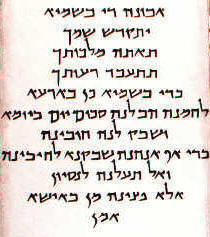
The transliteration is poor, and so anyone reading the English letters will not get a sense of what the words sound like. The transliteration is based on the Syriac version of the Lord’s Prayer. Syriac is a dialect of Aramaic, but it differs in some respects from Galilean and other Palestinian dialects of Aramaic, and so even to the extent that the Syriac prayer is Aramaic, it is not the original Aramaic. (Scroll to the end of the post for the text of the prayer in Syriac).

Let me go through the alleged translation of the alleged original Aramaic prayer line by line, and explain why it is not a translation of the meaning of the Aramaic into English (whether the Syriac or a reconstructed Galilean version), and thus does not deserve to be considered a form of the Lord’s Prayer.

Oh Thou, from whom the breath of life comes, who fills all realms of sound, light and vibration.

This is not a translation of either Matthew’s or Luke’s version, much less an attempt to determine which is the more original. The likelihood that Jesus’ own uttered version of the prayer, before it was adapted for communal use by Christians as reflected in Matthew, simply began with Abba, the Aramaic word for father, is likely. There is no personal pronoun, and no sense in which Abba means “one from whom the breath of life comes.” Nor does the reference to heaven/sky – again, found in Matthew but not in Luke – translate naturally to “realms of sound, light and vibration.”

May Your light be experienced in my utmost holiest.

This is clearly an attempt to do something with “Hallowed be your name.” But how does name become light, and how does the expression of a desire for the name to be sanctified become something holy in the one praying? This is not a translation or even an interpretation of what is in the Syriac, Aramaic or any other version of the Lord’s Prayer.

Your Heavenly Domain approaches.

This line is not as bad as the previous ones if considered an attempt to paraphrastically explore the meaning of Matthew’s version. But since we know that the version in Matthew, “kingdom of heaven,” is his rendering of “kingdom of God,” combining the sense that it is God’s domain with the idea that it is heavenly is potentially confusing.  As for the verb, the future tense has been rendered in previous lines as expressing the desire for something to happen, and so for consistency it should be rendered the same way here: “May the domain of God come.” Otherwise, it should be “The domain of God will come.”

Let Your will come true – in the universe (all that vibrates) just as on earth (that is material and dense).

The first part of this is not bad – a very literal rendering might be “Let your will be” which can carry the sense of “Let your will happen/come to pass.” Turning the heavens into a universe that vibrates and adding commentary about density to the earth is unhelpful and does not reflect an ancient understanding, which did not necessarily view the heavens as immaterial, nor do I think that people today think of the universe as immaterial. So once again, not only is this not translation, much less good translation, but it is unnecessarily confusing.
Give us wisdom (understanding, assistance) for our daily need, detach the fetters of faults that bind us, (karma) like we let go the guilt of others.

Turning the request for bread into a request for wisdom, however much the provision of manna was treated as symbolic of the giving of wisdom, takes one well beyond translation. The second part adds karma for no reason, and this is clearly the importing of an Indian concept into what is being claimed as a first century Galilean Jewish prayer.

Let us not be lost in superficial things (materialism, common temptations), but let us be freed from that what keeps us from our true purpose.

The interpretation of temptation as having to do with superficial things and materialism, and the interpretation of evil as “what keeps us from our true purpose” is interesting and worth reflecting on, but it is not in any sense a translation of what the Aramaic words mean, but an attempt to apply the prayer to today’s very different setting. Materialism was not an issue that most of Jesus’ audience had the luxury of being tempted by.

From You comes the all-working will, the lively strength to act, the song that beautifies all and renews itself from age to age.

This has almost nothing in common with the Aramaic. The closest is its rendering of the word for power in terms of “strength to act,” since strength is indeed one of the meanings of the Aramaic word found where, in the familiar English versions, the Greek is rendered “power.” But the introduction of a song as a substitute for “glory” when the Aramaic has no musical connotations is unjustified, and so too the introduction of the notion of “will” where previously the same word for kingdom was rendered (quite legitimately, if narrowly) as “domain.”

Sealed in trust, faith and truth. (I confirm with my entire being)

I am tempted to mention that “Amen” means different things in different contexts – my pastor regularly says that in a Baptist church, “Amen” means “You may be seated.” The question of what Amen means in a lexical sense is relevant, but so too is the question of how the term functioned when used even by people who were speaking languages other than Hebrew and yet still used the Hebrew term.

In short, I have no problem with anyone who happens to want to utter this prayer or finds it meaningful or spiritually useful. Just don’t mistake it for a translation of the Lord’s Prayer, much less the original Aramaic one. The same applies to many of the other supposed translations of the Aramaic Lord’s Prayer that one can find online. In short, the less it looks like the Lord’s Prayer as you know it, the more likely it is to be a free paraphrase or interpretation rather than a translation. And if you want to really grasp the Lord’s Prayer as Jesus uttered it in his own language, there is only one way to get even close to doing that: learn the ancient Palestinian dialect of Aramaic. Translating words from one language into another always involves some transformation of meaning. There is simply no way to fully grasp the precise meaning and nuance of anything in another language than by becoming intimately acquainted with the language and culture in question.

For more on this subject, see the several relevant posts by Steve Caruso on The Aramaic Blog as well as other critical appraisals available online.


  • Ian

    Superb, thanks for this. Made my day.

  • Cdwild

    Even if you knew Aramaic, you still couldn’t be sure you knew the original prayer, since what we have is a Greek translation, right? You could translate the greek to aramaic, I suppose, but would that wouldn’t be the original Aramaic. If the Greek hasn’t preserved the at least the gist of the original meaning, no amount retranslating will uncover it.

    • http://www.patheos.com/community/exploringourmatrix/ James F. McGrath

      Indeed! One can attempt to translate it back into Aramaic, or use the Syriac which is a translation from the Greek into a dialect of Aramaic. But any reconstructed “original” will be hypothetical.

  • Pingback: PatheosProgXn

  • Pingback: Jason Staples

  • Pingback: Mark Letteney

  • Robert Perry

    I think you have done a real service here. My understanding of Douglas-Klotz’s prayer is that it is a translation into contemporary New Age. But because he bills it as the original deal, it has taken in a lot of people.

  • Sherry

    I do not understand why you all feel that this translation is so far from the real thing. I prayed, sang, and danced this version of the prayer and have never felt closer to God.  The version we get today in most bibles has been translated from person to person, from language to language over many years. Then you add in the fact that it was written by a male dominated society in which the the most powerful, fearful people ruled.  It was submitted to the bible at a time when control of the people was contingent on blind obedience and unquestioning faith.  They wanted followers who were too afraid to question perceived authority.(meaning man and not God)  Human beings, not God/ Jesus, needed fear of hell, damnation, suffering and pain.  Jesus worked hard and died to show us that we are all worthy.  Why would God ever “lead us into temptation”? We create and lead ourselves into temptation when we forget what Jesus taught us and stray fro m the personal path we were meant to take.  We deliver ourselves from perceived evil when we listen to the Holy Spirit within us that leads us to right action.  I was amazed that the use of the word “light” was so misunderstood.  The “light” is all that is good and right.  Jesus refered to himself and to us as the light of the world, and to be a beacon contrasting the “dark” and the “light”.  God created all that moves in light meaning if it is darkness or bad/negative, He did not create it. Although it seems as though this person seems to be well educated and knowledgable about the bible, I am surprised at the lack of understanding of the metaphors used in the text of the bible.  The Bible is plum full of anectdotes, parables, and metaphors.  With all due respect, open your minds and realize that “new age” is not really new at all but rather it embraces very ancient concepts in their purest form.  The Lord’s Prayer is beautiful either way and the meaning is the same. It is just a matter of how it is worded.  When I look into my heart I know He/She is there and that is all that matters.

    • http://www.patheos.com/community/exploringourmatrix/ James F. McGrath

      Many believe that God can work even through things that are imperfect or just plain wrong. I am happy to hear that the text gave you a sense of closeness to God, but that doesn’t mean that when the author of it made things up that do not correspond to what the Lord’s Prayer actually says in Aramaic, it therefore becomes an accurate and faithful translation. Faithful translation is about correspondence to the meaning of the original, and not the beauty or impact of the end product.

      • Ashley

        People feel good when they sin as well! …”feeling” can’t be an indicator of what is, or isn’t right.

        • Ashley

          Sorry…this was intended for Sherry….

  • Tygherlily

    I have been led here as of late to seek out the Lord’s Prayer in the original biblical Aramaic. I am at a disadvantage because I only speak English and cannot decipher in any way, shape or form what is correct and what isn’t in another language. I mean, if it’s spelled out in English I can obviously see whether it is correct or not.

    We have so many versions of the bible now and everything has become confused and disoriented. People are confused and disoriented for the most part. I am left with the idea that I will have to seek out a rabbi in order to learn the prayer in the Aramaic language. I will have to be taught how to say it that way, I can’t trust the internet.

    I do want to throw this out there for consideration though. When people refer to “God”, do they know who they are actually referring to? We inhabit this earth and this earth is the realm of Satan, this is his temporary domain and he considers himself to be “god” here. When we are indiscriminate about calling out to “God” or “god” who are we actually calling out to?

    A person can sing and dance and pray according to what they have been taught, but do they really understand what they are singing, dancing or praying about or even to whom? It’s not as simple as some would think, there is much deception about, especially where the word of the God of Heaven is concerned. This is why we were told to be wise and to test. Most people don’t even consider doing that. They are of the mind that if it sounds pretty it must be good and experience teaches that 9 times out of 10 (if not 10 out of 10) it never is what it appears to be. There is something to be said for “immediate gratification”.

    Just something to think about.

    • Servant of Allah

      Tigerlilly, You speak about what I’ve come to know, through my Creator’s guidance. In my life-long search for the truth, I found that Islam {submission to the Will of Allah(the proper name for “God”)} is the true way to worship The Most-Merciful Creator, Allah as the prophets from Adam, Abraham, Moses, David, Solemon, Jona, Jesus, and Muhammad(peace and blessings be upon them and all the prophets) have taught us throughout history. The message is the same, unchanging message from Allah to humankind, to worship Him and only Him, and no other. Islam teaches this and is not confused with poytheism as Christianity is. I invite you to read the Holy Quran, the last and final testiment of Allah, in the english translation (the original is in Arabic, you can learn Arabic and read it, too). And find a local Mosque to go and ask questions about your search for truth. Your soul and mine are only our own responsibilities, no one can decide for us to follow the Way of Allah or not to. It’s so good to see you looking for the truth. Alhamdulillah(thank God) sister, and may Allah guide you to the Way that is Straight. Salam(peace) to you.

  • Peggy Beatty

    I am not sure why people critique this – or other – versions and dont offer what they think is a more reliable Aramaic to English version? Because it doesnt exist? Well, then Syriac to English is probably the next best thing. Dont criticize unless you can offer something else. Good rule of thumb. This version makes complete sense to a mystic. Bread is always used for spiritual food, i.e. wisdom;the concept of Abba means one who is intimately close to me, not of superior status, i.e. the breath (God-spirit) that enlivens life; God is light, we are made in that image…hello? light has been used in a spiritual sense for eons. It refers to energy and our ability to make relative discernements about the phsycial AND the spiritual psychological realms. As long as people who are not intuitive keep trying to interpret scripture by objective measures, we wil fall short of the deep meaning there. Dont let the words confine you – this is the beauty of the “Aramaic” version – the words allow for far more expansive conscience, as do Hebrew and to some extent, Greek…but even Greek starts narrowing down the breadth of subjective interpretation that is truly available. The New Testament writers were telling us about spiritual reality – a reality that is obscured by the intellect and its need to define things. definition limits. God truth is unlimited. Unless you can let go of the mind’s need to define, you will not see the spiritual truth. It must be intuited/felt, not sensed or thought.

    • http://www.patheos.com/community/exploringourmatrix/ James F. McGrath

      The issue is not whether it makes sense to you spiritually. The issue is whether it is a translation of the Syriac. It is not. I could claim that your comment mens this, that, or the other to me spiritually. But if, in the process of claiming to translate your words into another language, I twisted and misrepresented the meaning of what you said, I suspect that you might not be too happy.

      Can you grasp this distinction? The issue is whether the supposed translator has offered a translation. In this case what you are given is not a translation, but a free reinterpretation only based very loosely on the meaning of the words. If their work was described as a “free reinterpretation” I would not have offered these criticisms. The point is that it is not a translation!

  • Tanitops1

    AMEN means that you agree on one accord and /or it is said, ….NOT to sit down. I am born and raised in the Baptist church, I have never heard of using AMEN to be used as a form of having the congregation to sit down. All I hear is allegations and your opinion. As Christ walkers, we suppose to seek Him, try to get closer to the HOLY ONE. If we meditate from HIS WORD ( The BIBLE) look for deeper meaning from original works aside of our KJVersion nor any other translation, then AMEN, So be it! The more we are closer to the original word the better the understanding.; but that is up to what you want your heart, mind and soul to take in as your spiritual food. Let the Holy Spirit Guide you and He show you HEy! “Taste and see that the LORD is Good” (Psalm 34:8)

    • http://www.patheos.com/blogs/exploringourmatrix/ James F. McGrath

      Although I could merely point out that you seem to have no sense of humor, your comment makes an important point in spite of not getting what was clearly a joke. A term like “Amen” which is often left untranslated has a meaning, it cannot just mean whatever we wish it to. That is the problem with the so-called “translations” of the Aramaic Lord’s Prayer. The renderings in English do not correspond to the meanings of the words in Aramaic.

  • Glynnis48

    It is always wise to pray IN the Spirit of God. Whatever way we pray, and whatever words we use, it is how and why we pray. In every word of the Lord’s Prayer he is asking that God’s Will be done, even down to our daily bread. He is also showing his disciples how to trust. God Will Provide. God will and does provide. If we lack anything, according to ourselves, then the true lack is that we lack God’s spirit and obedience to Him. The Lord’s Prayer is asking God to lead us through the day and through the world, walking WITH Him, not He following. He leads, not us. Loving, trusting God, that IS the true meaning of ALL prayer, no matter what the words may be. I love the Lord’s Prayer, I love all prayer, including the new one, because it helps to bring us ever closer to HIM, which IS the TRUE mean of prayer.

  • Clive Clifton

    Tyndale gave his life so we, the ordinary may understand Gods word for ourselves. When he translated the Bible into English from the Greek and the Aramaic, I do not believe he had any additional agenda, other than to making Gods Word available for the masses which eventually happened after his death by a German printer.

    In the Church of England we swing from the original King James translation which was taken from Tyndales, or the modern version. We do not use the words hallowed, thy, trespasses etc but the meaning is still the same but maybe not as clear. I do lean toward the King James version and yesterday that was confirmed by one our Church seer’s. At our Monday prayer meeting she had a vision of the Bible in Gold, written in Aramaic. Jesus said to her “please say this prayer in it’s original way”. We all agreed that the King James was the one He meant.

    In everyday life we often misunderstand many things as the meaning gets lost in translation. I understand what Jesus was saying in that prayer because I know Him from reading His story from Genesis to Revelation and my 32 years as a believer.

    Our Father, which art in Heaven

    Hallowed be thy name

    Thy Kingdom come

    Thy Will be done

    In Earth as it is in Heaven

    Give us today our daily bread

    And forgive us our debts

    As we forgive our debtors

    And lead us not into temptation

    But deliver us from evil

    For thine is the kingdom

    And the power

    And the Glory for ever Amen

    Matthew 6 v 9. In Luke it is worded differently but the same meaning comes through as Jesus teachers what the prayer means in practice.

    I have a number of Bibles with various translations which help me to understand what was being said in a particular culture at a particular time. many learned people say that Shakespeare was the way that English should be spoken and what we have now is a very crude simplification.

    I can’t argue any of this but I do believe and know that my redeemer liveth, How? because Gods Spirit is in me making him Known.

    When we look are we seeking to find Him or striving to disprove him.
    Clive.

    • http://www.patheos.com/blogs/exploringourmatrix/ James F. McGrath

      Can you please explain your logic. Your friend has a dream about Jesus with a Bible in Aramaic saying that the prayer should be said in the original way, and you conclude from that that Jesus was communicating to you all that you ought to use the King James Version? I don’t follow your reasoning.

  • nic paton

    Hi James. According to http://www.abwoon.com/shop/custom.aspx?recid=31, Douglas-Klotz’s claim is that it is a “Transliteration and original translation”. He does not claim that it is simply a “translation”. Your polemic assumes a particular paradigm – literal correspondence – that is only half (or one third, since he says “original” translation) claimed by the author. In as far as he might claim translation, you make some good points. However, if it indeed a transliteration (you may be better placed than I to define that technically) then as I understand it its allowing for a more subjective, poetic correspondence.

    The bigger discussion here must include an epistemological angle. That is, what is the nature of our knowing? Some here claim that the knowing that counts is intuitive, others poetic, and then there is your more rigorous and rational approach. We have to be up front about our paradigms. While I very much respect your rigor, I myself tend to prefer a “poetic intuitive” epistemology in ultimately deciding what is true. Our “modern literal” culture is a latecomer; I tend to agree with Aquinas that truth comes by the bible AND by nature, or Eckhardt who says every creature is a book about God. This points to a perennial intuative tradition, out of which the likes of Douglas-Klotz are writing.

    • http://www.patheos.com/blogs/exploringourmatrix/ James F. McGrath

      Transliteration refers to the rendering of the sounds of the Aramaic into their closest corresponding English letters. It is not a more poetic or freer translation. It is writing the Aramaic word for father as “Abba” rather than using the Aramaic alphabet, for example.

  • http://twitter.com/CedRockStarr CedRock eL Starr I

    I don’t think it’s unreasonable to call into question a “Matthew” “Mark” “Luke” or a “John” (4 English-sounding white dudes) as “authentic” sources for a wooly-haired, brass-skinned revolutionary named Yoshua bin Yoself (that would later become Yeshua, then Jeshua, on & on until we somehow got to Jesus) that was executed by The State for being too radical in his messages of love and oneness and speaking out against The State. Not to mention all the exact or similar stories of virgin birth/miracle child/Dec 25th/healing/performing miracles/Sun/Son of God worship from so many “Gods” before him that predate the Jesus story. Starting with Heru (aka Horus) of ancient Kemet (aka what is now called Egypt). So… y’know.. debate until the cows come home. Who knows. Get what you can from it and move on. These so-called “scholars” obvious lack an authority to tell you what’s what. I’m no scholar and I can shoot half that bs down. Amen

    • Claude

      Just No.

    • http://www.patheos.com/blogs/exploringourmatrix/ James F. McGrath

      You are indeed not a scholar, as you seem not to fact check any of the things you read on the internet or the ideas that pop into your head. I would encourage you to not be so confident in your own ability to simply know what is correct without having to either investigate evidence or practice critical thinking. Your belief that you are being skeptical can actually result in your being gullible and taken for a ride.

  • http://twitter.com/CedRockStarr CedRock eL Starr I

    I personally dig this version best *shrug* ….so far, until we “dis-cover” another one I like better.

  • JofELO

    I don’t think there ever was an “original” Aramaic Lord’s prayer. The modern consensus is that Jesus spoke primarily Hebrew, not Aramaic, and certainly the “original” Lord’s prayer would have been spoken in Hebrew since it is mainly a compilation and repetition of already existing Hebrew prayers, which in turn were derived from bits and pieces of the Hebrew scriptures. For us, though, the original Lord’s prayer is in Greek, since that is the oldest version we have. If there was an earlier Hebrew or Aramaic version, we don’t have it.

    • http://www.patheos.com/blogs/exploringourmatrix/ James F. McGrath

      I’m curious what gave you the impression that there is a modern consensus that Jesus primarily spoke Hebrew rather than Aramaic.

  • Colin Saxton

    Your prayers to the Lord are from the heart (your new mind given to you by Christ). You do not have to go
    Back to the original languages. Speak to God in the language he gave you, God understands just as well
    And you will also understand your prayer to God, 1Corinthians14:7-9