

How do humans process information and make moral choices?

Stephen said he left The Traitors UK with his moral compass intact.
Was he right?
This video looks at how humans make difficult choices, using The Traitors as moral theatre.
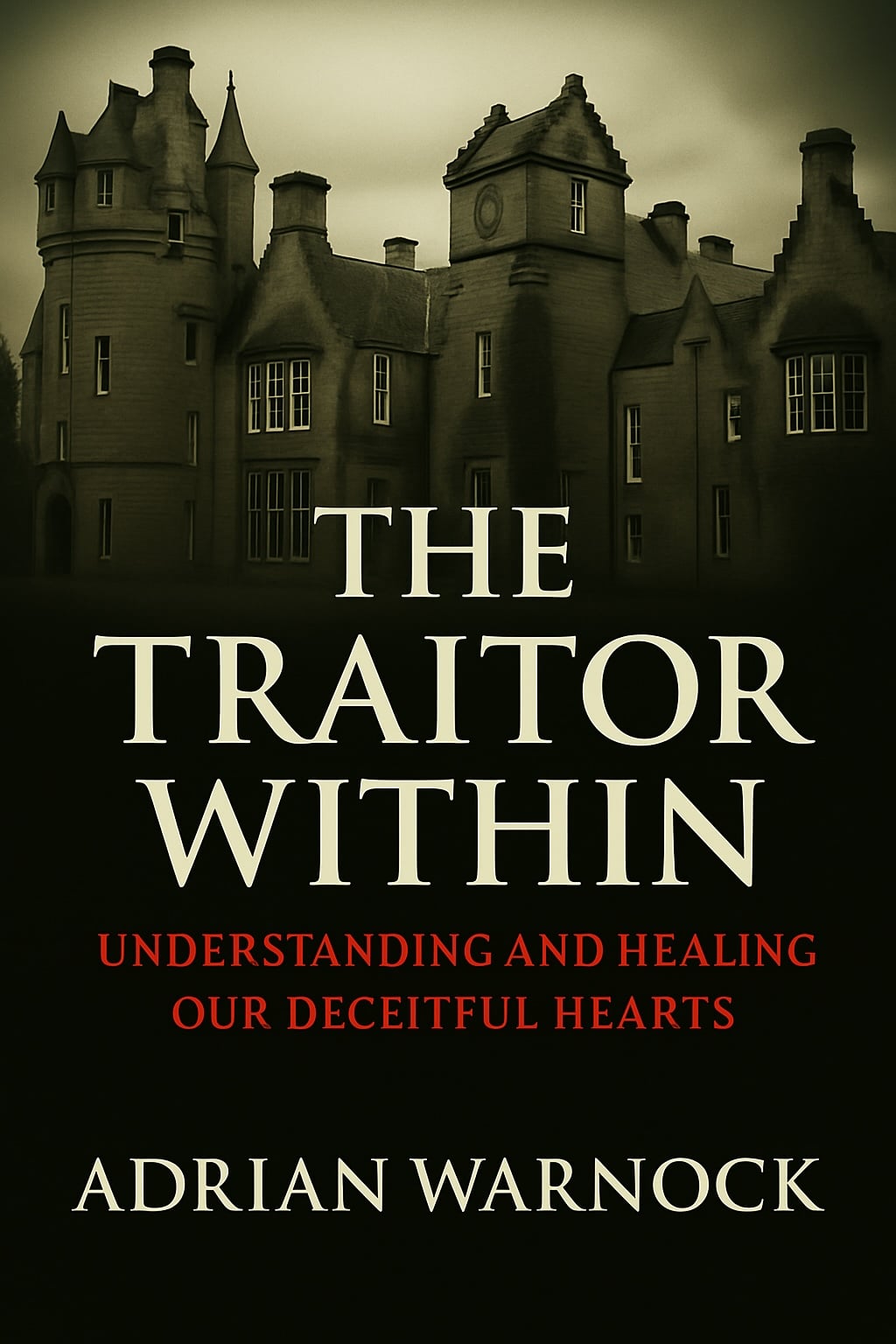
� Questions like this sit at the heart of my book The Traitor Within: Understanding and Healing Our Deceitful Heart.
I can’t believe it. The Traitors UK Season 4 is over already! It felt like it was over very quickly. But it’s been a great series, and I want to use it to illustrate something much deeper than reality TV: how we make decisions, how we process information, and how human beings deceive themselves without meaning to.
 SPOILER ALERT!
Stop reading if you haven’t yet watched the Traitors UK Season 4 Finale and don’t want to know what happened!
TikTok Video
@adrianwarnockbooks Stephen said he left The Traitors UK with his moral compass intact. Was he right? This video looks at how humans make difficult moral choices, using The Traitors as moral theatre. ⚠️ Final spoilers ahead � Questions like this sit at the heart of my book The Traitor Within: Understanding and Healing Our Deceitful Hearts #thetraitors #thetraitorsuk #morality #psychtok #BookTok ♬ The Traitors Main Theme – Sam Watts
Also available as a podcast
The Traitors shows, in real time, how we sense, feel, think, reason, and finally choose.
From sensing to feeling
Everything starts with what comes into us — our senses, both external and internal.
Externally, we see and hear things. Internally, we feel bodily states: tension, fear, excitement, guilt, fatigue. These inputs often produce an immediate emotional reaction, which is physiological. You see it on faces before anyone has thought anything through.
One of the striking things watching Stephen was how obviously guilty he often looked — sweating, anxious, conflicted. For those watching closely, his face often seemed to betray him. And yet it wasn’t noticed.
Why not?
Because of cognitive biases.
How bias blinds us
People often talk about confirmation bias, and you see it constantly in The Traitors. Once someone is labelled a traitor, everything they do is interpreted as proof.
-
They speak at the round table? Clearly a traitor.
-
They don’t speak? Clearly a traitor.
You can’t win. Jade experienced this strongly. Once suspicion landed, everything confirmed it. She did well to remain in the game as long as she did.
But the opposite bias also appeared. Rachel survived two attacks in succession, and that survival was taken as evidence of innocence. Once someone is perceived as innocent, people become blind to obvious slips.
Rachel said:
“If I was a faithful, I’d murder myself — I mean, if I was a traitor…”
She didn’t even remember saying it. Nobody noticed. At the time they were simply paying attention to other theories and their own emotional states. We were all yelling at the TV!
Stephen made a similar slip:
“Last night I was thinking about this…”
He was referring to something that only traitors would have known the previous evening, everyone else only knew that morning. Again, a major giveaway. And again it was unnoticed, even though it happened at the round table. And again he didn’t even remember saying it and was shocked to watch himself on TV making such a major error and giving himself away to anyone who was listening carefully.
Sometimes deception hides in plain sight. Not because we don’t see it, but because we don’t integrate what we see into conscious reasoning.
That’s what biases do. They filter reality before thinking begins.
It was so easy for us watching at home to pick up on these “obvious” signs but not so easy for the faithful contestants.
Emotions, feelings, and thoughts
When something is sensed, it often produces a bodily emotion first, alongside that the sense that this is alerting or calming, and pleasant or unpleasant. That raw emotion is then labelled by the brain. That label is what I’m calling a feeling.
This matters.
Feelings like guilt, shame, love, jealousy, pride. These aren’t basic emotions in the same way fear or anger are. They involve appraisal, a value judgement, even if it is usuallly a snap one. You can’t identify guilt or love just by looking at a face. Love, in particular, can look joyful or deeply sorrowful, think of tears of joy.
So we have:
-
sensations
-
bodily emotions
-
labelled feelings
These feelings quickly become what Cognitive Behavioral Therapy (CBT) calls automatic thoughts:
-
“I feel anxious.”
-
“I feel angry.”
-
“I feel unsafe.”
These are already more than feelings — they are interpretations. And they can be distorted.
From thought to reasoning
Once we begin thinking, distortions can creep in.
Some people carry a distortion like:
-
“I always fail.”
Others carry:
-
“I’m invincible.”
Both are lies, just in opposite directions.
As thoughts become more complex, we begin to reason — weighing pros and cons, justifying actions, imagining explanations.
We also begin to formulate how we are going to justify these decisions to ourselves and other people. This is where logical fallacies come in.
But once we have a list of alternative actions to take, and perhaps a series of justifications for each of them, often something fascinating happens, particularly if it is a difficult decision with doubt about what is right and wrong.
Moral reasoning: the tripod
When reasoning turns moral we are asking the question what should I do? We usually consult three powerful voices that influence us. I call this the moral reasoning tripod. It helps us decide what is good for us to do.
We saw this in The Traitors UK, particularly in Stephen, although I suppose Rachel must have gone through the same dilemma. Do you betray the other Traitor to take all the whole money, or do you win together?
Stephen was faced with this really interesting dilemma particularly acutely because by this point Rachel was on the ropes and vulnerable. Adding his vote to everyone else’s would have been enough to cause her to be banished. This opportunity presented itself four times.
The dilemma was, does Stephen betray Rachel, his fellow traitor, who he’d promised to never write her name on the slate, or does he betray his friends, the people he’s closest to in the castle?
Does he vote Rachel out, or does he vote his friends out who believe that he’s a faithful and he wants to get to the end game with him and share the money with him?
It’s a challenging question and you see that worked out. He talks about it in a fascinating way. What we’re looking at is moral reasoning.
You’ve got to go through all the processes that I spoke about to get to the place of moral reasoning. You have sensed, you have felt, you have thought, you have given pros and cons. Now you are trying to decide what is the right thing for me to do.
Reason said to Stephen:
“Betraying your fellow Traitor would double your money.”
1. Identity
In the Traitors season finale Stephen said he could not betray Rachel for money because it would violate who he was. He would leave the game having lost his moral identity.
The identity voice said:
“This is not me. I am someone who keeps their word.”
We are often driven by our identity, and of course this is shaped by our bodily feelings and desires, but also by other people, and our deep existential or spiritual beliefs about meaning.
But these days we often skip the other two and encourage people to base all their moral decisions on their identity and that they should shape their identity purely on the basis of their own desires.
“Follow your gut”
“Be true to who you are”
And yet our identities themselves are broken and can lie to us:
-
“I am weak”
-
“I am dangerous”
-
“I am a failure”
- “I have no self control”
Sometimes there are conflicting voices we would be wise to listen to and you see that in Stephen’s explanations of his thinking behind his decision that seems to be what he was doing.
After all to sacrifice money which he could have spent on himself meant that he wasn’t simply thinking about what was best for him as an individual as we are so often encouraged to do today.
2. Social expectations
The voice of social expectation asks all of us:
“What would other people think of you for doing this?“
And of course are there any potential consequences. Here you are thinking about peer pressure, legal limitations, and cultural requirements.
Sometimes you have conflicting pulls within social expectations. When it came to Stephen, there were different social voices in his head.
Rachel gave him permission at one point to speak against her and warned him that she was going to be speaking against him, but that she wouldn’t vote for him. She said she was only doing it so as she wouldn’t look too traitorous. Obviously as the numbers dwindle, if you’re saying, hat person’s definitely a faithful it is suspicious, It could be because you know them well and trust them,but they had not been obviously friends. And that’s the interesting thing. He no doubt heard her voice warning with him not to turn on her.
You can imagine that peer pressure.
3. Existential or Spiritual Meaning
Stephen didn’t talk much about this, but I am sure it was there. He mentioned growing up in a Christian context. And whether or not we practise religion, in the West we all live off the residue of centuries of Christian moral teaching.
Meaning asks questions like:
- What is a human
- What are we doing here?
- What moral standards we must live by?
- What is loyalty?
- Why does everyone deserve compassion?
- Does sacrifice matter?
- Is faithfulness valuable even when it costs?
For Stephen, whether it was conscious or not, the ethical resonance of centuries told him:
“A promise is meant to bind you, even when it costs you.”
You could feel it in the room. Claudia was visibly moved. She cried and said:
“Two Traitors, but utterly faithful to each other.”
Claudia was in tears. Many of us felt it was a special moment. It was deeply moving, and somehow felt “right”
I don’t say this lightly, it felt almost holy.
Loyalty is a meaningful word. It involves sacrifice. Stephen sacrificed friends, money, and safety to keep his word.
That’s more than rational calculation.
Why this matters
Stephen could have done the easy thing. Many would have. But he balanced those three voices: identity, social expectation, and meaning, and acted accordingly.
Sometimes those voices cooperate. Sometimes they fight. Sometimes two gang up on one. That’s why moral decisions are so hard.
Modern culture often tries to silence one or more of these voices. Sometimes we skip straight from desire to identity:
“If it’s in my heart, it must be who I am — and therefore I must act on it.”
Most of us know that isn’t true.
Stephen didn’t follow his desire for money. He chose something more important.
This example demonstrates that the following value statements so often repeated today are false
-
“Everyone lies when the stakes are high”
-
“We’re all just input–output machines”
-
“Values are neutral”
-
“Identity is just preference”
In the end, Stephen didn’t win everything in the game, but he won enough, and he kept his word. Some might say he won at life.
To him some money with his integrity intact meant more than all the money without it.
In the end Stephen surprised everybody watching and voted three of his closest castle friends out in succession, and ended the game splitting the win with Rachel.
Two things happened at once throughout the series:
The Traitors lied constantly
They lied to the Faithfuls, manipulated perceptions, deflected suspicion from themselves and each other, and even at one point both pretended to doubt each other. They both weakly attacked each other to look faithful. Despite Rachel’s warning that she was going to do this and Stephen’s alarm (which was written all over his face in the turret) even this mutual accusation was a lie for the benefit of the Faithfuls.
We see every layer at work in this example:
-
The will: choosing against obvious incentive
-
Identity: “this is not who I am”
-
Meaning: some things matter more than money
-
Society: trust matters.
-
Deceit: not all lies are equal, and we know it
-
Shame and guilt: the difference between necessary concealment and moral betrayal
They refused to lie to each other
The promise quickly made in a hallway, “I am never writing your name on that slate,” became a fixed moral boundary. None of us expected them to live up to that promise. They both had doubts whether the other one would do so. But they both chose to have each other’s backs. Their alliance was unstoppable and they won the game together.
What happened was a demonstration that humans are moral beings. Even in a game where lying is incentivized, some people will still create islands of truth, and draw lines they will not cross, and promises that bind their actions in the future.
It wasn’t about a social connection as Rachel and Stephen were not even that close. It was about a commitment, a contract if you like. In an age that encourages freedom from restrictions, they both chose to limit their choices in the game very early on.
This wasn’t a clever strategy, it was identity, social expectations, and meaning working together.
The individual’s desires would have said, I want the money to spend on myself.
Logical reasoning says “betraying the other Traitor would give me more money” and in his final interview with Claudia Stephen admitted he was torn and could see two ways through the endgame, one where he saved Rachel and one where he voted her out and kept all the money. He admitted that the money was a factor in his decision. But in the end other voices sounded stronger to him and were more compelling.
For me, this was deeply instructive. It illustrated how humans actually make moral decisions. We do not do so as machines, not as pure rational calculators, but as embodied, social, meaning-seeking beings.
That’s why The Traitors works. It’s not just entertainment. It’s moral theatre.
And watching it, if we’re honest, we’re not just enjoying the entertainment, or judging the contestants.
We’re recognizing ourselves.
Explore these ideas further in my book
 The Traitor Within: Understanding and Healing Our Deceitful Hearts BUY HERE
“The human heart is the most deceitful of all things, and desperately wicked. Who really knows how bad it is?” (Jeremiah 17:9, NLT).
And yet our culture tells us to “follow your heart”. No wonder it too is now desperately sick and beyond cure. This book will explore the cultural phenomenon The Traitors as a modern parable as it unmasks the human heart.
Adrian blends his medical insights gained from his work as a doctor and psychiatrist with pastoral wisdom gathered from twenty-five years serving as part of a church leadership team. He witnessed a period of church growth from less than twenty members to thousands.
In recent years Adrian has also experienced chronic illness following his diagnosis with blood cancer, and this book reflects his passion to help others face all kinds of suffering with hope and compassion.
This book is available as an early access preview edition which includes free updates.
Preview some of the content here:
→ TV’s The Traitors: Spellbound by Lies
→ How Suffering Revealed What Was in My Heart
→ When Your Body Lies to You: False Messages and Appetites











 Ad-Free & Subscriber Log-In