

Clergy stress is rising in 2025 amid political polarization. Discover how pastors find resilience, support, and new energy for ministry.

Clergy are experiencing increasing stress since the 2025 U.S. presidential inauguration but are also rising to the challenge of navigating today’s politically charged environment. These are findings that emerged from a survey of ministers that my team and I conducted during the first 100 days of the current presidential term.*
Clergy face increased pressure amid political polarization.
Since 2017, we’ve conducted four waves of our survey, “Ministry, Preaching, and Social Issues,” with thousands of respondents. The results from this year’s survey of 970 respondents present a concerning picture of the pressures clergy are currently facing. Political polarization has reached unprecedented levels, with 43% reporting their church is somewhat or very divided, a jump from 25% in 2021.
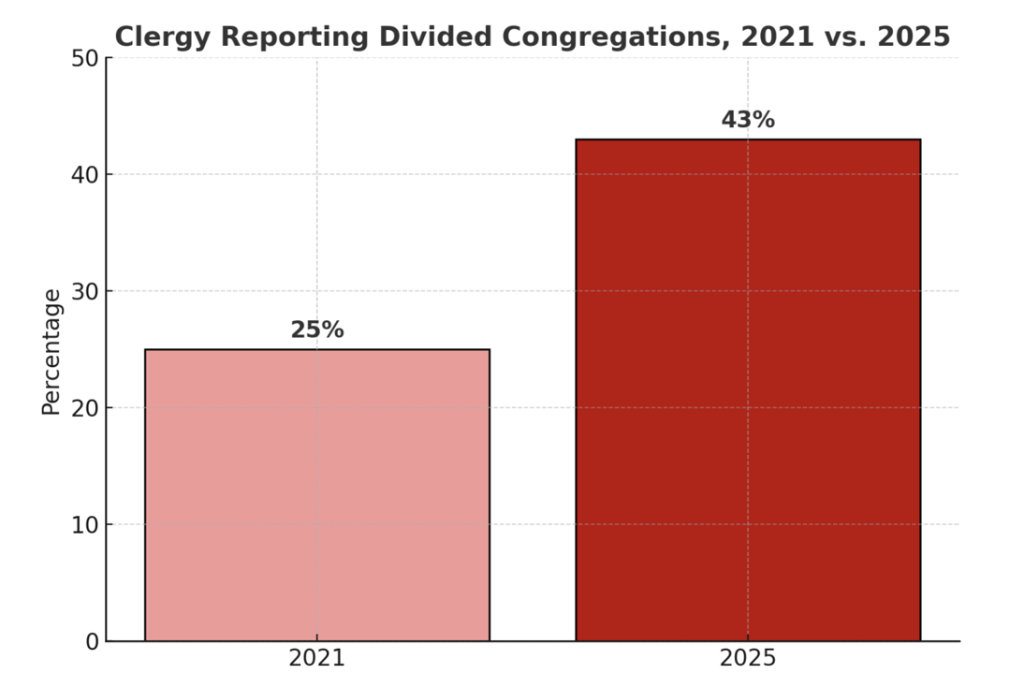
Even more alarming is that 82% of respondents are reporting their communities are severely divided – a dramatic increase from 48% in 2021.
Unsurprisingly, eight in ten respondents reported congregational stress at either moderate or high levels.
Backlash against clergy most often took the form of decreasing worship attendance and angry words, letters, or emails. Perhaps most concerning, 13% of respondents reported receiving threats against their safety, with over 120 describing experiences ranging from harassment and vandalism to death threats and actual violence. This contributes to an overall chilling effect in congregations and adds to the broader stress experienced by clergy, with 63% reporting frequent frustration and 59% feeling exhausted.
Yet, energy for ministry remains high.
Despite the challenges clergy are facing, the data reveal something remarkable. The majority of clergy (89%) reported feeling supported and collaborative as well as energized and full of new ideas (82%). Seven in ten indicated that they were enthusiastic about staying at least five years at their current ministry site.
It may seem contradictory that clergy can feel both energized and exhausted by ministry simultaneously. But those who are pastors are probably not surprised by this paradox. Ministry can be both invigorating and depleting. Clergy can feel supported by some in the congregation while undermined by others.
So, where are clergy finding support in this push and pull of ministry?
Our research identified five primary sources of support that enabled resilience for clergy.
- Support networks among fellow clergy (such as peer coaching groups and preaching mentors)
- Support networks within congregations (especially healthy governing boards)
- Support networks among family and friends outside of ministry
- Health and wellness practices (including spiritual direction, counseling, exercise, prayer and meditation, being in nature, and maintaining boundaries)
- Cultivating communal creativity amid tension to build resilience in congregations (such theatre, music, dance, writing, and deliberative dialogue)
Many respondents indicated that a combination of these supports sustained them for ministry. As one remarked, “I have received some fairly significant support from specific church members who are not leaders in the church. I’ve received lots of support from the wider community after starting a community organizing group on pro-democracy and anti-fascism.”
Others noted that online clergy groups have been especially important for those serving in areas with nonexistent or non-inclusive ministeriums. For example, a group I co-founded called the Clergy Emergency League is a grassroots network of over 3,200 clergy across the United States, founded in June 2020 to support ministers navigating political upheaval, rising Christian nationalism, and authoritarian threats. Clergy gather for weekly sermon preparation studies, monthly check-in meetings, and educational events.
Assessment tool for gauging risks and strengths for ministry in a divided society
For clergy navigating these difficult waters, I have developed a free online assessment tool to help pastors gauge risks and strengths within their specific contexts. This five-minute assessment helps determine whether Gentle, Invitational, or Robust approaches to addressing social issues are most appropriate in their setting. You can learn more about this from my book, Preaching and Social Issues.
Finding ways to maintain prophetic witness while sustaining themselves and their communities will be a challenge for clergy, congregations, and denominations. Building networks of support, education, accountability, creativity, and solidarity can boost clergy resilience during these turbulent times.
If you are a minister, what have been your biggest sources of stress? And where have you found sources for resilience? Share your thoughts in the comments below!
*This study was conducted by Leah D. Schade, Wayne Thompson, and Amanda Wilson Harper and was approved by a human ethics review at Carthage College, #IRB-FY25-136.

The Rev. Dr. Leah D. Schade is a professor of preaching and worship and an ordained minister. Her opinions are her own. She is the author of Preaching and Social Issues: Tools and Tactics for Empowering Your Prophetic Voice (Rowman & Littlefield, 2024), Preaching in the Purple Zone: Ministry in the Red-Blue Divide (Rowman & Littlefield, 2019) and Creation-Crisis Preaching: Ecology, Theology, and the Pulpit (Chalice Press, 2015). She is the co-editor of Rooted and Rising: Voices of Courage in a Time of Climate Crisis (Rowman & Littlefield, 2019). Her book, Introduction to Preaching: Scripture, Theology, and Sermon Preparation, was co-authored with Jerry L. Sumney and Emily Askew (Rowman & Littlefield, 2023).
















 Ad-Free & Subscriber Log-In