

The meeting between President Trump, a Republican, and New York City mayor-elect Zohran Mamdani, a democratic socialist, turned into what is being described as a “love fest.”
“Some of his ideas are the same as my ideas,” the president said. “He wants to see housing go up, see a lot of housing created, apartments built… People would be shocked, but I want to see the same thing.” . . .
“There were more New Yorkers who voted for President Trump in the most recent presidential election because of that focus on cost of living,” Mamdani said, “and I’m looking forward to working together to deliver on that affordability agenda.”. . .
“A lot of my voters actually voted for him,” Trump said.
“One in 10,” Mamdani interjected.
“And I’m OK with that,” Trump responded.
Trump also noted his agreement with another democratic socialist: “Bernie Sanders and I agreed on much more than people thought.” Trump said that he thought Mamdani had the potential to be “a really great mayor” and promised to help him.
The high point of this amiable exchange came when a reporter asked Mamdani if he still considers Trump to be a fascist. Trump, who had called Mamdani a communist, interrupted and said, “That’s OK you can just say yes.” Mamdani just said, “OK,” to laughter all around.
But, setting aside whether those terms apply to these two, there is not that much difference between Fascists and Communists. Mussolini described his Fascist ideology as nationalism plus socialism. Communism is international, class-based socialism. Both were revolutionary, anti-capitalist movements. Both installed authoritarian, totalitarian governments. Both were allies of each other in the first phase of World War II, when they divided eastern Europe between them, though they then turned against each other.
More to the point of comparing Trump and Mamdani, they and their supporters are both populists. Both MAGA and the DSA are anti-establishment. Both claim to represent the working class. Both are opposed to free markets, Mamdani by wanting the state to own or at least control the means of production and Trump with his tariffs and protectionism.
Yesterday we blogged about Claire Lehmann’s argument that critical theory offers a “portable” worldview that reduces issues to a “moral grammar” of oppressors vs. oppressed, and that this worldview can now be found across the the political spectrum. She also argued that the new “woke” preoccupation is being anti-capitalism.
Much has been said about how Trump has taken over the working class, which was once the Democratic base, while the new Democratic base consists of our highly-educated social elite. But while the working class has always struggled economically, today large elements of our highly-educated social elite–especially young adults–are also struggling economically.
While members of Gen Z are not impoverished in absolute terms—the average 25-year-old in the U.S. now earns more than $40,000 a year, outpacing Millennials at the same age—many feel deprived in relative terms, as social media has opened up avenues for social comparison hitherto unknown to humankind. Where previous generations compared themselves to classmates or peers in their town or city, today’s teenagers measure their worth against influencers and celebrities across the globe. . . .And despite relatively high household incomes, homeownership for those under 35 has been in decline across the Anglosphere, adding to a sense of relative deprivation. . . .In the U.S., according to the National Association of Home Builders, only 36 percent of adults under 35 currently own their own homes.
Marriage in this demographic is also way down, as is having children. Many young adults feel they can’t afford to.
Even young adults raised in wealthy families are having problems. Despite their “privileged” background, according to Rob Henderson’s Free Press article, The Revolt of the Rich Kids, “fewer than four in 10 children born into the richest fifth of households stay there; more than one in 10 fall all the way to the bottom fifth.” Such downward mobility creates bitterness, which creates radicalism.
Urban expert Joel Kotkin calls financially pressed but highly educated young adults the educated precariat. That latter term means “existing without predictability or security, affecting material or psychological welfare” and is a mashup of “precarious” and “proletariat.”
Kotkin describes the economic problems of our big cities, including high rents and an astronomical cost of living that means even high wage city-dwellers have lower disposable incomes than low wage earners in the small towns of the midwest. Despite their expensive education, they often can’t find jobs in their fields but still have big college loans to pay off. Says Kotkin,
Other economic pressures are radicalizing the hipsters. They face a job market that is getting tougher — barely half of workers under 30 have full time jobs — even for those with expensive advanced degrees. Their jobs are increasingly threatened by the rise of artificial intelligence, including in finance, business services, and even “creative” professions that historically have clustered in cities.
All of this, Kotkin says is the reason New York City voted overwhelmingly for Mamdani. And these economic problems are a formula for radicalism:
Burdened with astronomical college debt, these high-education-but-low-wage voters constitute the vanguard of the far Left in many cities. They have largely adopted radical positions hostile to Israel and are seen as threatening to Jews, especially older ones, who once played a dominant role in the city politics. Onetime rapper and Hollywood nepo baby Mamdani knows well how to appeal to this emergent class. His high-priced proposals for free childcare may seem family-friendly, but many of these voters are unliikely to have children (a majority of Manhattanites are single and have never been married). Socialist campaigners thrive in those places that have far fewer children — gentrified sectors of Queens and Brooklyn, Chicago’s near northside and trendy swaths of west LA.
So here is my thought experiment. What if the populists of the right and the populists of the left joined forces? This would have to be post-Trump, since progressives’ hatred of the man blinds them to what they have in common. But what would happen if the working class–whose lot doesn’t seem to be greatly improved by the Republican regime–went back to their earlier Democratic home and formed a coalition with disaffected urban college grads? They would need a Trump-like candidate with magnetism and the ability to whip up a crowd. The common theme would be anti-establishment, anti-business-as-usual, anti-capitalist, and pro-socialism.
As Claire Lehmann observes, “Until now, wokeness has been largely an elite project, preoccupied with identity issues of race, sexuality, and gender, as opposed to economic inequality. But if this movement mobilises the working class and the downwardly mobile middle classes, it will no longer be confined to the campus or cultural niches. On the contrary, it will ignite into a truly mass movement.”
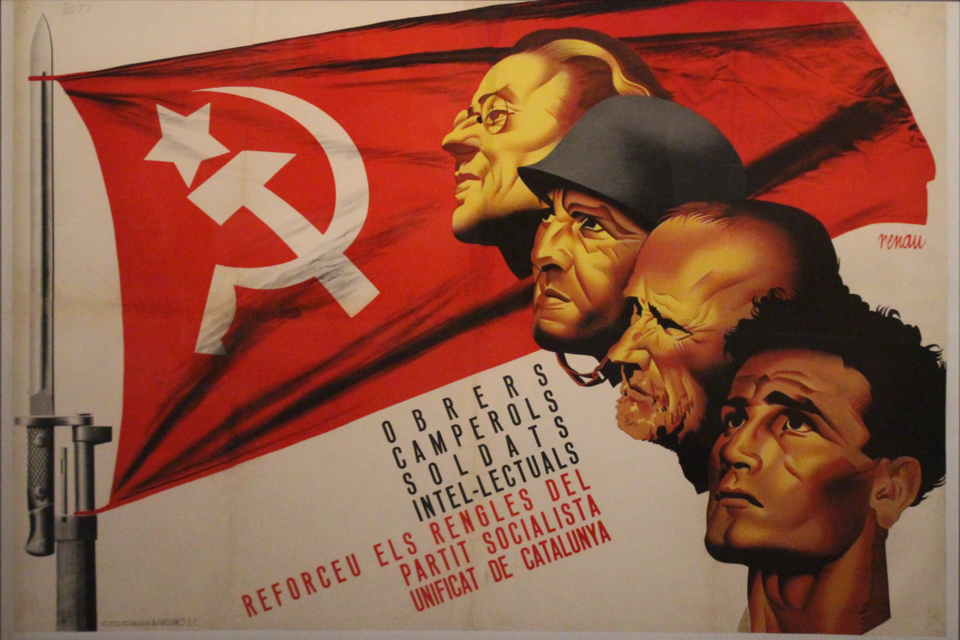
Illustration: Workers, peasants, soldiers, intellectuals, reenforcing the ranks of the Unified Socialist Party of Catalonia by Steve Kelem – Own work, CC BY-SA 4.0, https://commons.wikimedia.org/w/index.php?curid=49899784













 Ad-Free & Subscriber Log-In