

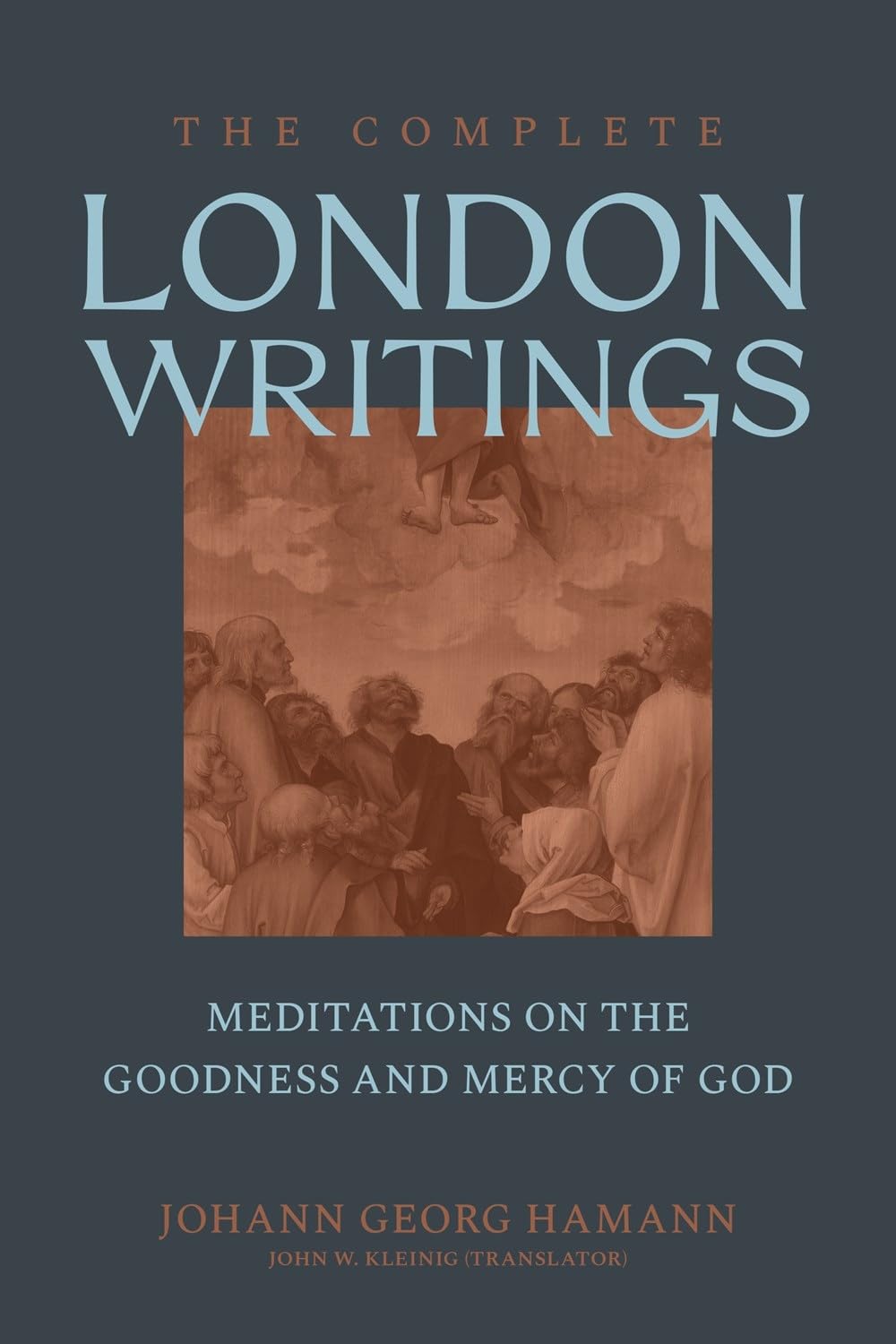
Some of you will remember back in 2022 when I announced the publication of the first English translation of the London Writings by J. G. Hamann. It was translated by the Australian Lutheran theologian John Kleinig, edited by yours truly, and commissioned and published by George Strieter of Ballast Press.
George sold the rights to Lexham Press, which has recently released a new edition. (Just in time for Christmas!)
Hamann was the 18th century thinker who has been rediscovered recently and is being hailed as the only way forward from the dead ends of both modernism and postmodernism.
Significantly, Hamann–once a card-carrying member of the Enlightenment–became a Christian, specifically, a Lutheran Christian. He tells how this happened in the London Writings, which also sets forth how his new faith in Christ and trust in the Bible were catalysts for his critique of both the rationalism of the Enlightenment and the constructivism of his good friend Immanuel Kant that would morph into postmodernism.
Hamann’s writings, many of which have not been translated into English, are a strange mix of humor, allusions, and dense argumentation, but the London Writings–his personal reflections not intended for publication–are crystal clear and thus are the best introduction to his thought.
Today, any attempt to counter modernism and postmodernism in a sophisticated way and to move towards a “post-secular” mindset formed by the Word of God will do well to go through Hamann, as the “radical orthodox” theologian John Milbank and the interrogator of secularism Charles Taylor have been doing.
The translator, John Kleinig, is a major figure in confessional Lutheran circles. In addition to his brilliant renditions of Hamann’s German into English, Kleinig’s introductions–to Hamann, to the London Writings as a whole, and to each of the nine individual texts that comprise it–are worth the price of the volume. He also provides illuminating notes and traces Hamann’s Biblical texts and allusions.
None of this would have been possible without George Strieter, who discovered Hamann, had the idea of translating an English version of the London Writings, initiated the project, commissioned the translation, and made it available to the public. George has a history of recovering forgotten Lutheran writings and making them available again through his micropublisher Ballast Press. He did this with Gustaf Wingren’s Luther on Vocation and Adolf Koeberle’s The Quest for Holiness. These books have a huge impact, whereupon they get taken over by larger publishers. This is what happened with London Writings.
Lexham Press has much greater reach than Ballast Press, not to mention the expertise and the technology to design beautiful books. Ironically, though, Lexham Press has just been bought by an even bigger publishing company, Baker Books, which has an even greater reach. This new edition of Hamann has come out under the Lexham imprint, though I have been told that future printings will be under the auspices of Baker Academic.
You can buy the book here. To those of you who bought the original Ballast Press edition, there is not much difference. I noticed a few minor tweaks in the introductions, the headings are handled differently, and there are other formatting changes. For one thing, the Ballast edition kept Hamann’s abbreviations and writing various quirks, which Lexham regularizes. The Lexham edition has a more polished look. Still, I could recognize typographical and design elements that I came up with.
The change that jumped out at me the most had nothing to do with the text or the apparatus, but the endorsements. Lexham is an evangelical publisher, as is Baker, so the scholars they asked to endorse the book and to write promotional blurbs were all of the Reformed and evangelical persuasion, with not a Lutheran in sight.
The endorsers are distinguished scholars, including the Lutheran-friendly Michael Horton whom I know, and they had good things to say. I’m glad to see how much they appreciated Hamann and Kleinig’s translation. But their evangelical take on Hamann is evident. One of them cited the significance of this book “for the development of modern evangelicalism.” In contrast, Kleinig cites his significance for “the confessional revival” in Lutheran theology.
But I hope evangelicals will read Hamann. They will benefit greatly from his distinction between Law and Gospel, his sacramental view of Scripture, his high view of baptism and the Lord’s Supper, his understanding of revelation as opposed to reason in theology, and other distinctly Lutheran emphases that other theological traditions can also find helpful.
For the record, let me just quote the blurbs we used in the Ballast Press edition–from the great contemporary Lutheran theologian who is largely responsible for Hamann’s rediscovery; from a Catholic scholar who has written the best book on Hamann; and the editor of the German edition of Hamann’s works:
Hamann’s London Writings “can be compared to Augustine’s Confessions. In their theological and philosophical significance. . .they are equal in stature.”
–Oswald Bayer, A Contemporary in Dissent
“These writings are indispensable to understanding everything he subse-quently wrote. . . .There is an undeniable advantage in beginning with these writings, which, unlike Hamann’s later authorship, are direct and personal, written in clear, accessible prose.”
–John Betz, After Enlightenment
The London Writings are “the diary of a soul concerning the greatest experience it could possibly have: [becoming] a child of God.”
–Josef Nadler, Johann Georg Hamann 1730-1788
Illustration via Amazon.com
















 Ad-Free & Subscriber Log-In