

My fellow Patheos blogger Paul Thompson points out that “Jesus’s ‘church’ combined a Zealot committed to the overthrow of Roman rule of Palestine, and a tax collector who colluded with the Roman rulers for his own benefit.”
Thompson is writing about the different kinds of diversity in the church–not just of race, gender, and the usual DEI canons, but of ancillary beliefs and, his main focus, different kinds of personalities.
In his post at Anxious Bench, How Diversity Drives Sanctification After Easter, Thompson, a history professor at North Greenville University, goes on to consider the various personality profiles–according to Myers Briggs, Ennegram, etc.–and leadership styles, how some of these personalities tend to conflict with other of these personalities and how important it is for Christians to deal with these in a positive way.
He concludes, citing the Scripture “As iron sharpens iron, so one person sharpens another” (Proverbs 27:17),
The only way iron can sharpen iron is by creating much friction between the two pieces of iron. Usually by hitting. Friction requires contact. Contact requires very close proximity.
If you divorce because things are too difficult, if you leave a church every time you are offended, you lose proximity, and contact, and friction, and thereby you lose the opportunity to be sharpened by the relationships in your life. This means you don’t have to change, which means you don’t have to learn anything new. In the context of our Christian journey, these separations can mean we abandon a relationship through which the Holy Spirit was working to make us more Christlike. We could be avoiding a key aspect of the sanctification process (being in community with other believers) as God designed it. How else would we develop the fruit of the spirit — patience, kindness, etc. — if it wasn’t through relationships with fellow believers that rub us the wrong way?
Interesting post–I recommend you read all of it–and he makes a very good point: Personality conflicts can be good for us and for the church.
Today in our age of church shopping it has become easy when we encounter conflicts to flee from one congregation to another, so that our congregations have become more homogeneous. And church communities can become a force for unhealthy conformity. The old parish model in which everyone attended the congregation of their confession that was closest to them, ensuring the mixing of Christians of different personalities, backgrounds, and social positions, was no doubt far more salutary.
So can there be different political beliefs in the church? That is, can people of widely divergent political convictions agree with each other when it comes to holding a common Christian faith, in following Jesus? The examples of Simon and Matthew would indicate yes.
I would argue, though, that many of the polarizing conflicts today are not so much political as moral (e.g., abortion, homosexuality, euthanasia) and differences in world view (feminism, transgenderism, relativism). These are, in effect, religious issues. Those kinds of disagreements are difficult to reconcile in a common religion. Congregations and church bodies must share a common faith and confession. Indeed, that common faith and confession is what makes it possible for people of different personalities, background, social conditions–as well as different races, genders, and political beliefs–to come together as one body.
Those of us who have been around for awhile can remember having both political liberals and political conservatives in our congregations, with lively but usually good-humored debates and teasing at church dinners. But back then both Democrats and Republicans, New Deal liberals and fiscal conservatives, would both be horrified at abortion and the sexual revolution.
Today political differences have morphed into something else entirely, becoming antagonistic moral and philosophical convictions that are deeply corrosive of unity. I have, however, seen friendships and family relationships that persevere despite such divisions. Those are worth striving for. And there are still pro-life liberals and pro-common good conservatives.
Thompson’s post made me curious about what happened to Simon (did he remain a Zealot?) and Matthew (did he get disillusioned with Roman government?).
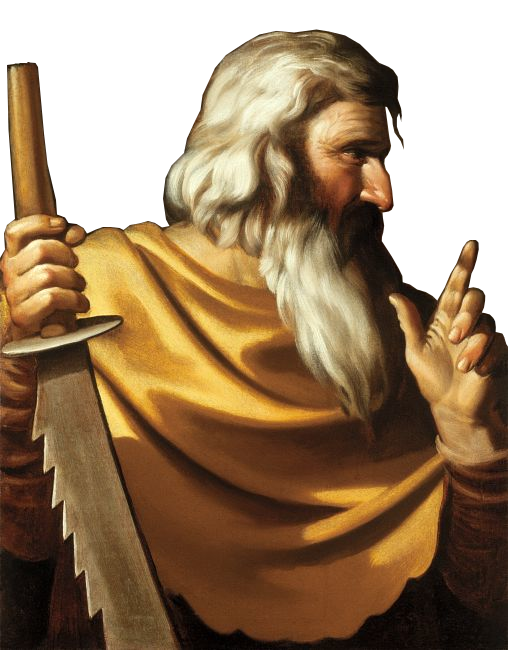
According to Simon’s Wikipedia entry there is no real consensus about him, including whether he may have gone by different names and what “zealot” meant. Of the many different traditions about him, some say he became the Bishop of Jerusalem (which would be fitting for his Jewish nationalism), while others say he proclaimed the Gospel in Egypt, Persia, Armenia, Lebanon, and Georgia. Most agree that he was finally martyred by the Romans (which he might have expected). Most traditions say that he was crucified, though some say he was sawn in half, so that Christian art generally depicts him holding a saw.
As for Matthew, his Wikipedia entry focuses mainly on his authoring the Gospel that carries his name, something very well-attested, going back to the first century. According to tradition, Matthew played an important role in evangelizing Ethiopia, where he was martyred by a king whom he rebuked for lusting after a young Christian woman. (He must have learned not to be as deferential to official authority as he used to be.)
Interestingly, the streaming series The Chosen depicts Matthew as being on the autism spectrum. According to director Dallas Jenkins, “I saw three things that stood out. One, he was a numbers guy, obviously, as a tax collector. Two, he was a facts guy; his whole first chapter is a genealogy in three equal sections of 14 names. Finally, he chose a profession that made him a social outcast.” I’m not sure how historically valid that is, but this has made Matthew a favorite saint among autistic children.
As for diversity, yet unity, in the church, this is a clear teaching in the New Testament. Unlike other world religions–like Islam, Hinduism, Buddhism, and animism–which come with a culture, Christianity is not a cultural religion. Rather, it is for “every nation, from all tribes and peoples and languages”:
And how is it that we hear, each of us in his own native language? Parthians and Medes and Elamites and residents of Mesopotamia, Judea and Cappadocia, Pontus and Asia, Phrygia and Pamphylia, Egypt and the parts of Libya belonging to Cyrene, and visitors from Rome, both Jews and proselytes, Cretans and Arabians—we hear them telling in our own tongues the mighty works of God.” (Acts 2:8-11)
After this I looked, and behold, a great multitude that no one could number, from every nation, from all tribes and peoples and languages, standing before the throne and before the Lamb, clothed in white robes, with palm branches in their hands, and crying out with a loud voice, “Salvation belongs to our God who sits on the throne, and to the Lamb!” (Revelation 7:9-10)
Baptism creates a new identity, one that transcends race, nationality, gender, and socio-economic status:
For as many of you as were baptized into Christ have put on Christ. There is neither Jew nor Greek, there is neither slave nor free, there is no male and female, for you are all one in Christ Jesus. (Galatians 3:27-28)
Here there is not Greek and Jew, circumcised and uncircumcised, barbarian, Scythian, slave, free; but Christ is all, and in all. (Colossians 3:11)
Despite this unity in Christ, the Word of God praises the differences and the extreme individuality of those who make up the church, which is nothing less than the Body of Christ:
For just as the body is one and has many members, and all the members of the body, though many, are one body, so it is with Christ. For in one Spirit we were all baptized into one body—Jews or Greeks, slaves or free—and all were made to drink of one Spirit.
For the body does not consist of one member but of many. If the foot should say, “Because I am not a hand, I do not belong to the body,” that would not make it any less a part of the body. And if the ear should say, “Because I am not an eye, I do not belong to the body,” that would not make it any less a part of the body. If the whole body were an eye, where would be the sense of hearing? If the whole body were an ear, where would be the sense of smell? But as it is, God arranged the members in the body, each one of them, as he chose. If all were a single member, where would the body be? As it is, there are many parts, yet one body. (1 Corinthians 12: 12-20)
Such a variety of Christians is a reality in individual congregations–which do include different human beings despite any surface similarity–but also in the “holy Christian church” that extends through time and around the world.
Illustration: Simon the Zealot by Carravagio, photo by Hakjosef – Own work, CC BY-SA 4.0, https://commons.wikimedia.org/w/index.php?curid=89475039











 Ad-Free & Subscriber Log-In