

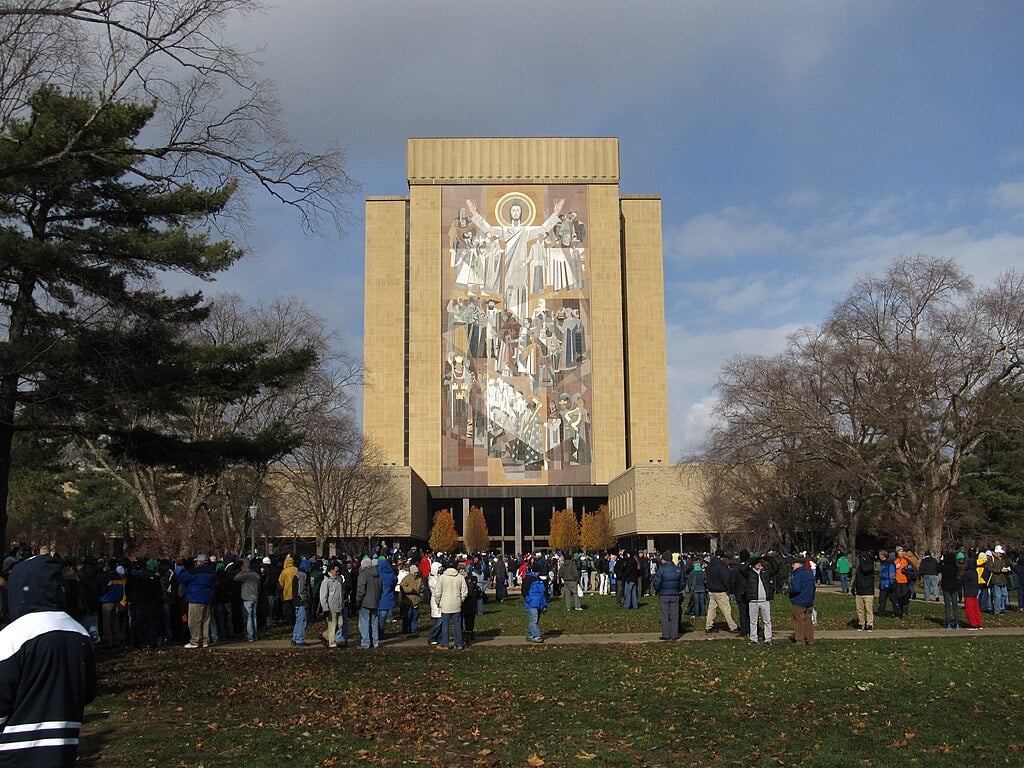
The university was essentially invented by the church. And yet today Christian universities have a hard time maintaining their Christian identity.
Recently, Notre Dame, the nation’s leading Catholic University, appointed one of its faculty members, Susan Ostermann, to be head of its institute for Asia Studies. Ostermann, though, is a vocal and militant supporter of abortion, in direct contradiction to the teaching of the Roman Catholic church. This has traditional Catholics wondering not only why she was chosen for a leadership position, but also what she was doing on the faculty in the first place.
Now sociologist Christian Smith has resigned from the faculty, giving his reasons in a First Things article entitled Why I’m Done with Notre Dame. He doesn’t explicitly mention the Ostermann controversy, but he expresses his long-term overall frustration at the university’s leadership and its failure to take seriously its Catholic mission. In doing so, he brings up temptations that can apply to Christian colleges more broadly.
First of all, Christian Smith is a first-rate scholar by any measure. He is well-respected in his field, secular though it be. He has made some important contributions to the sociology of religion. He is the one, for example, who, with his co-author Melinda Denton, coined the term “moralistic therapeutic deism” to describe today’s dominant religious assumptions. He is far from the stereotype of the anti-intellectual crusading Christian zealot.
But Smith is leaving after 20 years on the faculty because he realizes that, despite scattered exceptions, the leadership of the university is not longer committed to–and sometimes undermines–its Catholic mission. You can read the details of his complaint for yourself. (His article seems to be out from behind the paywall.) But I want to focus here on what he says about how this happened, since similar things can happen to Lutheran, evangelical, and other denominational schools.
Many schools uphold their religious identity by hiring for their faculty members of the sponsoring religious tradition–if not all, a certain percentage, a critical mass. This can be effective, as long as the faculty member actually believes in that religion. But this practice can fail to take account of nominal members, those who are on a church roll but no longer believe what that church teaches.
According to Smith, “Though Notre Dame formally requires ‘a predominant number’ of faculty to be Catholic, in many if not most cases that goal is achieved through a ‘tick the box’ approach, whereby a candidate who was baptized Catholic but now despises Catholicism counts as Catholic.”
Another problem is the desire to avoid conflict. “On every issue, dispute, or debate that might cause controversy, top administrators avoid institutional intervention like the plague.”
Rather than confidently advance the university’s stated Catholic mission—which would generate contention—Notre Dame’s leaders talk a good game and then retreat from the rough-and-tumble that implementing it would involve. . . .Fear of conflict is debilitating to a university. Of its nature, academic life engages differing perspectives, names and forthrightly acknowledges disagreements, and works through arguments with civil critiques and replies. That is how disciplined inquiry gets anywhere. It is also what the Catholic Church and our entire American culture now desperately need to see modeled.
Another problem is a “craving for mainstream acceptance.” Notre Dame, like other Christian schools, wants to be accepted by peer institutions, as well (I would add) on the program level by professional associations and on the faculty level by other scholars in the various academic disciplines. The problem is that, as Smith says, “Catholic teachings on abortion, birth control, same-sex relationships, the male priesthood, and other culture-war issues embarrass many Catholic professionals and intellectuals.” The same holds true for orthodox Christian teachings in the other traditions.
But today’s academic establishment is dysfunctional to the point of being anti-intellectual. “A crazy irony is at work: Notre Dame is chasing the acceptance of peer institutions that are far more lost than Notre Dame when it comes to the parameters and final purposes of higher education. Notre Dame allows its mainstream peers to set the terms—however confused and misguided—and then conforms to them. The fact that it does this should be the true source of its embarrassment.”
Another problem is ambition. Smith says,
A third and related explanation for Notre Dame’s failure to fulfill its Catholic mission is its ambition to become a globally pre-eminent research university. Not long before my arrival, the Board of Trustees and campus leadership apparently decided that the university would no longer be content to pursue excellence in undergraduate liberal arts education, with a side serving of graduate studies, and maintain a serious Catholic identity. To those two goals a third was added: becoming a great research university—not cautiously, but as expeditiously as possible.
Smith cites the principle of the “Iron Triangle” or “Triple Constraint” of business and project management: “In any production process, one can achieve only two of three desired features—cheap, fast, and high quality—but never all three. Cheap and fast is doable, but at a cost to quality. Fast and high quality is possible, but it will be expensive. And cheap and high quality can be done, but never quickly.”
He says that in today’s climate, Notre Dame cannot have all three of its stated purposes: “maintaining excellent undergraduate education, sustaining a strong Catholic mission, and rapidly becoming a great research university.” For several reasons, you can’t have all three. He says you can’t find enough believing Catholics who are also good teachers and who are also world-class researchers.
Furthermore, the very nature of “world class universities” goes against the nature of Catholic education:
The governing logic of the modern research university is hyper-specialization. A Catholic mission that focuses on intellectual life (not just humanitarianism) tends in the opposite direction: toward integration, holism, coherence of thought and life. Notre Dame credulously thinks it can have its hyper-specialization and its integration, too. This refusal to recognize hard limits and trade-offs leads to the inevitable compromise of the Catholic mission.
There are lessons here for Lutheran, evangelical, and other Christian colleges. As a college professor and administrator at various Christian institutions, I’ve encountered such temptations first hand, but I think we mostly navigated them well.
Luther Classical College, where I am a visiting professor, is organized precisely to avoid these temptations. The classical Christian curriculum counters the hyper-specialization that afflicts other schools. We have no ambition to be a “world-class university,” nor do we desire to conform to secularist “peer” institutions. Both faculty and students constitute a community of believing Lutheran Christians. The school’s focus is providing both excellent undergraduate education and intentional Christian formation. Staying on mission is helped by staying intentionally small. The bigger the school, the more challenging that can be.
Patrick Henry College, where I was provost, successfully avoided these temptations, I would say. Not only that, by doing so we ironically have acquired a strong academic reputation, to the point that our graduates regularly get accepted by the “world class” graduate schools.
The Concordias, where I spent most of my career, may have had their problems, but overall they have been better in this regard than most denominational schools. And my impression is that their leadership today is strongly committed to their Lutheran identity and mission.
Photo: Theodore Hesburgh Library, Notre Dame University, photo by Ken Lund from Reno, Nevada, USA, CC BY-SA 2.0 <https://creativecommons.org/licenses/by-sa/2.0>, via Wikimedia Commons. [The work of art is “The Word of Life” by Millard Sheets, also known as “Touchdown Jesus.”]














 Ad-Free & Subscriber Log-In