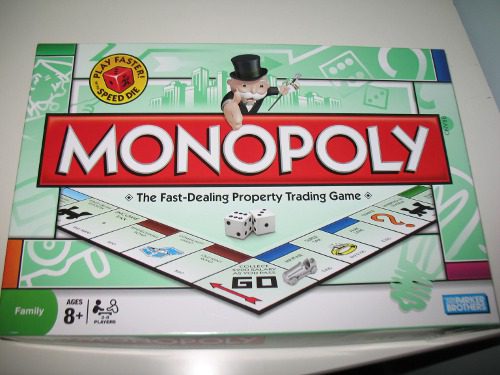
Imagine a store whose clientele is not one city but the entire country, if not the world. And that sells nearly everything–books, electronics, clothing, toys, food. That is what Amazon.com has become. Does that constitute a monopoly?
Corporations in a free market often grow until they become monopolies, whereupon the free market ceases to function because there is no longer any competition. At that point, according to economic theory and government policy, they need to be broken up, so competitive forces can click in again so that the free market functions.
Has Amazon.com reached that state? Does Amazon.com need to be broken up?
Normally, monopolies, by eliminating competition, raise prices. But Amazon’s dominance is lowering prices! Also, Amazon works by giving manufacturers and publishers (including self-publishers) access to customers, providing consumer information about their products and offering inexpensive shipping. So maybe it’s more like infrastructure.
Economist Douglas Rushkoff, in the article linked after the jump, says that Amazon.com represents a different kind of monopoly in a different kind of free market than that of the industrial revolution. But he concludes that it is important that Amazon be broken up.
What do you think?
From Douglas Rushkoff, It’s Time To Break Up Amazon, Fast Company:
“Amazon just bought Whole Foods,” my friend texted me seconds after the announcement of the proposed acquisition. “It’s over. The world.”
This unease is widespread, and has raised new calls for breaking up Jeff Bezos’s impending monopoly by force. Surely the company, which now generates 30% of all online and offline retail sales growth in the United States, and already controls 40% of internet cloud services, has reached too far. The 3% hike in Amazon’s share price since the announcement—which would alone more than pay for the acquisition—may attest less to the deal’s appropriateness than to investors’ growing fear that missing out on Amazon means missing out on the future of the economy.
Whatever you may think of Jeff Bezos, and whether or not antitrust regulations can justifiably be applied to a company whose expansion doesn’t raise but actually lowers costs for end consumers, may be beside the point. Many of us get that something is amiss, but are ourselves so deeply enmeshed in the logic of last century’s version of free-market industrial capitalism that we can’t quite bring ourselves to call this out for the threat it poses to our markets, our economy, and even our planet.
[Keep reading. . .]
Illustration credit: I, Coolguy6662, am the owner of the image., CC BY-SA 3.0, https://en.wikipedia.org/w/index.php?curid=33407164















 Ad-Free & Subscriber Log-In