In 1991, the vast communist enterprise known as the Soviet Union was dissolved, along with its evil empire. This was due–in addition to the heroism of its opponents–to the failure of its economic system, the hatred of its citizens for its totalitarian repression, and the fact that nearly everyone in Russia and Eastern Europe stopped believing in Marxism.
Communism collapsed, with the important exception of China, which kept it alive only by changing it by incorporating elements of free market capitalism.
And yet today, Marxism, with its economic-political manifestation known as communism, is making a comeback. Antifa street protesters and their leftwing allies are agitating for a revolution. The “post-Marxists” who have substituted out Marx’s economics-based class struggle for other kinds of class struggles based on race, sex, gender, et al., are still very much Marxists. And they reign supreme on university campuses and other intellectual centers, enforcing ideological conformity just as their counterparts did in the Soviet Ministries of Education and Culture. Today Democratic Socialists–that is, Marxists who believe in ushering in the revolution through political action rather than violence–are poised to get elected to run New York City and Minneapolis.
During the Cold War, conservatives worried about communist infiltration of the government and other institutions, a concern that would be mocked as paranoid, though post-Soviet discovery of documents proved that quite a bit of infiltration was, in fact, going on. But today even many conservatives sound as if they have been infiltrated, echoing the Marxist party line that workers are being oppressed by free market capitalists.
Why is communism persisting, despite its failures and its record? I like historian Gary Saul Morson’s comment: “Karl Marx and Friedrich Engels famously began The Communist Manifesto (1848) proclaiming that ‘a specter is haunting Europe—the specter of Communism,’ but today it is more like a zombie, unexpectedly risen from the dead.”
That comes from Morson’s essay for the Free Press entitled Why the Revolution Never Ends, a review of two new books about communism from the same mainline publisher, Basic Books.
Reds: The Tragedy of American Communism by historian Maurice Isserman is a sympathetic account of the American Communist Party, whose members he portrays as idealistic social justice warriors who were betrayed by their Soviet handlers.
In contrast, To Overthrow the World: The Rise and Fall and Rise of Communism by historian Sean McMeekin. The reviewer Morson, who calls this book “the best short history of communism that I know,” summarizes his thesis:
For McMeekin, the essence of communism, and the source of its endless appeal, lies not in its outdated economics but in its totalitarian imperative to destroy utterly the old world, reject all traditional values, and completely remake both individuals and society.
That strikes me as a brilliant insight, explaining why communism has been and still is so popular among alienated intellectuals, young people, and the power-hungry rich. And why China is still communist, despite its free market reforms.
Thus, Chairman Mao’s “cultural revolution” in China mobilized young people to destroy “the four olds”: “old thought, old culture, old customs, and old habits.”
The strategy of the mass-murdering, culture-destroying Khmer Rouge in Cambodia, says McMeekin was “stripping away, through terror and other means, the traditional bases, structures, and forces which have guided an individual’s life,” until each person “is left an atomized, isolated individual unit; and then rebuilding him according to party doctrine.”
McMeekin quotes Lenin:
Far from pretending otherwise, Lenin scorned anything but force, which was to be used not as necessary but whenever possible. The fundamental fact about Soviet coercive power, he insisted, is that it was and always would be unlimited. Soviet schoolchildren learned Lenin’s definition of “dictatorship of the proletariat” as “nothing more nor less than authority untrammeled by any laws, absolutely unrestricted by any rules whatever, and based directly on force. The term ‘dictatorship’ has no other meaning but this.”
Lenin sought to employ law as an instrument of terror. “The law should not abolish terror,” he told the People’s Commissar of Justice who was drawing up the new Soviet legal code. Rather, terror “should be substantiated and legalized in principle, clearly, without evasion or embellishment.”
This mindset is evident in communism from its very founding. “Terror was supposedly capable of accomplishing what Engels called ‘the leap from the kingdom of necessity to the kingdom of freedom,’ that is, to a world in which humanity no longer submits to laws of nature but alters them as needed.” Freedom requires altering the laws of nature! Sound familiar?
McMeekin gives much more evidence in this vein, some of which Morson brings up in his review. But that “it’s the economy, stupid” does not really apply to the far left–though it is doubtless a good bait to attract idealists and a good cover to hide the real agenda–explains a great deal, from its antagonism to the working class to its embrace of the transgender cause.
Until the apocalypse, there will always be those with a “totalitarian imperative to destroy utterly the old world, reject all traditional values, and completely remake both individuals and society.”
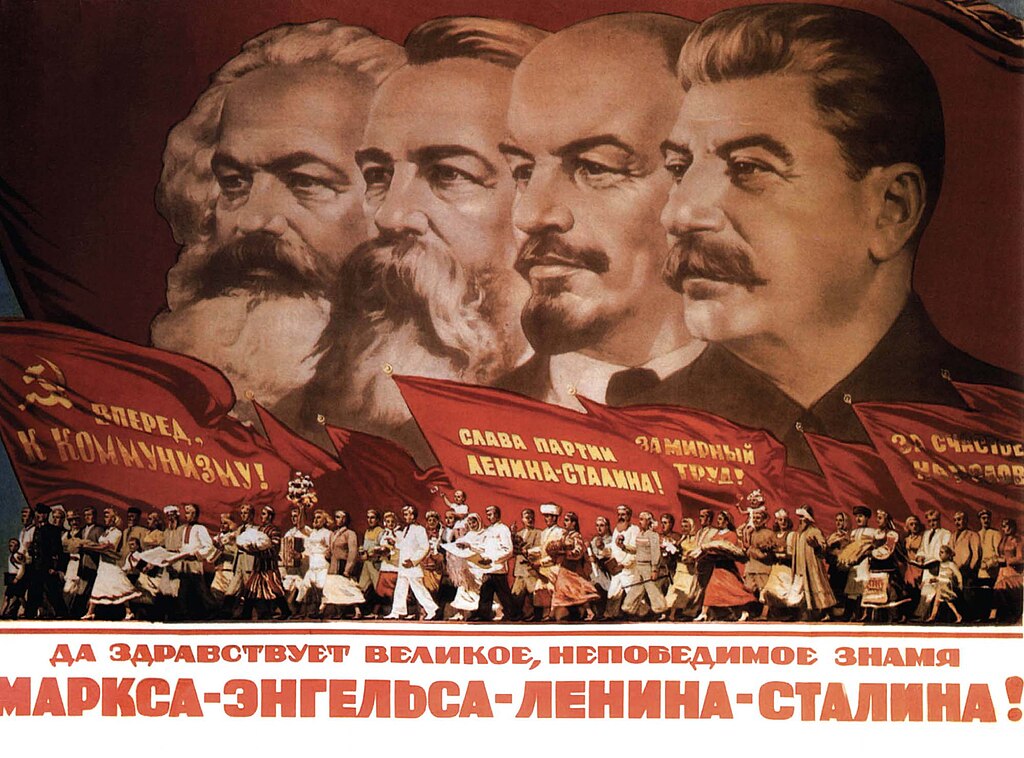
Illustration: Propaganda poster depicting Marx, Engels, Lenin, and Stalin via Wolfman5678, CC0, via Wikimedia Commons
















 Ad-Free & Subscriber Log-In