

Having repudiated God, our society is now repudiating humanity.
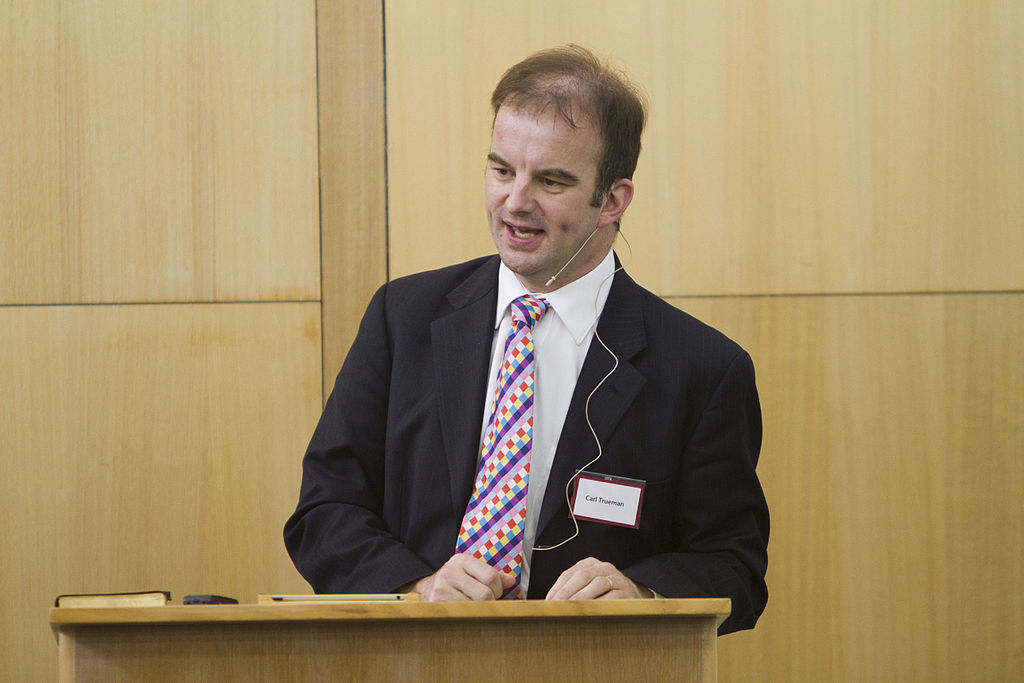
So says Reformed theologian and cultural critic Carl Trueman in his First Things article Towards a New Humanism:
To adapt a phrase from Nietzsche, the problem in our modern world is that man is dead and we have killed him. The concept of human nature is no longer subject to any kind of consensus, with obvious and catastrophic implications for society. Man has been abolished. So what has led to this abolition? Four causes suggest themselves: Human nature has been dismantled, disenchanted, disembodied, and desecrated.
(1) Human Nature Has Been Dismantled. Christianity gave human beings a purpose. Trueman cites the Westminster Catechism: “What is the chief end of man? Man’s chief end is to glorify God and enjoy him forever.” (Lutherans would say something like “to love and serve God and your neighbor.”)
But the rise of naturalistic science–Trueman specifically cites the doctrine of evolution–eliminated any sense of final purpose. “When man has no God-given end, he has no stable or distinct nature,” says Trueman. “In killing God, we kill man.”
The point was made by Nietzsche in his critique of Kant. One could not murder God and then expect human nature to do the late God’s work for him. If God had died, so had the notion that human beings were made in his image.
In this way of thinking, human beings lost their exceptionalism. Today they are seen as merely “the hapless products of networks of discursive power relations, a view that now rings out from countless university seminar rooms and underpins the rhetoric of identity politics, left and right.”
(2) Human Nature Has Been Disenchanted. Human beings have become stripped of their mystery, depth, and dignity. Man became just another object, a thing. The Industrial Revolution turned human beings into commodities. And the sexual revolution went even further in reducing human beings into objects to be used.
The sexual revolution, that progressive watershed, has arguably done more than anything to turn people into things. And pornography, the most consistent iteration of the logic of the revolution, makes sex into a commodity, turning the actors on the screen into objects for consumers.
Then there is the transformation of abortion from an evil into a regrettable necessity and then into a right to be celebrated. Society’s moral imagination has been shaped by the logic of the sexual revolution, in which children are deemed accidental to sex; the humanity of the child in the womb has thus been stripped of its mysterious personhood.
(3) Human Beings Have Become Disembodied. The body has become “a hindrance to liberation of the self.” Feminism “has tended to treat women’s bodies and procreative functions as problems that must be solved if sexual equality is to be achieved.” And transgenderism “involves a psychologized view of identity that marginalizes the sexed nature of the body and also the belief that bodies are simply raw material.”
Meanwhile, our technology has diminished the importance of the body. “Never in human history has life required less actual, physical, interpersonal engagement.” “Today social media have universalized disembodied social interaction and perhaps made it normative for interpersonal engagement.” And AI threatens to take this disembodiment even further.
(4) Human Beings Have Become Desecrated. The world’s religions have always taught that sex is sacred. “To consider sex sacred makes sense, for in creating new life, it is the act that makes humans most like God. The sexual revolution did not simply make sex into recreation; it stripped it, and therefore the human nature of which it is a central part, of its sacredness.” Pornography desecrates both sex and humanity. Abortion desecrates life itself. “Current pro-abortion politics are the politics of transgression, specifically the transgression of what was once considered sacred.”
The same applies to death. Cultures have typically surrounded the end of life, no less than its beginning, with sacred significance. . . . And yet western societies are making great efforts to transform death from a mystery into a medical procedure—a procedure that governs not just late-stage terminal illness but old age in general, depression, indeed any condition that can be presented as burdensome to the individual, the family, or even the state.
Trueman laments the eclipse of religion, though the fact that many are returning to the church is evidence for him that a reaction might be brewing against the anti-human quality of so much of contemporary thought.
He calls for a new humanism that both believers and thoughtful non-believers might agree on. He admits, though, that the possibilities of such an alliance are limited, due to the lack of consensus in our secular society about the reality of God. “The response to the desecration of human nature must be its consecration, and consecration must occur in a religious context.”
Still, he hopes for a new consensus around the problem of the other three (dismantled, disenchanted, disembodied). We need a new humanism to dig ourselves out of the ditch we find ourselves in.
I don’t see it myself. Just as “desecration” can only be resolved by “consecration” (that is, the loss of sacredness being resolved by recovering the sacred), the loss of purpose (being “dismantled”) requires finding a purpose that only religion can bestow. Being “disenchanted” requires being “enchanted”; that is, recovering a sense of transcendent mystery that only religion can provide. Recovering from being “disembodied” requires appreciating being “embodied,” which requires a belief in God’s creation.
That the loss of God has brought on the loss of humanity only proves the foolishness of jettisoning God. If some secularists are starting to realize that, the better hope is that they will abandon their secularism. And, as Trueman himself notices, this is starting to happen.
Photo: Carl Trueman by Blarneytherinosaur, CC BY-SA 3.0 <https://creativecommons.org/licenses/by-sa/3.0>, via Wikimedia Commons










 Ad-Free & Subscriber Log-In