


In the rush to harness the transformative potential of Generative AI (Gen AI), many organizations fall into a familiar trap: competition. Teams, departments, and divisions vie to prove their AI prowess, driven by metrics, deadlines, and a desire for recognition. But while competition may push individual teams to excel, it often stifles the broader organizational progress that Gen AI demands. Success in the Gen AI revolution isn’t about racing ahead in isolation—it’s about working together to share insights, break down barriers, and innovate collectively to overcome challenges, address risks, and leverage opportunities.
The Pitfalls of Internal Competition for Gen AI Initiatives
The instinct to compete is ingrained in many organizations. Teams may feel pressure to outperform their peers, to deliver faster results, or to claim ownership of innovations. While this competitive drive can sometimes inspire exceptional work, in the context of Gen AI, it can backfire.
Gen AI thrives on learning from experimentation, and not all experiments succeed. However, when competition rules the day, failures are hidden rather than celebrated. Teams may shy away from sharing mistakes for fear of losing credibility, depriving others of the opportunity to learn from their experiences.
Even worse, silos created by competition lead to duplicated efforts. For example, in one organization I was invited to consult for on Gen AI integration, both the marketing and customer service teams developed separate Gen AI models to analyze customer sentiment. Neither team knew about the other’s work because they kept their projects hidden, viewing success as a zero-sum game. Not only did this duplication waste time and resources, but it also prevented the organization from developing a unified, more effective solution that leveraged the insights from both teams. Needless to say, this organization required some serious culture change and relationship-building work as a broader part of the Gen AI project.
Collaboration Unlocks the Full Potential of Gen AI Initiatives
The key to unlocking Gen AI’s transformative power lies in collaboration. By bringing together diverse teams with unique perspectives, organizations can develop richer, more innovative solutions than isolated teams could achieve on their own.
Consider a mid-sized regional e-commerce company specializing in niche home goods. This company faced recurring issues with inventory shortages and overstocking, leading to lost revenue and wasted resources. When I began consulting with them, their sales, IT, and logistics teams were working in silos, each attempting to solve the problem using different approaches.
I initiated a collaborative process, assembling a cross-functional team that pooled data from sales trends, warehouse inventories, and external market indicators. Together, they developed a Gen AI-powered demand forecasting system that improved accuracy by 40%. Over six months, this collaboration reduced stockouts by 30% and cut inventory holding costs by 20%. What made the difference wasn’t technology alone—it was the collective intelligence generated by teamwork.
The Building Blocks of Collaboration
To foster a collaborative culture, organizations need to create the right structures and processes. Collaboration doesn’t happen by accident; it requires intentional design.
1. Formal Knowledge-Sharing Platforms
Innovation forums and cross-functional working groups can serve as powerful enablers of collaboration. These spaces encourage teams to present their Gen AI experiments, share insights, and discuss challenges. For example, a regional manufacturing company I advised introduced monthly Gen AI forums where teams showcased their work.
During one session, the operations team presented a Gen AI model for optimizing factory floor layouts, which inspired the logistics team to adapt the same principles for optimizing warehouse storage. This knowledge-sharing led to a 15% improvement in storage efficiency and a 10% reduction in operational costs across the firm, as opposed to a 6% storage efficiency and 5% for the factory floor alone.
2. Collaborative Tools and Technologies
Collaboration tools such as Slack, Microsoft Teams, or Trello facilitate seamless communication and coordination, especially in geographically dispersed organizations. These platforms enable real-time updates, data sharing, and brainstorming, making it easier for teams to align their efforts. And of course, Gen AI itself can facilitate collaboration.
One small tech startup I worked with used Trello to track Gen AI projects across teams. The visibility provided by this tool allowed the marketing and IT teams to quickly identify overlapping goals and merge their efforts on a shared recommendation engine. This unified approach not only improved the engine’s performance by 25% but also reduced project timelines by 30%.
3. Leadership That Champions Collaboration
Leadership sets the tone for collaboration. By recognizing and rewarding cross-team efforts, leaders can shift the organizational mindset from competition to collective success. Incentives such as awards for collaborative innovation or public recognition for teamwork signal the importance of collaboration.
In one case, a mid-sized financial services firm introduced a “Collaboration Excellence” award, which honored projects that demonstrated significant cross-departmental cooperation. The first recipients were a customer service and IT team that worked together to create a Gen AI chatbot. The chatbot resolved 40% of customer inquiries without human intervention, improving response times by 35% and cutting service costs by 20%.
Overcoming Resistance to Collaboration
Despite its benefits, fostering collaboration can be challenging. Teams accustomed to operating independently may resist sharing their work or may fear losing control over their projects. To address this, organizations need to embed collaboration into their workflows.
When launching Gen AI initiatives, leaders should design cross-functional teams from the outset, ensuring that projects draw on diverse skills and perspectives. This approach not only creates stronger solutions but also normalizes collaboration as part of the organization’s DNA.
Moreover, leaders must communicate the value of collaboration clearly. By highlighting successful examples and demonstrating the tangible benefits—such as faster project completion or improved outcomes—they can build buy-in across the organization.
Collaboration does more than improve individual projects; it creates lasting organizational value. Shared knowledge becomes a repository of collective intelligence that grows over time. Future teams can draw on past experiments, lessons learned, and best practices, accelerating innovation cycles and improving success rates.
Additionally, collaboration builds agility. In a rapidly changing Gen AI landscape, organizations with strong collaborative cultures are better equipped to adapt to new challenges and opportunities. They can pivot quickly, leveraging their collective expertise to navigate uncertainties and stay ahead of competitors.
Conclusion
The Gen AI revolution demands a shift in organizational thinking. Internal competition may have its place in traditional business strategies, but in the world of Gen AI, it’s collaboration that drives success. By breaking down silos, fostering knowledge-sharing, and celebrating teamwork, organizations can unlock the full potential of Gen AI.
Collaboration isn’t just a strategy—it’s a competitive advantage. The businesses that thrive in the Gen AI era will be those that recognize the power of working together to achieve greater things. To truly lead in this revolution, it’s time to embrace collaboration and leave internal competition behind.
Key Take-Away
True success in Gen AI initiatives comes not from competition but from collaboration: breaking down silos, sharing insights, and working together to unlock innovation, agility, and lasting organizational value… >Click to tweet
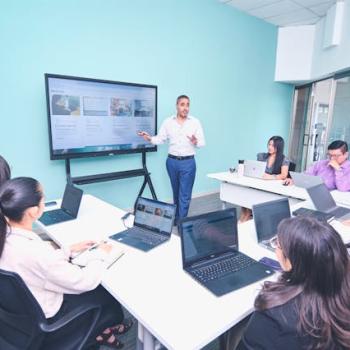
Image credit: Mikhail Nilov/pexels
Originally published in Disaster Avoidance Experts
Dr. Gleb Tsipursky was named “Office Whisperer” by The New York Times for helping leaders overcome frustrations with Generative AI. He serves as the CEO of the future-of-work consultancy Disaster Avoidance Experts. Dr. Gleb wrote seven best-selling books, and his two most recent ones are Returning to the Office and Leading Hybrid and Remote Teams and ChatGPT for Leaders and Content Creators: Unlocking the Potential of Generative AI. His cutting-edge thought leadership was featured in over 650 articles and 550 interviews in Harvard Business Review, Inc. Magazine, USA Today, CBS News, Fox News, Time, Business Insider, Fortune, The New York Times, and elsewhere. His writing was translated into Chinese, Spanish, Russian, Polish, Korean, French, Vietnamese, German, and other languages. His expertise comes from over 20 years of consulting, coaching, and speaking and training for Fortune 500 companies from Aflac to Xerox. It also comes from over 15 years in academia as a behavioral scientist, with 8 years as a lecturer at UNC-Chapel Hill and 7 years as a professor at Ohio State. A proud Ukrainian American, Dr. Gleb lives in Columbus, Ohio.
















 Ad-Free & Subscriber Log-In