

I Once Was Blind, But Now I See: A Prophetic Witness for a Time of Moral Crisis
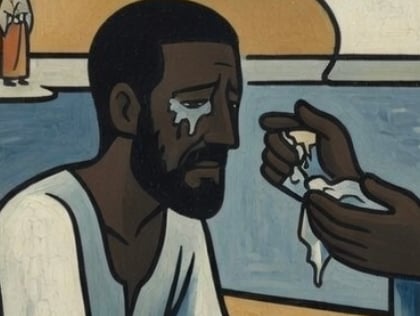
A man is sitting in the dust.
He has sat there his entire life…not by choice, but by circumstance. He was born blind, and in the world he inhabits, that means he was also born poor, born dependent, born outside the circle of the respectable. Every day, he takes his place at the edge of the road and waits for someone to show mercy. Every day, the religious and the righteous pass by with their theology already settled: this man’s suffering is his own fault. He was born in sin. God marked him. Move along.
Then Jesus comes.
In the ninth chapter of John’s Gospel, something unfolds that begins as a miracle and quickly becomes something far more dangerous: a moral crisis. Jesus kneels in the dirt, spits into the dust, forms mud with his hands, and presses it gently over the man’s eyes. He sends him to wash in the Pool of Siloam. The man obeys. When he returns, for the first time in his life, he can see.
You would think that would be the end of the story. A happy ending. A miracle affirmed and celebrated. But the Gospel of John doesn’t let us off so easily.
The miracle is not the end of the story. It is the beginning of the conflict.
I Once Was Blind, But Now I See: What the Authorities Could Not Accept
The religious leaders of the city cannot bring themselves to celebrate what has happened. A man who was blind now sees…and rather than rejoicing, they interrogate. They question the man. They question his parents. They convene hearings. They search for a technicality. The healing happened on the Sabbath, after all. The rules appear to have been broken.
Read that again slowly: a man’s sight has been restored, and the first response of the gatekeepers is to find a reason to discredit it.
This is not a story about ancient villains. This is a story about the particular danger of people who have wrapped their authority so tightly around their assumptions that they cannot recognize God moving right in front of them. They are not cruel in an obvious way. They are not twirling mustaches. They are doing what they believe is right…protecting the system, enforcing the tradition, maintaining the order. And in doing so, they miss everything.
Finally, when the healed man will not give them the answer they want, they say to him: “You were born in sin.” And they throw him out.
His testimony in response is perhaps the most disarming sentence in all of Scripture.
“I once was blind, but now I see.”
Not a theological argument. Not a defense of doctrine. Just a witness to what is undeniably, personally, bodily true. The simple declaration of someone whose world has been transformed, and who refuses to pretend otherwise…even at the cost of belonging.
The Blindness We Inherit
Every generation inherits blindness. The tragedy is that it rarely feels like blindness from the inside. It feels like common sense. It feels like the natural order. It feels like what God intended.
There was a time when churches preached slavery from the pulpit. Pastors quoted scripture in support of chains. Entire theological systems were constructed to explain why racial hierarchy reflected divine design…why some people were made to serve and others were made to rule, why the suffering of the enslaved was either their punishment or their calling. Respectable people believed this. Educated people believed this. People who prayed before meals and sang hymns on Sunday mornings believed this.
They were not all monsters. They were people whose eyes had not yet been opened.
But some people began to see differently. They read the same scriptures and heard something else…a Gospel that proclaimed liberation rather than domination, a cross that dismantled every hierarchy claiming one group of human beings was superior to another. They saw that the God revealed in Jesus did not create racial caste systems. And when that realization came, it sounded exactly like the healed man’s testimony:
I once was blind to racism. But now I see.
Every movement toward racial justice in this country began with that moment of sight…some individual or community refusing to accept the inherited blindness, insisting on what they now could not unsee.
The Poor in the Dust
It is worth slowing down to notice something the story makes easy to overlook. The man in John 9 is not only blind. He is poor. He survives by begging. He is, by every measure his society used, a nobody…someone whose suffering has been explained away so thoroughly that most people walk past him without a second thought.
The disciples’ first question when they encounter him is theological, not compassionate: “Who sinned, this man or his parents, that he was born blind?” They want to understand the accounting. They want the moral ledger to balance. If someone is suffering, there must be a reason…a fault, a failure, a sin that explains it.
Jesus refuses that framework entirely.
He does not debate the man’s worth. He does not explain the man’s condition. He kneels in the dirt beside him. The divine presence meets him exactly where he is, without requiring him to justify his existence first.
This is the scandal of the Gospel: God consistently draws near to those whom society has declared disposable. Not after they have proven themselves. Not once they have cleaned themselves up. In the dust, as they are, where they are.
Yet we live in a world that still worships wealth and still blames the poor for their poverty. The unhoused are treated as inconveniences rather than neighbors. Entire policy debates are constructed around the assumption that suffering is the result of bad choices…that if people simply worked harder, wanted better, chose differently, they would not be in their circumstances. We have theologized poverty the same way the disciples did.
When the Gospel opens your eyes to that, it is disorienting. It requires you to look at systems rather than just individuals, at structures rather than just choices, at the face of God in the person you were previously trained to walk past.
I once was blind to classism. But now I see.
“You Were Born Wrong”
There is a sentence in John 9 that should stop us cold.
When the religious authorities have exhausted their arguments and the healed man still refuses to recant his testimony, they reach for the cruelest weapon available: “You were born in sin.”
Not you have sinned. Not you have done something wrong. But your very existence is the problem. You were born wrong. You do not belong here.
That sentence has echoed across centuries with haunting persistence.
It has been spoken to LGBTQ people who came to their families and churches in vulnerability and were told that their love was incompatible with faith. It has been spoken to gay men dying of AIDS who were told their suffering was divine punishment. It has been spoken to queer teenagers lying awake in the dark, searching their Bibles for a word of hope and finding only condemnation. It has been spoken to transgender people who are today, in this very moment, facing a renewed wave of legislation designed not to protect anyone but to make clear that they are not fully welcome in public life…that their bodies are contested territory, that their existence requires special explanation and justification.
The language is always the same. You were born wrong. You do not belong. You cannot teach us anything.
And into that moment, the Gospel offers a different image.
Indeed, Christ doesn’t go stand with the gatekeepers. Christ goes and stands with the one who was expelled.
That is not a minor detail of the story. That is the heart of it. And that reality exposes as moral blindness…not moral faithfulness, but moral blindness…every use of religion to shut out, condemn, and expel queer and trans people from the table of belonging.
I once was blind to homophobia. But now I see.
I once was blind to transphobia. But now I see.
The Most Dangerous Blindness
It would be comfortable to end by locating blindness entirely in the past…in the slaveholders, in the ancient Pharisees, in people whose names we do not know. But the story of John 9 will not let us do that.
The tragedy of the text is not that a man was born blind.
The tragedy is that the religious authorities refuse to see even after the miracle unfolds directly in front of them. They have every piece of evidence they need. The man himself is standing there, testifying, offering the most straightforward account imaginable: I could not see. Now I can. And still they cannot receive it, because receiving it would require them to revise something. It would cost them something. It would mean admitting that their system, their assumptions, their authority might be wrong.
And that, it turns out, is a price they are not willing to pay.
This is the blindness that should frighten us most…not the dramatic cruelty of obvious evil, but the quiet, respectable, scripture-quoting insistence that the way things are is the way God intended them to be. Moral blindness rarely announces itself as cruelty. It disguises itself as tradition. As common sense. As protecting what matters. As faithful stewardship of what was handed down.
The question John 9 asks every reader is not only: can you see what is in front of you?
The question is: when sight arrives…when evidence comes, when testimony comes, when a living human being stands before you and says, I exist, I am here, God has touched my life…will you receive it? Or will you defend the system?
I Once Was Blind, But Now I See: The Testimony That Remains
Movements toward justice do not begin with legislation. They do not begin with policy. They begin with the moment someone’s eyes open…someone who recognizes a humanity they had previously been trained to overlook, someone who finds themselves unable to explain away what is now plainly visible.
And when that happens, there is only one honest thing to say.
Not a manifesto. Not a theological treatise. Just a witness.
I once was blind, but now I see.
That testimony has never been comfortable. The healed man was thrown out of his community for it. Those who testified against slavery risked their lives and livelihoods for it. Those who first stood up and said queer people belong at this table were dismissed, expelled, and ridiculed for it.
But once sight arrives, it cannot be undone. You cannot unsee what has been seen. You cannot return to the comfortable dark after the light has come.
And so the testimony continues…passed down through every generation that refuses to accept the inherited blindness of its age, carried forward by every person who has the courage to say: this is what I know to be true, regardless of what it costs me.
I once was blind, but now I see.
I once was blind, but now I see.
And once sight arrives, the world never looks the same again.









 Ad-Free & Subscriber Log-In