2025-03-04T17:39:56-05:00

I’m thinking of taking up blogging for Lent. I know! It’s been ages.

Nothing overly dramatic going on, other than since August I can’t seem to make it three weeks without catching some new, usually minor virus, but which lays me out hard due the dread disease. But Lord willing, I will be picking back up with blogging here and over at the evangelization newsletter.

Today I want to hit a few essential Lenten notes, and also talk about the question of giving up social media or other habit-forming distractions for Lent.

First some essential Lenten links, and then my commentary after.


Yes, non-Catholics may receive ashes!

Reminder that anyone at all is free to receive Ashes on Ash Wednesday. It’s a sign of repentance and remembrance of your mortality. If you would like to resolve to live your life a little better from here on out, this is for you!

Grim Reaper reaching out for you, "Memento Mori" on its scythe.
Artwork by A.Fitz, photo by me. T-shirt I commissioned some years ago, now worn out and hanging behind my desk.

Some tips if you are going to a Catholic service as a non-Catholic:

  • Follow along as best you can (there may be some kind of program of the service, but there might not be), but don’t panic if you’re not always sure which end is up.
  • The service you attend might or might not be a Mass.
  • If it is a Mass, there will be a distribution of Holy Communion at a different time in the service from the distribution of ashes.
  • For ashes, go on up, just follow the person ahead of you in line.
  • For Communion, you aren’t receiving Communion! (Among other things, it is a public proclamation that you believe all that the Catholic Church believes. Do you? If so, speak with the priest afterwards and ask about getting yourself prepared to enter the Church!)
  • Therefore you can stay in your pew (hop up to let anyone in/out, people are used to this) and pray quietly.
  • In many parishes (but not all), people not receiving Communion can go up with arms crossed over the chest (like ASL for “love” but with your hands unclenched) to receive a blessing. There will usually be an announcement about it if your parish has this practice, since they’ll know lots of non-Catholics come for ashes, but you can also ask an usher before Mass.


You’re welcome to keep coming to Mass any time you like. Also, grab a bulletin on your way out, your local parish probably has some Lenten services like Stations of the Cross outside of Mass, service opportunities such as feeding the homeless, and fun stuff like fish fries or soup suppers. It is AOK to get involved in your local parish while you are still just exploring the Catholic faith and learning more.


Catholic and struggling with fasting?

Here are my notes on How Strict is the Fast on Ash Wednesday and Good Friday?

Yes, it’s a fast. No, it shouldn’t destroy you.

Catholic and not struggling with fasting?

If you want to get deeper into the spirituality of Lent, here are Amy Welborn’s collection of writings on Lent. I find her work consistently interested in “What does the Catholic faith actually teach” in an intellectually rigorous way.


Is God calling you to turn off your phone?

And now onto today’s topic. Here are three essays I found helpful:

Now getting personal . . .

One of the things about being sick all the time is that it can wreck your social life. That’s not true for every chronically-ill person, and not necessarily true all the time if your disease relapses and remits (as mine tends to do), but it’s definitely a thing.

Something about just the right level of fatigue is that you can both be completely unable to do any of the things you want to do, but also bored out of your mind.

Enter the world of social media and video streaming. If you want human contact but are struggling to hold a conversation? There’s an algorithm for that.

Digital’s been good to me in so many ways, but these are my three biggest challenges:

#1 My situation is constantly shifting.

I never know what my energy level is going to be, or how much exertion is the right amount — not too much, not too little. This makes it impossible to set out a balanced “rule” of life, and even a flow chart of if/then rules is doubtful.

This physical chaos feeds into the kinds of mental traps that promote digital addiction.

#2 Is it “engaging” or just toxic?

Something I’m asking myself about my use of the internet is: What am I getting out of this?

I love the news and commentary from people I respect and enjoy.  But I find that the negativity, even within my carefully curated follow list, wears me down.

By way of example:

I’m a person who hasn’t made it three full weeks without getting sick in the last six months. Per my internist’s instructions, I wear an N95 in crowded places (and still get sick, but presumably it’s a milder infection than it would be with a higher viral load). By being on social media, I’m unavoidably aware there are two opinions concerning mask-wearing:

  • Only self-righteous virtue-signaling fascist hypochondriacs do such a thing;
  • If you don’t wear a mask, it’s because you’re a hating hater who wants everyone to die, miserably.

Knowing about these two incredibly stupid reigning opinions is not helping me. Sure, forewarned is forearmed. But wow some ignorant bliss would be a lot more comfortable.

This negativity is emotionally toxic. So I think for Lent I’m transitioning to getting my news and commentary from e-mail based blog subscriptions from select non-toxic sources, and letting go of the interesting but sometimes-poisonous feed of snippet-commentary.

(But I will probably keep following hockey Twitter? Because that is good for me, for now? I think?)

–> By the way, if you haven’t already done so, you can subscribe to this blog via e-mail on the sidebar, so that you can unplug from social media but still know when a post goes up.


#3 But sometimes I’m just bored.

And so we complete the circle. Disease-life is inherently depressing, and it takes a lot of mental discipline to not let it trigger actual depression. I’m the queen of pivoting.

I would rather play hockey than watch hockey, but if I can’t play, I’ll watch. I’d rather than watch a good game than just scroll commentary and highlight snippets, but watching a game takes far more mental focus and energy, and games run late at night on bright screens, not great for sleep.

–> Ideally you pivot towards the highest level of engagement in the thing that you can, but sometimes that’s not very high.

The same applies to prayer, to gardening, to chores, to social life, to reading, and so on.

The digital solution is very bottom of the barrel, but sometimes you’re laid out and you’re exhausted and it’s depressing doing absolutely nothing, and at least a nice movie or cute dogs on Twitter is better than that?

Except social media and streaming services are designed to be addictive. Opioids for your intellectual pain.

Sometimes fasting is the worst thing.

So that’s where I am this Lent. Discerning.

Media consumption won’t be my thing I “give up” for Lent, because that can lead, for me, to binging when the fast is over. My Lenten penance will be focused slightly differently.

But discernment and discipline with the internet thing will be interconnected, for sure.
2024-11-18T13:54:37-05:00

When my daughter played in weekend-long sports tournaments, we always went to Sunday Mass, and so did the other Catholics on her various teams.

I live in the Bible Belt, though, and I knew that a number of her teammates and coaches were believing Evangelical Christians, so it surprised me that they never attempted to make it to church when they were out of town.

I would not have been surprised if some or all had chosen, instead, to host a short private prayer and worship service of some nature — but for these committed Christians to have no Sunday church at all was not on my mental bingo card.

But there it was, season after season, and it is understandable that a pastor of such absentee souls would like to do something about that.

Pastor James Griffin from Crosspoint Community Church has generated significant discussion with his promotion of a Thursday evening service, targeted towards members who can’t attend on Sundays due to any number of possible schedule conflicts.

No one seems to doubt that first responders and healthcare workers have to work on Sundays. I have not seen much discussion of Sunday work generally, either. What seems to be gathering the most attention is the question of travel sports.

For example, Anthony Bradley asked:

Question: how did parents succumb so easily to the false belief that travel sports are actually beneficial—allowing sports to determine the rhythm of the family? Why don’t parents just say, “we’re not doing that?” What happened?

I’d like to answer this one.

Why play travel sports at all?

There were quite a lot of negative-type answers to Bradley’s question:

  • Parents are living vicariously through their child.
  • Family is convinced their child will pay for college through sport scholarships.
  • Weekend sports fill a void in the soul, giving purpose to an otherwise empty interior life.
  • Sports are a source of community and friendship in an increasingly lonely age.

A few parents, though, gave the same answer that we had: If my child wanted to play her sport at a competitive level (that is to say: at her ability level), weekend travel-teams were the only option.

In our case, we had a younger daughter who played the same sport, but only recreationally. Fortunately she attended a small school where there was room on the roster for players at her ability level.  In contrast, quite a few dedicated, hard-working athletes attending the enormous nearby public schools could not get onto their school team even if they trained year-round.

We certainly could have told our elder daughter that she simply was not going to get to train and play her sport — we nearly did so, in fact, but her first few club teams offered her scholarships that brought her costs into our budget. I recall at least one very talented teammate who nearly always traveled with another family, because her own family could not afford the expense of a hotel and a weekend away.

All that to say: There are quite a few of us who wish that there were local leagues where our children could practice their chosen sport at a suitable level given our child’s ability and interest, but it’s not on offer.

In our case, it wasn’t something we were in a position to change, either, no matter how much I might daydream of doing so.

Play for this year.

The one dynamic I found most toxic at the upper end of travel play were the families who were pegging everything on their child’s sports career. By “upper end” here I mean teams where the child is playing at the most competitive level within reach of the athlete’s ability and family resources.

These parents were somehow convinced that if only they yelled, and swore, and badgered, and nagged enough, the parents’ terrible budgeting decisions would all be made good thanks to an athletic scholarship down the road. These parents had not done a whole lot of math.*

When we were considering whether to let my daughter play on a travel team, I made one thing clear: We are deciding all this based on what you will gain from this experience this year.  If you never touch a ball again at the end of this season, we still will have been glad you went out for this team.

The game is not the most important thing.

I don’t know if we prioritized athletics correctly in the life of our daughter and our family. That’s a question I don’t think I could assess objectively, and I’m not sure I have the knowledge necessary to do so.

I know that God appears to have cooperated with our good intentions, and certain very good things (for example, that son-in-law I mentioned on this blog earlier this summer) came into our lives directly due to the fact of my girl following her athletic dreams as far as they might take her.

Personally I did struggle, and still do, with the fact that weekend sports means making other people work on Sundays — people who can’t go to church because they are busy making my leisure plans happen.

But I look around me and notice that the Church is not speaking out against watching Sunday  Night Football, nor against the evils of athletes whose Olympic dreams came at the price of Sunday practices and competitions. That isn’t the most rigorous conscience-formation that ever was, but also I can’t say that these things are prohibited, when clearly they are not.

But yes, we went to Sunday Mass every weekend. Sometimes it was a Saturday vigil, sometimes it was the early-bird, sometimes it was the last-chance Sunday night, sometimes it was a mid-afternoon Spanish Mass.

The first year it was stressful, because we didn’t know what we were getting into, but thank God it always worked out that we could find something, somewhere, that worked with the play schedule. After that, we knew to speak to the coach before signing with the team and clarify that Sunday Mass was not a negotiable.

We made it clear that we would attend whichever available Mass was least inconvenient to the team, and that we understood it might mean having to be benched if our child missed a game due to the conflict, but was this okay? It was always okay, and also we never had to miss a game, because the silver lining of the priest shortage is that many parishes offer lots of odd-hours services.

I was glad for this chance for my child to see that although I was willing to put a lot of time and expense into helping her do something that was important to her, God was still more important than anything else we might have on her schedule.

I was also glad for the opportunity to teach her and show her: Yes, you can go to church when you’re out of town. Just look up the various services, pick one, walk in and find a seat. It’s not difficult, and you get to see some interesting things.

Related: Are Sports Sabotaging or Strengthening Your Family’s Faith?

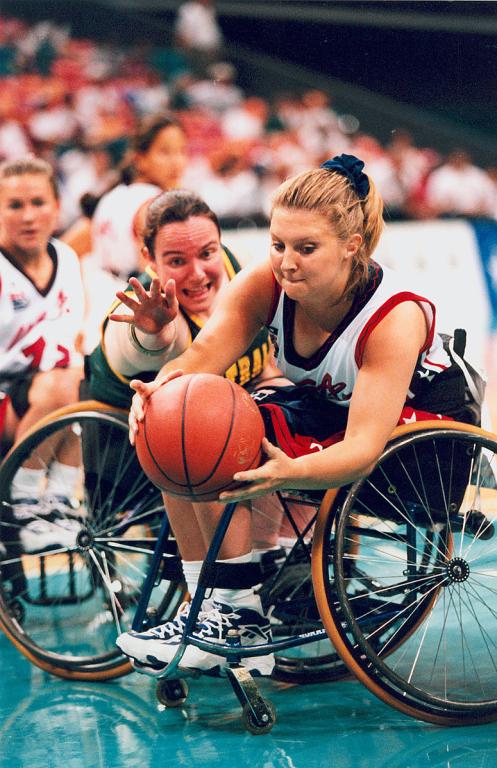
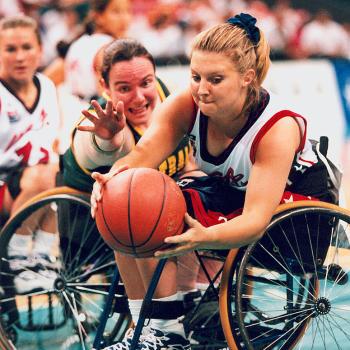
Australia vs. USA 1996 women's paralympics basketball

Photo: Australia vs. USA, 1996, women’s basketball, courtesy of the Australian Paralympic Committee.

*Yes, I know that sometimes a student-athlete really does end out making more money on athletic scholarships than the family spent on sporting to get there, but that’s a rare situation. Making sports more widely available is a good goal, because sports can be good for us, but your far better bet for paying for college is a combination of good grades, a weekend and/or summer job, and putting that cash you’d spend on a travel team into a 529 plan instead.

2024-08-07T13:43:08-05:00

I’d like to talk about sporting categories generally, and then look at a couple of specific situations for people with XY disorders of sexual development.


Update 8/4/24: See here for “Toward a Robust Definition of Sport Sex” by David J. Handelsman in Endocrine Reviews. Table 2 lays out all the variations in genetic and physiologic status for the purpose of determining how to categorize an athlete for elite sport.  (To my knowledge everything I say below in simpler terms is consistent with this article.)


What are sports categories for?

Sporting categories exist in order to create opportunities for fair, enjoyable play for whoever the category was created for.

We create categories based on age, based on interest (recreational vs. highly competitive), based on budget (local vs. travel teams), based on resources (D1 vs. D3 schools), based on skill (C1 vs. C4 cycling), based on size (featherweight vs. heavyweight), based on physical ability, and also quite often (but not always) based on sex.

You can no doubt think of other categorization systems as well.

Aren’t the categorization rules sometimes unfair?

A frustrating reality of categorization systems is that they are imperfect. The child whose birthday falls just inside the maximum age-limit for a team has an advantage over the year-younger child who is also lumped in the same bracket.

Likewise, given the limited availability of teams, a newer, less skilled, or less physically adept child may struggle to find opportunities to play a given sport, due to restrictions on age or sex categories.

Shouldn’t categories be flexible to allow for these exceptions?

It all depends. Fortunately some less-competitive leagues will allow category exceptions, specifically in acknowledgement that a given player is of a fitting size and skill level for the team, despite not matching the general categorization.

Likewise, given a limited pool of athletes, there might be some mixing and matching of rules. For example, a youth team might be co-ed, but with older girls allowed to play in a younger boys’ age bracket, or younger boys allowed to play only if they move up to an older girls’ bracket.

Another example: I’ve been playing this summer in a co-ed hockey league that is for either 45+ or beginners, and the categorization is “you would like to play a chill, lower-contact, slower-paced game.”

In some situations, though, flexing category rules doesn’t work well.

Are there are important social reasons for the categorization?

Single-sex teams (and other groups) may have been created specifically for providing the unique mentoring and community-building that boys-only or girls-only groups provide.

Alternately, a team or league might be strictly-single sex due to religious or philosophical concerns about modesty or appropriate male-female interactions.

Changing it up: A team might be strictly co-ed because its physical, aesthetic, or social purpose centers on male-female pairs.

And moving on to other social purposes entirely . . . A team or group might be strictly lgbtq+ (or a subset), strictly for those in addiction recovery, strictly for children in foster care, etc., because it exists to create support and community for persons with experiences under some portion of the stated umbrella.

Is the category too hypercompetitive?

I wish I could say this is only a problem at the elite level, but there’s something about sports that brings out insanely, manically competitive behavior in otherwise seemingly normal people.

Thus unfortunately your local kiddie t-ball team or adult rec softball league might have to start checking birth certificates and enforcing strict eligibility requirements because the grown-ups have gotten so emotionally warped that they are determined to win at all costs, or at least go down trying.

When the stakes are higher — when scholarships, prize money, endorsements, fame, and advancement to the premier level come into play, then things can get extraordinarily nasty, fast. The only way to be as fair and sane as possible is to set clear categorization rules and stick to them.

How do the Olympics fit into all this?

The Olympics runs competitions for a limited number of sports, so there’s already a paring down of which athletes will ever have their accomplishments acknowledged at the Olympic Games.

Within that framework though, the Olympics has decided (rightly) to create sex-based categories, in addition to a few size-based categories such as for boxing.  The Paralympics also uses ability-based classifications specific to each sport.

I think we can reasonably say that the sex-based categorization of Olympic sports is not for a purely social reason. It’s not to help young men and women to build community and social support with others of their own sex. The two categories exist because the goal of the Olympics is to see who is the very best in the world at a given athletic feat.

For nearly all Olympic sports, if there were not sex-based categorization, only men would qualify.  The physical performance potential between males and females is massive, because human female bodies are designed to accomplish tasks that male bodies cannot do; in the survival tradeoffs, female athleticism takes a backseat to childbearing capacity.

And thus it becomes of interest: What can the very best-trained female athlete do?  Just how far can a woman’s body go in pursuing a given athletic task?

Note very well: We don’t have to have elite women’s sports. We could decide that from birth through adulthood, girls and women will simply play in the co-ed league that matches their ability level, and that will mean the best females will do quite well at the recreational level, end of movie.

If that is your stance, say so.

Those of us who support the existence of female-only sports beyond the recreational level believe that it is good and worthwhile for women to be able to see just how far a female body can go. This requires strict sex-segregation.

An aside on safety and bodyweight:

–> In some sports there may also be safety hazards at play, as there is a significant gap between the size and power of the largest and strongest men compared to the largest and strongest women.

Likewise, in sports with bodyweight categories, a male of the same weight as a female opponent will have greater physical power, and at the very least should play up to a higher bodyweight category to offset the male physical advantage in strength-to-weight ratios.

I mention these two factors because they are equally pertinent to the examples that follow, and would also apply to athletic organizations that aren’t pursuing a goal of promoting female sport, and therefore allow males into “female” categories, but may nonetheless decide that not injuring the smaller, weaker athletes is a worthwhile secondary social goal.

How does all this affect intersex, non-binary, and transgender persons?

Keep in mind that sporting categories can exist for any number of reasons. If your goals are primarily social, then your local sporting category rules can be adapted to meet whatever the social goal might be.

We know that the Olympics and most (but not all) other elite sporting events don’t have a primarily social focus in sex-categorization because of the many female athletes who socially identify as transgender or non-binary but who compete, rightly, in the female category. They have female bodies, and do not engage in testosterone doping (if they wish to be eligible for the female category), and therefore they are correctly striving to see how just well their female bodies can perform at their chosen sport.

One of the difficult cases, however, is for individuals who test as XY genetically, but who due to a disorder of sexual development were assumed at birth to be female.  Let’s look at two examples.

Should every XY athlete compete in the “male” category?

In 1999, the IOC stopped performing the routine genetic screening (via a cotton swab on the inside of the athlete’s cheek) to confirm that all female athletes were in fact female. This has created the scenario in the present Olympics where athletes disqualified for testing as XY by their own sporting bodies have gone on to compete as females at the Olympic games.

In the interest of fairness (and safety), a return to screening would be a simple, low-hassle way of quickly confirming that female athletes are eligible for their category.  Such screenings are faster and less invasive than the many anti-doping screenings that are routine in elite sporting due to the widespread problem of cheating.

However, a strong case can be made that some XY athletes flagged during a routine genetic screening should be allowed to appeal and play in the female category. Others belong in the “male” category, even if socially they have chosen to maintain a feminine personal identity.

In Swyer Syndrome, the affected person has XY chromosomes but develops female genitalia and does not undergo puberty unless hormone replacement therapy is provided.

It would be reasonable that a woman with Swyer syndrome, receiving female hormonal therapy and who has by definition never been exposed to male hormones, let alone male puberty, be allowed to appeal for the right to compete in the “female” category after an initial cheek swab genetic screening raises a flag.

It’s no doubt a frustrating situation having to take that extra step after screening, but also by the time a woman is actually competing at the elite level, she’s probably already been to the doctor for her amenorrhea and has the case notes ready to go. If the cheek swab results are in fact a surprise to her, it’s a fortunate catch, since untreated Swyer Syndrome causes osteoporosis due to the lack of estrogen, as well as an increased risk of certain tumors.

In justice, sporting authorities should have an accelerated pipeline for referral, diagnosis, and treatment in these rare but real cases, so that the young woman doesn’t miss out on important competitions due to bureaucratic delay.

While one could make the argument that all XY athletes should automatically be required to compete in the male category, Swyer Syndrome seems to be a legitimate exception — not because the affected persons “identify” as female, but rather because in terms of the goal of seeing just how far a female body can perform, physically this is the matching group.  The usual course of treatment does not confer male physical athletic advantage.

–> Obviously if a person with Swyer Syndrome has made the decision on diagnosis to pursue male hormone therapy (a valid personal medical decision), thereby undergoing the masculinizing affects that confer male physical advantage, then the “male” category would be the better match.

Now let’s look at a different disorder that leads to a different result.

5-alpha reductase deficiency causes an XY male to have underdeveloped male gonads to undergo male puberty:

Doctors diagnose 5ARD when a baby with female-like or nonbinary genitalia has tests that show 46,XY chromosomes and specific hormone levels (high testosterone and low DHT). In older kids or teens, doctors might notice the condition when someone who looked more female at birth starts to develop changes typical for males during puberty. Tests will show the same hormone pattern as in younger children.

Although men with this disorder may experience impaired fertility, they are indeed able to father children.

While this is obviously a very psychologically and socially challenging situation, there is no doubt that for elite competitions (even at the high school level or as soon as the disorder is identified), the athlete should compete in the “male” category.

We could go through every disorder of sexual development and make similar assessments, but we’ll stop there. For more reading:

In all cases, there is no reason to assume that an athlete with a disorder of sexual development is intentionally trying to game the system; a fair and consistent application of the category rules based on the physical facts of the individual case can put to rest any such suspicions.

Joe Thomas (football) and Simone Biles (gymnastics) high-five at a celebrity softball game.

Photo by Erik Drost: Joe Thomas (American football) and Simone Biles high-five during a celebrity softball game, via Wikimedia, CC 2.0. One of the other beauties of sex-based categories for elite sports is seeing how sports such as gymnastics differ in style because of the ways that male and female bodies are each magnificent in their own distinct ways.

2024-06-13T11:10:23-05:00

Checking in to apologize for the radio silence and assure you a new beginning is in sight!

Marriage has been much on my mind, and I’m hoping to write more on interrelated topics soon, but meanwhile let me say that the past several months have been the most work* I’ve ever put into preparing for a single sacrament.


Usually my advice to young couples is to keep the wedding small and hold onto as much of your savings as possible for getting your marriage off on solid financial footing. I stand by this generally. I remain absolutely firm on avoiding all wedding-induced debt, and likewise leaving the emergency savings untouched, even if it means just a tiny wedding with only the very closest family.

And yet sometimes parenting takes us to new places.  Unexpected plot twists that have come to us thus far in the journey:

  • We became rabbit lovers!
  • We became sports parents!!
  • We became big-wedding people???!!!

These things happen. Your vocation should lead you to new places, and here we are.


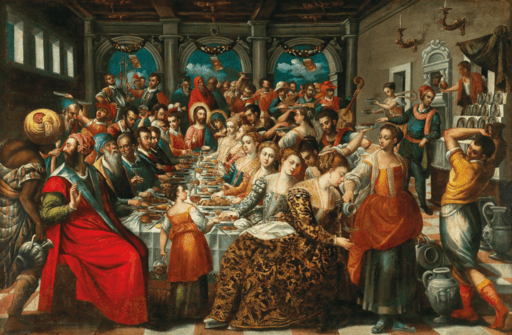
In prayerfully discerning whether to accept the very generous contributions of some loved ones to basically double our budget so this wedding could be a much more elaborate affair than previously planned, what I found myself coming back to in prayer was The Wedding at Cana.

Here is this young couple embarking wholeheartedly on a marriage that is exactly what our world needs — cherishing each other, centering their lives around Jesus, eager to embark on their lifelong mission together as husband and wife for certain, and as father and mother when the time comes.

Our other children and their peers can attest that it can be very hard to find a future spouse, even when you are both intentional in your dating and open to letting God surprise you.

There are no guarantees in life, but if ever I had confidence that an engaged couple had chosen well and were likely to succeed, with the Lord’s help, at the long and challenging vocation ahead of them, this is that moment.

So yes, this is indeed something to celebrate.


Well, you don’t go big and stay within even generously-loosened financial constraints unless you put a load of work into it. At every turn my daughter has been finding the most frugal way to get the thing done, putting hours of work into researching, handcrafting, and carefully selecting where to outsource help and what to do in-house.

I’ve been the co-conspirator all along, letting her lead but putting in the manpower when there is something I’m uniquely suited to either by talent or dint of free time.

It’s going to be good. So beautifully good.

But I don’t anticipate any serious writing happening through the rest of June, because I’ll be deep in extended family time before and after.


In good news: Come August our youngest goes off to college, and the SuperHusband and I will be empty nesters!  So after a summer that will stay pretty busy even after the last of the wedding guests heads home, it is our plan that I’ll focus in the year head on more writing stuff.

We all know how plans tend to go, but my hope is to pick back up with a novel project that, while entirely, 100%, heavens to Betsy this is fiction fiction fiction, will certainly having me doing a lot of thinking about the kinds of topics I write about here and at the ‘stack.

That’s the hope.

Anyway, rejoice with me as my daughter and future son-in-law prepare for the biggest moment in their young lives, and thanks for being here.

Wedding at Cana, late 16th century, lavishly painted feast scene

Artwork: Wedding at Cana, public domain, click through for details and a full-resolution image.  Yes, this is basically what my life feels like right now, but in a good way!

*Okay if we count gestating and delivering the recipient, then I’ve put waaaay more work into four baptism preps. Although, then we think about two decades and change spent rearing the Fitz-half of the couple, and there we are.


PS: 100% I got my daughter a copy of The Sinner’s Guide to NFP.  You know it.

2024-05-29T16:09:07-05:00

My daughter and soon-to-be son-in-law are facing some major school and career decisions today, and here’s what I’ve been telling her this spring: Marriage is meant to change you.

Who you each are, separately, as single, unmarried persons is supposed to be different than who the two of you become when you are intimately joined in a lifelong, life-giving union.  The whole point is to become something different!  If you wanted your life to be exactly how it was before, you wouldn’t be getting married!

So it is with the priesthood, with religious life, with parenting . . . with undertaking any serious vocation, religious or secular.


So often we hear moms — it’s usually the mom — saying “I’ve lost my identity now that I have a baby.”

When you dig underneath, there are different kinds of common identity concerns:

  • Her identity was tied up in her career, but now she’s staying home and feels herself slipping away from her profession and her financial self-sufficiency.
  • Previously she found her identity in hobbies and pastimes that just don’t mesh with caring for a baby, so now what?
  • Her body has completely changed and it’s never going back to how it was, and she really loved identifying with how it used to be.

–> Pause here to note that moms who continue pursuing their careers after having kids often report struggling with a different identity crisis.

Too often work-at-work moms are expected to bring no hint of the impact of their new family life with them into the office, lest they sabotage their employment opportunities, and furthermore they are somehow supposed to also pull off everything some fictional, hyper-idealized stay-at-home-mom reputedly does with her kids.

Meanwhile the loss of free time and the struggles with body image apply equally or more so.


Sometimes the “identity” crisis isn’t about identity at all, though, but about a serious and potentially even life-threatening situation:

  • She is overworked, exhausted, not getting enough sleep, and struggling with basic physical needs, and no surprise this is wearing her into a state of despair.
  • She is under-appreciated and taken for granted in her new life as a caregiver, and can’t get the emotional and practical support that she needs.
  • She is criticized and demeaned for “not doing enough” or being “incompetent” because she has taken on an endless, enormously difficult task that will never, ever be done to perfection because hello caring for a baby is not, at all, like finishing some project at the office.

This is not the way. None of this is.

When I talk below about finding your identity in your new vocation, that does not mean “finding yourself” in neglect, abuse, or casual indifference from the people who are supposed to love and care for you.

It’s normal to find parenting and other serious vocations to be highly demanding and challenging pursuits. It is not normal or healthy to be driven to feeling hopeless, worthless, isolated, burnt-out, or unable to cope.

If that last list is you, claw your way to a place and physical and emotional safety and start figuring out what changes you can make to get out and stay out of the black hole.


I had a pastor once who really liked going to the gym in a regular t-shirt and shorts, or going around town on his day off in a generic polo and khakis, and being taken for just some random guy.  He loved being a priest, and truly relished giving of himself in priestly service to others, but sometimes he needed the emotional space that comes with no one coming up to you for priest-stuff.

That’s cool.

No matter how much you love your kids, it’s pretty likely you need some breathing space to not be needed for a little bit, while the kids are safely being tended by some other person.

No matter how much you love your profession, and how much the world desperately needs the work that you do,  sometimes you need to turn off the phone and let someone else deal with the thing while you take well-earned vacation.

No matter how vital and soul-saving your ministry is, you can only give yourself away to others if there is something of you left to give.

None of this is about “identity” — it’s just common sense.


So what is identity about?

I had a great aunt who shared with me something my generation didn’t fully understand: When the wedding announcements or society pages in the local paper back in the day referred to the bride by the husband’s name, “Mrs. John Smith” or what have you, it was a moment the girls longed for and cherished.

They loved taking their husbands’ names, in full, not because they were losing themselves, but rather because to them it was about arriving: I am so proud of who he and I are becoming, now that we are one. We are undertaking a mission together, and I am proud of the man I have chosen to be my partner in this life we are going to forge.

That proper sense of joy and self-identification with a mission and vocation wasn’t then and isn’t now about naming conventions, or who watches the baby, or what kind of professional career you do or don’t pursue.

Rather, it’s this: A great vocation changes us. It changes who and what we are.


One of the ladies I play hockey with will often explain some quirk about her day or her choices or her interests by saying, “Well, I mean, it’s probably because I’m a nurse.”

It’s changed her.  She poured her life into an irreplaceable and invaluable vocation, and she is therefore a different person than she was so many years ago, before she gave her life to caring for an unending line of patients who desperately needed the help she had studied for and practiced to be able to give.


Sometimes, though, our vocations call us into a new and unwanted identity.

It is hard, so hard, when you find your life being pared down to a set of constraints you didn’t choose.

It’s hard enough when you walk into a vocation — a marriage, a religious vocation, a career, a ministry, a new child — and face in full the normal and expected sacrifices but which bite more keenly than you’d imagined.

Even harder is when the sacrifices you must make in life come from things no one expects or deserves: Unjust financial or legal problems, betrayal by someone in a position of trust, illness or injury, bereavement, disaster, or just some miserable combination of bad luck and weirdly converging lousy circumstances.

But even here, we have an opportunity for a horrible vocation to become a great vocation. I didn’t choose this suffering, but I will allow myself to be changed as a result into something and someone new and different and good. 

I will do all I can to leave a legacy of virtue even as everything I once held dear diminishes and wafts away on the breeze.


So I am going to tell a story about these kids I mentioned up top. My daughter and her fiancé have just wrapped up undergrad, and as they get married this summer they are also entering a transitional period of figuring out graduate school and jobs and next steps.

All spring I’ve been telling my daughter: It’s okay if your major life choices as a wife are different than what you would choose if you were single. It’s not bad or wasteful or letting anyone down if you make job and school decisions for your marriage that are different than what you’d do otherwise.  That’s normal and healthy and all part of it.

But here is what happened: She got offered this thing (and she has to decide on it today) that is her dream opportunity in so many ways, but the logistics are a mess.  To accept the position would be to ask her husband to make an enormous sacrifice just weeks into their marriage.

So he said to her, “But if I had this opportunity, I wouldn’t be able to pass it up. So if you want to take it, I will figure something out.”

And whatever that something turns out to be, we will know that marriage has changed who and what he is.  Instead of being a guy who does his own preferred things, he’s now a guy who steps up and sacrifices out of love for his wife.

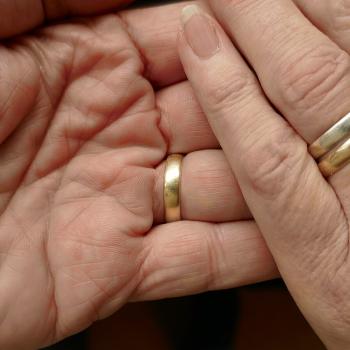
Hands of husband and wife with their gold wedding bands prominent.

Photo by RF Vila, via Wikimedia, CC 4.0, showing the hands and wedding bands of a couple married forty years.

2024-02-27T14:40:44-05:00

What does the Catholic Church have to say about the recent Alabama Supreme Court ruling on embryos and wrongful death of minors lawsuits? Today I want to run through several aspects of the case that touch on the Catholic faith, from legal questions to very personal family planning decisions.

Every aspect of this case is highly emotionally charged, and my goal here is to sort out truth from hyperbole.  You may not be comfortable with the Church’s stance on a given aspect of the case (even if you’re Catholic), but the only way to know where you agree and disagree is to start by understanding correctly what the Church actually teaches.

What are the key aspects of this ruling?

The two cases being considered involve three families whose frozen embryos were destroyed due to negligence by their IVF clinic. The parents have attempted to get compensation for their loss under the Alabama Wrongful Death of a Minor Act.

Click here for the link to the full text of the decision, which is fairly readable.  Here’s a summary of Justice Mitchell’s key points:

  1. The Supreme Court of Alabama can only rule on questions or concepts that it has been specifically asked to treat.
  2. The Supreme Court is limited in its decisions to interpreting what the law of the State of Alabama actually is, according to the plain meaning of the legislative texts.
  3. Even if the justices themselves might prefer the law to say something other than what it does, they can’t create interpretations to conform to their wishes; it’s the job of the legislature to reform the law.
  4. The plain meaning of Alabama law as currently written includes stored embryos in the definition of “minor children” for the purposes of the specific civil law statute in question in this pair of cases.

This last point is important, because the decision specifically explores the differences between civil and criminal law, and explains why it’s often (rightly) possible to get compensation for damages in a civil case even if the situation doesn’t rise to the level of bringing about a conviction for related criminal charges.

This makes sense! There are many situations where we might accidentally or carelessly bring about some harm that in justice we should try to make amends and restore our neighbor as much as possible, but in which a criminal charge would be going too far — it would be an injustice to send someone to jail (or worse) given the circumstances and/or level of evidence.

This distinction is very important in wading through reactions. This ruling treats civil law, so anyone saying that “IVF has been criminalized!” is just not being honest.  This ruling does say that the law as written allows parents of frozen embryos to sue for civil compensation under the Alabama Wrongful Death of a Minor Act.

Who is affected by this ruling?

This ruling concerns Alabama state law. Other states may have similar laws but which either explicitly carve out exceptions for IVF, or which create exceptions indirectly.

And, narrowing it down further, what this ruling did was send the case back down to a lower court for trial.  Justice Mitchell’s opinion laid out multiple aspects of the case that the Supreme Court was unable to rule on because it was not asked by either party to do so.  Thus while the Alabama Supreme Court ruled that the Wrongful Death of a Minor Act could apply in this case, it did not make any decision about whether the IVF clinic actually owed damages.

Justice Mitchell’s decisions pointed out one very important aspect of the case that, in the new trial, may have a strong bearing on whether new precedents will be set concerning civil liability for IVF clinics:

During oral argument in these cases, the defendants suggested that the plaintiffs may be either contractually or equitably barred from pursuing wrongful-death claims.

In particular, the defendants pointed out that all the plaintiffs signed contracts with the Center in which their embryonic children were, in many respects, treated as nonhuman property: the Fondes elected in their contract to automatically “destroy” any embryos that had remained frozen longer than five years; the LePages chose to donate similar embryos to medical researchers whose projects would “result in the destruction of the embryos”; and the Aysennes agreed to allow any “abnormal embryos” created through IVF to be experimented on for “research” purposes and then “discarded.”

The defendants contended at oral argument that these provisions are fundamentally incompatible with the plaintiffs’ wrongful-death claims.  . . .  The trial court remains free to consider these and any other outstanding issues on remand.

In what ways is this ruling “Catholic”?

Here are two aspects of Catholic teaching that are consistent with this ruling:

Subsidiarity.  In sticking strictly within the bounds of what the state Supreme Court has the right to decide, this ruling respects the principle of not overreaching in authority.

Dignity of human life from conception. As it happens (whether the judges agree with the law or not — their job isn’t to approve the law but to rule according to the law as written), Alabama state law is in many ways in accord with Catholic teaching on the reality that human life is sacred, that our lives begin at conception, and that our worth as a person isn’t determined by our age, ability, or usefulness.

–> To better understand the philosophical underpinnings of this belief, whether from a religious or secular point of view, the book you want is Embryo: A Defense of Human Life by Robert P. George and Christopher Tollefsen.

All that said, there are details of this case that bring to light some areas where Catholic teaching is quite distinctive. Let’s look at that next.

What is the Catholic position on embryonic human life?

The Catholic position is rooted in biological fact: The defining moment when a human being comes into existence is at conception. That would be fertilization of the ovum (not a human being) by the sperm cell (also not a human being).

The Church takes an interest in this scientific question because the implications are so far-reaching. Unlike a utilitarian philosophy, which judges the worth of a person based on his or her usefulness, Catholicism holds that all human beings have equal rights and dignity.

Thus, for example, genetically screening embryos to select a child who doesn’t have an undesired trait, and in the process killing those who don’t meet spec, is morally abhorrent.

This position is in no way unique to Catholicism — many religions, as well as many non-religious people — agree that we shouldn’t kill people just because they have a particular illness or disability.

Likewise, it is absolutely unacceptable to participate in any way in discarding frozen embryos just because they are no longer wanted, nor to use stored embryos for scientific research or technological developments that knowingly, intentionally involve killing the embryo.

–> In contrast, we could imagine a scenario where an embryo from an ectopic pregnancy, which is certain to die if it remains implanted in the mother, might morally be transferred to an experimental artificial womb, if the hope is that the child will survive — perhaps to be experimentally re-implanted into the mother’s uterus. Even though there’s high likelihood the procedure would not succeed, the intention is not to kill the child; it is an attempt, however long the odds, to save the child’s life.

And remember that in all cases, it is morally acceptable to remove the embryo or fetus from the mother’s body if indeed necessary to save the mother’s life. We can’t actively kill the baby as in abortion, but surgical or vaginal delivery of the intact child is morally acceptable, even if the baby is far too young (such as in ectopic pregnancy) to survive outside the womb.

Is IVF okay as long as no embryos are destroyed?

This is a completely different question, and one on which Catholicism has far less company.  Many Christians (and others) who recognize the embryo’s inherent dignity as a human being do, nonetheless, allow IVF as long as a sincere attempt is made to implant and bring to term all embryos conceived in this way.

Here’s the Catholic position on IVF in a nutshell:

Most important: Every child conceived by IVF is a gift of God, precious and equal in dignity to all other humans.

More difficult to understand: Nonetheless, the sexual act itself has a sacredness that needs to be respected.  Conception should occur within an act of intercourse between faithfully, lovingly married husband and wife.

This second point is a hard teaching. We can point to many cases where IVF is attempted by loving, faithfully married husband and wife who are only trying to solve their fertility problem.

These cases are fundamentally different from surrogacy or donor cases where the right of the child to know and be reared by its own parents is intentionally denied by design, and which in some cases even amount to full-on trafficking. We need to acknowledge that.

We need to recognize that not every instance of IVF has the same level of moral problems.

Nonetheless, Catholicism does teach that couples should not use IVF.

We should also recognize that even though in many cases couples will be able to conceive by seeking alternate forms of fertility treatment, that won’t always be true.

Isn’t the strict rule against IVF counter to the pro-life ethic?

To be pro-life is to respect the dignity of all human beings.  Often (not always) our respect for the sacredness of the gift of human life leads married couples to have another child, even when doing so involves a certain amount of sacrifice or hardship.

(And there is no denying that IVF involves sacrifice and hardship!)

Likewise, respect for human life means that when a child is conceived in a way that isn’t ideal, such as an out-of-wedlock pregnancy, or even in a way that is overwhelmingly and entirely evil, such as rape, we nonetheless treasure the child. The child might be the only good thing in the whole horrible situation, but the child is good.

We seek to help the mother through the serious hardships her pregnancy involves, and we seek to support her in whatever choice she makes about whether to rear the child herself or to seek a good adoptive family for her child.

When appropriate (such as an ordinary out-of-wedlock pregnancy), we seek to help the father to also foster a right relationship with his child. The best way to do that will depend on the unique circumstances of the situation.

All that said, being pro-life is not about maximizing human population via any means available. For couples suffering from infertility, the pro-life choices are to:

  1. Help them conceive using morally acceptable means if possible. If that is not possible then to . . .
  2. Provide support and accompaniment as they find other ways to live out their God-given vocation, whether that be through adoption, fostering, or some completely different ministry.

What if a Catholic has used IVF anyway?

Well, that’s in the past.  You can’t change the past.

Furthermore, even though few people can understand the pain of infertility, any honest Catholic will admit that frankly we’ve been tempted by far less, and have frequently fallen short of the mark.

That doesn’t mean IVF is no big deal. What it means is that you move on.  Your past makes its mark on your life, but it doesn’t define who you are now, nor who you will become.

If you knew it was wrong when you did it? Take it to Confession. You chose to do something you knew not to do, and you’re sorry, and you want to live differently going forward. Receive God’s forgiveness and healing.

If you didn’t even know it was wrong when you did it? Then you didn’t know. In order to be culpable of a sin you have to know it’s a sin! Now you do know, and your life will be different as a result.

If you aren’t clear in your mind about where you were, mentally, at the time? Just bring it up in Confession.  God knows your heart, and He is ready to embrace you, and love you, and welcome you into a relationship of peace and joy.

God bless.

2024-01-31T20:43:07-05:00

Question that’s been generating some unnecessary panic: Is it okay for a Catholic to celebrate Valentine’s day, birthdays, anniversaries, or other special events that happen to fall on Ash Wednesday or Good Friday?

Short answer: In the United States, at present yes in fact you can, though with some restrictions.

Here are the details.

Period promo poster for "The Ashes of My Heart" starring Barbara Castleton, 1917.
Poster: Top result on Wikimedia when I searched for “heart with ashes.” I had no idea they were making films about opioid addiction back in 1917. (Image is public domain.)


#1 It’s always better to fast as fully as possible.

If your health and state in life allow it? Nothing but prayer, water, and works of mercy for you. (And the Eucharist of course!)  That’s not a requirement, but it’s an ideal worth approaching.  For some of you with a history of eating disorders or perfectionism-related mental health issues, your correct approach is to simply follow the rules set forth by your bishops’ conference and offer up your genuine sorrow that a stricter fast simply is not the prudent course.

#2 Your state in life makes a difference.

If you are clergy or religious, you have an obligation to immerse yourself in the liturgical life of the Church with a totality prescribed by whatever rule of life you are bound to follow.

If you are a lay person, your vocation is lived out in the context of family and community life, and you have wider room for discernment on what exactly that should look like on a holy day.  There may be good, serious reasons that a celebration on-the-day is in fact a work of mercy on your part.

#3 Is it possible to reschedule?

Still, the goal is not to play “What can I get away with here?”  If you can move an important life or work event to another day, do that.

As much as possible, we want to set aside Ash Wednesday and Good Friday as the sacred days that they are, leaving behind as many of our worldly attachments as we can.  The kids will be *just fine* if you hand out the pink cupcakes a day early. Talk about a perfect teaching moment!

Likewise, in most dating and marriage relationships, your simply expressing a preference to move the celebration to a slightly different date will be a non-issue. The mere fact that you request it is all your loved one needs to hear, just like you are always quick to accommodate the preferences of those around you whenever possible.

#4 Can you do the thing without doing the thing?

If it’s just a little bit of a cake being passed around the office, you can hover during the brief festivities sipping water from your Yeti cup, and then gratefully accept your slice of cake and carefully wrap it up and put it in the fridge to save for later.

Not every celebration requires actually eating and drinking the celebratory foods.  It’s fine to just watch and make merry on an empty stomach.

#5 What’s my real intention?

Nonetheless, we can think of situations where you might rightly discern that going along with a given celebration is the right thing to do. Examples:

  • Your spouse is very uncomfortable with your deepening practice of the faith, and would be saddened and alarmed if you moved Valentine’s dinner, which you two have always celebrated on the 14th for reasons that go way back to some important traditions and memories in your marriage.  Out of love for your spouse and a desire to not create a stumbling block to the faith, you resolve to celebrate your special day together cheerfully and without hang-ups.
  • You forgot to check the calendar last fall before setting the date for your Baptist great-grandma’s 99th birthday party.  There is no way on earth you’d cancel on the biggest event the senior center is going to see all year.
  • Your employees have been through a rough time lately, and everyone is (genuinely!) looking forward to that big thing the facilities team put together to honor some colleagues who really went the extra mile. You didn’t pick the date, and you wouldn’t dream of letting these guys down after everything they put into it.

You can think of other situations. The decision to go ahead with the celebration isn’t about you wanting to slack off on your spiritual discipline, it’s about respecting the real emotional needs of others around you.

If we lived in a totally-Catholic society this wouldn’t be a factor. But we don’t. Perhaps the fact of our nation’s cultural and religious pluralism is one reason the US bishops have set their fasting guidelines as they have.

#6 There are still limits.

Your celebratory meal needs to meet two requirements:

  • No overeating.
  • No meat.

That’s it.  By the US bishop’s guidelines for fasting, you are permitted one full (normal) meal on the fast day. Alternately, if you are joining your loved ones for just that slice of cake or a few chocolates, it can be part of one (or both) of your two allowed snacks that together make less than a complete second meal.

Yes, you could have dessert, if you eat less of the dinner so that you aren’t over-stuffing yourself.  Yes you could drink that glass of wine or mocktail, ditto. If you go to one of those restaurants where the portions are huge, you need to either leave the extra on your plate or else request a to-go box and eat the remainder tomorrow.

And yes, you need to skip the meat and go with the fish or the vegetarian option. At Great-Grandma’s barbecue birthday luncheon, you will need to discretely manage to eat only the rice and the vegetables, no pork or chicken or brisket, and yeah even pick out the obvious lumps of bacon in those collards, so maybe it would be smart to call the caterers and get a tray of catfish added to the menu.

And you don’t get to pout about it, either. Man up, eat your greens without drawing attention to yourself, and silently thank God that at least the bishops haven’t outlawed banana pudding.

On the other hand, you do not need to scruple over sauces or soup stock made from animal products, but which aren’t meat themselves.  It’s legal.  (Hash, my friends, is not legal. Sorry. But you knew that.)

Finally, it is essential to remember that it is still a day of prayer and fasting.  Be joyful and fully present to those you love during your time together, but during those hours of the day that are yours to do with as you please, dedicate your holy day to prayer and penance.

#7 You set your own rules for your personal Lenten penance.

So does all this mean you can have cake and chocolate candy and brownies on Ash Wednesday and Good Friday? What??

Well, that’s up to you.  It’s your job to discern what specific penances you wish to take on above and beyond what is strictly required, and it is your job to decide if you should make exceptions to those penances.

It’s quite possible you shouldn’t have cake ever, because you know that it’s terrible for your (personal) health, and the people who love you wish you wouldn’t.  Nothing celebrates 99 years, or the lifelong marital commitment, or appreciation for the people who spend large parts of their lives working alongside you, like doing your best to be there, healthy as possible, for those you love.

It’s also possible that everyone’s just happy you could come, and nobody cares whether you have the cake. So skip it.

Likewise, consider that people around you might be genuinely inspired by your example if you are able to share their joy while also (without drawing attention) denying yourself in accordance with the spirit of the sacred season.  Your act of self-denial may evangelize people you had no idea were noticing.

But if that chocolate candy or that cake are in fact not a problem for you physically, and it would be really meaningful to your loved ones to share that moment of celebration with you? Yes, you are in charge.

You decide what your personal Lenten penances will be, and then you decide when it’s best to stay the course without exception, and when, in contrast, setting aside your planned penance is in fact a work of mercy.


Related:


Follow Us!


TAKE THE
Religious Wisdom Quiz

What Christian holiday celebrates the visit of the Magi to the baby Jesus?

Select your answer to see how you score.


Browse Our Archives