

The Gospel of the Visitation
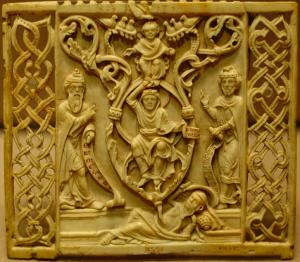
Ivory panel carved in 12th-c. Germany, showing
the Tree of Jesse (Jesus’ lineage).
Though proper to the Feast of the Visitation, Luke 1:39-56 is associated with the Assumption as well. It’s possible—
Wait, What’s the Visitation? and Why Are We Reading About It?
That depends, actually: in addition to being a Marian event/feast, The Visitation is also the title of a Frank Peretti novel, one which really isn’t at all bad. The prose is kinda tacky in places, but in theming and character complexity, it’s a cut above his other stuff.
But never mind that, we’re talking about the Gospel text. It recounts the Virgin Mary’s journey from her home in Nazareth to somewhere close to Jerusalem. We aren’t told in the Bible where precisely SS. Zechariah and Elizabeth lived; tradition locates them in Ein Kerem, a village now within the outskirts of Jerusalem, though at the time it stood at a slight remove (like how Westminster used to be a separate city from London). This tradition seems perfectly credible: it would make sense for them to live there, given St. Zechariah was an active priest who needed to live close to the Temple.
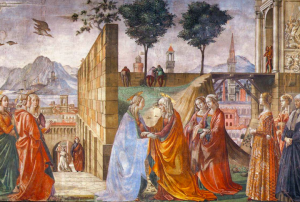
Florentine fresco (1490) depicting the
Visitation by Domenico Ghirlandajo; the
artist’s relish for realistic perspective is
very conspicuous.
The gist of the “plot” is that right after the Annunciation, the Virgin dashes down from Galilee to Judea to see her cousin1 Elizabeth, who (as Mary has just learnt from the archangel) is six months pregnant. As soon as she arrives and greets her hostess, the event once known as “the quickening of St. John the Baptist” takes place; quickening is an obsolete term that referred to the first time the mother feels the baby move in the womb.2 St. Elizabeth, overwhelmed, utters what have become the second and third lines of the Hail Mary:
Hail Mary, full of grace; the Lord is with thee.
Blessed art thou among women,
And blessed is the fruit of thy womb, Jesus.
Holy Mary, Mother of God:
Pray for us sinners, now and at the hour of our death.
Incidentally, these first three lines were for some time the only lines in the Hail Mary; some time between the twelfth and fifteenth centuries, it became a general custom to add some sort of petition for our Lady’s prayers, but the exact form of the request was for a long time variable by local custom and even personal preference. It’s only in the latter half of the sixteenth century, at least according to nineteenth-century British Jesuit Herbert Thurston, that the modern form from “Holy Mary” to “of our death” becomes fixed.
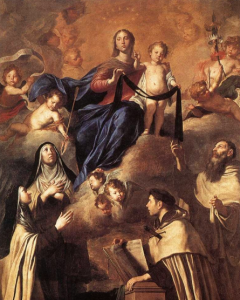
Our Lady of Mount Carmel and Saints (1641), by
Pietro Novelli. All left to right, the nuns and friars
are Mary Magdalene de’ Pazzi, Teresa of Jesus,
Angelus of Jerusalem, and Simon Stock.3
The Gospel for many Marian feasts is either the Annunciation or the Visitation. This is partly for the practical reason that, if you want a passage specifically from the Gospels that focuses on the Mother of God, you have a definite list of pericopes that maxes out at just under a dozen; most of them come from Luke, and cluster strongly around the infancy narratives. There are more New Testament passages than this which include her, of course, but these are the ones specifically in the Gospels.
- The Annunciation by St. Gabriel—Luke 1:26-38 (or maybe Matthew 1:18-25, if you push it)
- The Visitation to St. Elizabeth—Luke 1:39-56
- The Nativity at Bethlehem—Luke 2:1-21
- The Presentation in the Temple—Luke 2:22-40
- The Epiphany to the Magi—Matthew 2:1-12
- The Sojourn in Egypt—Matthew 2:13-23
- The Finding in the Temple—Luke 2:41-52
- The Miracle at Cana—John 2:1-12
- “Here Are My Mother and My Brothers”—Matthew 12:46-50 or Mark 3:31-35
- “Blessed Is the Womb That Bare Thee”—Luke 11:27-28
- The Third Logion From the Cross—John 19:25-27
Of course, that in itself invites the question of why not to use the last one on the list, which seems suited to the theme of “dormition”? One answer is that they do use the John 19 text, but it’s used on the Vigil. Yet this gravitation toward the Annunciation or Visitation does appear, and at a glance, the story of the Visitation is a pretty weird choice for Assumption no matter what. Nonetheless, there is a logic here—a theologic, as it were (I’m not sorry for that awful joke, I’d do it all over again in an instant, maybe louder). Actually, the limits and focus of the Marian Gospel texts point to a theological reason for why they are thus limited and focused. That reason is grounded not in who, but in what, Mary is.
Dē Officiīs4
All saints are saints because they love and imitate Christ.
I’m not 100% sure why, but after writing that sentence, I could not go on writing for about a solid minute. Might be something there to sit with.
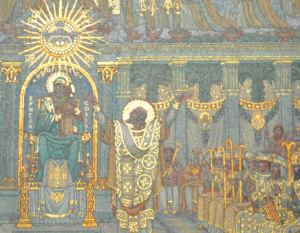
A mosaic depicting St. Cyril of Alexandria at
the Council of Ephesus, where the title Theo–
tokos was confirmed. Photo by Palamede,
used under a CC BY-SA 4.o license (source).
Besides this, certain saints serve particular “structural” roles within the Church. Take the temple-building analogy for the Church, which Paul uses in Ephesians 2: “Jesus Christ himself being the chief corner stone,” it is no less true that “ye are built on the foundation of the apostles and prophets.”5 I find that the word I’m continually reaching for to describe the thing I’m talking about is “functionary.” The apostles (and, in a lesser degree, all bishops as their successors) are the most obvious example, since the rest of the sacraments depend on the sacrament of Holy Orders.6 Among the apostles, St. Peter’s role is the most strongly functionary of the bunch; a new Peter is chosen every time one dies. I’d argue that the evangelists—quite independently of whether they were literally SS. John, Luke, Mark, and Matthew—also play this kind of role in the Church. One way to spot functionary roles, I think, is to ask whether so-and-so is still alive, and if not, whether somebody has inherited the “job” they had in life: if yes, probably a functionary.
The supreme example of these “functionaries” is Mary, because she is Jesus’ mother. Without the Theotokos, there could be no Incarnation and therefore no Church. This idea was driven home to me in a quite unexpected way, years before I resolved to become a Catholic.
I was reading the Dorothy Sayers translation of Dante’s Purgatorio, or to be more precise, her introduction to the Purgatorio. It’s in that part of the Divine Comedy, well past the halfway point of the poem, that we finally meet Beatrice—the woman whom Dante fell in love with all those years ago, and in pursuit of whom he has followed Virgil through and out of Hell and up Mount Purgatory. That is a weird point at which to introduce a not just main but a central character in a story, yet because of the Comedy’s structure, she really could not appear earlier than this; what’s more, we lose Virgil (of whom, if we’ve kept reading this far, we have probably grown very fond) at just about the same moment we gain Beatrice. Sayers therefore naturally spends a little time highlighting how Dante makes such a challenging handover work, which draws her into a broader discussion, about gender and literature and Jungian archetypes and so on, that was going on at the time. After addressing some stuff from a fellow Dante scholar (one Miss Bodkin) about das Ewig Weibliche7 and All That, Sayers writes:
Personal love for a woman, and a diffused idealism about Woman-in-general are two different things; they may or may not coexist in the same person—if they do, either the second is a mere overflow and by-product of the first, or the first is a mere by-product of the second and is destroyed by it. But the question is: which is the redeeming power? In Dante’s case there is no possible doubt about it: redemption is in the personal love. I do not, in fact, find in his work any vestiges of “Ewig-Weiblich” mystique … of mere Femininity as a power for good or evil there is no more trace than in the Gospels. …
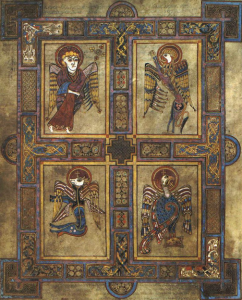
A page from the Book of Kells, showing the
emblems of the Evangelists (clockwise from
top left: man—Matthew, lion—Mark,
eagle—John, ox—Luke).
[Sayers then quotes another passage from Bodkin, this time on Jesus, and proceeds:] the two passages on Beatrice and the passage on Jesus display the same trend: the flight from the concrete, individualized, historical, and mystical into the abstract, generalized, mythical, and magical …It is not our business at the moment to inquire whether a diffused incarnation of attributes is in fact more poetically inspiring than a real baby in a real manger, or whether such cautious “minimum of faith as may sustain the moral life” was quite what Dante had in mind when he brought the three Theological Graces dancing at the wheel of his Lady’s triumph-car. But … to the medieval mind this hole trend could only appear as a retrogression into the infantilism of pagan ignorance. Thirteen Christian centuries had toiled to bring conscious order out of subliminal chaos; to replace the female principle and the Great Mother by the personal operation of the Mother of God … The Christian formula is not: “Humanity manifests certain adumbrations of the divine,” but: “This man was very God.”8
A peculiarity of this office is that, because of how motherhood works (as contrasted with, for example, how being the king’s grand vizier works), it has only ever had a single occupant, and she will have no successor. This seems to me to create a resonance between my proposed way of detecting functionaries on the one hand, and the Solemnity of the Assumption on the other; for one element of the doctrine of her assumption is that she either was resurrected or never died at all. Though she is, in a mysterious manner, away, she is not dead—so even if it were possible for someone else to fulfill the function of Theotokos, the office has not been vacated.
בַּת צִיּוֹן [Bat Tziyown]9
This in turn resonates not only with Jesus’ giving of his mother to St. John on Calvary (interpreted by Catholic and Orthodox Christians for many centuries as a gift on our Lord’s part to the Church, not to St. John alone), but also with two additional texts. The first is from St. Paul:
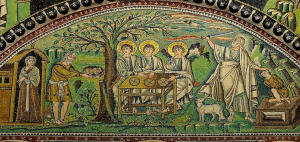
A mosaic from the Basilica of St. Vitale,
a 6th-c. church in Ravenna, Italy; note the
stories it links.10 Photo by Petar Miloševic,
used under a CC BY-SA 4.0 license (source).
When the fulness of the time was come, God sent forth his Son, made of a woman, made under the law, to redeem them that were under the law, that we might receive the adoption of sons. … It is written, that Abraham had two sons, the one by a bondmaid, the other by a freewoman. But he who was of the bondwoman was born after the flesh; but he of the freewoman was by promise. Which things are an allegory: for these are the two covenants; the one from the mount Sinai, which gendereth to bondage, which is Hagar. For this Hagar is mount Sinai in Arabia, and answereth to Jerusalem which now is, and is in bondage with her children. But Jerusalem which is above is free, which is the mother of us all.
—Galatians 4:4-5, 22-26 (emphasis, use of “Hagar” for original “Agar” mine)
For the other, we turn to the Apocalypse. As is so often the case in the Old Testament and as in the letter to the Galatians, so here, the virgin daughter of Zion, Mount Zion, the city of Jerusalem, and the Tabernacle and Temple flow in and out of one another in the imagery.
I John saw the holy city, new Jerusalem, coming down from God out of heaven, prepared as a bride adorned for her husband. And I heard a great voice out of heaven saying, “Behold, the tabernacle of God is with men, and he will dwell with them, and they shall be his people, and God himself shall be with them, and be their God.” … There came unto me one of the seven angels which had the seven vials … and talked with me, saying, “Come hither, I will shew thee the bride, the Lamb’s wife.” And he carried me away in the spirit to a great and high mountain, and shewed me that great city, the holy Jerusalem, descending out of heaven from God, having the glory of God: and her light was like unto a stone most precious, even like a jasper stone, clear as crystal …
Revelation 21:2-3, 9-11 (emphases mine)
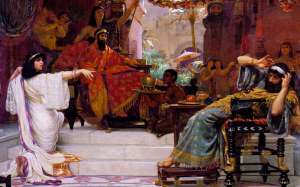
Esther Denouncing Haman (1888),
by Ernest Normand.
A few times here on the blog, usually offhandedly or in a footnote, I’ve alluded to the ancient Semitic custom in which the king’s mother reigned as his queen, was the מַלְכָּה [malkhâh] to his מֶלֶךְ [melekh]—a custom we see was observed by the Davidic monarchy in I Kings 2:13-25. That passage also exemplifies a principal role played by ancient Near Eastern queens, that of an advocate and intermediary.11 No doubt this way of determining who was queen was partly because a king would almost certainly have wives, in the plural (and good luck openly naming a favorite wife without causing chaos in the harem, your majesty; you’ll notice how smoothly everything went for the shah in the Book of Esther when he started getting all Candaulean about his bird12). But also, the king’s mother, as the widow of the previous king, literally embodied the continuity of the dynasty, linking the last monarch to the present one. This role is played by the Mother of God on two levels: first, there is the level in which she embodies the continuity of God’s covenant which she shares with every Jewish Christian (something I touched on last year in my three–part series on the lesson for Assumption, which comes from Revelation 11 and 12). The second level is, again, literal. Her flesh is what connects his flesh to ours, in quite a literal sense; after all, he had no other immediate relatives, not even another parent.
I feel like I’m tap-dancing around the significance of all this without coming out and saying it; no idea why I’m so tongue-tied. The point is, the Virgin’s whole significance, both personal and “official”—derives from and revolves around Christ. Every queen mother is the mother of a king; in this case, of the King. The Annunciation, the Visitation, the Nativity, and the Presentation are the four episodes in the Biblically-recorded life of the Theotokos that most emphatically place this reality front and center; they center upon her crucial maternity, the literal motherhood to which all her other motherhoods refer.
(Two minor notes: first, since I decided to split this post in two, on account of the length of the prefatory material above, I’ve cut the textual note markers from the copies of the text in this post. They’ll appear in the next, where I’ll reproduce the passage in both translations, along with the textual notes themselves. Second, you’ll notice that several of the names in my translation differ from the familiar ones—Miriam rather than “Mary” and Elisheva instead of “Elizabeth” are the most prominent. This will be explained in more detail in said textual notes.)
Luke 1:39-56, RSV-CE
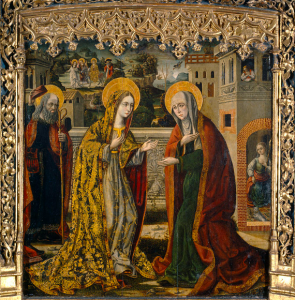
La Visitación [“The Visitation”] (1500),
by Maestro de Perea.
In those days Mary arose and went with haste into the hill country, to a city of Judah, and she entered the house of Zechariah and greeted Elizabeth. And when Elizabeth heard the greeting of Mary, the babe leaped in her womb; and Elizabeth was filled with the Holy Spirit and she exclaimed with a loud cry, “Blessed are you among women, and blessed is the fruit of your womb! And why is this granted me, that the mother of my Lord should come to me? For behold, when the voice of your greeting came to my ears, the babe in my womb leaped for joy. And blessed is she who believed that there would be a fulfillment of what was spoken to her from the Lord.” And Mary said,
“My soul magnifies the Lord,
and my spirit rejoices in God my Savior,
for he has regarded the low estate of his handmaiden.
For behold, henceforth all generations will call me blessed;
for he who is mighty has done great things for me,
and holy is his name.
And his mercy is on those who fear him
from generation to generation.
He has shown strength with his arm,
he has scattered the proud in the imagination of their hearts,
he has put down the mighty from their thrones,
and exalted those of low degree;
he has filled the hungry with good things,
and the rich he has sent empty away.
He has helped his servant Israel,
in remembrance of his mercy,
as he spoke to our fathers,
to Abraham and to his posterity for ever.”
And Mary remained with her about three months, and returned to her home.
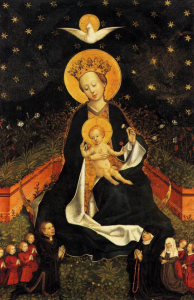
Madonna on a Crescent Moon in Hortus Conclusus
(ca. 1450), anonymous.
Luke 1:39-56, my translation
Miriam arose in those days and went into the highlands with all speed to a city in Judea, and she came into the house of Zekharyah and greeted Elisheva. And it happened that when she (Elisheva) heard Miriam’s greeting, the infant leapt within her, and Elisheva was filled with a holy spirit, and she exclaimed with a great cry and said: “Blessed are you among women, and blessed is the fruit within you. And how has this happened to me, that the mother of my Lord should come to me? For see, just as the voice of your greeting came into my ears, the infant within me leapt with gladness. And happy is she who has had faith that there will be completion of what was told her from the Lord.”
And Miriam said:
“My soul magnifies my Lord,
and my spirit is glad for my God and Savior;
because he looked upon the humiliation of his slave,
for see— from now on, they will call me happy, every generation;
because he, the powerful one, has done great things,
and his name is holy;
and his pity is on generation after generation among those who fear him.
He enacted strength with his arm,
he scattered those who were conceited in the thought of their hearts;
he took down the powerful from their thrones and put the humiliated on high,
the hungry, he filled with good things, and the rich he sent out empty.
He took hold of Yisroel, his boy, remembering pity,
just as he told our fathers,
Avraham and his seed for ever.”
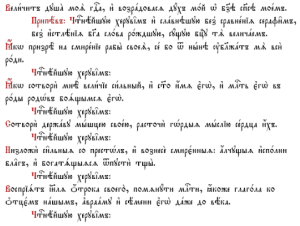
The Magnificat in Church Slavonic, penned by
Alexei Zoubov. Note that this is written in the
Glagolitic script, a predecessor of Cyrillic.
So Miriam stayed with her about three months, and turned back to her own house.
Footnotes
1They likely weren’t first cousins, due to the difference in age: the Theotokos would presumably have been somewhere in her teens at the time (I’ve come across conflicting assertions about whether we should assume she was at the younger end or closer to age 20, and haven’t yet devoted time to researching the question properly), whereas St. Elizabeth is stated to be past childbearing age, which places her in her forties at the very youngest. That makes for a gap of twenty years or more, which, while possible, seems unlikely. But even being first cousins once removed would be enough to make the gap fairly normal, and any more distant kinship would hardly pose an issue in the first place. (If you’ve always wondered what “once removed” means, it works like this: imagine two siblings who each have children. Those children are first cousins—though nowadays we usually just say “cousins” without specifying. If your first cousin has a kid, that kid is your first cousin once removed; the kid’s kids will be your first cousins twice removed. However, if the two siblings we imagined at the start are instead a pair of first cousins, the kids they each have will be second cousins, and if your second cousin has a kid, that kid is your second cousin once removed, and so forth.)
2The word quick descends through Middle English quyk from the Anglo-Saxon ᚳᚹᛁᚳ [cwic], meaning “alive.” This meaning is, ironically, almost extinct in modern English; almost, but not quite. There are a few contexts in which the meaning has “fossilized.” Leading examples include “quicksilver,” “the quick and the dead,” and “cut to the quick”—which formerly had a specific referent, namely the flesh underneath the fingernails: to cut someone to the quick was, taken literally, to trim their fingernails so closely you started cutting into the pink part of the nail. Before modern tech, quickening was widely believed to be when the fetus became a living thing.
3St. Mary Magdalene de’ Pazzi was a sixteenth-century Florentine sister, known for her frequent ecstasies and extreme mortifications. St. Teresa of Jesus, better known as “of Ávila,” was the foundress of the Discalced branch of the Carmelite Order; she also wrote multiple volumes on the spiritual life, The Way of Perfection being perhaps the most famous. St. Angelus of Jerusalem was, with his mother and his twin brother, a Jewish convert to Catholicism (I get the impression the Carmelites have a special relation to Jewish converts? both Teresa and St. John of the Cross were children of conversos); directed to travel to Italy to preach against the Bogomil, Cathar, and Patarene heresies, he was murdered by a Catharist knight in 1220. St. Simon Stock, an Englishman and a slightly older contemporary of Angelus, was one of the early popularizers of the Brown Scapular, which remains an extremely popular Marian devotion to this day.
4This is funny because I’m punning on the title of a book by Cicero (the title roughly means “On Moral Duties”). Look, it’s funny, okay? Just trust me.
5I had a teacher in middle school—a good man, God rest him—who used this as a proof text against the idea that miraculous charismata could be a normal element in Christian life today, because he interpreted the idea of being “built on a foundation” as indicating a temporal sequence; if we still had apostles and prophets, he argued, then we’d still be in the “foundation” stage, which we weren’t … for some reason? Quite apart from the reply “How on earth do you know we aren’t?”, I’ve since come to view the “temporal stages” interpretation of St. Paul’s phrasing there as dead wrong, not least because that isn’t how buildings work—it’s crucial that the foundation, once laid, still be there when the rest of the structure is put up atop it.
6With the exceptions of baptism and, potentially, marriage.
7This is German for “the Eternal Feminine” (though if you wanted to stick to cognates, there’s a case to be made that the best English equivalent is “the Ever-Wifely”); the phrase comes in in the course of an allusion to Goethe, who was all about that sort of wittering.
8Dorothy L. Sayers, “Introduction” to the Purgatorio, pp. 38-39 of the 1955 Penguin paperback (underlining mine).
9This Hebrew title means “daughter of Zion,” a common personification of Jerusalem (and sometimes of the Kingdom of Judah in general) in the prophets.
10Specifically, it connects the theophany at Mamre—when the “three men” appeared in Genesis 18, and Abraham evidently recognized them as angels (or something of that sort) and hastily set a feast before them, followed by their prophecy that Isaac would be born in a year, Sarah’s notorious laughter, and Abraham’s attempt to bargain for mercy for Sodom and Gomorrah—with the binding of Isaac.
11Admittedly, Queen Bathsheba’s advocacy and mediation does not work with King Solomon in the text in question; but this doesn’t alter the fact that this intercessory role was a customary aspect of queenship. Fascinatingly, this system of mother-son dyarchy exists as a form of government to this day in exactly one country,, which is one of the (how perfect) two existing dyarchies in the world (Andorra is the other): Eswatini, the country that used to be called Swaziland, nestled in between South Africa and Mozambique, is traditionally ruled by a king and a queen mother.
12Esther is made queen and “chief wife” to Ahasuerus, after the repudiation (or at least demotion) of Vashti; this may appear to clash with what I’ve said about ancient Semitic monarchies, except of course we must remember that the Persians were (and are) not Semites. Like Anglos, Persians are an Indo-European people, and their system of queenship presumably reflects that cultural background. Interestingly—and I personally think the reason Esther is canonical is that it is typologically about the Mother of God—the function of being an intercessor for the people, and especially her own people, is not only common to both the Semitic and the Iranian settings of the Bible, but is central in this book.










 Ad-Free & Subscriber Log-In