

I Assume He Means Cato the Younger
This is the post that should have gone up for the 19th! But here it is now, and this coming Sunday’s proper post can be found here.
The parable of the widow and the unjust judge calls for a little commentary on those figures. We may begin with the latter. An explanation of unjust judges is, in itself, no doubt superfluous; however, we don’t always appreciate what a high standard of conduct—even five years deep1 in the current presidential administration—our legal system observes. Once upon a time, bribing officials and judges was utterly routine; Norfolk’s outburst in A Man for All Seasons suggests what is, historically speaking, the typical state of affairs.

Sir Thomas More (1527), by Hans Holbein the
Younger. Painted while its subject was Lord High
Chancellor (not to be confused with
the Chancellor of the Exchequer).
CROMWELL I have evidence that Sir Thomas, while he was a judge, accepted bribes.
NORFOLK What? Goddammit, he was the only judge since Cato2 who didn’t accept bribes! When was there last a Chancellor whose possessions after three years in office totaled one hundred pounds and a gold chain?
It is, however, rather striking that the imaginary judge in this text “neither feared God nor respected people” (emphasis added). In other words, while this judge was by no means one of the Catos of his profession, this—unusually—wasn’t a matter of his being the rapacious or bootlicking type. Apparently neither avarice nor pride are his sins, but only sloth.
Getting Into the Weeds
Secondly, widows. Their social standing was defined first of all by their sex; and women in general did not enjoy high status in the ancient world. (I touched on several of my themes here in textual note g of this post.) Admittedly, geography and especially class played a role here, too: the daughter of an aristocrat in Sicily was going to have a much nicer life in almost every way than a freeborn male peasant from Cappadocia. Yet even in these high positions, women were, by custom and frequently by law, inferior to men of the same place, age, and status.
This was partly because the home and marriage were even more central to ancient society than they are today, not only because of changes in values but for economic reason. Remember, while cities and commerce certainly existed, this was not a primarily urban-commercial society, but an aristocratic-agrarian one. In antiquity, the household was the basic economic unit. Corporations did exist, or rather, something like them did exist, called κοινωνίαι [koinōniai] in Greek; St. Peter, his brother, and the sons of Zebedee appear to have been part of a pre-existing κοινωνία when Jesus called them. But these operated differently from the modern joint-stock company, and κοινωνίαι were not the international, or even regional, economic hubs they are today. The economy was far more local, and trade not nearly such an important element in it—when you bought something you had not made yourself, you were probably buying it from the maker or harvester. (There’s an interesting train of thought in this direction about the guild system, but we can’t stop for that now!)
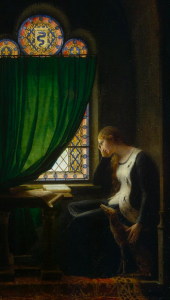
Valentine of Milan Mourning Her Husband the
Duke of Orléans (1802), by Fleury-François
Richard.
As a result of these economic conditions (among other causes), the particular powerlessness of women was exemplified in, and reinforced by, the tradition of families arranging marriages in youth. Men had some control over their marriages, at least once they came of age. But women were expected to wed, with little to no choice about whether, when, or to whom. (It is no accident that so many martyrs of the ancient Church are virgin martyrs like SS. Agatha, Agnes, Cecilia, Lucy, Margaret, and Ursula.) They also faced atrocious double-standards regarding their conduct as compared with their husbands.3
It was not absolutely impossible for a woman to have independent means, like St. Lydia; or to achieve public esteem, like Hypatia; or even—under exceptional circumstances—hold high office, like Empress Zenobia. And there were usually a small number of official exceptions to the curtailed liberties of women, too, varying from culture to culture: the Vestals are an example.4 But for the overwhelming majority of women, a public reputation as anything but a wonderful wife and mother was frowned upon, public power was out of the question, and economic activity—let alone autonomy—ranged, by law, from impeded to impossible. Everything a woman did, everything she was, had to be under the legal guardianship of a man, who was normally either her father or her husband. Legally, her personhood was subsumed into theirs.
Which prompts the question: what became of a woman whose father and husband had both died?
That depended. If she had a living son, he would be expected to provide for her. (According to the Catholic doctrine of the Mother of God, this is why the Fourth Word from the Cross in John 19 was so important: she is generally held to have been widowed of St. Joseph before Jesus began his ministry, and if she remained perpetually virgin, then Jesus would have had no siblings. Naming the youngest of the Apostles was a good way of ensuring that she would have a designated supporter very probably until the end of her life.) If a widow had no living son, an adult daughter, or more precisely the widow’s son-in-law, would hopefully pick up the slack; if not, a living brother or brother-in-law might do so, and so on down the lines of kinship.
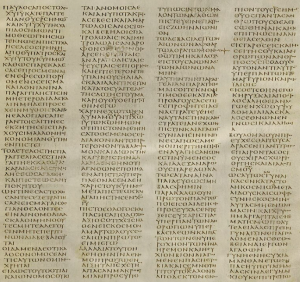
The beginning of I Timothy in Codex Sinaiticus
(created c. 350).
As mentioned, it was possible, if something of a last resort, for her to support herself—so long as she had something: if she were a daughter with no brothers and no male cousins, she might be able to receive an inheritance from her parents (splitting it with any sisters). This might consist in money or in kind—perhaps a plot of land on which she could grow a few crops that would allow her to eat some, plant some more, and sell the rest. This was not a perfect setup; there might no cushion for her if she became ill or unable to work her land. Yet it would be a start. If a woman were widowed with no children, no living relatives (or none close enough to contact), no inheritance, and no property, she could be destitute in days. Small wonder that, in the matter of the Church’s provision for widows, St. Paul advises St. Timothy,
Honor widows that are widows indeed. But if any widow have children or nephews, let them learn first to shew piety at home, and to requite their parents: for that is good and acceptable before God. Now she that is a widow indeed, and desolate, trusteth in God … But if any provide not for his own, and specially for those of his own house, he hath denied the faith, and is worse than an infidel. … If any man or woman that believeth have widows, let them relieve them, and let not the church be charged; that it may relieve them that are widows indeed.
—I Timothy 5:3-5, 8, 16
This explains, too, why the death of Dorcas in Acts 9 was such a blow to the Church in Yafou, or Joppa, a city on the coast of the Holy Land.5 The Church had undertaken to keep widows fed, and had been doing so since her inception (as I’ve had cause to touch on more than once, it was sorting out the details of this that prompted the creation of the diaconate); Dorcas had chosen to devote her skill as a seamstress to making clothing for the widows of Joppa. To quote an old pastor of mine, Dr. Glenn Parkinson, she did this
so that they would not have to wear rags. … Every morning, when those women rose and put on a fine garment, as fine as the other women, who had families, and were loved and respected and cared for, they remembered that they were loved, and respected, and cared for; not only by Dorcas, but by the risen Christ that lived in her.6
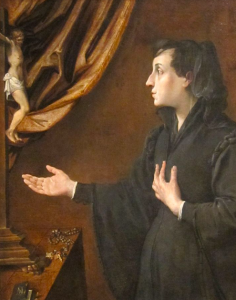
Portrait of a Widow (c. 1585),
by Ludovico Carracci.
But I digress (slightly). Here we are dealing with a fictional widow, and moreover with one who did have something—and it has been taken from her. A strip of land, for a vegetable garden or a hen run, would be just the sort of thing about which she could be pestering a judge, “Avenge me against my adversary.” For it would assuredly be easy for some plutocrat to lay claim to her little strip of land in fact, even though she had a watertight case that it was hers; but of course a watertight case does nobody any good if they can’t get it heard.
This forms rather a striking contrast with the kind of judgment Christians are usually thinking of, in which we (a) are the defendant, (b) know ourselves to be guilty, and (c) hope through Christ for clemency. But often in the Gospels, and most of the time in the Old Testament, the metaphor of God as judge is envisioned with the psalmist (or whoever else) in the role of the plaintiff, seeking compensation for damages unjustly inflicted.7 Even when they imagine themselves as a defendant, it is typically as one falsely accused:
O LORD my God, if I have done any such thing;
…..or if there be any wickedness in my hands;
… Then let mine enemy persecute my soul and take me;
…..yea, let him tread down my life upon the earth
…..and lay mine honor in the dust.
Stand up, O LORD, in thy wrath,
…..and lift up thyself because of the indignation of mine enemies;
arise up for me in the judgment
…..that thou hast commanded. …
The LORD shall judge the peoples:
…..give sentence with me, O LORD,
according to my righteousness,
…..and according to the innocency that is in me.
—Psalm 7:3, 5-6, 8
Thus, when Luke speaks of persisting in prayer rather than slowly weakening and ultimately giving up, the frame of mind we should be bringing to this, based on the parable, is a little different from what we (well, from what I) tend to think of. The danger in view is not desperate self-loathing in the face of repeated sins: it is resentful, angry embitterment in the face of un-mended injustice—something we rarely call “despair,” however similar its operation in practice.
Luke 18:1-8, RSV-CE
And he told them a parable, to the effect that they ought always to pray and not lose heart. He said, “In a certain city there was a judgea who neither feared Godb nor regarded man; and there was a widow in that city who kept coming to him and saying, ‘Vindicate me against my adversary.’ For a while he refused; but afterward he said to himself, ‘Though I neither fear God nor regard man, yet because this widow bothers me, I will vindicate her, or she will wear me out by her continual coming.’”c And the Lord said, “Hear what the unrighteous judge says. And will not God vindicate his elect, who cry to him day and night? Will he delay long over them?d I tell you, he will vindicate them speedily. Nevertheless, when the Son of man comes, will he find faith on earth?”e
Luke 18:1-8, my translation
And he told them this analogy, toward it being necessary for them always to pray and not to weaken, saying: “There was a certain judge in such-and-such a citya who neither feared Godb nor respected people. Now, there was a widow in that city, and she came to him, saying, ‘Avenge me against my adversary.’ And he did not want to at the time, but after these things, he said to himself, ‘Though I neither fear God nor respect people, because this of this widow presenting herself to me as a bother, I will avenge her, lest by her coming she give a black eye in the end.'”c And the Lord said, “Listen to what the unjust judge says; will God, then, not do vengeance for his chosen ones, who cry out to him day and night—and he is longsuffering over them?d I tell you that he will do them vengeance quickly. And yet, when the Son of Man comes, will he even find faith on the earth?”e
Textual Notes
a. In a certain city there was a judge/There was a certain judge in such-and-such a city | Κριτής τις ἦν ἔν τινι πόλει [kritēs tis ēn en tini polei]: The repeated use of τις (τινι is another form of the same word), meaning “some, a certain, an [unspecified X],” gives this parable a sort of “extra-hypothetical” atmosphere, as though Jesus wants to be unusually clear that he is not inviting comparison with any particular unjust judge.
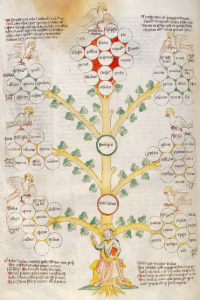
A tree bearing the seven gifts of the Holy
Ghost (date and provenance not given).
Image provided by the Wellcome Collection
under a CC BY-SA 4.0 license (source).
b. neither feared God | τὸν θεὸν μὴ φοβούμενος [ton theon mē foboumenos]: Here we run into one of the traditional confusing Biblical expressions, “the fear of the Lord.” Being afraid of God doesn’t sound like it’s any fun, and if God is someone to be afraid of, that doesn’t entirely make him sound like a good guy. St. John concurs:
We have known and believed the love that God hath to us. God is love; and he that dwelleth in love dwelleth in God, and God in him. Herein is our love made perfect, that we may have boldness in the day of judgment … There is no fear in love; but perfect love casteth out fear: because fear hath torment. He that feareth is not made perfect in love.
—I John 4:16-18
Yet, if the traditional ascriptions are true, this is the same John who also wrote:
I was in the Spirit on the Lord’s day, and heard behind me a great voice, … saying, “I am Alpha and Omega, the first and the last …” And I turned to see the voice that spake with me. And being turned, I saw seven golden candlesticks; and in the midst of the seven candlesticks one like unto the Son of man … His head and his hairs were white like wool, as white as snow; and his eyes were as a flame of fire; … and his voice as the sound of many waters. And he had in his right hand seven stars: and out of his mouth went a sharp two-edged sword: and his countenance was as the sun shineth in his strength. And when I saw him, I fell at his feet as dead. And he laid his right hand upon me, saying unto me, “Fear not; I am the first and the last: I am he that liveth, and was dead; and, behold, I am alive for evermore, Amen.”
—Revelation 1:10-18
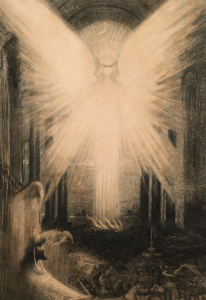
L’Allégorie de l’Enfer [The Allegory of Hell]
(c. 1890), by Jean Delville. Also known by the
name of the angel it depicts, Azrael (held in
Islam to be the angel of death).
Regardless of their authorship, the wisdom books of the Tanakh, especially Proverbs, are chock-full of praise for “the fear of the Lord,” calling it among other things “the beginning of wisdom.” The radical ירא [y-r-‘], which typically underlies the expressions rendered the fear of the LORD, carries meanings like “fear,” “awe,” and “reverence.” To us, “fear” and “reverence” probably sound like two quite distinct concepts, and that isn’t wrong, but there is a kinship between them that is worth some attention.
The best (imperfect) way I can think of to get at the unity between these ideas is this. Twenty years ago, my family visited Yosemite National Park, which is famed for its waterfalls: it has eleven, seven of which exceed a thousand feet in height, and two of which are more than two thousand feet high. My personal favorite is Bridalveil, but the best-known is the eponymous Yosemite Falls—it’s the highest waterfall in all of North America. Pictures, naturally, don’t do it justice; but imagine really being in Yosemite Valley, where the photo below was taken. The valley is wide enough to line its floor with about forty Boeing 737s side by side, and stack them well over a hundred jets deep with room to spare.8 Gigantic. Look up along the waterfall, to the summit it’s falling from. The valley is filled with California redwoods, the tallest species of tree now alive on earth, which routinely exceed three hundred feet in height—and these are absolutely dwarfed by the rock: a vast wall of naked granite, hardened out of magmatic plumes underneath the earth, of which the youngest took shape eighty-seven million years ago during the late Cretaceous. Slowly forced up to the surface, the overlying ground weathered away to nothing, these masses of granite were broken open by glaciers that have repeatedly submerged the area, withdrawn, and then returned, carving Yosemite as we know it—the fountain of the Merced River, a tributary of the San Joaquin that, with the Sacramento, flows into the San Francisco Bay and from there out into the Pacific. Impressive, to say the least. (You’ll notice the lack of buildings or even fences at the top of that ridge; we were marginally better about Yosemite than we were at Mount Rushmore!)

Yosemite Falls, photographed by Mike McBey.
Used under a CC BY 2.0 license (source).
Now imagine, instead, that you are on the top of that cliff, looking down on the valley, from however close to the edge you choose to stand. The rushing water of Yosemite Creek flashes beside you until it passes over the edge and descends, largely through open air, more than twenty-four hundred feet to reach the valley floor. Also impressive, yes. But, even if you’re not afraid of heights, standing on a cliff of bare rock with a sheer drop of close half a mile nearby—that would give anyone a little shiver of nerves, no? It isn’t exactly fear, or not as we ordinarily mean the word; but that frisson is more like fear than to any other easily-nameable emotion.
That, I think, is the common thread between fear in the standard sense and “the fear of the Lord.” After all, the Abrahamic contention about the Lord our God is that he is, among other qualities, the unmade Maker—the Being upon whom all other beings depend. He is thus, at the same time and for the same reason, more intimate to us than anything else ever could be, and also more sheerly, incomprehensibly alien from us than anything else ever could be. (As pseudo-Dionysius points out, God, whose being is uniquely independent, doesn’t even “exist” in exactly the same sense we do; his is more absolute than ours.) Any being who did not, on some level, occasionally give us some frisson of that kind could hardly be the transcendent Creator, if we were thinking about him at all.
c. or she will wear me out by her continual coming/lest by her coming she give a black eye in the end | ἵνα μὴ εἰς τέλος ἐρχομένη ὑπωπιάζῃ με [hina mē eis telos erchomenē hüpōpiazē me]: The word ὑπωπιάζω [hüpōpiazō] literally means “to under-the-eye,” i.e. to hit someone under the eye, as in boxing (which was an Olympic sport at the time). This had become an idiom for wearing out an opponent. Ὑπωπιάζω appears only one other time in the New Testament, namely in I Corinthians 9:27.
d. Will he delay long over them?/and he is longsuffering over them? | καὶ μακροθυμεῖ ἐπ’ αὐτοῖς; [kai makrothümei ep’ autois?]: The verb μακροθυμέω [makrothümeō] is a vivid one; it literally means something like “to be big-spirited.” Θυμός [thümos], the noun on which it is based, had come by this point to mean “anger” when found by itself, though originally it was something more like “fervor, passion, heat”; Plato’s “spirited element,” one of the three parts of the soul according to the Republic, is a related word.
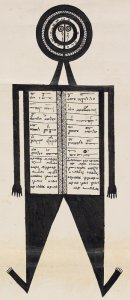
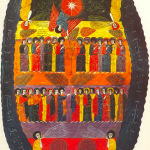
A diagram of Adam Kasia (“the hidden Adam”) in
the Alma Rišaia Rba, a Mandæan9 religious text;
Adam Kasia is in some sense the soul of every
human being.
Now, this next part must be understood as what it is, and no more. It is only a hunch; nevertheless I do have a hunch that μακροθυμεῖ, or whatever the Aramaic word or expression the Lord used here may have been, translates an idiom from the Hebrew Bible. It is a figure of speech just as boldly physical as the one from note c, but at first glance, likely incomprehensible to us today.
Recall with me one of the most momentous passages in the Torah. The Israelites have just made, worshiped, been rebuked for, and destroyed the Golden Calf; Moses broke the first copy of the Torah on his way down Mount Sinai, when he saw that his people were busily violating it—adoring a god whom they were expecting instead of the God who was there—before he even had a chance to share it with them. He has returned up Mount Sinai to obtain a new set of tablets of the Law; he now begs God to reveal his full glory to him. The Lord consents; almost. He lays down one restriction: “Thou canst not see my face: for there shall no man see me, and live … my face shall not be seen.” In the following chapter, with that caveat, the Lord unveils himself to Moses.
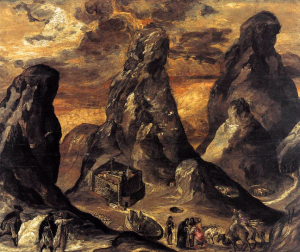
Mount Sinai (c. 1571), by El Greco.
Moses rose up early in the morning, and went up unto mount Sinai, as the LORD had commanded him … And the LORD descended in the cloud, and stood with him there, and proclaimed the name of the LORD. And the LORD passed by before him, and proclaimed, “The LORD, The LORD God, merciful and gracious, longsuffering, and abundant in goodness and truth, keeping mercy for thousands, forgiving iniquity and transgression and sin, and that will by no means clear the guilty …” And Moses made haste, and bowed his head toward the earth, and worshipped.
—Exodus 34:4-8
The English word that my translation shares with this text, “longsuffering”—that is not, word for word, what the Hebrew says here. The phrase it uses is אֶ֥רֶךְ אַפַּ֖יִם [‘erekh ‘apayim], which means “long of nose” or “with long nostrils.”
This is a standard Hebrew idiom for patience, and one that comes from a surprisingly intuitive place. Think of some of the things people do to control their tempers. Counting to ten is a well-known technique, as is venting one’s frustration on some soft inanimate object; but one of the most common and often half-unconscious things we do is to take a deep breath. If we do that through our nostrils, they quickly fill up and therefore flare, indicating our displeasure. Someone with a particularly large or long nose, however, would take longer before they flared—and thus the idiom was born that described the Lord God: he is merciful and gracious, long of nose, and abundant in goodness and truth.10
e. I tell you, he will vindicate them speedily. Nevertheless, when the Son of man comes, will he find faith on earth?/I tell you that he will do them vengeance quickly. And yet, when the Son of Man comes, will he even find faith on the earth? | λέγω ὑμῖν ὅτι ποιήσει τὴν ἐκδίκησιν αὐτῶν ἐν τάχει. πλὴν ὁ υἱὸς τοῦ ἀνθρώπου ἐλθὼν ἆρα εὑρήσει τὴν πίστιν ἐπὶ τῆς γῆς; [legō hümin hoti poiēsei tēn ekdikēsin autōn en tachei. plēn ho huios tou anthrōpou elthōn ara heurēsei tēn pistin epi tēs gēs]: The first sentence here is a difficult one—in the same way and for the same reason the saying “If you ask anything in my name, I will do it” is difficult.
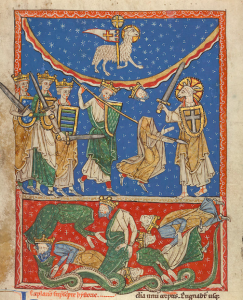
An illumination (c. 1230) from a copy of
Beatus of Liébana’s commentary on Reve-
lation, showing the Lamb beheading
the ten kings that serve the Beast.
Moreover, the question that follows is a rather puzzling in its own right. Insofar as “the Son of Man” is a messianic title, Jesus has already used it to describe himself, so this is presumably not a reference to his first coming; that leaves his return, the Parousia.11 I’m not certain I understand the question here, though; it seems to be asking if there will be anyone left on earth who still has faith, come the Parousia. My understanding has always been yes: that the Church’s nature is such that she cannot fail to persist until then—which I later learned is called the doctrine of the indefectibility of the Church. (The term comes from the negation of the Latin verb dēficere, meaning “to fail, be exhausted, lack, run out; to withdraw; to be finished, die, cease”; this is why verbs which lack one or more of the standard principal parts are known as defective.12) Then again, the fact that Jesus asks this question may precisely be to prompt us to look for the answer; rabbinic questions often are. Or, to appeal to a very old joke:
Mr. Alef: Rabbi, why do you always frame your teaching in the form of a question?
Rabbi Beyt: What’s wrong with a question?
Footnotes
1By God’s mercy, they have been five non–continuous years, which has helped just a little.
2Or at any rate I hope he means Cato the Younger. Cato the Elder, the “Carthage must be destroyed” one—though he maintained a high standard of honesty in public office—was strict at best, normally cold, and at his worst, very cruel; his Dē Agrī Cultūrā (roughly, How to Run a Farm) includes gems like “An old slave, a sickly slave, and whatever else is superfluous, sell.” Cato the Younger was just as incorruptible as his great-grandfather, but a generally more attractive personality. He too could be intransigent, refusing to brook any compromise with Cæsar before the civil war of 49-45 BC. Nonetheless, in that war, he intervened with his own side to have mercy on the city of Utica, which had tried to defect to Cæsar’s; and when the defeat of the Senate became clearly inevitable, some of his final acts were to sort out that city’s finances and disburse the remaining public monies back to said public. Even though he chose to end his own life rather than live under the imminent dictatorship, he sent his family and friends to accept the clemency he knew Cæsar would extend.
3Adultery is of course the outstanding example. While an adult, married Roman male could not sleep with a married woman with impunity, there were (usually) no consequences for his sleeping with an unmarried woman or a slave girl; by contrast, an adulterous wife had to be divorced, and might be exiled under the lēx Julia passed in 23 BC. (Augustus, who was not himself an entirely faithful spouse by any stretch, enforced this law upon his own daughter twenty-one years later; she died in exile.)
4The Vestal Virgins were so named from Vesta, the Roman goddess of the hearth, and thus of the home. There were about half a dozen at a time, and they tended the sacred fire in Vesta’s temple, the hearth of the city itself. They were answerable to no one except the pontifex maximus, who was in charge of all priests and rites in the Roman religion. This rule was maintained even in the imperial era, albeit by uniting the offices of emperor and pontifex maximus. Like tribunes of the people, the Vestals were personally sacrosanct: anyone who tried to attack a Vestal Virgin, or even block her path, was considered to be ipso facto an outlaw and cursed by the gods, and could be killed on the spot; that was easy enough to do, since, like most Roman officials, the Vestals were preceded wherever they went by lictors (who carried fascēs, bundles of sticks bound around axes, which were ceremonial emblems of state power but suitable for, ahem, practical use). Unless the Vestal pardoned the offender, that is, for they could pardon anyone condemned to death—even seeing a Vestal on one’s way to execution was sufficient to obtain remission. Vestal Virgins also had the authority to make wills and dispose of property without the approval of some male guardian, including leaving property to other women, which Roman men generally could not do.
5It is immediately adjacent to the Israeli capital of Tel Aviv, which is why you may occasionally have seen the name Tel Aviv-Yafo on maps and things.
6Unfortunately, though the words themselves made a deep impression on me, I cannot recall the name of the sermon, the date it was preached, or the series it was a part of!—only that it was on the resurrection of Dorcas by St. Peter.
7I got most of the material in this paragraph and the last from Reflections on the Psalms, one of C. S. Lewis’s lesser-known works, but I seem to have either given away or mislaid my copy, so I once again can’t give an exact quotation or reference. (Similarly, my attempt at articulating the meaning of “the fear of the Lord” in textual note b surely owes something to the conversation on the hunting of hnéraki in Out of the Silent Planet.)
8Granted, I’m not clear why you would want to do this; it doesn’t seem like an exercise with a clear reward. But you could. You weirdo.
9The Mandæans are an ethnoreligious group (originally from Iraq, though the events of the past quarter-century have driven many into exile), consisting at most of a few hundred thousand people. They are in some respects like several other ethnoreligious groups from the Near East, of whom the Jews are only the best-known: Alawites, Druze, Samaritans, and Yazidis are other examples, as in a different way are Assyrian Christians. The Mandæans are exceedingly ancient group, very possibly as old as Christianity. They are often characterized as the only surviving Gnostic religion from the ancient world, though they seem to lack the rigorous spirit-matter dualism one might expect based on sects like the Marcionites or the Sethians, possibly aligning more with the neo-Platonic or Zoroastrian views of matter. They consider John the Baptist the last and greatest of all prophets; however, they probably wouldn’t much like being described as a Christian heresy or even an Abrahamic religion—they consider both Abraham and Jesus to have been Mandæan priests who turned apostate. Scholars have proposed links between the Mandæans and a variety of groups, including the Essenes and the Manichees.
10The שִׁעוּר קוֹמָה [Shiuur Qoumah], a document from the Kabbalah (a form of Judaic mysticism since the High Middle Ages), relates certain measurements of the “body” of God; according to it—if I’ve done the math right—the nose of God is as long as 9.6 quadrillion universes.
11Stress is on the third syllable: par-oo-SEE-ah. The Greek original of this word for the Second Coming meant “presence, arrival, visitation.”
12Ironically enough, dēficere is not a defective verb—dēficiō, dēficere, dēfēcī, dēfectum.












 Ad-Free & Subscriber Log-In