

(No, Not the John Cusack Film)
EDIT: Well, gentle readers, I have egg on my face: these readings are for next week, the 26th, not the 19th, this Sunday! Oh well—it’s too late to do them the right way around now, and I’d have been doing these passages (and this rant about the scholarship on the Paulines) in any case, so here we are.
As our Gospel passage this week is another short one, I decided to translate the Epistle as well. Just a couple “housekeeping” remarks about this as we begin. First, I wound up composing a lot of introductory matter for this post; if you dip in and decide that it’s not for you, you’ll find the translations and textual commentary after the picture of the cross decorated with Celtic knot-work. And second, because I am the actual worst person, footnote 6 in this post is nested—a footnote on a footnote—so don’t drive yourself crazy looking for it in the body of the piece, because it’s not there.
The Problem of the Paulines
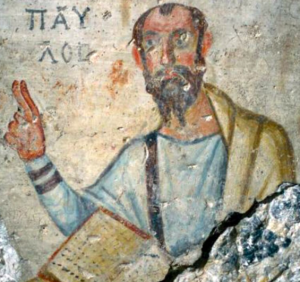
Painting of St. Paul from Ephesus,
thought to be 6th-c.
This coming Sunday’s second reading happens to be from II Timothy, which is one of four Pauline letters—I and II Timothy, Titus, and Philemon—addressed to individuals directly. I Timothy, II Timothy, and Titus (but not Philemon) are known collectively as the Pastoral Epistles, thanks to their subject matter; however, thereby hangs a tale.
Of the twenty-one letters included in the New Testament, fourteen have been associated with St. Paul, and thirteen claim to be by his hand. Of those thirteen, seven are now generally accepted as authentic, while a further six, including all of the Pastorals, are disputed to varying degrees. The full complement of fourteen are as follows, as they appear in most printed New Testaments. Blue is used for those epistles considered authentic by current scholarly consensus; purple indicates the somewhat-contested ones; strongly contested ones are in red; green is used for the letter which does not claim to be by him in the first place (which is handily the last one on the list anyway).
- Romans
- I Corinthians
- II Corinthians
- Galatians
- Ephesians
- Philippians
- Colossians
- I Thessalonians
- II Thessalonians
- I Timothy
- II Timothy
- Titus
- Philemon
- Hebrews
Tübingen? More Like Tübin-Go Away
This view, like so many things that annoy me, goes back to the nineteenth century. At the University of Tübingen in southwestern Germany, a certain Ferdinand Christian Baur—to my own lasting regret—got the whole thesis-antithesis-synthesis thing stuck in his head and never got over it. This is often called Hegelian dialectic in honor of its inventor. That inventor was, of course, Johann Gottlieb Fichte (Hegel disliked the terms). This is because German idealist philosophy is bad at everything and also hates you, personally.

Dr. F. C. Baur, 1792-1860.
Just look at this weirdo. You
know he smells like cabbage.
Baur’s original thesis was actually that there are only four genuine Pauline letters—Romans, I and II Corinthians, and Galatians. In his view, “Paul-ism” was originally a Gentile heresy, the antithesis to the original, Jewish form of Christianity, which was more or less synonymous with the Ebionites (an ancient sect who seem to have affirmed that Jesus was the Messiah but denied his divinity). Baur also credited Marcion, a second-century Gnostic heretic, with being the leader of the Paulists in his day. Christianity more or less as we know it was held to be the synthesis of these two groups.
Higher criticism has continued to develop since the 1840s, when Baur’s influence was at its height. Nonetheless, this view of St. Paul seems to haunt New Testament scholarship. Among other things, the mainstream view has remained that some of the Pauline epistles are forgeries,1 because come on guys, you’ve got to let us have a little deconstruction? As a treat? My reply to New Testament scholars is: no I don’t, you’re all wrong, and if you won’t behave I’m going to decree the entire Bible to be by St. Paul.
Why I Am a Hidebound Reactionary About This
The reason I’m so impatient with this stuff is not that I think every traditional ascription of authorship for the New Testament has to be true or Christianity falls apart. (On the contrary, I’m on record already as taking the view that Hebrews isn’t by the Apostle Paul and that II and III John aren’t by the Apostle John; while I in fact accept the traditional account of most of the rest, there are several where I’m perfectly open to other theories—the Gospel of Matthew, another strictly anonymous work, is a good example.) Rather, what gets under my skin about it is the flimsy, cherry-picked case for this view. That case normally rests primarily on the claim that the style of the disputed Pauline letters differs too much from that of the accepted letters for them to be by the same man, based on things like word choice and sentence length; the doctrinal concerns of the Pastorals and of Colossians are also occasionally cited as proving that these must have been composed too late for them to be authentic.
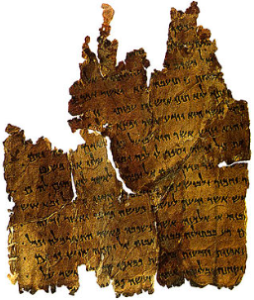
Part of the Damascus Document, a fragment from
the Dead Sea Scrolls that addresses qualifications
for membership in and leadership of the Qumran
community (thought to have been Essene).
Both parts of that argument seem to me to be remarkably silly, for several reasons. We can begin with the implied premise that we would expect little to no stylistic variation among the Pauline epistles if they were really all written by the same man. First of all, that’s not true! I am not the first person to make this point!—especially since the letters in question were (judging from both internal and external evidence) written over a span of about twenty years. We might expect anybody’s style to evolve a bit over that much time and, according to both internal and external reports, that many changes of circumstances.
I’m also not the first to point out that, if you took the incredibly oversensitive criteria for what word usages or sentence lengths prove forgery, and applied those criteria to modern authors whom we know were single individuals, dozens if not hundreds of them would get declared multiple people. Look at Tolkien. Not only would The Hobbit and The Lord of the Rings demand different authors, with all their stylistic inconsistencies and divergent words for the same thing; you’d probably need at least three or four authors just to account for the variation within Rings itself—and then, to account for the tradition that they were all a single person, we’d probably get one final extra forger, or “redactor” (as manuscript critics occasionally spell it). And heaven only knows how many C. S. Lewises we’d reach in the end,2 even if we restricted ourselves to the Chronicles of Narnia and entirely ignored both his theological writings and his professional works!
But let’s pretend for a moment that that is how writing works. Well, here is a list of the epistles that mention only St. Paul as their author:
- Ephesians
- I Timothy
- II Timothy
- Titus
That’s it. Every other Pauline letter alludes to someone else, or multiple someones else, helping to write it—a secretary at the very least; for example, when I was first drafting this, I mistakenly thought Romans made the cut, but nope! I was forgetting Romans 16:22: “I, Tertius, who wrote this epistle, salute you in the Lord.” Sometimes the assistants are of the vaguest, as in Galatians (which is by “Paul, an apostle … and all the brethren which are with me”), but in most cases they’re explicitly named: St. Timothy appears as a co-author in II Corinthians, Philippians, Colossians, and Philemon; Sosthenes, who may or may not be the Sosthenes of Acts 18:17, is mentioned as a co-author of I Corinthians; and both Timothy and Silvanus (a.k.a. Silas, Paul’s mission-buddy after he and St. Barnabas parted ways) apparently co-wrote both letters to Thessalonica. So we presumably ought to expect a certain sort of variability between the Pastorals and the other Pauline epistles anyway.
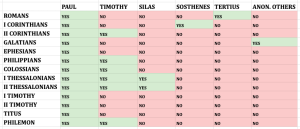
The authorship information from the
paragraph above, in chart form.
On top of which, we ought to expect that anyway anyway, because the Pastorals, unlike every other professedly Pauline letter, are addressed specifically to two of his protégés in, and on the subject of, ministry (i.e. working in it, not just as a thing that exists). That isn’t a topic that directly comes up much in any of his other writings. You might as well argue that all the claimed letters of Paul are forgeries because they’re so unlike the Pauline homilies recorded in the Book of Acts, while ignoring the fact that the audiences, topics, and circumstances of these things are all different from one another.
As for the argument that the content shows the Pastorals to be too late to be Pauline, because (they claim) the Church was less hierarchical at first, or because the various Gnostic schools hadn’t developed yet … I mean, have these people heard the definition of a circular argument? The New Testament, along with some of the earliest Patristic literature, like the Didache and First Epistle of Clement, are our primary sources on what was going on the first-century Church. Surely it stands to reason that we should get our idea of its atmosphere from them? On what basis is the first century Church assumed to be without hierarchy?—which is not what we would expect from its Judaic antecedents, nor from the subsequent history of Christianity, which appears with a full panoply of tiered authorities as early as the second century. And while I’m not claiming that any of the Gnostic movements were fully formed when the New Testament was written, they wouldn’t have to be for there to be proto-Gnostic, syncretic tendencies among some Christians that far back. Honestly, it would be extremely normal if there were—they’d be the sort of thing that, you know, could develop into Gnosticism in a few decades?
A Celtic cross from Brompton Cemetery, London.
Photo by Flickr user Tracy, used under
a CC BY 2.0 license (source).
Anyway. Let’s turn to our texts.
II Timothy 4:6-8, 9-15, 16-18, RSV-CE
For I am already on the point of being sacrificed;a the time of my departure has come. I have fought the good fight, I have finished the race,b I have kept the faith. Henceforth there is laid up for me the crown of righteousness,c which the Lord, the righteous judge, will award to me on that Day, and not only to me but also to all who have loved his appearing.
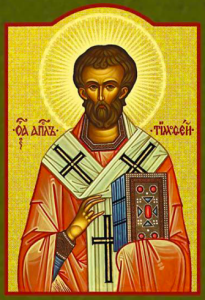
Ikon of St. Timothy (date
and provenance unknown).
Do your best to come to me soon. For Demas,d in love with this present world, has deserted me and gone to Thessalonica;e Crescensd has gone to Galatia,e Titusd to Dalmatia.e Luked alone is with me. Get Markd and bring him with you; for he is very useful in serving me. Tychicusd I have sent to Ephesus.e When you come, bring the cloak that I left with Carpusd at Troas,e also the books, and above all the parchments. Alexander the coppersmithe did me great harm; the Lord will requite him for his deeds. Beware of him yourself, for he strongly opposed our message. At my first defense no one took my part; all deserted me. May it not be charged against them!f But the Lord stood by me and gave me strength to proclaim the word fully, that all the Gentiles might hear it.g So I was rescued from the lion’s mouth. The Lord will rescue me from every evil and save me for his heavenly kingdom. To him be the glory for ever and ever. Amen.
II Timothy 4:6-8, 9-15, 16-18, my translation
For I am already becoming a libation,a and the moment of my untethering is here. I have fought the good fight, I have finished the race,b I have maintained the faith; for the rest, the crown of righteousnessc has been laid away for me, which the Lord will give back to me in that day—the just judge—not only to me, but also to all that have loved his appearance.
Hasten to come to me quickly; for Demas,d who loves this age, left me behind and went to Thessalonica,e Crescensd to Galatia,e Titusd to Dalmatia;e Luked alone is with me. Pick Markd up and bring him with you, for he is very useful to me in service. I sent Luckyd to Ephesus.e The cloak, the one I left in Troase with Carpus,d bring it when you come, and the books, most of all the parchments. Alexander the coppersmithd displayed much badness to me; the Lord will give back to him according to his works; you too be on your guard about him, for he stood exceedingly against our words.
In my first defense, no one came with me, but they all left me behind (may that not be reckoned to them);f yet the Lord stood with me and empowered me, in order that through me, the proclamation might be fulfilled and all the nations hear it,g and I was drawn from the lion’s mouth. The Lord will draw me out from every oppressive work, and will save me for his heavenly kingship; to him be the glory into ages of ages. Ameyn.

Part of Dalmatia (cf. note e below). Photo by
Wikimedia contributor Marin0110, used under
a CC BY-SA 4.0 license (source).
Textual Notes
a. on the point of being sacrificed/becoming a libation | σπένδομαι [spendomai]: A libation, or drink offering, is a particular form of sacrifice (most typically of wine in the ancient world, though libations are also known with other alcoholic drinks, olive oil, honey, milk, and even clarified butter). In the Torah, drink offerings using wine or olive oil are prescribed, usually as elements in other offerings: for grain offerings, flour would be mixed with oil and baked into “cakes,” for example, though in reality these were probably something more like naan than the stuff Americans associate with the word “cake”! In Greek religious practice, it was common to make a libation—usually in honor of the dead—from the first kylix3 of wine at a meal by tilting it so as to let a single drop fall.
b. I have finished the race | τὸν δρόμον τετέλεκα [ton dromon teteleka]: The footrace was one of the events in the ancient Olympic games, and is a motif St. Paul uses in several places. Incidentally, the word δρόμος [dromos] (appearing here as δρόμον, the accusative form) is where we get the suffix –drome in words-slash-names like “Hippodrome,” which originally meant “horse-race [stadium]” (Gr. ἵππος [hippos] “horse”).
Interior of the Colosseum, Rome (1832), by
Thomas Cole. When this was painted, the
Papal States were still in control of the city,
hence the Stations of the Cross shown here.
c. righteousness | τῆς δικαιοσύνης [tēs dikaiosünēs]: Δικαιοσύνη is a rather frustrating word, because it’s not difficult to understand or, in a sense, to translate, but it’s hard to translate well, and it is (pretty naturally) extremely frequent in the New Testament. It derives, via δίκαιος “just,” from the noun δίκη [dikē], “justice”; -σύνη (sometimes appearing in loans to English as -syne) is a common nominalizing suffix in Ancient Greek, roughly equating with our –ness—a parallel appears in the name of another virtue, σωφροσύνη [sōfrosünē], i.e. “temperance, moderation, sensible restraint.” The difference between δίκη and δικαιοσύνη is thus, linguistically, very like the difference between right and righteousness: so far, so good.
But we hit a snag, because of course we do. This is English; it isn’t just going to give us things, that would only encourage us. See, δικαιοσύνη is a social virtue: it centers on giving others their due, whatever that may be. I’ve never had the impression that, to most English speakers, “righteousness” has any very particular meaning, perhaps partly because “right” (outside of a few specific contexts) is a generic synonym for “good, morally correct.” Moreover, not only is “righteousness” rather vague, it bears no etymological relationship in English to words that are etymologically linked in the Greek, like “justice” (Gr. δίκη) or “justify” (Gr. δικαιόω [dikaioō]).
This would in theory point us to the alternate translation, “justice,” but this has its own problems. You can describe a person as “just” in English—in theory; but we don’t really use the word “justice” as the name of a personal virtue most of the time. Normally it either means justice as an abstraction, or has to do with the judicial system. And though it is a possible (if ugly) root + suffix combination, “justness” doesn’t seem like it fixes the problem.

A modern sofer (Torah scribe) at work on a copy
of the Torah in 2015; soferim still work by hand.
Photo by Wikimedia contributor Spaceboyjosh,
used under a CC BY-SA 4.0 license (source).
There are a few alternatives I’ve toyed with. “Honesty” and its related terms are far too narrow, and not quite on target in the first place; “integrity” is closer, but its related terms have gone their own ways in English (“integrate” and “integrated” can be stretched to cover something moral with some special pleading, but “integer” really isn’t going to coöperate).4 But, as my rendering shows, I have yet to decide on any satisfying resolution here. Note that another related term appears in the Gospel text, discussed briefly in textual note j.
d. Demas … Crescens … Titus … Luke … Mark … Tychicus/Lucky … Carpus … Alexander the coppersmith | Δημᾶς … Κρήσκης … Τίτος … Λουκᾶς … Μᾶρκον … Τυχικὸν … Κάρπῳ … Ἀλέξανδρος ὁ χαλκεὺς [Dēmas … Krēskēs … Titos … Loukas … Markon … Tüchikon … Karpō … Alexandros ho chalkeus]: This long string of mostly-unfamiliar names is probably why this bit was cut from the lectionary! (Which makes a certain amount of sense, but I don’t have to like it.) Let’s take them one at a time.
• Demas (if it is the same person, a key assumption to several of these entries) is mentioned here and in Colossians and Philemon. In those letters he is described as a fellow worker in Paul’s ministry, but his description here implies that he deserted the mission—unless, of course, Paul is being sarcastic. I float this possibility not at random, but because there seems to be no rebuke here against Crescens or Titus, although they too have left. As far as I could tell, nothing further is known about Demas.
• Crescens—a Latin name like Titus and Marcus, adapted for Greek noun patterns as Kreskes—is venerated in the Eastern Orthodox Church as one of the Seventy, who were apostles in a wider sense than the Twelve (and were sent out by Jesus after the mission of the Twelve, an episode described in Luke 10).5
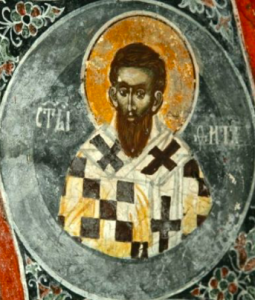
Anonymous 14th-c. ikon of St. Titus.
• Titus, though not an unusual name, is presumed to be the same person to whom the Epistle to Titus was written, who was the first Bishop of Crete.
• Luke is by all accounts the Evangelist.
• Mark is a bit of a problem. Some commentators see in this the healing of the rift that had opened not only between SS. Paul and Mark the Evangelist, but even between SS. Paul and Barnabas, recounted in Acts 15; and we do know from Colossians that this rift was in fact healed. However, “Mark” (in its various forms) was one of the commonest names of the period, so we can’t be sure that this passage is about the same man. According to Eastern Orthodox traditions, there were two or three different members of the Seventy who all had the name Mark. (That said, if it is the same Mark, it’s striking that he is thus juxtaposed with Demas, assuming Demas’ departure is read as a desertion.)
• Tychicus (or “Lucky”—the name derives from Τύχη [Tüchē], or Tyche, the Greek equivalent of the Roman Fortuna) was a long-time, loyal companion of St. Paul’s. He first comes up in Acts, which states that he was from the province of Asia, i.e. western Anatolia. He is also mentioned in Ephesians and Colossians, and probably brought those letters to those churches,7 as well as in Titus. It’d be fun, and would certainly explain his lasting fidelity to Paul, if he were the same person as the similarly-named Eutychus, whose story is related in the same chapter of Acts Tychicus first appears in; however, I have no evidence for this except the similarity of the names.8
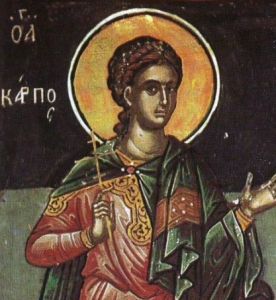
Detail of an ikon depicting St. Carpus of
Beroea (date and provenance unknown).
• Carpus is thought to be St. Carpus of Beroea (modern Veria) in northern Greece, basically at the upper left corner of the Ægean; like Crescens and Mark, he is reputed to be one of the Seventy. (I wondered briefly whether Carpus might be short for Polycarp—Κάρπος for Πολύκαρπος [Polükarpos]—a disciple of St. John who was the Bishop of Smyrna until his martyrdom in 155 at the age of eighty-six; however, St. Polycarp was not born until a year or two after Paul’s death, so I assume he wasn’t in charge of anybody’s cloak at that point.)
• Alexander the coppersmith (not to be confused with Demetrius the silversmith, the guy who instigated the pro-Artemis riot in Ephesus recorded in Acts 19) was, evidently, a coppersmith named Alexander. There are Alexanders (Alexandri?) mentioned in Acts 19 and I Timothy 1: the first was an Ephesian Jew, the second a Christian whom Paul had “handed over to Satan,” i.e. excommunicated. The name was not uncommon, and it’s unclear whether either or both of these people were the same as one another or Alexander the coppersmith. It’s possible that Paul mentions his profession as a distinguishing mark, lending slight weight to the view that this Alexander differs from the one in I Timothy, at least.
e. Thessalonica … Galatia … Dalmatia … Ephesus … Troas | Θεσσαλονίκην … Γαλατίαν … Δαλματίαν … Ἔφεσον … Τρῳάδι [Thessalonikēn … Galatian … Dalmatian … Efeson … Trōadi]: As above, but this time, place names.
• Thessalonica—modern Thessaloniki, Greece—was a city quite close to Beroea. Two of St. Paul’s epistles, generally considered his earliest (indeed, some of the earliest documents in the New Testament) were addressed to this city. It had been founded about 350 years earlier by Cassander, the Macedonian successor of Alexander the Great, and became one of the most important cities in the Ægean; it later served as a regional administrative capital under the Romans. I can’t at the moment find the reference, as it’s in a six-hundred-page book with a strikingly bad index, but I’ve read that for some centuries after the Empire was Christianized, the bishops of Thessalonica were something like papal representatives in the East.9
• Galatia probably means the Roman province of Galatia in north-central Anatolia, though the name could also refer to the larger, more loosely defined center of the peninsula. This was so named because it had been settled by Gallī, “Gauls”: in other words, Celts. St. Paul had evangelized Galatia (in the regional sense) personally, in the cities of Antioch-in-Pisidia, Derbe, Iconium, and Lystra, and probably addressed the epistle of that name to them, seemingly either shortly before or shortly after the Council of Jerusalem.
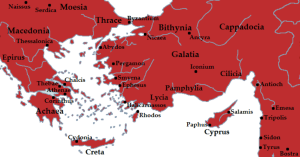
Selection from a map of the Roman Empire in the
first century; the province of Asia (unlabeled) is
in the center. Original map by Tataryn, used
under a CC BY-SA 3.0 license (source).
• Dalmatia is roughly synonymous with the coastal part of modern Croatia; the name is thought to have been derived from an Illyrian tribe called the Dalmatæ, meaning something like “the shepherds.” The distinctive vestment worn by deacons and subdeacons, the dalmatic, is named after this region. (And yes, it is where Dalmatians come from.10)
• Ephesus was the provincial capital of Asia, which then referred to roughly the western one-third of Anatolia.11 Ephesus was just about in the center of the western coast, in what is now the Turkish province of Izmir, and was a thriving center of trade—and of the local version of Artemis, whose temple in that city was one of the classical Seven Wonders of the World. Unfortunately for the Ephesians, over time, their harbor silted up to the point of uselessness, and the city was abandoned; its ruins now lie a few miles inland.
• Troas means one of two things, almost certainly the second. The first is the Troad, a small region in northwestern Anatolia held to be the former domain of Troy (a tradition proven correct in the nineteenth century by Heinrich Schliemann). The ancient Troad is roughly equivalent to the modern Turkish province of Çanakkale. The likelier possibility is Alexandria Troas, or Alexandria-in-the-Troad—which, hilariously, even though it was not one of the seventeen cities Alexander the Great named for himself, was named after him, by somebody else (around when Thessalonica was founded). Nonetheless, given how many cities were named “Alexandria,” only the Egyptian one was regularly referred to by that name. This one would have been “Troas” to most people most of the time.
f. the Lord will requite him for his deeds … May it not be charged against them!/the Lord will give back to him according to his works … may that not be reckoned to them | ἀποδώσει αὐτῷ ὁ κύριος κατὰ τὰ ἔργα αὐτοῦ … μὴ αὐτοῖς λογισθείη [apodōsei autō ho kürios kata ta erga autou … mē autois logistheiē]: At first blush, these two sentences are very oddly juxtaposed. The distinction, I think, lies in the differing moods of the two verbs, which thankfully does go neatly into English! The first verb, ἀποδώσει (“will requite/give back to”), is an indicative, the kind of verb generally used for statements of fact. The second, λογισθείη (“may [it] be charged/reckoned to”), is an optative, a verb form which expresses hopes or desires. (Optatives are comparatively rare in the New Testament, occurring mainly in Luke and Paul; in the Koiné period of Greek, when it had become an international language, some grammatical forms had been simplified, and the optative was the least-used and least-necessary of the four verbal moods Greek possessed, so it was the easiest for second-language speakers to do without.)
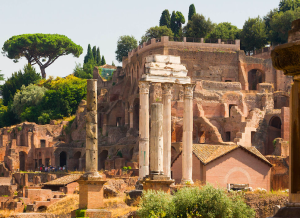
Part of the ruins of the Roman Forum, viewed
through the Arch of Septimius Severus. Photo
by Wikimedia contributor Jabulon.
g. to proclaim the word fully, that all the Gentiles might hear it/the proclamation might be fulfilled and all the nations hear it | τὸ κήρυγμα πληροφορηθῇ καὶ ἀκούσωσιν πάντα τὰ ἔθνη [to kērügma plēroforēthē kai akousōsin panta ta ethnē]: This is rather an interesting remark on St. Paul’s part. It seems to be equating the proclamation of the gospel in Rome with its proclamation to every Gentile people. Now, this was certainly either hyperbole or symbolism on his part; the ancients knew perfectly well that there were people north of the Danube, south of Ifriqiya, east of Alexandropolis, and west of the province of Britannia. (Indeed, it would have been difficult not to, since assorted Gothī, Garamantēs, Indī, and Scotī12 periodically crossed the borders of the Roman world for purposes of trade, warfare, or both!) The city of Rome wasn’t even the edge of the Empire, but its heart, geographically as well as conceptually—Paul himself speaks a few times in his letters about hoping at some point to proceed on a missionary trip to Hispania. Yet this may carry an echo of the two ends of Acts.
In its first chapter, Jesus tells the Apostles that “ye shall be witnesses unto me both in Jerusalem, and in all Judæa, and in Samaria, and unto the uttermost part of the earth.” The book opens following Peter in Jerusalem—beginning almost immediately (chapter 2) with Pentecost, during which Roman visitors are explicitly mentioned—and then in Judæa more broadly. By chapter 8 we see Samaria evangelized. Then we come to the conversion of Paul to the Church, the opening of the Gentile mission under Peter’s auspices, the consecration of Paul to that mission, its beginnings, and its full validation at the Synod of Jerusalem (c. 49). Thus far, we have been in Asia,13 mainly in Syria, Cyprus, and Asia Minor; these are regions fairly close to Judæa and Samaria. But the Pauline mission continues to thrive and expand, crossing the continental border into Europe in Acts 16. Though we do not directly witness the beginnings of Christian Egypt, in chapter 18 we meet Apollos, a Christian from Alexandria, which thus confirms the gospel to have come to all three continents (as they were known to inhabitants of the first-century Empire). A few chapters later, having already voiced his determination to preach in Rome, Paul—in fear for his life after outraging the Sanhedrin, or spotting an opportunity to reach the city, or both—appeals to Cæsar; and in Acts 28, at last, “so we came to Rome.” Being the capital of nearly the whole known world, it would have served eminently well as a symbol for “the uttermost part of the earth”: if the gospel was preached there, it was hardly going to fail to reach everywhere that was still left.
Luke 18:9-14, RSV-CE
He also told this parable to some who trusted in themselves that they were righteous and despised others: “Two men went up into the temple to pray, one a Pharisee and the other a tax collector. The Pharisee stood and prayed thus with himself, ‘God, I thank thee that I am not like other men, extortioners,h unjust, adulterers, or even like this tax collector. I fast twice a week,i I give tithes of all that I get.’ But the tax collector, standing far off, would not even lift up his eyes to heaven, but beat his breast, saying, ‘God, be merciful to me a sinner!’ I tell you, this man went down to his house justifiedj rather than the other; for every one who exalts himself will be humbled, but he who humbles himself will be exalted.”
Luke 18:9-14, my translation
And he spoke to certain people, who were persuaded of themselves that they were just and made nothing of the rest, with this analogy: “Two people went up into the Temple to pray, the one a Pharisee and the other a tax-farmer. Standing, the Pharisee prayed these things to himself: ‘God, I thank you that I am not like the rest of these people—greedy,h unjust, adulterers, or even like this tax-farmer; I fast twice a week,i I tithe from everything I possess.’ The tax-farmer, standing a long way off, did not want to lift no eyes to heaven, but beat on his chest, saying, ‘God, be appeased for me, a sinful person.’ I tell you, this [latter] went down justifiedj to his house over that [other] one: because everyone who lifts himself up will be brought low, while he who lowers himself will be lifted up.”
Textual Notes
h. extortioners/greedy | ἅρπαγες [harpages]: This is an elaboration of an older adjective, ἅρπαξ [harpax], meaning “ravenous, rapacious, apt to snatch; thieving.” The name of the mythological Harpies is related; the Harpies were supposed to be shaped like birds, with the heads of young women—lovely young women, according to Hesiod, but most other authors make them hideous. (Readers of either classical poetry or modern detective stories may recognize the lines below.)
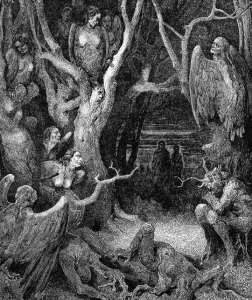
Harpies haunting the Wood of the Suicides,
an engraving (1861) for Inferno, Canto XIII,
by Gustave Doré.
Tristius haud illīs monstrum nec sævior ūlla
pestis et īra deum Stygiīs sēsē extulit undīs.
Virgineī volucrum vultūs foedissima ventrīs
prōluviēs uncæque manūs et pallida semper
ōra fame.
Scant a more bitter monster, or a plague
more savage, hath gods’ wrath from waves of Styx
drawn out. The girl-faced birds discharge a filth
most vile; their hands are claws, and ever wan
their lips with hunger.14
i. I fast twice a week | νηστεύω δὶς τοῦ σαββάτου [nēsteuō dis tou sabbatou]: One of the most ancient extra-Biblical Christian writings, the Didache or “Teaching of the Twelve Apostles,” says that Jews in the first century habitually fasted on Mondays and Thursdays. At least, scholars generally assume that the Jews are what is meant in Did. 8:1-2:
And let not your fastings be with the hypocrites, for they fast on the second and the fifth day of the week [i.e., Monday and Thursday]; but do ye keep your fast on the fourth and on the preparation (the sixth) day [Wednesday and Friday].
Now, American culture is in kind of a bad place about this sort of thing right now, so let it be stated frankly of the Didache‘s use of “the hypocrites” to mean Jews: YIKES. That said, let’s continue.
Assuming the Didache is (otherwise) correct, I’m not sure why Monday and Thursday were selected as fast days—though I notice that they’re two days after and two days before the sabbath, so there’s a nice balance there. As for the ancient Christian selection of Wednesday and Friday, bumping the fasts each forward a day, as the sabbath had been bumped forward a day, would have been simplicity itself, and Friday’s character as a penitential day is established by its clear ties to the Passion; but the author or authors of the Didache evidently decided not to switch from Monday to the day after. I have spent literal years scratching my head over the apparent exemption of Tuesday, and come up with nothing. The only explanation I’ve come across for Wednesday being brought in is that Matthew 26 suggests that Judas sought out the Sanhedrin on the Wednesday preceding Good Friday (hence the “Spy Wednesday” service during Holy Week, known formally as Tenebræ, “shadows”). It does make a certain amount of sense that the day of this apostle’s treachery should be perennially associated with penance thereafter—but I’m not sure I buy it; I feel like there’s something off, or missing, about that explanation. Certainly it fails to line up with the Johannine parallel to Matthew 26, John 12:1-11, which implies that Judas’ decision was taken on a sabbath, not a Wednesday. (I will venture, pursuant to my series on sacred time from almost a year ago now, to point out that Wednesday and Friday are the days associated with those two classical planets, Mercury and Venus, which lie between the Earth and the Sun—whatever that might represent.15)
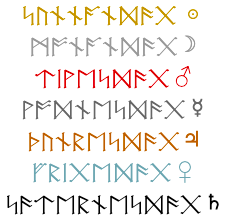
The Anglo-Saxon names of the days of the week,
written in fuþorc, followed by the symbols of
the classical planet for which each day is named.16
j. justified | δεδικαιωμένος [dedikaiōmenos]: Since most of the complex of words related to δίκη can be translated best as words related to “justice,” I’ve gone with “justified” here. “Vindicated” or “exonerated” would also be possible translations, though “justified” more or less covers the former sense in this case.
Footnotes
1It should be noted that words like “forged” and “forgeries” are not well-liked by New Testament critics; they prefer to speak and write about pseudepigraphical works, or pseudepigrapha (Greek words which mean “forged” and “forgeries”). Some of them will hold forth at length about how pseudepigraphy was not necessarily dishonest in classical antiquity, any more than writing a novel in the first person is dishonest—nobody calls Suzanne Collins a liar for writing “as” Katniss Everdeen in The Hunger Games. I was persuaded by this argument myself for a while, but there are two serious snags in it. One is that The Hunger Games is and always was marketed as fiction. The same cannot be said about any of the Pauline Epistles, especially not the Pastorals: if forged at all, these were forged with a serious (and, until the nineteenth century, successful) effort to deceive. In the very passage here translated, St. Paul (or whoever) gives directions about whom to collect parchments and a cloak from; people don’t write that sort of thing “for edification”!—either that is an instruction given because it was practical, or it is a pointless detail added purely to make a fake convincing. And the other is that, to the primitive Church, far from being an accepted convention that did no harm, pseudepigraphy was absolutely a mark against accepting a work as sacred Scripture. Trying to arrogate the authority of the Apostles when you weren’t one was considered, you know, lying, an activity about which the Bible in general and the New Testament in particular have some choice words to say. Part of the reason documents like the Apocalypse of Peter and the Epistle of Barnabas weren’t accepted into the canon was precisely that they were widely known to be forgeries, while on the other hand, uncertainty in some circles about their authorship was why books like Hebrews and II Peter took longer than the rest of the New Testament to gain universal recognition as canonical.
2For any who choose to follow the link and read my old “From a Thirty-Second Century Dissertation” parody piece, I will say only that while the first commenter is of course entitled to his opinion, I am absolutely bewildered by the claim that these views were then (or are now) “Trumpist.” To the best of my knowledge, neither Trump nor most of his partisans have strong views about the authorship of any New Testament book; given their undisguised scorn and hatred for the vast majority of what it contains, one would hardly expect them to.
3A kylix (from κύλιξ [külix]) was a type of drinking bowl, mostly used for wine. (Most drinking vessels were bowls; cups proper were uncommon in the ancient world.)
4Yes, in this house we do maintain the New Yorker diaeresis, because it is a good idea for making English more legible and one of our few uses of any diacritic, and getting rid of it is frankly an insane move.
5The number twelve is widely recognized as symbolizing the children of Israel, according to the sons of Jacob by his two wives, Leah and Rachel, and two concubines, Zilpah and Bilhah (see the nested footnote about the colored type6). The same is true of the number seventy, though it was used far less often; with a little room for rounding, it was the number of Jacob’s full male-line clan—Jacob, the Twelve Patriarchs, and the Patriarchs’ sons—when they accepted Joseph’s invitation to migrate to Egypt, during the famine of Genesis 41ff. The transition from the mission of the Twelve in Luke 9:1-6 (parallel to Matthew 10 and Mark 6:7-13) to the mission of the Seventy, found only in Luke (10:1-24), thus suggests a claim on Jesus’ part to be constituting a “new Israel,” one that is already proving fruitful. It may also allegorically foreshadow the parting of this “new Israel” from “the land of Israel” (i.e. the separation of the visible Church from the Jewish people, such that most Jews are not Christians and most Christians are not Jewish)—though the New Testament also promises a reunion of the two in the end.
6These twelve sons are, in their birth order (color-coded by their mothers): Reuben, Simeon, Levi, Judah, Dan, Naphtali, Gad, Asher, Issachar, Zebulun, Joseph, and Benjamin. Joseph is conventionally split into the two tribes (a.k.a. half-tribes) Manasseh and Ephraim, Joseph’s twin sons. It is noticeable in the tribal allotments in Joshua that the center of the country—near the sacred cities of Bethel, Jerusalem, and Shiloh—is reserved for Jacob’s favorites, Benjamin, Ephraim (Jacob himself was the younger of a pair of twins), and Judah: Benjamin and Ephraim are descended from Jacob’s favorite wife, Rachel, while Judah is the honorary firstborn of his senior wife, Leah. The rim of the Promised Land is given to the concubines’ sons, Dan, Naphtali, Gad, and Asher, plus the chronological firstborn, Reuben (who disgraced his father by sleeping with his concubine Bilhah). The two next-eldest, Simeon and Levi—who, for a sympathetic reason (avenging the rape of their sister), nevertheless fully torched their family’s honor in Canaan by betraying and massacring the Shechemites—are not banished to the periphery, but they are scattered among the land of other tribes. Finally, Issachar, Zebulun, and the half-tribe of Manasseh are placed between the rim and the center. (By the time of Christ, Benjamin, Judah, and Levi seem to have been the only tribes in Palestine that still had a strong identity within mainstream Judaism; some Samaritans maintain to this day that they are Ephraimites, as do some Jews in Iran and India.)
7At first, I assumed Tychicus would also have delivered the Epistle to Philemon. However, looking at its text and particularly the closing salutations, there is no mention of Tychicus, even though the letter to Colossæ (where Philemon lived) indicates that he was traveling with Onesimus. Some readers may recall that Onesimus was a runaway slave of Philemon’s: in Rome, Onesimus met St. Paul and eventually converted; Paul then sent him back to his old master (for slaves to run away was against the law, likely putting Paul in a delicate position), but also sent along his request that Philemon free Onesimus and let him go back to Paul in turn. This makes it sound like Onesimus had to—or, who knows, volunteered to—bring the letter to Philemon with his own hand. (Subsequent traditions state that Philemon, along with Apphia, Archippus, and Onesimus himself, were martyred in Colossæ during the Neronian persecution, which began only a few years after the letter was written.)
8It would not be completely unlike Luke to mention a person in a story and only hint at their identity; if the conventional interpretation of the “sinful woman” of Luke 7 is correct, his mention of St. Mary Magdalene just afterward (Luke 8:2) fits this pattern. However, it is at least equally probable that two guys, one named Tychicus and another named Eutychus, existed at the same time and both met Paul.
9Most of modern Greece was part of the ecclesiastical province of Rome until the eighth century, when Emperor Leo III confiscated it for Constantinople during the First Iconoclasm. The iconoclasts were condemned at the Second Council of Nicæa in 787, and the movement permanently defeated in 843 by Empress Theodora; however, the ecclesiastical irregularity perpetrated by Leo III was never corrected.
10I mean, originally. Not all Dalmatians are from Dalmatia today. I don’t think.
11The name Asia may derive remotely from Assuwa, the name of an ancient Anatolian confederacy that was a vassal of the Hittite Empire in the fifteenth century BC, located in roughly the same region as the later Kingdom of Lydia.
12Gothī, Garamantēs, Indī, and Scotī refer in Latin respectively to the Gothic peoples of northern Europe, a people of the northern Sahara who may have been related to the Berbers, the inhabitants of India, and the Irish. (These four groups were not literally the only ones beyond the boundaries of the Roman Empire that the Romans knew about, of course! They’re just convenient exemplars.)
13The continents of Africa, Asia, and Europe were already established geographical ideas in antiquity; the divisions between the three were held to be the Mediterranean, Black, and Red Seas (the Mediterranean demarcating the Afro-European boundary, the Black the Euro-Asiatic, and the Red the Afro-Asiatic). Of course, this neat schema was spoilt a little by the later discovery that, whereas the Red Sea goes on south to open on the Indian Ocean, which will certainly do for a continental boundary, the Black Sea is a hydrological cul-de-sac; the gigantic, unbroken expanse of what is now Russia renders almost any attempt to draw a primarily geographic line between Asia and Europe a bit silly.
14The text is Virgil’s Æneid III.214-218. This comes from a passage describing one of the early hardships encountered by Æneas and his crew, refugees from the sack of Troy: an attack by the Harpies, who stole or befouled much from their supplies. These lines appear as a significant quotation in the novel Gaudy Night by Dorothy L. Sayers, which is set principally in a women’s college at Oxford University. (The translation is my own.)
15It may be edifying to note the symbolic values assigned to the planets in Dante’s Paradiso. It was recognized in Medieval astrophysics that, because the Sun is larger than the Earth, the latter had not a cylindrical but a conical shadow, extending many millions of miles “behind” it in space—the Earth’s “front,” for these purposes, being wherever the Sun was at the moment. This shadow was considered to be capable of falling on the Moon (as it does during lunar eclipses), Mercury, and Venus, but no further. Dante makes these three spheres the heavenly abodes of those who did die in the grace of God, but whose merits were lessened by some grave, chronic sin. Breaking religious vows—e.g., caving to family pressure by forsaking one’s vows as a nun and marrying—is matched with the variable light of the Moon; Dante pairs worldly ambition with Mercury, a planet which is usually invisible beside the light of the Sun; and undue preoccupation with earthly loves is placed in Venus. (These defects can be generalized as: failure to pursue one’s vocation; pursuit of one’s vocation, marred by a preoccupation with self; and pursuit of one’s vocation, marred by a preoccupation with others, the least-culpable and most nearly heaven-like of these flaws.) This may prompt the question of why Monday isn’t a fast-day too. Well, on the one hand, we know this wasn’t the origin of the Wednesday-Friday fasting custom—that was established over a thousand years before Dante set pen to paper. Yet it is an interesting coincidence that, in some monastic houses in the Christian East, Mondays are kept along with Wednesdays and Fridays as penitential days.
16To be clear, every use of Anglo-Saxon runes on this blog is based on my extremely amateur knowledge of the system! This is me looking up the value of each rune and reverse-engineering how to spell words, purely for fun; I’m not taking the names from inscriptions or anything like that. I am the bolder to have this sort of fun because Anglo-Saxon didn’t have standardized spelling, so a little variation from whatever the commonest forms were is, I assume, acceptable. As for the colors, they correspond to the metals the classical planets were associated with: gold for the Sun, silver for the Moon, iron for Mars, mercury for oh come on, tin (an ingredient in bronze) for Jupiter, copper for Venus, and lead for Saturn. (Mars and Venus are both tinted according to their metals’ natural forms of tarnish, i.e. rust and and verdigris.)











 Ad-Free & Subscriber Log-In