

You can find my two-part introduction to the Gospel of John at these two links, and my index/outline for it here; for the previous installment on John 1:29-42, go here.
The Beginning of the New Cosmos, Part III (John 1:43-51)
Verse 43 brings us to the fourth day of the “new creation” sequence. Two more apostles, SS. Philip and (by most accounts) Bartholomew, are called, and the connection of Jesus’ ministry with the Galilee begins.
John 1:43-51, RSV-CE
The next daya Jesus decided to go to Galilee.b And he found Philipb and said to him, “Follow me.” Now Philip was from Bethsaida,b the city of Andrew and Peter.c Philip found Nathanael,b and said to him, “We have found him of whom Mosesb in the law and also the prophets wrote, Jesus of Nazareth,b the son of Joseph.”b Nathanael said to him, “Can anything good come out of Nazareth?”d Philip said to him, “Come and see.”e Jesus saw Nathanael coming to him, and said of him, “Behold, an Israelite indeed, in whom is no guile!”f Nathanael said to him, “How do you know me?” Jesus answered him, “Before Philip called you, when you were under the fig tree, I saw you.”g Nathanael answered him, “Rabbi, you are the Son of God! You are the King of Israel!”b, h Jesus answered him, “Because I said to you, I saw you under the fig tree, do you believe? You shall see greater things than these.”i And he said to him, “Truly, truly,j I say to you, you will see heaven opened, and the angels of God ascending and descending upon the Son of man.”k
John 1:43-51, my translation
The next day,a he wanted to go to the Galilee.b And Yeshua finds Philipb and says to him, “Follow me.” (Philip was from Beyt Tzayadh,b of the city of Andre and Rocky.c)
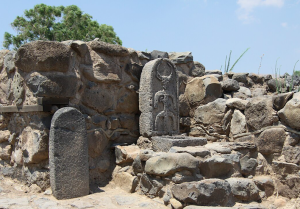
Ruins of the city gate of Beyt Tzayadh in 2011.
Photo by Petr Brož, made available under
a CC BY-SA 3.0 license (source).
Philip finds Nethanelb and tells him: “Him that Mosheb wrote about in the law, and the prophets—we have found him, Yeshua son of Yousef,b who is from Natz’rath.”b
But Nethanel said to him, “Can something good come from Natz’rath?”d
Philip tells him, “Come and look.”e
Yeshua saw Nethanel coming towards him, and says about him: “Look—truly, an Israelite, in whom there is no guile.”f
Nethanel says to him, “Where do you know me from?”
Yeshua told him in reply, “Before that Philip called out to you, while you were under the fig tree, I saw you.”g
Nethanel replied to him: “Rabbi, you are the son of God, you are king of Yisra’el.”b, h
Yeshua said to him in reply, “Because I said to you that I saw you underneath the fig tree, you have faith? You will see greater things than that.”i And he says to him: “‘Amin, ‘aminj I tell you, you will see heaven opened and the messengers of God going up and going down upon the Son of Man.”k
Textual Notes
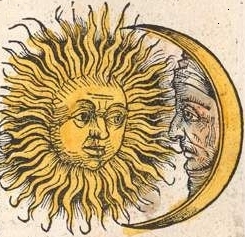
a. The next day | Τῇ ἐπαύριον [tē epaurion]: This, then, is the fourth day of this new creation. The fourth day in the first creation is that of the creation of the sun, the moon, and the stars, which illuminate the earth by day and night (so that darkness is never absolute in creation again) and also afford us a means of measuring time in terms of “signs, seasons, days, and years.” Though the idiom is archaic, this is still how we measure time today—hours and years align with two kinds of (apparent) solar motion, while the week and month are traceable to the lunar cycle.1 (Interestingly, the sun and moon are not given names here in Genesis; this suggests that it is Adam who named them, emphasizing their status as servants of mankind, not the divinities other cultures—especially in Mesopotamia—treated them as.)
What this has to do with the calling of the two new apostles, I’m not sure. Moonlight is reflected sunlight, and Nathanael is brought to Jesus by Philip; that analogy is a bit weak, as it doesn’t seem to tell us much in comparison with the lessons of the last three days. Moreover, it’s perhaps a little spoilt by the exact same relation existing between Andrew and Peter, but without association with this “day of the luminaries.” However, all of this may be barking up the wrong fig tree entirely.
In the Sacra Pagina commentary on John, Francis Moloney S.D.B. made a point that had escaped me: the seven days of John 1:19-2:11 do not only contain imagery of a new Eden, but of a new Sinai as well.
And the Lord said unto Moses, “Go unto the people, and sanctify them today and tomorrow, and let them wash their clothes, and be ready against the third day: for the third day the Lord will come down in the sight of all the people upon mount Sinai …” And Moses went down from the mount unto the people, and sanctified the people; and they washed their clothes. And he said unto the people, “Be ready against the third day …” And Moses brought forth the people out of the camp to meet with God; and they stood at the nether part of the mount. And mount Sinai was altogether on a smoke, because the Lord descended upon it in fire … and the Lord called Moses up to the top of the mount; and Moses went up.
—Exodus 19:10-11, 14-15, 17-18, 20
Bear in mind that we are still more or less fresh off the Prologue here, which gives us the the Incarnation in the language of the Tabernacle: “The Word became flesh and dwelt among us, and we beheld his glory”. This will achieve its primary relevance in John 2:1-11 (and it is fitting for that relevance that most of the Apostles John will mention, excepting St. Thomas and St. Jude, have been gathered as of this passage). However, it also lends some background to note k below.
b. Galilee … Philip … Bethsaida … Nathanael … Moses … Nazareth … Joseph … Israel/the Galilee … Philip … Beyt Tzayadh … Nethanel … Moshe … Yousef … Yisra’el | τὴν Γαλιλαίαν … Φίλιππον … Βηθσαϊδά … Ναθαναὴλ … Μωϋσῆς … Ἰωσὴφ … Ναζαρέτ … Ἰσραήλ [tēn Galilaian … Filippon … Bēthsa’ida … Nathanaēl … Mō’üsēs … Iōsēf … Nazaret … Israēl]: Once again we have a string of names for which I have pointlessly provided new and more nearly-Aramaic equivalents, with a disobliging inconsistency. As Jesus/Yeshua, Andre/Andrew, and Peter/Rocky are either relatively recent introductions (which were explained when first introduced), or are relatively well-known in their own right, I’ve left them off the list. The other new names—or in one case, lack thereof—are discussed below.
- Galilee/the Galilee: Derived ultimately from the Hebrew name הַגָּלִיל [ha-Gâlyl], “the Wheel,” referring to a vaguely circular formation of highlands in the north of Canaan.
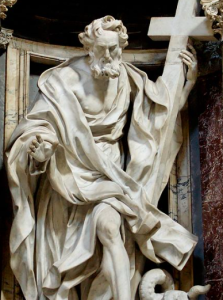
A sculpture of St. Philip the Apostle (1711)
in the Archbasilica of St. John Lateran, by
Giuseppe Mazzuoli. Photo by Jastrow, used
via a CC BY 2.5 license (source).
- Philip: This is not an unheard-of name for a Jew, but it is an odd one, as it’s straightforwardly Greek: φιλε- [file-] “love” + ἵππος [hippos] “horse.”2 (Since Alexander’s time, Greek names had become more popular in the Levant. This use of a Greek name could perhaps allude to some philosemitic benefactor, either of Jews generally or of St. Philip’s own family; alternatively, it could indicate that there were Greek or Græco-Syrian proselytes to Judaism in Philip’s ancestry.) Given my philosophy of translation—which normally involves turning Greek into English, and therefore turning names built from Greek elements into names built from English ones—I did try to come up with a good native-to-English equivalent of the name Φίλιππος, only to realize with chagrin that we have a perfect equivalent that I can’t use, because that perfect equivalent is the name Éowyn (ᛖᚩᚻ [eoh] “horse” + ᚹᚣᚾᚾ [wynn] “delight, joy”). I also toyed with the idea of re-transcribing the name as Filipp, which is a little nearer in form to the Greek, but decided against it on the grounds that this is one of the few cases in which even my weirdo style of translation has a chance to keep things simple!
- Bethsaida/Beyt Tzayadh: Likely from the Hebrew בֵּית צַיָּד [Bêyth Tzayyâdh]. Its meaning is disputed, but one possibility is that it means “House of Hunting.” Given that Bethsaida was on the Sea of Galilee, this name, if it did bear this meaning, could perhaps have served to distinguish Bethsaida from the many villages on that shore that called themselves some variation on “you can buy fish here.” That being said, another possible interpretation of this name is a variation on “you can buy fish here.”
- Nathanael/Nethanel: This name is adapted from the Hebrew נְתַנְאֵל [N’than’êl], and means “given by God.” Interestingly, the name may indicate that Nathanael (widely thought to be the same person as St. Bartholomew, making him “Nethanel bar-Tolmai”) was from the tribe of Levi. Ten people with the name appear in the Old Testament: all are Levites except the very first, Nethanel ben-Zuar, who was a leader of Issachar mentioned several times in the book of Numbers.
- Moses/Moshe: I don’t know why the Hellenized version (Μωυσῆς) of מֹשֶׁה [Mosheh] got quite so vowel-happy: “three consonants and two vowels in strict alternation” is hardly a tongue-twister in any language. That aside, the Tanakh tells us that Moses means “drawn from [the waters],” thus giving it a Hebrew origin. Many modern scholars dismiss this as a “pious fiction” and point out that Ancient Egyptian had a verb—usually transcribed from hieroglyphic script as ms—which meant “born of, child of” and which appears in many Egyptian names; we normally see it in English as the suffixes –mosis, –moses, –mose (e.g., Thutmose “born of Thoth” or Ahmosis “born of Iah”3), since the Greeks made it into -μωσις [-mōsis] and we got our first knowledge of Egypt and its history from Greek sources.
- Joseph/Yousef: My version is lightly adapted from my transcription of יוֹסֵף. (Its meaning, “he [God] shall add,” referred to Rachel’s hope to have another son.)
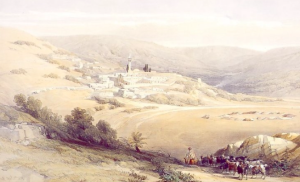
A view of Nazareth (1839) from painter David
Roberts’ The Holy Land, Syria, Idumea, Arabia,
Egypt, and Nubia, published in 1842.
- Nazareth/Natz’rath: Nazareth (variably Ναζαρέτ or Ναζαρέθ in Greek, the latter version being where we go the final –h in our version) is, say it with me, of disputed etymology. The Hebrew equivalent, נָצְרַת [Nâtz’rath], could be related to נֵצֶר [nêtzer] “stem, seedling, shoot; scion, descendant,” or it might come from נָצַר [nâtzar] “to guard.” A town name deriving from “shoot” seems like a fairly natural place-name choice in any agrarian society. If it were taken instead from the verb, it might be that the town began as some type of fort or military outpost (not necessarily the home-base of a garrison, but perhaps one of the points in a line of signal fires, for example).
- Israel/Yisra’el: In Classical Hebrew, this name was יִשְׂרָאֵל [Yišrâ’êl], the pronunciation of which seems barely to have altered at all down to its Yiddish descendant Yisroel. (Hebrew’s qamatz gadol—a term loosely equivalent to “long a“—appears to have been a sound similar to the a of father, the o of pot, or the oa of broad. I represent the niqqud indicating it by â.) The most familiar translation of this name is “he wrestles with God”; other renderings include “God rules” or “he prevails with God.”
c. the city of Andrew and Peter/of the city of Andre and Rocky | ἐκ τῆς πόλεως Ἀνδρέου καὶ Πέτρου [ek tēs poleōs Andreou kai Petrou]: This statement is an oddity, as St. Peter is elsewhere associated strongly with K’far Nachum (Capernaum), which is six miles from Bethsaida. Perhaps the bar-Jonah family were originally from Beyt Tzayadh and moved to K’far Nachum later.
d. Can anything good come out of Nazareth?/Can something good come from Natz’rath? | Ἐκ Ναζαρὲτ δύναταί τι ἀγαθὸν εἶναι; [ek Nazaret dünatai ti agathon einai?]: It is illegal for any homilist or commentator to allow this text to go by without saying that it “seems to resemble a popular proverb” (or any phrase of the same gist).
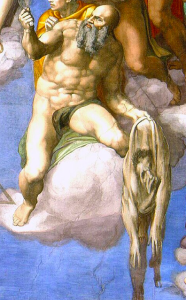
St. Bartholomew (ca. 1550), normally identified
with Nathanael, as portrayed by Michelangelo
on the wall of the Sistine Chapel; the misshapen,
leathery thing he is holding is his skin.
e. Come and see/Come and look | Ἔρχου καὶ ἴδε [erchou kai ide]: St. Philip’s answer here expresses a frequent motif in the Gospel of John (see note i below for further development of this same motif in this very passage). All four Gospels include a certain amount of back-and-forth on the finicky relationship between believing and seeing. The Synoptics give many readers an impression that faith inspired by miracles is of little value, if any: “An evil and adulterous generation seeketh after a sign,” Jesus tells crowds requesting one, “and there shall no sign be given to it, except the sign of the prophet Jonas” (Matt. 12:39). This is not without its cognate moments in John, as we will see in the section I have labeled IVδ in the outline (4:43-54); moreover, it is this book which says in so many words, “Blessed are they that have not seen, and have yet believed.” However, on the whole, the Fourth Gospel is far less shy to advance the “naïve” attitude to miracles, the “I saw it, so I believe it” attitude. Though some readers seem to miss it, the “naïve” outlook has its reflexes in the Synoptics also, like “Yea, and why even of yourselves judge ye not what is right?” or “Ye know how to judge the face of the sky …”
Given how dependent we are on our senses, it’s a curious fact of human psychology that once we find some kind of security in a theoretical idea about something, we then become far more ready to disbelieve our senses than we are to tamper with the theoretical idea. On the other hand, almost as if we had wounded our senses’ pride or something, they do play tricks on us and do need correction from the abstract, logical part of our brains. In a way, this makes it fitting that this is not only a psychological but a philosophical problem. There has been an intellectual quarrel between the empirically-minded and philosophical idealists since, gosh—Tuesday, if not before; figuring out how to strike an appropriate balance between perceptibility and rationality in how we define knowledge is a task that has produced dozens of schools of thought across thousands of years, with no academic consensus either known to history or in the foreseeable future.
f. guile | δόλος [dolos]: I don’t recall where, but I believe I have translated this term elsewhere as “bait.”
There is a slight irony here; for of course Israel the patriarch, i.e. Jacob, is basically a Trickster Protagonist from his birth in Genesis 25 until his reconciliation with Esau in ch. 33; “guile” is his middle name. (It is in ch. 34 that Jacob’s sons begin to be the tricksters, afflicting him with the consequences of such conduct.) That Nethanel is a “true Israelite” may therefore have needed clarification!
g. when you were under the fig tree, I saw you/while you were under the fig tree, I saw you | ὄντα ὑπὸ τὴν συκῆν εἶδόν σε [onta hüpo tēn sükēn eidon se]: This is, needless to say, a puzzling reply. There is no mention of Nethanel being under a fig tree when Philip found him; as with the woman at the well of Sychar, both the evangelist’s failure to mention these things in advance and the response of the person he is addressing suggest that his knowledge is miraculous. (Incidentally, we learn in ch. 21 that Nathanael is from the city of Cana.) We may therefore be inclined to look for a symbolic meaning for this fig reference.
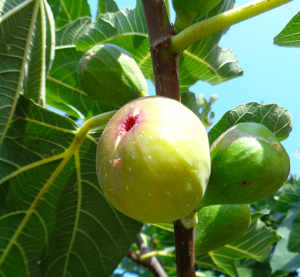
Two immature fruits and one ripe or near-ripe
fruit on a fig tree. Photo by Silverije, used via
a CC BY-SA 4.0 license (source).
Figs are one of the seven species, the crops by which the Promised Land is characterized (barley, dates, figs, grapes, olives, pomegranates, and wheat)—but that doesn’t seem to be pertinent here.4 However, according to Bible Hub’s topical lexicon, sitting beneath a fig tree was associated by some rabbinic literature of the time with studying Torah, which would suggest that Nathanael was an avid devotee of such study; unfortunately it doesn’t give any specific references, so I can relate that only as a “maybe.” If it is accurate, this chimes rather nicely with Old Testament uses of the name touched on up in textual note b, since (though most of them had disappeared via the Assyrian deportations) the Issacharites were esteemed for their shrewdness, and the connection of the Levites to the Torah scarcely needs explanation!
h. the Son of God … the King of Israel/the son of God … king of Israel | ὁ υἱὸς τοῦ θεοῦ … βασιλεὺς εἶ τοῦ Ἰσραήλ [ho huios tou theou … basileus Israēl]: St. Nathanael’s reaction is an early example of one of this Gospel’s frequent motifs—robust professions of faith in Christ. The motif recurs in 4:42, 6:69, 9:38, 11:27, and 20:28, on the lips of the Sycharians, Peter, the man born blind, Martha, and Thomas; there are also a few moments that are nearly professions of faith, but not quite, like Nicodemus’ imperfect acknowledgment in 3:2, or the mysterious moment of terror on the part of the contingent sent to arrest Jesus in 18:6. In Matthew, in Mark, and to a lesser extent in Luke, St. Peter’s confession at Cæsarea Philippi (occurring in chapters 16 of 28, 8 of 16, and 9 of 24) marks a turning point in the narrative, especially since all three pass immediately from that confession to the Transfiguration; the approach of the Passion becomes more intensely obvious as the later chapters pile up. John, although he includes a Petrine confession (6:68-69), gives it in a distinct form and in a completely different context, and, though he seems now and then to be hinting at the Transfiguration (e.g. in 1:14’s “we beheld his glory”), he never recounts it as such.
i. do you believe? You shall see greater things than these/you have faith? You will see greater things than that | πιστεύεις; μείζω τούτων ὄψῃ [pisteueis? meizō toutōn opsē]: Just as one of John’s recurring themes is the relationship between belief and, for lack of a better word, evidence, one of the most consistent rhetorical devices used by Jesus across all four canonical Gospels is the a fortiori—the “if X, how much more Y” turn of phrase. This, while not quite the same thing, exemplifies a similar pattern.
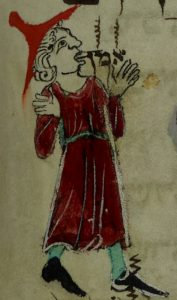
Illumination of Jewish man saying “amen”
(c. 1300) from the Machzor Luzzatto, a prayer
book for the high holy days created by or for
the Luzzatto family.
j. Truly, truly/‘Amin, ‘amin | Ἀμὴν ἀμὴν [amēn amēn]: This word, Hebrew in origin (אָמֵן [‘âmên], “certainly, truly”), was easily loaned into Aramaic, but it is also one of the handful that made the jump into Greek, from there to Latin, and thence even into English, comparatively intact. Others include “Baal” (בַּעַל [ba3al]),5 “hosanna” (הוֹשִׁיעָה־נָּא [houshy3âh-nâ’]),6 “Armageddon” (הַר מְגִדּוֹ [Har M’ghidou]),7 “kosher” (כָּשֵׁר [kâshêr]), and, supremely beside amen, “hallelujah” (הַלְלוּ־יָהּ [hal’lú-yâhh])—but even these parallels give some idea of how much more words tend to drift in pronunciation, meaning, or both, as contrasted with how little “amen” has changed.
Moloney (vid. sup., textual note a) notes that, while Jesus often prefaces his own remarks with “amen” in the Synoptics, this doubled use of it is unique to the Fourth Gospel.
k. heaven opened, and the angels of God ascending and descending upon the Son of man/heaven opened and the messengers of God going up and going down upon the Son of Man | τὸν οὐρανὸν ἀνεῳγότα καὶ τοὺς ἀγγέλους τοῦ θεοῦ ἀναβαίνοντας καὶ καταβαίνοντας ἐπὶ τὸν υἱὸν τοῦ ἀνθρώπου [ton ouranon aneōgota kai tous angelous tou theou anabainontas kai katabainontas epi ton huion tou anthrōpou]: This is another rather cryptic statement. It could, maybe, be associated with this being the “fourth day” of the new creation, since angels are supposed to be the governors of the heavenly bodies. I think it is likelier that it alludes to the giving of the Law (vid. sup., textual note a), which we know from Galatians was mediated by angels. At the same time, it obviously alludes to Jacob’s dream at Bethel—a handy conceptual midpoint between the creation narrative and the narrative of Sinai in the Torah.
Footnotes
1This may leave you wondering what the stars have to do with it. There are a number of ways they can come in, depending partly on whether one is in the southern or northern hemisphere. The star Sirius is a good example: viewed from Egypt (or anywhere at about 30° N latitude), Sirius “sets” close to the end of April, and does not reappear in the night sky until a little after mid-July; this made it an important star in the ancient Egyptian calendar, marking the beginning of Akhet, the flood season. (This vaguely equated with autumn, but ancient Egypt had a three-season system, so all correspondences on that level are inexact.) Sirius was useful here because the rising of Sirius was perfectly regular while the flooding of the Nile could occur a little bit early or late. The Polynesian societies of the southern Pacific, which ranged as far as 45° S, also took special note of Sirius, but for them it was a herald of winter. The zodiac may seem like an obvious example of the stars’ influence on how we measure time, but in fact the constellations of the zodiac don’t neatly align with the twelve-fold division of the year into months (the month is a lunar measurement, not a sidereal one), so it isn’t really—in the West. In the Chinese astrological system, it is not the movement of the sun that is divided into twelfths, but the movement of Jupiter, which incidentally orbits the sun for a period of about twelve years; this is why East Asians use a twelve-year system instead of a twelve-month system for determining a person’s zodiacal sign. (Sort of.)
2Thus confirming that one of the Apostles was named for, albeit was not perhaps himself, a horse girl.
3Thoth and Iah were Egyptian gods, associated with the mind and the moon. Thoth is still relatively well-known, partly thanks to having a fairly clear and direct analogue in the Greek Hermes and the Roman Mercurius, save that Thoth was more a god of intelligence and knowledge than of wits or guile; it’s hard to imagine Thoth as mischievous, whereas Hermes very much is and Mercurius can be. The lunar deity Iah, on the other hand, saw his stock fall even in Egypt; by the period known as the New Kingdom (during the 16th-11th centuries BC), Iah receded in importance in favor of the alternative moon god Khonsu, or was absorbed by Khonsu.
4The canny reader may be thinking of the sets of seven from my “Outroduction” (see IV2aג), and wondering if this allusion to one of the seven species might be a hint of another heptad. Barley, figs, grapes, and wheat all make explicit appearances in John, and olives can be added with a little special pleading, the grounds being that lighting was by oil lamp, and the oil in use for these was olive oil, so that its presence is implied by almost all conversations that occur indoors or at night. By the same logic, the use of palm fronds during the triumphal entry in 12:13 could be held to imply the presence of dates. At first, I thought this idea still ran aground on the absence of pomegranates from the text; yet maybe some of the special-est pleading imaginable can tease out an allusion to them also on the grounds that the high priest is mentioned, and the vestments for the high priest were edged at the bottom with alternating golden bells and (artificial, woven) pomegranates. However, even if we regard this threadbare connection as establishing the presence of all seven species in the Fourth Gospel, it’s not clear that they’re doing anything in the narrative, besides serving as (heh) Easter eggs.
5The word ba3al in Classical Hebrew was a word, not a name—it meant “lord,” hence the allusions in the Hebrew Bible to pagan gods as “the baals,” in the plural and uncapitalized. It was also used (cf. Hosea 2:14-17), and is used to this day, with the sense “husband” (though, as the text from Hosea indicates, it was not the only Hebrew word with this meaning).
6Houshy3â-nâ’ was originally quite similar in meaning to Miserere nobis. It evolved into an expression of praise, and was also shortened, over time.
7Har M’ghidou (also transcribed “Har Megiddo”) means “Mount Megiddo.” In the ancient Levant, Megiddo was a prosperous city in the Jezreel Valley, a river valley in northern Canaan that connects the Jordan Rift Valley to the (oddly named) Zevulun Valley, which is the stretch of coastal plain lying to the north of Mount Carmel and the modern city of Haifa. The sharp-minded reader may have noticed that “valley,” rather than being a synonym for “mountain, hill,” is the other thing, and that this makes the referent of “Mount Megiddo” rather mysterious. Why does this expression occur in Revelation? I’ll tell you: I don’t know.









 Ad-Free & Subscriber Log-In