

You can find my two-part introduction to the Gospel of John at these two links, and my index/outline for it here; for the previous installment on John 1:43-51, go here.
The Beginning of the New Cosmos, Part IV (John 2:1-12)
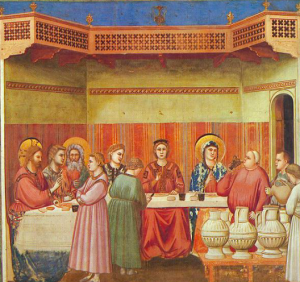
Nozze di Cana [Wedding at Cana] (c. 1300-1330),
by Giotto di Bodone.
Having passed through four days, we now add three more in one go. We thus reach what is both the seventh day, evoking the completion of the first creation, and the third, evoking the descent of God upon Sinai. Both images, in the context of the Logos appearing on earth as a man, prompt us to expect a manifestation of his presence, an act of self-revelation; and we are not disappointed.
John 2:1-12, RSV-CE
On the third daya there was a marriageb at Cana in Galilee, and the mother of Jesusc was there; Jesus also was invited to the marriage, with his disciples. When the wine failed, the mother of Jesus said to him, “They have no wine.”d And Jesus said to her, “O woman, what have you to do with me?e My hour has not yet come.”f His mother said to the servants, “Do whatever he tells you.”d Now six stone jars were standing there, for the Jewish rites of purification, each holding twenty or thirty gallons.g Jesus said to them, “Fill the jars with water.” And they filled them up to the brim. He said to them, “Now draw some out, and take it to the steward of the feast.”h So they took it. When the steward of the feast tasted the water now become wine, and did not know where it came from (though the servants who had drawn the water knew), the steward of the feast called the bridegroom and said to him, “Every man serves the good wine first; and when men have drunk freely, then the poor wine; but you have kept the good wine until now.”i This, the first of his signs, Jesus did at Cana in Galilee, and manifested his glory; and his disciples believed in him.i
After this he went down to Capernaum, with his mother and his brethren and his disciples; and there they stayed for a few days.j
John 2:1-12, my translation
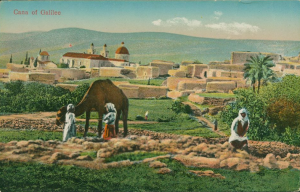
Postcard (c. 1925) of Kafr Kanna, traditionally
identified with the Biblical Cana (here seen
to be indeed “v. Eastern with camels”).1
And on the third day,a a marriage came aboutb in Qanah in the Galilee, and the mother of Yeshuac was there; Yeshua and his students were also called to the wedding. And the wine having fallen short, the mother of Yeshua says to him: “They have no wine.”d
And Yeshua tells her, “What could you want with me, ma’am?e My hour has not yet arrived.”f
His mother tells the servants, “Whatever he may tell you, do it.”d
There were six stone water-pots (for the cleansing [rites] of the Jews) lying there, with room for up to two or three rundlets.g Yeshua tells them: “Fill up the water-pots with water”; and they filled them up to the very top. And he tells them, “Now bail [some] out and bring it to the banquet-master”;h so they brought [it to him].
When the banquet-master tasted the water that became wine, and did not know where it was from (but the servants who bailed the water knew), the banquet-master calls the bridegroom and tells him: “Everyone first puts out the fine wine, and whenever people have gotten drunk, the lesser stuff; you have kept the fine wine until this moment.”i
Yeshua did this, the beginning of his signs, in Qanah in the Galilee, and showed his glory, and his students had faith in him.i
After this he went down to K’far Nachum, he and his mother and brothers and his students, and they stayed there, not many days.j
Textual Notes
a. On the third day/And on the third day | Καὶ τῇ ἡμέρᾳ τῇ τρίτῃ [kai tē hēmera tē tritē]: This phrase indicates the third day following the last day mentioned, which was the fourth: four plus three equals seven completing the symbolic week of the new creation. Or rather, that is one possible reading, but counting in the ancient world was usually inclusive. That would make this the sixth day. Which is it? In my opinion, probably both:2 there is, after v. 12, a definite sense of having accomplished something significant in the sequence from 1:19-2:11, and the image of a feast aligns naturally with the sabbath; on the other hand, there are a couple of verses here that are definitely evoking the sixth day, on which mankind was made. We’ll come to that, especially in note e. (Moreover, see the first paragraph of note b for how lengthy wedding celebrations were at the time—a marriage feast would be well-suited to correspond to multiple days.)
The Sabbath Breakers (1896), by J. C. Dollman
—a work I cannot help finding hilarious.
This is also “the third day,” which, picking up the Torah theme suggested in the meeting with Nathanael, ought to mean the day of God’s descent upon Sinai—don’t forget that the newest-minted apostle has been promised that he will see the angels traveling upon Christ between earth and heaven. This idea, too, is taken up quite specifically (see note i); but even before that, it is suggested by the image of marriage. In the Tanakh, God’s covenant with the Jews is incessantly represented in terms of his “espousing” them; this is why idolatry is so often described in terms of adultery, particularly in Ezekiel and Hosea. Furthermore, the books of the Chamesh Megillot3 that are most concerned with marriage—Song of Songs and Ruth—are intimately tied to the reception of the Torah: they are read for Passover and Pentecost, which in the Judaic calendar are associated with the Exodus itself and the arrival at Mount Sinai for the giving of the Law.
b. there was a marriage/a marriage came about | γάμος ἐγένετο [gamos egeneto]: First-century weddings were much more lavish affairs than any modern wedding. Today, even a really huge, opulent ceremony-plus-reception is only going to take about a day for all concerned (though preparation and getting home may take a few days more, depending). In ancient Palestine, it was typical for the banqueting surrounding a marriage to last for a week, opening with a torchlit procession at night, and guests were provided with elegant dress at the host’s expense (the host normally being the father of the groom). Hence, whereas it’d be a mortifyingly stupid error to underestimate how much alcohol was needed for a modern wedding, it’s a little more understandable—though probably no less embarrassing—at the ceremony in question.
Some commentators seem positively tormented by the fact that we don’t know whose marriage this was. I don’t think it matters at all, but let’s explore the topic anyway, to be thorough.
I’m prepared to dismiss one theory right off the bat: the theory that this was Jesus’ own marriage. Apart from flying in the face of traditions about Jesus which even the vast majority of hardcore Protestants accept, and setting aside the theological and, frankly, practical problems with the idea that God incarnate got married, the text never bothering to mention that Christ is the bridegroom strains credulity to the breaking point.
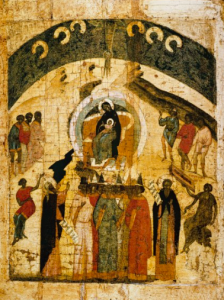
Anonymous ikon of the Synaxis of the Theotokos
(17th c.), written in the city of Pskov (near the
modern Russian border with Estonia).
So, whomst? It must be said plainly, we do not know. It makes sense to conjecture this was the marriage of one of the Twelve (perhaps even the occasion of that disciple’s vocation to follow Jesus); if that supposition is correct, five names among the Twelve come to my mind.
- I’ve seen it suggested that it was the marriage of the Beloved Disciple himself, which would be well-matched with the Gospel’s silence on the matter. However, if the Beloved Disciple was indeed St. John, there is a very ancient tradition that he remained a virgin all his life. That is not absolutely incompatible with this interpretation (we believe Mary was both a wife and perpetually virgin, after all), but it would certainly be counter-intuitive.
- Marriage in one’s late teens was the norm for men, and this might, maybe, point to St. Jude Thaddæus. One possible etymology for the name “Thaddæus,” or תַדַּי [Thadai] in the Aramaic, is that it comes from תַּד [tadh], meaning “breast”—which might mean he was, after or alongside St. John, “the baby” of the group (if the name accordingly meant something like “suckling child,” “child not yet weaned”). Still, I can’t stress enough, this is highly speculative. There are other things תַדַּי could mean, like being “big-hearted,” even if this is the correct etymology; further, the etymology is (or so I understand) disputed; and the text never says it’s St. Jude.
- We know from ch. 21 that Nathanael was from Cana. If this were Nathanael’s own wedding, that would account for why Jesus and his disciples were invited, and perhaps also why Jesus’ mother was invited (presumably by Nathanael in honor of his new rabbi); it could also go some way toward explaining why she and her son were treated as authorities by the servants, if Nathanael directed them to. The snag here is the obvious question of why the text, which was just telling us about Nathanael, doesn’t tell us he is the groom, and also leaves out the instructions to the servants that explain the situation. Moreover, the Mother of God is mentioned first in the list of guests invited to the wedding, even before Jesus himself; this suggests that she was, so to speak, the primary guest, and that Jesus was invited as a connection of hers rather than the reverse. (This may lend color to #5, below.)
- It would be low-key hilarious if it were St. Thomas’s wedding. This would mean the Gospel almost begins on a miracle Thomas witnesses before believing, and almost ends on a miracle he won’t believe till he witnesses it. However, there seems to be no reason to think this besides God’s tendency to do things that are funny.4
- Finally: I think this may have been the marriage of St. James the Less. I find this credible is because of the longstanding tradition that James the Less, a.k.a. James bar-Alphæus, was a relative of Jesus through their mothers: Mary of Clopas is widely considered to have been the Virgin’s sister.5 Moreover, his epithet “the Less” likely means “the younger,” i.e. that he was younger than James bar-Zebedee; this doesn’t have to mean he was at the marrying age, but it could, which would align with his long life (he was reputedly martyred in the year 62). Like #3 above, but without its snags, this neatly explains both the invitations and the servants’ readiness to take instructions from Mary, and even for her to delegate her authority to her son. They’d hardly have behaved this way for mere guests, especially since Jesus had as yet no reputation as a rabbi or a wonderworker; but as members of the groom’s family, it makes sense for the servants to obey them.
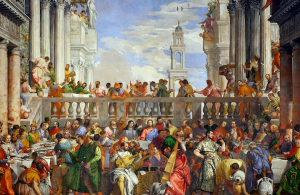
The Wedding at Cana (1563) by Paolo Veronese.
c. the mother of Jesus/the mother of Yeshua | ἡ μήτηρ τοῦ Ἰησοῦ [hē mētēr tou Iēsou]: Strikingly, though she features more prominently in John than in Matthew or Mark, the Mother of God is never given a name in this Gospel—she is spoken of (and to) only by titles and allusions. Jesus speaks to her exactly twice, here and in 19:26, and addresses her the same way in both cases: see note e for more on that.
d. the mother of Jesus said to him, “They have no wine.” … His mother said to the servants, “Do whatever he tells you”/the mother of Yeshua says to him: “They have no wine.” … His mother tells the servants, “Whatever he may tell you, do it” | λέγει ἡ μήτηρ τοῦ Ἰησοῦ πρὸς αὐτόν· Οἶνον οὐκ ἔχουσιν. … λέγει ἡ μήτηρ αὐτοῦ τοῖς διακόνοις· Ὅ τι ἂν λέγῃ ὑμῖν ποιήσατε. [legei hē mētēr tou Iēsou pros auton: Oinon ouk echousin … legei hē mētēr autou tois diakonois: Ho ti an legē hümin poiēsate]: The Mother of God here offers a perfect model of prayer in two sentences: approaching the Lord with whatever is on our minds, and then making ready to do whatever he may say.
There is, additionally, an interesting parallel here between the Virgin’s words and those of Exodus 19:
In the third month, when the children of Israel were gone forth out of the land of Egypt, the same day came they into the wilderness of Sinai … and there Israel camped before the mount. And Moses went up unto God, and the Lord called unto him out of the mountain … And Moses came and called for the elders of the people, and laid before their faces all these words which the Lord commanded him. And all the people answered together, and said, “All that the LORD hath spoken we will do.” And Moses returned the words of the people unto the LORD. And the LORD said unto Moses, “Lo, I come unto thee in a thick cloud, that the people may hear when I speak with thee, and believe thee for ever.”
—Exodus 19:1-3, 7-9
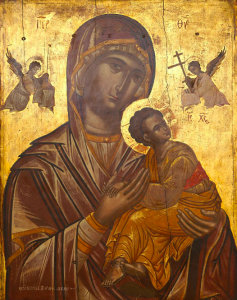
Panagía tou Páthous [The All-holy Lady of the
Passion] (c. 1600-1620), written by Emmanuel
Tzanfournaris.
e. O woman, what have you to do with me?/What could you want with me, ma’am? | Τί ἐμοὶ καὶ σοί, γύναι; [ti emoi kai soi, günai?]: Both the wording of Jesus’ reply and the term by which he addresses her have caused massive amounts of misunderstanding and confusion, partly because of the wild inconsistency of translations. Consider this selection:
- Jesus saith unto her, “Woman, what have I to do with thee?” (King James Version)
- Jesus said to her, “Woman, how does your concern affect me?” (New American Bible, Revised Edition)
- “Woman, why do you involve me?” Jesus replied. (New International Version)
- Jesus said, “Woman, why turn to me? My hour has not come yet.” (Jerusalem Bible)
- “Is that your concern, or mine?” replied Jesus. (New Testament in Modern English—J. B. Phillips)
- Jesus said to her, “Woman, what does this have to do with me?” (English Standard Version)
- Jesus said to her, “[Dear] woman, what is that to you and to Me? [What do we have in common? Leave it to Me.]” (Amplified Bible, Classic Edition)
- Jesus saith to her, “What to me and to thee, woman?” (Wycliffe Bible)
- “Dear woman, that’s not our problem,” Jesus replied. (New Living Translation)
Against my usual habit, my translation is idiomatic, not literal. This passage happens to use an idiom for which we don’t even have a bad English equivalent; we just have no equivalent at all. A hyper-literal rendering would be: What to me and to you, woman?; to which, bizarrely, we draw closest not in the notoriously literal King James, but in Phillips, along with the Amplified and Wycliffe renderings. Let’s unpack the two halves of Jesus’ remark.
• O woman/ma’am. In English, addressing a woman as “woman” is rather rude, except as a joke.6 This is not true of the Greek γύναι; it’s much more nearly equivalent to a polite form of address like “ma’am.” This is doubtless the reason for the use of dear in the Amplified Bible and the NLT, although this has a patronizing sound the Greek doesn’t. (I was tempted to use the more elevated word madam, until I remembered its slang meaning and decided not to risk it.)
But that’s still a strange way to talk to your mother. Why did Christ say this? Here we come back to the theme of the new cosmos being created by the Logos. This is the seventh day of that creation, or the sixth, or both at once; and remember that humanity—now united with the divine Logos—was made on the sixth day.
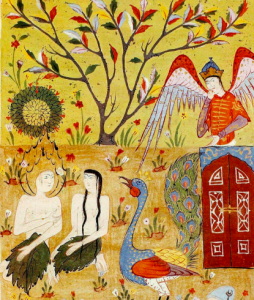
An anonymous Muslim illumination (1579) of
Hawwa (Eve) sitting with Adam, from a manu-
script in Istanbul. The angel to the right is
Ridwan, the guardian of Paradise in Islam.
Here is the first creation of man:
And God said, “Let us make man in our image, after our likeness: and let them have dominion … over all the earth …” So God created man in his own image, in the image of God created he him; male and female created he them. And God blessed them, and God said unto them, “Be fruitful, and multiply, and replenish the earth, and subdue it … Behold, I have given you every herb bearing seed, which is upon the face of all the earth, and every tree, in the which is the fruit …; to you it shall be for meat …”: and it was so. And God saw every thing that he had made, and, behold, it was very good. And the evening and the morning were the sixth day.
—Genesis 1:26-31
The following chapter provides an alternate account which zeroes in further on the making of man:
And the LORD God formed man of the dust of the ground, and breathed into his nostrils the breath of life; and man became a living soul. … And the LORD God said, “It is not good that the man should be alone; I will make him an help meet for him.” And out of the ground the LORD God formed every beast of the field …: and whatsoever Adam called every living creature, that was the name thereof … but for Adam there was not found an help meet for him. And the LORD God caused a deep sleep to fall upon Adam, and he slept: and he took one of his ribs, and closed up the flesh instead thereof; and the rib, which the LORD God had taken from man, made he a woman, and brought her unto the man. And Adam said, “This is now bone of my bones, and flesh of my flesh: she shall be called Woman, because she was taken out of Man.”
—Genesis 2:7, 18-23
The first Adam, upon meeting the first woman, bestows on her the name אִשָּׁ֔ה [‘Isshâh], “Woman,” taken as she was from אִ֖ישׁ [‘Ysh], “Man.” Likewise in this passage, the Logos, the architect of the original creation, has now taken the form of Adam; and during this statement of the second creation, at his first encounter with her out of whose “side” he was himself taken, he salutes her with the primordial title: “Woman.” It is from this text above all that the imagery of Mary as the second Eve is drawn.
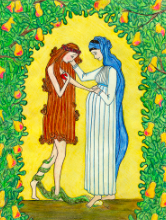
I don’t usually like the phrase “instant classic,”
but what else do you call this? Well, besides
Mary and Eve (2005) by Sr. Grace Remington,
SOCist, of Our Lady of the Mississippi Abbey.
• what have you to do with me/What could you want with me. Now, about that idiom we don’t have in English. As stated above, a literal translation of τί ἐμοὶ καὶ σοί is “what to me and to you?”, the implication being something like what pertains to both me and you? or what do I have to do with you? However, these are not ideal translations, because to most readers they come across as cold or dismissive—a tone this expression doesn’t necessarily carry in Greek. It could be said with hostility, as it presumably is in Mark 1:24; however, it could equally be (and, I gather, was more often) an expression of great deference; it comes closer to denigrating the speaker, as too small a fry for the addressee to concern themselves with, than it does to dismissing the addressee.
Why Jesus would be so modest when approached by his own mother is a further question. We will examine the reason he gives momentarily, but first, I’d like to take note of the dynamic between Jesus and Mary in this passage. She brings an issue to his attention, with an implicit request that he do something about it; he salutes her respectfully and, though taking care to direct most people’s attention away from what he does (in a way she immediately picks up on, which is rather interesting in itself!), ultimately assents to that request.
This, especially in combination with Nathanael’s earlier statement that he is “the king of Israel,” points to the function of the queen in ancient Semitic monarchies. In the Ancient Near East, the reigning queen was not normally one of the king’s wives, but his mother, a topic I went into at some length last October; we see an exception to this in Esther, but there we are dealing with a Persian court, which was culturally Iranian rather than Near Eastern. And the queen’s function, which we do see exemplified in Esther, was to be an intercessor and advocate for the people with the king.7 We see the same function, albeit with a denied request, in I Kings 2, where we also see King Solomon exhibiting immense courtesy to Queen Bathsheba (who, while David lived, would have been Princess Bathsheba).
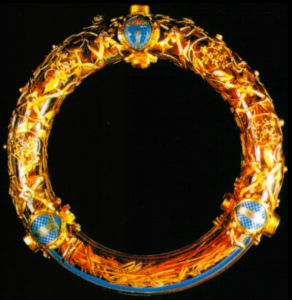
Purported relic of the Crown of Thorns, sent to
King Louis IX of France by Latin Emperor8
Baldwin II. Photo presumed to be by Gavigan,
used via a CC BY-SA 3.0 license (source).
f. My hour has not yet come/My hour has not yet arrived | οὔπω ἥκει ἡ ὥρα μου [oupō hēkei hē hōra mou]: This idea comes up again in chs. 7 and 8, and is finally overturned in 17:1: “Jesus lifted up his eyes to heaven, and said, ‘Father, the hour is come,'” just before the Johannine account of the Passion. But what does the time of the Crucifixion have to do with this? Or, if “hour” is being used in a generic sense and the gist here is more like “It is not yet my time [to begin performing miracles],” how do we reconcile that with the fact that he promptly does perform a miracle?
What follows is once again speculative; it seems plausible to me, but I’m not claiming it appears in the text. It doesn’t. However: I suspect that (to whatever extent the Gospels represent Christ’s ipsissima verba) he is using this expression casually, and that what he’s talking about—the “hour” that has not yet come—is the time for him to inaugurate his public ministry. As discussed last time, it doesn’t seem like there has yet been time for him to spend forty days in the desert fasting and fighting the devil, which seem (along with his baptism) to be prophet-credentialing events. Further, he doesn’t appear to have done any preaching yet; and while he does perform a miracle here, it’s an unusually “offstage” one—not only because he demurs at first, but because, unlike miracles that set the whole countryside gossiping (the Synoptics are full of these), this one is only known to the servants, his mother, and the half-dozen students he has already collected. It doesn’t even make it into the other three Gospels.
Hence, it sounds as though this miracle was—insofar as this can be said coherently about anything divine!—”not part of the plan,” “off-book,” “coloring outside the lines.” Yet it was granted; which, itself, is fascinating. Taking up the theme from note d, Blaise Pascal (allegedly9) said “God instituted prayer that he might confer upon human beings the dignity of being causes”; in that way, this passage may draw near10 to texts like Exodus 32, in which, at Moses’ prayer, “the LORD repented of the evil which he thought to do unto his people.”
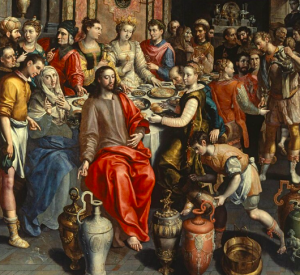
The Marriage at Cana (c. 1596),
by Maerten de Vos.
g. twenty or thirty gallons/two or three rundlets | μετρητὰς δύο ἢ τρεῖς [metrētas düo ē treis]: The μετρητής [metrētēs] was a unit of liquid measurement, equivalent to about 8¾ gallons. (The literal equivalent of the word would be the amazingly unsatisfying “measurement.”) The RSV’s “20 or 30 gallons,” apparently based on rounding 8¾ up to 10, is justifiable, not only because there doesn’t appear to be much significance in the measurement, but because measures weren’t always precise in the ancient world—if anything, the exactitude of “17½ to 26¼ gallons” would be a less appropriate option! But I preferred the other route, preserving the numbers and reaching for a different term for liquid measurement.
The term I found, “rundlet,” is now exceedingly obscure, unless you’re a vintner.11 The rundlet is the smallest of the standard measures of wine;12 it is used in that technical context for an amount that’s nearly twice as much as the μετρητής was. However, the word can also be used casually for far smaller measurements, down to something like three gallons—a range which will obviously embrace eight and three-quarters.
Incidentally, the upshot of all this is that Jesus made more than a hundred gallons of wine, and very probably (since it says they were filled “to the very top”) over a hundred and fifty.13
h. the steward of the feast/the banquet-master | τῷ ἀρχιτρικλίνῳ [tō architriklinō]: An architriklinos14 was something a little bit like a professional party-planner. His job was to arrange the couches on which the diners would be reclining, plan the menu, taste each course of food and drink before it went out, and generally ensure that everything went swimmingly. Jesus is therefore showing great prudence and sensitivity to protocol by directing that the new wine be taken first to the architriklinos, so that it can be blended seamlessly into the rest of the marriage feast; it draws attention to itself only by its exceptional quality.
i. “you have kept the good wine until now.” … Jesus … manifested his glory; and his disciples believed in him/”you have kept the fine wine until this moment.” … Yeshua … showed his glory, and his students had faith in him | σὺ τετήρηκας τὸν καλὸν οἶνον ἕως ἄρτι. … ὁ Ἰησοῦς … ἐφανέρωσεν τὴν δόξαν αὐτοῦ, καὶ ἐπίστευσαν εἰς αὐτὸν οἱ μαθηταὶ αὐτοῦ [sü tetērēkas ton kalon oinon heōs arti. … ho Iēsous … efanerōsen tēn doxan autou, kai episteusan eis auton hoi mathētai autou]: The banquet-master’s line strikes me as rather funny; I’ve never been able to tell whether it seems to be spoken in admiration or exasperation.
Symbolically, this miracle, or in Johannine language this first sign, points to the new teaching that the incarnated Logos is here to reveal: as we heard in the Prologue, “the law was given through Mosheh—grace and truth came to be through Yeshua the Anointed.” This divine “grace and truth,” brought by the Logos, are to surpass even the Torah.
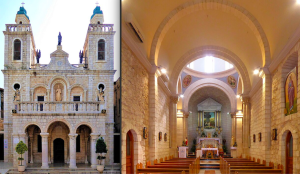
The façade and interior of the “Wedding Church”
in Kafr Kanna, Israel. Photos by Chris06, used
via CC BY-SA 4.0 licenses (source; source).
j. he went down to Capernaum, with his mother and his brethren and his disciples; and there they stayed for a few days/he went down to K’far Nachum, he and his mother and brothers and his students, and they stayed there, not many days. | κατέβη εἰς Καφαρναοὺμ αὐτὸς καὶ ἡ μήτηρ αὐτοῦ καὶ οἱ ἀδελφοὶ καὶ οἱ μαθηταὶ αὐτοῦ, καὶ ἐκεῖ ἔμειναν οὐ πολλὰς ἡμέρας [katebē eis Kafarnaoum autos kai hē mētēr autou kai hoi adelfoi kai hoi mathētai autou, kai ekei emeinan ou pollas hēmeras]: This verse serves two purposes in the narrative. One is to establish the group we’re dealing with: it consists in at least part of the Holy Family (“his mother and brothers”) and the current disciples (“his students”). As in the other Gospels, we will learn later (7:5) that some of Jesus’ relatives disbelieved in him, at least before the Resurrection—although, if the theory of who St. James the Less was (mentioned in note b above) is correct, then this unbelief among the Holy Family was never total, and didn’t stop that relative from being made an Apostle in the strictest sense. In any case, whether unbelieving or believing or undecided or some mixture thereof, some of Jesus’ family are part of the group that now proceeds to Capernaum, his Galilean HQ.
Second, this serves is to signal that the symbolic day-sequence cycles we were in have now concluded. The new-Eden sequence has reached its crowning glory with the introduction of the Woman; the new-Sinai sequence has reached its climax by “show[ing] his glory” so that “his students had faith in him”, as the Israelites did in Moses and the God of Moses. The vague “not many days” makes a point of interrupting our ability to count, and so tying off the numerable days. (I surmise that it was after this that Jesus made his retreat into the wilderness and had his confrontation with the devil.)
Footnotes
1To anyone not afflicted with the precise type of weird Anglophilia that runs in Blanchard veins, this is an allusion to Evelyn Waugh’s epistolary short story “Cruise.” In-universe, this consists in a series of postcards written by a young Englishwoman to a friend while on a cruise in the Mediterranean; it abounds in abbreviations—the phrase “goodness how sad,” one of the young lady’s favorites, is eventually reduced to “g. how s.”—and her verdict on the Holy Land is that it is “v. [=very] Eastern with camels.” To my mild surprise, I was able to find an audio version of the story, which had one like (g. how s.); it has two likes now.
2I.e., I think both days are being symbolically invoked. I’m not suggesting that God monkeyed with the normal flow of time just to suit the author of the Fourth Gospel!
3The Chamesh Megillot or “Five Scrolls” are five books of the Bible linked with special occasions in the Judaic liturgical year: the Song of Songs is read for Pesach (Passover); Ruth, for Shavuot (Pentecost); Lamentations for Tisha b’Av (commemorating the destructions of the two Temples, which chanced to fall on the same Hebrew date); Ecclesiastes for Sukkot (commemorating the forty years’ wandering in the desert); and Esther for Purim (commemorating the events of that book).
4Just try to tell me the platypus is not a divine prank. I dare you.
5This may seem like a baffling assertion, since it’d mean two sisters were both named “Mary,” and one of these Maries was (simultaneously?) married to a man named Clopas and a man named Alphæus! However, none of this is nearly as bizarre as it sounds. Both Alphæus and Clopas, or Cleophas, are thought to be attempts at transcribing the same Jewish name, the Hebrew form of which was חַלְפַּי [Chalpai]; I’ve found slightly inconsistent reports of the Aramaic form, but Thayer’s appears to be saying it was חָלְפָּא [Châlpâ’]. As for two sisters having the same name, this wasn’t at all uncommon in the ancient Mediterranean. Weird though it sounds to us, names were less used for distinguishing individuals—partly because individuals just weren’t as important in ancient society, and partly because there was a lot more use of epithets (stuff like the younger, the wise, the fat, the stammerer, and so on). John 19:25 can be read as listing either four or three women: if it means the latter, then it specifically confirms that the Virgin Mary had a sister also named Mary (and if it means the former, this verse still does not rule out that possibility).
6Which is fascinating, since “woman” is not in any way a rude word. Unfortunately, we can’t stop to analyze this now!
7We also see this at times in Medieval European monarchies, even though the primary meaning of “the queen” shifts there from the queen dowager to the queen consort. A good example is Queen Anne, or Anne of Bohemia, the first wife of King Richard II: she is widely credited with having improved the earlier part of her husband’s reign by persuading him to temper punishments and forgive offenders, until her death due to plague in 1394. (Notably, it was only years after Anne’s death that Richard provoked the crisis that ended with him being deposed, and probably murdered, in 1399.)
8The Latin Empire was a short-lived crusader state (1204-1261) in what’s now northern Greece and northwestern Turkey, mainly around the Sea of Marmara. It was the fruit of the Fourth Crusade. The lords of the First Crusade (1096-1099) originally swore fealty to the Byzantine emperors (part of a big-picture hope the popes had to reconcile Catholicism and Orthodoxy). The forces of the Fourth Crusade (1202-1204) became entangled in a succession dispute in Byzantium; eventually, the crusaders decided to sack the city—an act which horrified Pope Innocent III, who promptly excommunicated them—and install a Catholic dynasty. To itself, this regime simply was the Byzantine Empire; to the populace, it was the Frankokratia, “Frankish rule” (Franks was used generically in Byzantine Greek for all Western Europeans). Surviving nobles of the Byzantine court set up a handful of successor states around the Ægean and Black Sea coasts, one of which retook Constantinople in 1261 and reëstablished the Byzantine Empire proper. Modern historians coined “Latin Empire” to distinguish the crusaders’ time in power from the rest of Byzantine history.
9It’s a great quote regardless, but I wasn’t able to track this to a source in Pascal—only to one in C. S. Lewis (namely, the essay “The Efficacy of Prayer” from the collection The World’s Last Night, where he attributes this statement to Pascal in passing). I’m not doubting that Lewis was correct about this, as he is a generally reliable scholar; but, for that very reason, he’d probably be rather disgruntled with me if I didn’t point out that, without the original referent, this is not a well-sourced quotation.
10That is, the philosophical puzzle they present us with is similar; the emotional atmosphere of the texts is pretty different!
11If your question here is “What the hell is a ‘vintner’?”: exactly. (Also, a vintner is a person who makes wine, at least in American English. I gather it simply means a wine merchant elsewhere.)
12Formally, the rundlet is one-seventh of the delightfully-named butt of wine (also called a pipe of wine by bores). The butt is one half of a tun (252 US gallons), which is the basis of the other cask measurements: the puncheon or tertian is a third of a tun, the hogshead a fourth of a tun, the tierce half a puncheon (a sixth of a tun), and the barrel—when it’s a wine barrel—half a hogshead (an eighth of a tun). I am, of course, using “rundlet” informally.
13It’s difficult to say how far this would have gone, because the text doesn’t make it clear whether this was merum or not—merum being the Latin term for pure wine, unmixed with water. Today, what we drink would qualify as merum. In the ancient world, when you actually drank wine, it was habitually mixed with water, half and half; however, it was stored as merum (as if it were “wine concentrate”), which saved space, allowed maximum freedom with what you’d be doing with your current water supply, etc. If the wine of our text was “made pre-mixed,” so to speak, then it would have supplied something like twenty-four hundred glasses of wine by modern pouring standards (eight ounces to a glass); if it was merum, it could easily have translated into twice that much. Suffice it to say: the party was severely on.
14A literal rendering in this case would be something like the unenlightening “arch-three-seater.”











 Ad-Free & Subscriber Log-In