

You can find my two-part introduction to the Gospel of John at these two links, and my index/outline for it here; for the previous installment on John 2:13-22, go here.
The First Nightfall (John 2:23-3:21)
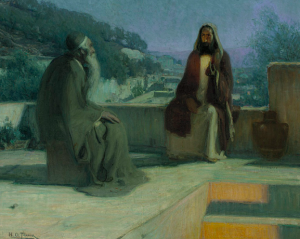
Nicodemus Visiting Christ (1899),
by Henry Ossawa Tanner.
The structure of the narrative thus far has been as follows: a cosmic-level prologue (1:1-18), dealing with the identity of the divine Logos and his incarnation as a man; the seven days of the new creation he is initiating (1:19-2:12); and his visit to the heart of the world (2:13-22). Following these, we get something almost unprecedented in the book of John, outside 1:5, back in the prologue: darkness. The continued waking, or watching,1 of the Logos during the night is surely no coincidence:
Behold, he that keepeth Israel
…..shall neither slumber nor sleep. …
The sun shall not smite thee by day,
…..nor the moon by night.
The Lord shall preserve thee from all evil:
…..he shall preserve thy soul.
The Lord shall preserve thy going out and thy coming in
…..from this time forth, and even for evermore.
—Psalm 121:4, 6-8
Here we come to the Fourth Gospel’s first portrait of a formal interaction between Yeshua and a member of the religious establishment. As this is one rabbi “talking shop” with another, we might expect a positive interaction, especially since Nikodemos opens deferentially, to the pitch of recognizing his host as a prophet. Alternatively, primed by the Synoptic Gospels, we might anticipate hostility or even conflict, since Nikodemos is a Prysha—see the postscript after textual note h for details. In reality, we don’t exactly see either; something subtler appears to us.
John 2:23-3:21, RSV-CE
Now when he was in Jerusalem at the Passover feast, many believed in his name when they saw the signs which he did; but Jesus did not trust himself to them, because he knew all men and needed no one to bear witness of man; for he himself knew what was in man.a
Now there was a man of the Pharisees, named Nicodemus, a ruler of the Jews. This man came to Jesus by nightb and said to him, “Rabbi, we know that you are a teacher come from God; for no one can do these signs that you do, unless God is with him.” Jesus answered him, “Truly, truly, I say to you, unless one is born anew,c he cannot see the kingdom of God.” Nicodemus said to him, “How can a man be born when he is old? Can he enter a second time into his mother’s womb and be born?” Jesus answered, “Truly, truly, I say to you, unless one is born of water and the Spirit,d he cannot enter the kingdom of God. That which is born of the flesh is flesh, and that which is born of the Spirit is spirit. Do not marvel that I said to you, ‘You must be born anew.’ The wind blows where it wills, and you hear the sound of it, but you do not know whence it comes or whither it goes; so it is with every one who is born of the Spirit.”e Nicodemus said to him, “How can this be?” Jesus answered him, “Are you a teacher of Israel, and yet you do not understand this? Truly, truly, I say to you, we speak of what we know, and bear witness to what we have seen; but you do not receive our testimony.f If I have told you earthly things and you do not believe, how can you believe if I tell you heavenly things? No one has ascended into heaven but he who descended from heaven, the Son of man. And as Moses lifted up the serpent in the wilderness, so must the Son of man be lifted up,g that whoever believes in him may have eternal life.”
hFor God so loved the world that he gave his only Son, that whoever believes in him should not perish but have eternal life. For God sent the Son into the world, not to condemn the world, but that the world might be saved through him. He who believes in him is not condemned; he who does not believe is condemned already, because he has not believed in the name of the only Son of God. And this is the judgment, that the light has come into the world, and men loved darkness rather than light, because their deeds were evil. For every one who does evil hates the light, and does not come to the light, lest his deeds should be exposed. But he who does what is true comes to the light, that it may be clearly seen that his deeds have been wrought in God.
John 2:23-3:21, my translation
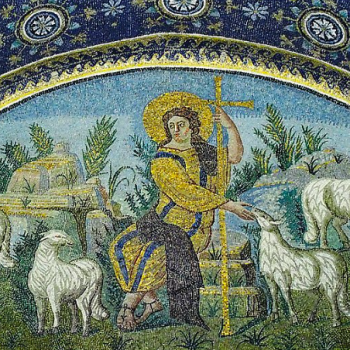
Baptismal font cover (c. 1930s) from the
Church of the Good Shepherd in Rosemont,
PA. Photo by Francis Helminski, used via
a CC BY-SA 4.0 license (source).
As he was in Yrushalem during Pesach, during the feast, many trusted in his name, beholding his signs which he did; but Yeshua, he did not entrust himself to them, for that he knew them all and that he had no need that anyone should witness about people, for he knew what was in people.a There was a person of the Pryshaya—Nikodemos was his name, a prince of the Jews; this man came to him at night,b and said to him: “Rabbi, we know that you have come as a teacher from God; for no one can do these signs which you do, unless God be with him.”
Yeshua responded and told him, “‘Amin, ‘amin I tell you, unless one be born from the top,c he cannot see the kingship of God.”
Nikodemos says to him: “How can a person be born when he is an old man? He cannot go inside his mother a second [time] and be born, [can he]?”
Yeshua responded, “‘Amin, ‘amin I tell you, unless one be born of water and spirit,d he cannot come into the kingship of God. What is born of the flesh is flesh, and what is born of the spirit is spirit. Do not marvel that I said to you, ‘It is necessary for you to be born from the top.’ The Spirit, wherever it wants, breathes, and you hear its voice, but do not know where it comes from or whence it leaves for; it is thus with everyone born of the Spirit.”e
Nikodemos said to him in response: “How can these things happen?”
Yeshua responded and told him, “You are the teacher of Yisra’el, and you do not know these things? ‘Amin, ‘amin, I tell you that what we know, we talk about, and what we have seen, we witness about, yet you all do not accept our witness.f If I spoke to you about earthly things and you did not have faith, how should you have faith if I speak to you about heavenly things? And no one has gone up into heaven except him that came down from heaven, the Son of Man.
“And just as Mosheh lifted up the snake in the desert, just so it is necessary that the Son of Man be lifted up,g in order that everyone who has faith in him should have age-long life. For thus God loved the world, so that he has given the only-begotten Son, in order that everyone who has faith upon him should not be destroyed, but should have age-long life. hFor God did not send the Son into the world in order that he should judge the world, but in order that the world should be saved through him.
“The one who has faith upon him is not judged; while the one who does not have faith has already been judged, because he has not had faith upon the name of the only-begotten Son of God. This is the judgment, that the light came into the world, and people loved the dark rather than the light, for their works were cruel. For everyone who practices worthless things hates the light and does not come to the light, lest his works be rebuked; one who does the truth comes to the light, in order that his works may be shown, that they are worked in God.”
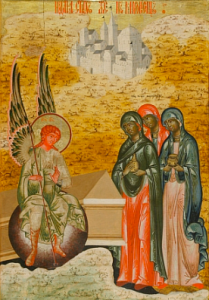
Russian ikon of the Myrrh-bearers, 18th c.
Textual Notes
a. many believed in his name when they saw the signs which he did; but Jesus did not trust himself to them, because he knew all men … for he himself knew what was in man/many trusted in his name, beholding his signs which he did; but Yeshua, he did not entrust himself to them, for that he knew them all … for he knew what was in people | πολλοὶ ἐπίστευσαν εἰς τὸ ὄνομα αὐτοῦ, θεωροῦντες αὐτοῦ τὰ σημεῖα ἃ ἐποίει· αὐτὸς δὲ Ἰησοῦς οὐκ ἐπίστευεν αὑτὸν αὐτοῖς διὰ τὸ αὐτὸν γινώσκειν πάντας … αὐτὸς γὰρ ἐγίνωσκεν τί ἦν ἐν τῷ ἀνθρώπῳ [polloi episteusan eis onoma autou theōrountes autou ta sēmeia ha epoiei: autos de Iēsous ouk episteuen auton autois dia to auton ginōskein pantas … autos gar eginōsken ti ēn en tō anthrōpō]: Here we have a Johannine motif: people believing in Yeshua, but lacking the nerve to profess their belief publicly. (Note too that, although John exhibits the most optimism about the idea of genuine faith being based on miracles, this is one of several remarks in the book that show the author did not naïvely assume this was a guaranteed or usual result.) At this juncture, it becomes a signal that the ensuing conversation with Nikodemos will not be a complete success.
Speaking of Nikodemos, he will prove a recurring character. His development complicates what can, at a first and surface-level reading, seem like a simplistic black-and-white outlook on the part of the author of the Johannine literature. Interestingly, though patristic-era tradition2 reports that Nikodemos became a publicly-avowed Christian, the author of this Gospel stops short of saying so; it is, however, our only source which reports that St. Nikodemos joined St. Yousef of Ramathaim3 as a Myrrh-bearer (the only two males so honored).
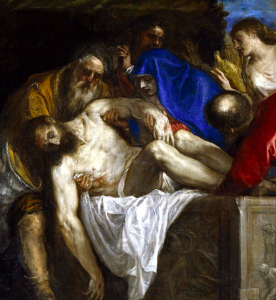
Entierro de Cristo [Burial of Christ] (1559),
by Titian. St. Nicodemus is at the far left;
St. Joseph of Arimathea is on the right, in red.
Especially in light of my complaint in note h last week, I feel it important to note something about the vocabulary here. I’ve basically agreed with the RSV in v. 24 by rendering the verb πιστεύω [pisteuō] as “entrust.” I almost invariably render this verb “to have faith (in)” because that nearly always covers both of the two senses of πιστεύω adequately: either a) believing something or someone, or b) trusting them. Unluckily, “have faith in” won’t quite stretch to mean “entrust (something or someone) to”, which πιστεύω does cover, so there’s not much choice here but to alter my usual course. However, I still wanted consistency within the sentence. The resonance of the word’s repeated use, first as the action of the nebulous “many” in v. 23 and then as the action of Jesus in the following verse, is muffled by the RSV’s decision to translate one occurrence of πιστεύω as “believed” and the next as “trust.”4 This asymmetric trust is reflected in their asymmetric understandings: Yeshua “knew what was in people,” whereas it is implied that people-in-general did not know what was in him. He will make this explicit while addressing Nicodemus: “you do not know these things … what we know, we talk about … yet you all do not accept our witness”.
b. by night/at night | νυκτὸς [nüktos]: Here we come to the first of three nights noted in the Gospel of John. These nightfalls are each associated with a lengthy homily, which is part of my reason for interpreting this passage as Christ speaking all the way through verse 21 (discussed further in note h below). The second night occurs immediately before the Bread of Life discourse in chapter 6, and the third is noted as Jesus is about to deliver the Upper Room discourse in chapters 13-17.
All three nights are also linked with some kind of sifting of his disciples, true from false. The Bread of Life discourse prompts a substantial number of Christ’s following to desist; the night in chapter 13 begins exactly as Judas is leaving the Last Supper, and contains both the teaching about remaining in him as branches of the Vine and the specific warning to the apostles that they were going to desert him. (I doubt this is where we get the saying that “integrity is who you are in the dark,” but it is certainly apt.)

The constellation Virgo in the night sky. (How
this looks like Astræa, or a young woman of any
kind, I don’t know.) Photo by Till Credner, used
via a CC BY-SA 3.0 license (source).
These themes are, forgive the pun, foreshadowed in Nicodemus. This is shortest of these three discourses, but still the longest uninterrupted speech we have yet had from Jesus. As religious practice in first-century Judaism laid the heaviest emphasis on circumcision, the templar sacrificial system, and the great commandment of the Shema (“Thou shalt love the Lord thy God with all thy heart, soul, mind, and strength”), so the language of these three homilies aligns with baptism, the Eucharist, and the mandatum novum (“As I have loved you, so you must love one another”). Yet Nicodemus himself, though he certainly thinks of himself as on Jesus’ side, is of two minds: he is bewildered by what Jesus is telling him here, and it is left ambiguous whether he accepts it. As Dr. Glenn Parkinson put it in a sermon on this text, Jesus “gently informs him that he is not, in fact, a believer—at least not yet. Why? Because Nicodemus came at night … when nobody could see him”. With each successive nightfall in the text, the length and emphasis of Jesus’ teaching, and the division among his hearers between belief and unbelief, will become greater.
c. anew/from the top | ἄνωθεν [anōthen]: Like the English phrase from the top, this word can mean either “from the physically uppermost part [of something],” or “from the beginning; over again.” The obvious interpretation, against the backdrop of John, is that Yeshua is saying that one must be born from above to enter the kingdom of heaven—which tracks—but that Nicodemus has misinterpreted this as a statement that one must re-do being born. Which makes it a little funny, or disquieting, or somehow both, that Christians seem so persistently to translate this phrase according to Nikodemos’s initial impression instead of the Lord’s intention!
Some commentators would consider this evidence either that: a) this conversation originally took place in Greek, or b) this does not record a real conversation between Christ and Nikodemos, since it relies on a Greek pun and this pair would have been speaking in Aramaic. (It would then be the commentator’s choice, depending on his or her philosophical sympathies, as to whether this was proof of the silliness of Christians for believing the New Testament, or a case of the author being “spiritually true to the real message of Jesus” or words to that effect.) I don’t think either of these conclusions follow. I went with the very clumsy translation I went with partly to highlight the fact that, when translating puns from one language into another, the crucial question is not whether there is a single word in the target language corresponding to each single word in the original language. The crucial question is: are there words or phrases in the target language, which can bear the same meanings that appear in the original, and can do so naturally enough to sustain the same verbal effect that occurs in the original? If the answer is “yes,” the pun is translatable, whether you have individual-word equivalences or not.
Moreover, while it would be a little surprising, it’s by no means impossible that this conversation was held in Greek in the first place. Greek was a widely spoken language throughout the eastern Mediterranean, and had been for centuries: nearly all Jews in the Holy Land would have had at least a conversational command of it, not least because they were next door to the Syro-Greek region of the Decapolis northeast of the Galilee, and, in Judea proper, only a little further from the Græco-Egyptian area of the Nile Delta to the west. Given that Nikodemos, like the apostles Andrew and Philip, has a Greek name, it’s possible he was from a family which spoke Greek even at home, and that Yeshua was fluent enough in this language that he adopted it, which would be a gracious gesture as the (formal or informal) host of the visiting rabbi.
d. of water and the Spirit/of water and spirit | ἐξ ὕδατος καὶ πνεύματος [ex hüdatos kai pneumatos]: This is more or less universally accepted among the Church Fathers2 as indicating the sacrament of baptism.
e. so it is with every one who is born of the Spirit/it is thus with everyone born of the Spirit | οὕτως ἐστὶν πᾶς ὁ γεγεννημένος ἐκ τοῦ πνεύματος [houtōs estin pas ho gegennēmenos ek tou pneumatos]: This is a very curious remark. Jesus seems to be saying that those who have not (or not yet) been “born from the top” can “hear the voice” of those who have been so born, “but do not know where [they] come from or whence [they] leave for”—attributing to these re-born people the same quality, or powers, as the Spirit itself. This receives interesting echoes in chapters 7 and 14:
Jesus stood and cried, saying, “If any man thirst, let him come unto me, and drink. He that believeth on me, as the scripture hath said, out of his belly shall flow rivers of living water.” (But this spake he of the Spirit, which they that believe on him should receive: for the Holy Ghost was not yet given; because that Jesus was not yet glorified.)
—John 7:37b-39 (emphases mine)
“Whither I go ye know, and the way ye know.” Thomas saith unto him, “Lord, we know not whither thou goest; and how can we know the way?” Jesus saith unto him, “I am the way, the truth, and the life: no man cometh unto the Father, but by me. If ye had known me, ye should have known my Father also: and from henceforth ye know him, and have seen him. … Believe me that I am in the Father, and the Father in me: or else believe me for the very works’ sake. Verily, verily, I say unto you, He that believeth on me, the works that I do shall he do also; and greater works than these shall he do; because I go unto my Father. And whatsoever ye shall ask in my name, that will I do, that the Father may be glorified in the Son.”
—John 14:4-7, 11-13 (emphasis mine)
f. you do not receive our testimony/you all do not accept our witness | τὴν μαρτυρίαν ἡμῶν οὐ λαμβάνετε [tēn martürian hēmōn ou lambanete]: Interestingly, this is another verse which suggests that the Gospel of John is not told entirely in chronological order. “You all do not accept our witness” seems to indicate that there is already a definite doctrinal rift between Yeshua and the rest of the Pryshaya, but thus far, Yeshua has hardly taught at all—this is his first discourse, and all he has done publicly is cleanse the Temple and say some cryptic stuff to the effect of “Tear it down and I’ll build you a new one in three days,” or something like that.
g. And as Moses lifted up the serpent in the wilderness, so must the Son of man be lifted up/And just as Mosheh lifted up the snake in the desert, just so it is necessary that the Son of Man be lifted up | καὶ καθὼς Μωϋσῆς ὕψωσεν τὸν ὄφιν ἐν τῇ ἐρήμῳ, οὕτως ὑψωθῆναι δεῖ τὸν υἱὸν τοῦ ἀνθρώπου [kai kathōs Mōüsēs hüpsōsen ton ofin en tē erēmō, houtōs hüpsōthēnai dei ton huion tou anthrōpou]: The brazen serpent was an amulet which reputedly went all the way back to the period immediately after the Exodus, when the Hebrews wandered the deserts in the northwest of Arabia. This region was known in the first century as Nabatæa (from Nabāṭū, the Arabian merchant kingdom which controlled it), or as Petræa (after the Nabatean capital of Petra—since made famous by its royal mausoleum’s appearance as scenery in Indiana Jones and the Last Crusade).

Maximum extent of the Nabatean Kingdom,
ca. 70 BC. Map created by Ali Zifan, used via
a CC BY-SA 4.0 license (source).
According to a famous episode in the Torah, the Israelites complained against Moses, in this case because
the soul of the people was much discouraged because of the way. And the people spake against God, and against Moses, “Wherefore have ye brought us up out of Egypt to die in the wilderness? for there is no bread, neither is there any water; and our soul loatheth this light bread [i.e., the manna].” And the Lord sent fiery serpents among the people, and they bit the people; and much people of Israel died. Therefore the people came to Moses, and said, “We have sinned, for we have spoken against the Lord, and against thee; pray unto the Lord, that he take away the serpents from us.” And Moses prayed for the people. And the Lord said unto Moses, “Make thee a fiery serpent, and set it upon a pole: and it shall come to pass, that every one that is bitten, when he looketh upon it, shall live.” And Moses made a serpent of brass, and put it upon a pole, and it came to pass, that if a serpent had bitten any man, when he beheld the serpent of brass, he lived.
—Numbers 21:4b-9
(This relic was preserved well into the monarchic period, presumably as part of the furniture of the Tabernacle and Temple; it was ultimately destroyed by Hezekiah, probably ca. 715-710 BC, as it had come to be treated as an idol.) Like the ancient amulet, Christ is to be lifted into the air on the Cross, but it is appropriate that the verb ὑψόω [hüpsoō], like the English phrasal verb “to lift up,” while often used literally, can also be used metaphorically for exalting or promoting someone or something. This is part of the reason that some commentators describe the Johannine conception as being that the Crucifixion, the Resurrection, and the Ascension are, spiritually, a single event: the Exaltation.
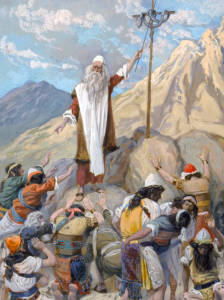
The Brazen Serpent (ca. 1900), by James Tissot.
Additionally, Numbers 21 and John 3 are two of the Bible’s uses of snakes as a positive symbol—and there are more of these than you might suppose, just as, say, the lion is usually a good symbol in the Bible yet there are also negative references to lions. Moses himself is associated with serpents through Aaron’s staff, which would transform into a serpent at Moses’ command (and which, hilariously, eats the serpent-staves of the Egyptian sorcerers in Exodus 7). Snakes were linked with cunning, an association they still have today. A symbolic significance one rarely sees snakes given today is that of metamorphosis and rebirth, but this was also familiar in antiquity, because snakes shed their skins. Both associations are suggested by this passage: the topic of this homily is rebirth, but the rebirth in question is a mystery understood only by those who receive it.
h. [—]: I’ve attributed vv. 16-21 to Yeshua. However, these verses are frequently interpreted as a comment from the author rather than as being said by his subject. (A similar interpretation is frequently given for vv. 31-35, though there it will be the Baptist who is presumed not to have said the words.)
Not a lot hangs on whether we attribute these words to Christ or the evangelist; people who believe the Bible is inspired will presumably accept vv. 16-21 regardless, and people who don’t presumably have no dog in this fight. Still, dividing the text this way is very odd to me. The author of John occasionally makes “asides” to the reader, but (outside a handful of obvious places to do that sort of thing, like the prologue) these tend to be brief and to the point, along the lines of 2:21 or 9:22-23, rather than the theological material of these verses. Further, nothing about vv. 16-21 is uncharacteristic of Yeshua’s remarks elsewhere, in the other Gospels or this one. The only thing I can think of to explain the interpretation that vv. 16-21 are no longer him speaking is that they describe him wholly in the third person? But he does that himself in v. 15, yet nobody seems to put that down as a narrator’s comment. Moreover, after ch. 3, passages widely interpreted as the author’s own theological meditations stop entirely until 12:37-43, and that’s the last one. This would make an uncharacteristic lack of pattern and balance in such an elegantly structured narrative. Incidentally, 12:37-43 occurs just before the Upper Room Discourse, one of those transitional points in the text where we might expect a bit of reflection before we change gears.
A Theological-Historical Postscript:
The Pryshaya
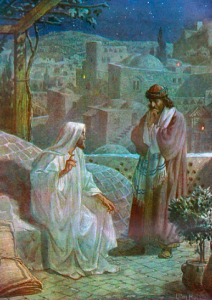
Depiction of Jesus and Nicodemus,
of uncertain title and date (19th or early 20th c.),
by William Brassey Hole.
As my readers are doubtless aware, there were a handful of sects in late Second Temple Judaism. The Pharisees and Sadducees5 are the sectarian names most familiar to Christians. There were also the Samaritans—though their status as Jews, then as now, was dubious, not only to the sticklers of Beyt Shammai, but even according to the extreme generosity of Beyt Yeshua—and the Essenes,5 the only important sect the New Testament says nothing about (which makes some sense, since the Essenes appear to have lived largely in remote communes).
The name Pryshaya is my approximation of the Aramaic term פְּרִישַׁיָּא [P’riyshaiyâ’], borrowed into Greek as Φαρισαῖοι [Farisaioi]; Prysha, from פְּרִישָׁא [P’riyshâ’], is the corresponding singular (with Φαρισαῖος [Farisaios]). The Pryshaya were the theological mainstream. All later forms of the Jewish religion descend from them, except possibly the tiny sect of Karaite Judaism.6 When exactly they became an identifiable group is not certainly known; Josephus reports that they, the Sadducees, and the Essenes had all taken shape not later than the time of John Hyrcanus I, a Hasmonean monarch who reigned from 134 to 104 BC.7 Both the Pharisees and the Essenes reputedly formed out of a division in an older group, הַחֲסִידִים [ha-Chàsydhym], “the Pious” (no relation to the modern Hasidic movement). It may be from these Chasydhym that the Pryshaya inherited the doctrine which set them apart from the Sadducees and Samaritans: the doctrine of the Oral Torah (תּוֹרָה שֶׁבְּעַל־פֶּה [Tourâh Sheb’3al-Peh]). This was a system of rules and interpretive principles which, they claimed, was passed on to Moses along with the Written Torah (תּוֹרָה שֶׁבִּכְתָב [Tourâh Shebikh’thâv]) at Sinai. This Oral Torah had been preserved by lineages of ordained teachers, descending from the seventy elders of Exodus, and more or less associated by the monarchic period with the prophetic schools. These lineages were known as רַבָּנִים [rabânym], “masters” or “teachers,” by no later than the first century.
This was not their only distinctive doctrine, and the Pryshaya were by no means a monolith. The canon of Scripture beyond the Torah was not entirely settled.9 While less disposed to apocalypticism, they shared an interest in eschatology with the Essenes, accepting ideas like messianism, the existence of angels, the reality of the human soul (i.e., as something that could meaningfully exist separately from the body), an eventual final judgment, and (as a prelude to this judgment) a general resurrection of the dead. Politically, on the whole, the Pryshaya opposed the violent tactics and xenophobic attitudes of the Zealots, as well as the collaborationism of the Sadducees.
I bring them up, because I want to highlight something most readers of the New Testament miss: Yeshua himself was a Prysha, a Pharisee.
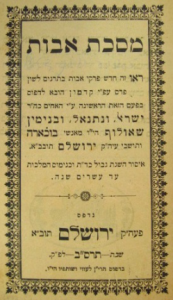
The title page of a Judeo-Persian edition of
Pirqei ‘Avouth [Chapters of the Fathers],
a Mishnaic-era compilation of rabbinic
writings on ethics.
This might be thought to be a forced conclusion, arrived at merely by the process of elimination from among the four or five half-cultural, half-theological varieties of Judaism that existed at the time. It’s easy to see the logic.
- Jesus was native to the Holy Land, and therefore was not a Hellenistic Jew.
- He accepted the templar system, and therefore could not have been an Essene.
- Equally and for the same reason (and others), he could not have been a Samaritan.
- This leaves only the two templar sects, the Sadducees and Pharisees; but we consistently find him taking the Pharisaic side wherever they differed with the Sadducees.
- Ergo, he must have been a Pharisee because they’re all that’s left.
Now, this would be a reasonable case for thinking he was nearer to the Pharisees than to anybody else, and might have been a Pharisee; but it would not be enough to justify the unqualified statement that he was one. Why not? Because Judaism doesn’t inherently fall into a four-sect or five-sect system. (Today, there are basically three in the Anglophone world, namely Orthodox, Conservative, and Reform Judaism.) Especially considering that what I’ve dubbed Beyt Yeshua rapidly came to be seen by others, and to see itself, as an independent religion—Christianity—it’s just as tenable that Jesus was not a Pharisee, but merely differed less from them than from anybody else.
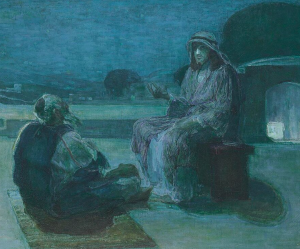
Nicodemus Coming to Christ (ca. 1925),
also by Henry Ossawa Tanner.
So why do I state categorically that Yeshua was one of the Pryshaya? Simple: he as good as tells us so—not in John, but in the Gospel of St. Matthew:
Then spake Jesus to the multitude, and to his disciples, saying “The scribes and the Pharisees sit in Moses’ seat: all therefore whatsoever they bid you observe, that observe and do; but do not ye after their works: for they say, and do not.”
—Matthew 23:1-3
This is, if anything, heightened in meaning, because it comes immediately before a passage known as the Seven Woes, the harshest denunciation of the Jewish religious establishment anywhere in the canonical Gospels (except possibly John 8:37-45, which may or may not be directed at the establishment per se). Even, or especially, a denunciation of this magnitude is not permitted to go forward without a clear prefatory statement that the Pryshaya enjoy the authority of Moshe himself. Even the instruction not to follow their example is explicitly given not because their doctrine is bad—which is what we might expect based on sermons that make the Pharisaic “hedge around the law” nothing but the moral error of legalism—but because their example fails to align with their own doctrine. If that’s not endorsement, I don’t know what is. And it is heightened by contrast with its background yet again, when we reflect that of the four evangelists, the author of Matthew is the one that most clearly and categorically asserts the divinely-instituted authority of the Apostles, especially St. Peter.
The reason I regard this as worth stressing is, I think it’s going to prove an important element in the long-term correction of Christian antisemitism. All Christian antisemitism is both sinful and thoroughly ridiculous; sadly, as I’ve remarked before, we live in interesting times, and the mere little fact that an idea or attitude is both morally disgusting and breathtakingly stupid doesn’t mean there won’t be thousands of Christians who accept it enough to publicly promote it—nor, however much we papists preen ourselves on the divisions or changefulness of our Protestant brethren (as if these were some sort of accomplishment on our part), do Catholics in this country seem to show an appreciably greater degree of resistance to the gangrenous contagion. Nevertheless, both Judaism and Christianity, “after their kinds,” are descended theologically from the Pryshaya of the first century. Obviously that alone does not effect peace between us. But the mere fact that it’s true is reason enough to say it; and I hope that, if that truth can be driven home for a majority of Catholics, some amount of amending the harms of the past two millennia can begin.
Footnotes
1Now more differentiated in meaning, wake and watch are both descended from Anglo-Saxon words (ᚹᚪᚳᚪᚾ [wacan] and ᚹᚫᚳᚳᚪᚾ [wæċċan], respectively) meaning “to be/stay awake.”
2The patristic era is that of the Church Fathers, a series of orthodox (or occasionally, initially- or primarily-orthodox) Christian writers who succeeded the Apostles properly so-called, before the era of what we might call academic theology. Most were bishops. Their historical period is usually defined as lasting from about the year 100 to roughly 800, bounded at one end by the death of St. John and at the other by the Second Council of Nicæa and the Carolingian Renaissance.
3In case “Yousef of Ramathaim” isn’t transparent (which, fair!), the more conventional terminology is “Joseph of Arimathea.” The identity of Arimathea with Ramathaim (more properly, Ramathaim-Zophim) is only a theory, but I have used it here because it seems credible to me.
4Indeed, it’s this type of pointless non-literalism—which I think is apt to distort the rhetorical effects (and thus, in some small degree, the meaning) of the original text—that spurs both my translation philosophy and my actual translation effort here. Non-literal translations are perfectly fine when a word-for-word rendering won’t make sense in English, or where they’re technically parse-able but so clumsy as to be distracting. But when a literal translation will make perfect sense in English, unless we’re dealing with poetry (where “sounding nice” is part of the point), what is the case against it? Even when we’re not dealing with the Bible, it just strikes me as silly.
5If you’re wondering why I haven’t coined a new Anglo-Hebrew term for “Saducee” and “Essene,” it’s because a) I don’t need either word for the Gospel of John, and b) the etymologies and, I gather, Aramaic forms of both are disputed. Sadducee is widely derived from the name of the Zadokites (from the Hebrew צָדוֹק [Tzâdhouq]), a priestly lineage, which I would tentatively accept. As for Essene, the celebrated Anglican divine J. B. Lightfoot suggested that it might be derived from an Eastern Aramaic cognate of the term Chasydhym, a word transcribed Hesi’im: I’m hesitant to draw any conclusion here, as I couldn’t trace Hesi’im to an actual Aramaic form (and know only a little about the language myself). Another possibility, which sounds credible to me, is that the name derives from חִיצוֹנִים [chytzounym] “strangers, outsiders,” and by extension “separatists, heretics.”
6Karaite Judaism is a tiny minority within Judaism—about fifty thousand people in a world Jewish population of nearly sixteen million. It is a little bit like a “sola Scriptura” version of Judaism, rejecting the inspired authority of rabbinic tradition. Some writers have suggested that the Karaites are descended from a remnant of the Sadducees, but most modern scholars reject this theory. However, the Karaites do maintain the more ancient Jewish custom of determining ethnicity patrilineally, against the later though still ancient tradition most Jews observe of determining ethnicity by matrilineal descent.
7The Hasmoneans were a Levite family. They held the high priesthood following the Maccabean Revolt, of which they were the principal leaders: Judah Maccabee himself was a Hasmonean, the third of five brothers, while the rest of the dynasty was descended from the second brother, Simon Thassi. (The dynasty were reputedly named for Simon and Judah’s great-great-grandfather חַשְׁמוֹנַאי [Chash’mouna’i]—Hashmonai is a near-equivalent in English, Asamon often appears in Hellenized or Latinized sources.) Simon Thassi and his son, our John Hyrcanus I, reigned as high priests and ethnarchs, not kings—on paper, the Maccabean Revolt had achieved autonomy within the Seleucid realm, not full independence. The royal title was assumed by Hyrcanus’s eldest son, Aristobulus I, who also conquered the Galilee.8 The Pharisees gain particular mention in Josephus because Hyrcanus, who had been affiliated at first with the Pharisees, went over later to the Sadducees (who therefore must also have existed by the late second century BC).
8This may prompt the question of why a Levite family was allowed to assume not just leadership, but the throne. The Judahite House of David had ruled by divine right, and restorations happen in monarchies all the time. Moreover, the dynasty was still extant. Zerubbabel, the Davidic heir as Jehoiachin‘s grandson, had been made governor of the province by Shah Darius the Great (see Haggai 1:12-2:9, Zechariah 4, and Ezra 1:5-2:2a—note that in Ezra, Sheshbazzar is likely the same person as Zerubbabel, cf. Daniel 5:12). Moreover, St. Joseph is listed in both Matthew and Luke as descended from Zerubbabel; and Luke’s genealogy is plausible, placing St. Joseph in the nineteenth generation from Zerubbabel, which accords well with the five-century gap involved. Now, one of Jeremiah’s oracles may have been interpreted as depriving not only Jehoiachin and his children, but the House of David as such, of divine right, as long as we ignore texts like II Samuel 7:11-16 or Psalm 89:20-37. Still, even if the House of David were ruled out, one might next have expected Benjamites to take precedence, since their tribe had produced a king, Saul. I don’t know for certain what the answer to this puzzle is; it may be as simple as “the Hasmoneans had enough power that they could afford to ignore the rules.” Either way, they lost power to an Idumean house, the Herods, in 37 BC, when Herod the Great wedded Princess Miriam (a.k.a. Mariamne I), one of the last two Hasmonean dynasts. The other was her brother Aristobulus III, who retained the high priesthood, at least until the paranoid Herod had him drowned a year later.
9The Torah was universally accepted (even by Samaritans, although their version contains many major and minor textual disagreements with both the Masoretic Text and the Septuagint). I gather that, among the Pryshaya, the prophets were also more or less agreed upon at this time—though in the Hebrew Bible, “the prophets” includes Joshua, Judges, Samuel (not originally divided into I and II), and Kings (also undivided), but excludes Lamentations, Baruch, and Daniel. If I’m correctly informed, dispute was mainly over the Kethuvim, or “Writings.” Today, eleven books are among the Kethuvim: Psalms; Proverbs; Job; the Song of Songs; Ruth; Lamentations; Ecclesiastes; Esther; Ezra-Nehemiah (combined); Daniel; and Chronicles (undivided). However, I gather that in the first century, Esther was still in doubt, and that some Pryshaya also esteemed Sirach and I Maccabees, which were originally written in Hebrew. The same may be true of Tobit as well, which was first composed in either Hebrew or Aramaic: the riddle posed to Jesus by the Sadducees, recounted in Matt. 22:23-33, Mark 12:18-27, and Luke 20:27-40, appears to be ridiculing part of the plot of Tobit, and the Sadducees were eager to needle their opponents over their “extra” books.











 Ad-Free & Subscriber Log-In