

You can find my two-part introduction to the Gospel of John at these two links, and my index/outline for it here; for the previous installment on John 11:1-46, go here. Also, as a small piece of “housekeeping”: even though it’s more common not to observe this convention, I’ve decided to start italicizing the names of individual books of the Bible in my text. This is because—and I can’t believe it didn’t cross my mind until now—this makes it much easier to show, without circumlocutions, when I’m talking about a book and when I’m talking about a person.
The Gospel of John: Entry to the Book of Glory (John 11:47-12:11)
At long last, we reach the (structural) midpoint of John. The seven miracles of the Book of Signs are concluded; hereafter, we are to behold what they signified: “Did I not tell you that if you had faith, you will see the glory of God?”
Interestingly, we close chapter 11 with a parallel to chapter 1—not to the prologue itself, but a parallel to the subcommittee of the Sanhedrin tasked with interrogating the Baptist (1:19-28), in order to decide what if anything to do about him. Here we have what again appears to be a subcommittee of the Sanhedrin—at any rate, it doesn’t sound as though troublemaking sympathizers like Nikodemos or Yosef of Ramathaim were invited—determining what they will do with Yeshua; later, they will interrogate him to extract a pretext for it. Thus one of the three critical pieces is set in place. Moreover the second piece, Yudah Ysh-Qriyot, is brought to the very brink in this passage, but is left there for the moment: he will not be set in his final position until chapter 13. (As for the third piece, Pontius Pilatus, he will become relevant only after the second and first pieces have made their capture.) This also positions the beginning of the Book of Glory parallel to the beginning of the Book of Signs in another way: the start of the Book of Signs shows thematic affinities with what was once the Hebrew civic new year, Rosh ha-Shanah, while the start of the Book of Glory is explicitly timed according to Paskha, originally the religious new year.
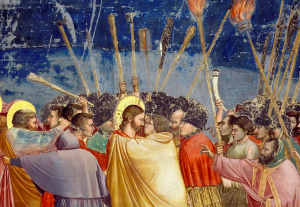
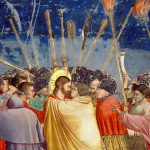
The Kiss of Judas (c. 1305), by Giotto di
Bondone—part of a fresco cycle of the life of
Christ from the Scrovegni Chapel in Padua.
A subtle parallel to the marriage feast of chapter 2 is instituted here. There are, if I have counted right, six meals in the Gospel of John:
- The marriage-feast in Qanah (2:1-11)
- The wayside “snack” in Süchar (4:8, 31-38)
- The feeding of the five thousand (6:1-15)
- This, the dinner given in Beyt Anya (12:1-8)
- The Last Supper (13:1-30)
- The breakfast by the Sea of Galilee (21:9-14)
If there’s a seventh somewhere in the text, it has eluded me. However, based on the evangelist’s love of heptads, I suspect that we are meant to perceive this set of six as an anomaly, and that the missing seventh meal is either or both of two things: the Blessed Sacrament (cf. 6:35-58); or the marriage supper of the Lamb (Revelation 19:9, 17-18, 21:1-3, 22:1-2). It is also worth recalling that, with the exception of the קָרְבַּן עוֹלָה [qârban ȝoulâh] or burnt offering, which was entirely burnt, sacrifices in the Judaic templar system were meals. Certain parallels are observable among these six meals.
- The first and fourth are banquets given in honor of a pair of guests: the wedded couple in the first, Yeshua and Eleazar in the fourth. Both also involve an unexpected and immense profusion of liquid (wine in the one case, perfumed oil in the other), and at both, another attendee asks why the high-quality liquid in question was not used otherwise.
- The second and fifth meals, although we can see from the text that they occurred, go almost completely un-described; both are also closely associated with harvesting language (this language is slightly delayed after the fifth meal, but emerges in chapter 15 with its vine imagery).
- The third and sixth, both of which are “hosted” by the Lord himself, are each closely associated with the Sea of Galilee—not just as a location,1 but as a site of miracles: the third meal is immediately followed by the Lord walking on water, while the sixth uses fish just taken in the catch of 21:1-8.2
As the first meal occurred in the context of the first sign in the Book of Signs, likewise, the fourth meal is placed right at the transition into the Book of Glory; the perfume of Miriam’s anointing becomes the setting in which the Book of Glory opens.
John 11:47-12:11, RSV-CE
So the chief priests and the Pharisees gathered the council,a and said, “What are we to do? For this man performs many signs. If we let him go on thus, every one will believe in him, and the Romans will come and destroy both our holy place and our nation.”b But one of them, Caiaphas,c who was high priest that year, said to them, “You know nothing at all; you do not understand that it is expedient for you that one man should die for the people, and that the whole nation should not perish.” He did not say this of his own accord, but being high priest that year he prophesiedd that Jesus should die for the nation, and not for the nation only, but to gather into one the children of God who are scattered abroad. So from that day on they took counsel how to put him to death.
Jesus therefore no longer went about openly among the Jews, but went from there to the country near the wilderness, to a town called Ephraim;e and there he stayed with the disciples.
Now the Passover of the Jews was at hand, and many went up from the country to Jerusalem before the Passover, to purify themselves. They were looking for Jesus and saying to one another as they stood in the temple, “What do you think? That he will not come to the feast?” Now the chief priests and the Pharisees had given orders that if any one knew where he was, he should let them know, so that they might arrest him.
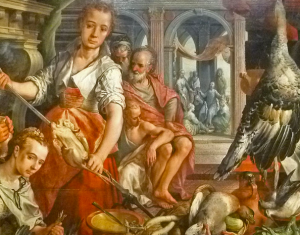
De Welvoorziene Keuken [The Well-Stocked
Kitchen] (1566), by Joachim Beuckelaer—the
house at Bethany, Christ teaching in the back-
ground. Used via a CC BY 3.0 license (source).
Six days before the Passover, Jesus came to Bethany, where Lazarus was, whom Jesus had raised from the dead. There they made him a supper; Martha served, and Lazarus was one of those at table with him. Mary took a poundf of costly ointment of pure nardg and anointed the feet of Jesus and wiped his feet with her hair; and the house was filled with the fragrance of the ointment. But Judas Iscariot, one of his disciples (he who was to betray him), said, “Why was this ointment not sold for three hundred denarii and given to the poor?” This he said, not that he cared for the poor but because he was a thief, and as he had the money boxh he used to take what was put into it. Jesus said, “Let her alone, let her keep it for the day of my burial. The poor you always have with you, but you do not always have me.”
When the great crowd of the Jews learned that he was there, they came, not only on account of Jesus but also to see Lazarus, whom he had raised from the dead. So the chief priests plannedi to put Lazarus also to death, because on account of him many of the Jews were going away and believing in Jesus.
John 11:47-12:11, my translation
Then the high priests and the Pryshaya gathered in session,a and said: “What are we doing? because this person does many signs; if we let him [go on] this way, everyone will have faith in him, and the Romans will come and take away our Place and nation.”b
But a certain one of them, Qayafa,c being the high priest that year, told them, “You don’t know nothing, nor reason that it suits you that one person should die for the people and the whole nation not be destroyed.” He did not say this of himself, but being high priest that year he prophesiedd that Yeshua was about to die for the nation, and not only for the nation, but also in order that the scattered children of God [should be] assembled in one. So from that day they took counsel in order that they might kill him.
So Yeshua no longer publicly walked about among the Jews, but went away from there into a region near the desert, into a city called Efraim,e and he stayed there with his students.
The Paskha of the Jews was near; and many people went up into Yrushalem from the region before Paskha, in order that they might hallow themselves. Then they were searching for Yeshua, and [people] said to each other, standing in the Temple: “What do you think? that he will not come to the feast?” The high priests and the Pryshaya had given charges in order that, if anyone knew where he was, he should report it, they might seize him there.
Then, six days before Paskha, Yeshua came into Beyt Anya, where Eleazar was, whom Yeshua raised from the dead. So they had a dinner for him there, and Marta served, while Eleazar was one of those who reclined with him; then Miriam took a troy poundf of perfume of genuine, very precious spikenard,g poured it on Yeshua’s feet, and wiped his feet with her hair; the household was filled with the scent of the perfume. Yudah Ysh-Qriyot, one of his students, who was about to give him over, said: “Why was this perfume not sold for three hundred dinars, and [the proceeds] given to beggars?” (He said this not because he cared about beggars, but because he was a thief and, having the money-box,h would carry off what was thrown in it.)
Then Yeshua said, “Leave her alone—she kept this for the day of my entombment; for you always have beggars among you, but you do not always have me.”
Then much of a crowd of the Jews knows that he is here, and they came not only for the sake of Yeshua, but in order that they might also see Eleazar, whom he raised from the dead. And the high priests took counseli in order that they might kill Eleazar too, because many of the Jews for his sake went off and had faith in Yeshua.
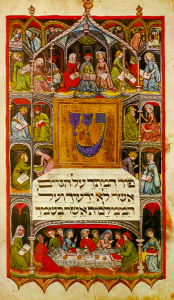
A fifteenth-century illuminated Haggadah (the
book used for the Pesach Seder) from Germany.
Textual Notes
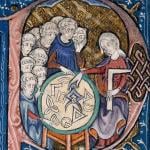
a. gathered the council/gathered in session | συνήγαγον … συνέδριον [sünēgagon … sünedrion]: As mentioned in the prefatory matter, I don’t think that this means the whole Sanhedrin was convened. A short review of a little of its structure and operations is in order.
The Great Sanhedrin was a form of the beyt dyn, a rabbinical court (still extant among observant Jews) convened to resolve some legal issue: religious, civil, or—while Judea was independent—criminal. A few minor matters could be settled by consulting with as few as three rabbis; most disputes serious enough to require arbitration would be brought before a local beyt dyn, which needed twenty-three members. This number may have been inspired by the twenty-two letters of the Hebrew script, but these courts always explicitly required an odd number of members, to avoid deadlocking via ties.
The Great Sanhedrin was a kind of supreme court, relative to these lesser courts, and had the authority to bind Jews in general by its decrees, whether they lived in the Holy Land or not. The date of its founding is not known. It consisted in seventy-one members. Its name, a little surprisingly, is an adaptation of a Greek word, in fact of συνέδριον, “together-sitting”; the end of the word was probably altered to –in because this was the Aramaic equivalent of the Hebrew –ym, the masculine plural ending. (This Aramaic ending is, occasionally, still discernible in Semitic loanwords in the religious register, like in the old Prayer-book translation of the Te Deum, whose “Cherubin and Seraphin continually do cry, ‘Holy, holy, holy'”.) It met daily, excluding sabbaths and holy days, in a place called the Hall of Hewn Stones which was convenient to the Temple. The Great Sanhedrin also had the power to assign lesser duties to subcommittees of twenty-three, though it was not supposed to do this in capital cases (which, after Archelaus was deposed in 6 CE, would also require collaboration with the Roman procurator): those required the full seventy-one man council to convene.
To be eligible for selection as an elder of the Sanhedrin, one had to be an adult, male Jew who studied Torah and participated in the rites associated with the Temple in Yrushalem. In practice, this involved belonging to either of two doctrinal-slash-ritual parties: the Pryshaya, the Pharisees; or the Tzaduqin, the Sadducees. There were other religiously observant parties, but, well …
- Hellenists. These were Jews who lived in the Mediterranean diaspora (whose first language was typically Greek, hence the moniker). This made their membership impracticable. Their theology could be dubious, too: there was a large population of Hellenists in Egypt, and some of them had another temple there, staffed by a branch of the Zadokite family and everything.3
- Samaritans. NO. Their status as Jews at all was in question, and they rejected the Temple on Mount Tziyon in favor of worship on Mount Grizym anyway.
- Essenes. The Essenes were reputedly derived from the same theological “party” as the Pryshaya, but by now that was a century or two ago, and they rejected the Temple—for less unorthodox reasons than the Samaritans, sure, but they weren’t going to accept an invitation even if one were issued.
Furthermore, one had to be of sufficiently pure Jewish descent that one’s daughters would be eligible for priests to take as brides.4 So most of the Sanhedrin’s members were rabbis, Levites, or both. It included three fixed members:
- כֹּהֵן גָּדוֹל [Kohên Gâdhoul]: the Kohen Gadol or high priest—until a no-confidence crisis a little before the Maccabean Revolt, the Kohen Gadol had presided over the Sanhedrin as a body.
- נָשִׂיא [Nâšy’]: the Nasi or “prince” (plural N’si’im), an office created as a result of the said no-confidence crisis, who was now the president of the Sanhedrin.
- אָב בֵּית דִּין [‘Âv Bêyth Dyn]: the Av Beyt Dyn or “father of the house of justice,” second-in-command to the Nasi.
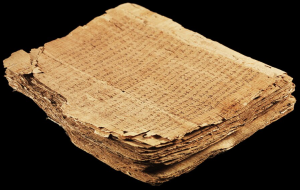
Bodmer Papyrus 66, a near-complete manuscript
of the Gospel of John which may date as early as
the second century.
Do we know who filled these positions when Yeshua was crucified? Yes and no. The high priest at the time, we know—Yosef ben Qayafa, or Caiaphas. (One thing that can be a little confusing at first when reading lists of who held what office among the ancient Jews is that people are often spoken of, and even addressed, by their patronymic, i.e. the “ben/bar5 ___” or “son of so-and-so” part of the name.) The other two are a bit of a problem.
One of the most famous N’si’im had been Hillel the Elder, still a favorite figure in Judaic history and theology. He founded Beyt Hillel, the school of interpreting the Torah that most emphasized leniency and compassion in its application; however, Hillel had died in about 9 CE, and was succeeded by his son, Shimon.6 He remained Nasi for approximately twenty years, and is held to have been the father of Rabban Gamliel I, the “Gamaliel” of Acts 5. Gamliel in turn served as the Sanhedrin’s Nasi for twenty years, from about 30 to about 50. Unfortunately, to the best of my knowledge, we don’t seem to know exactly when the changeover took place, or whether the Nasi at this time was Shimon or Gamliel I, or even whether there were a short interregnum for some reason.7
A similar issue plagues the third of these offices. The famous Shammai the Elder had been appointed Av Beyt Dyn under Hillel; he founded the rival, rigorist interpretive school, Beyt Shammai, although he and Hillel personally respected one another intensely. He died in or around the year 30 CE: since we don’t know exactly which years the Lord’s ministry extended through,7 it is accordingly impossible to say with certainty whether Shammai would have been alive at this time; if he had, he would have been eighty years old or very nearly. The office appears to have suffered a vacancy after his death, though it was eventually restored.
As mentioned, the Sanhedrin could authorize a subcommittee to handle certain duties, but it was not allowed to do this in cases that called for the death penalty. I cannot prove this, but my hunch is that—relying on the prestige of his status as high priest, and that of his father-in-law Chanan (see note c below)—Qayafa chose precisely to ignore this rule, summoned a group of twenty-three elders whom he felt he could rely on to be like-minded, and laid his plan before them. It makes a lot more sense to me to think that twenty-three members of the Sanhedrin could have been this hypocritical, than to suppose that sixty-nine (nice) men8 of good repute who were all serious enough about the Torah to make it their life’s work, could all have been so constrained by ego and anxiety and myopia as to conspire to murder a rural rabbi in an official meeting. This “illicit subcommittee” idea might also explain the two phases of the ecclesiastical trial, which only the author of John distinguishes—one before Chanan and one before Qayafa himself. Perhaps the extra layer of examination was a sop to their consciences for their breach of protocol.
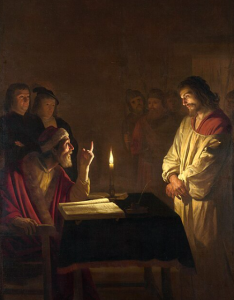
Christ Before the High Priest (c. 1617), by
Gerard van Honthorst, depicting the Lord’s
second ecclesiastical trial (cf. John 18:24).
Lastly. I don’t think I’ve seen other commentators address this, but the presence of this story in the Fourth Gospel implies that somebody who had been in on the plot, or one of their close associates (e.g. a spouse), eventually converted to Christianity and told John what had happened. This isn’t surefire; rumors filter through communities in lots of ways. But the outline of the plot is particular enough to make me wonder.
b. destroy both our holy place and our nation/take away our Place and nation | ἀροῦσιν ἡμῶν καὶ τὸν τόπον καὶ τὸ ἔθνος [arousin hēmōn kai ton topon kai to ethnos]: As touched on in textual note g of §ix, “the Place” was (and is) a Judaic title for God.
c. Caiaphas/Qayafa | Καϊάφας [Kaïafas]: According to Josephus, יוֹסֵף בַּר קַיָּפָא [Yousêf bar Qayyâfâ’] was made the high priest by Valerius Gratus, Tiberius’ first appointee as procurator of Judea.
Gratus was conspicuous for his interference in this office, despite the fact that appointment to the high priesthood was supposed to be for life. (This was not altogether a Roman novelty: the Herods had already shown themselves less than scrupulous in swapping out one Kohen Gadol for another.) Chanan ben Set—known in most New Testaments as Annas—was the high priest when he arrived in Judea in the year 15. However, Gratus removed him almost immediately, replacing him with Ishmael ben Phiabi, of Hasmonean descent (presumably on the distaff side). Ben Phiabi remained in office only a year; Gratus then made Chanan ben Set’s son, Eleazar ben Chanan, the high priest. After another year, he was meddling again, removing ben Chanan and installing one Simon ben Kimchit—who, say it with me, was only high priest for a single year. This brings us to the year 18, in which Yosef bar Qayafa was selected, who also happened to be the son-in-law of Chanan ben Set.
Qayafa proved to be an exceptionally successful appointee, keeping the office for eighteen years (outlasting not only Valerius Gratus but his successor, Pontius Pilatus). He appears to have belonged to the Tzaduqin,9 who were in favor of collaborating with the Romans. This does not appear to be confirmed explicitly in either Christian or Jewish literature of the time, but it aligns with three noteworthy facts: his hostility to Yeshua (even if that hostility was shared by some of the Lord’s fellow Pryshaya); the seemingly outsize influence of the Tzaduqin on the Sanhedrin at the time, at least as depicted in Acts 5, despite their unpopularity with the people; and the Mishnah‘s hostility to him, if calling him “the Monkey” is any guide.10
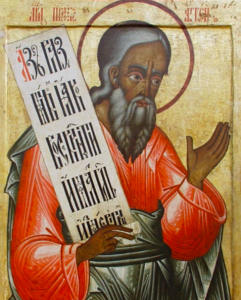
Russian ikon (18th c.) of the prophet Haggai
from Kizhi Monastery in Karelia, adjacent
to Finland.
d. being high priest that year he prophesied | ἀρχιερεὺς ὢν τοῦ ἐνιαυτοῦ ἐκείνου ἐπροφήτευσεν [archiereus ōn tou eniautou ekeinou eprofēteusen]: This is a cryptic and intriguing remark. That a genuine prophecy should come through someone individually corrupt is not at all strange to the Hebrew Bible; the Balaam pericope in Numbers 22-24 establishes that much. But, according to the Tosefta (a compilation of the Oral Law, similar in nature and date to the Mishnah), the Holy Ghost “left Israel” with the deaths of the last three of the Twelve Prophets, Haggai, Malachi, and Zechariah.
Unfortunately, we don’t know exactly when their deaths were. Haggai and Zechariah are generally thought to have flourished right around the construction of the Second Temple at the end of the sixth century BC, ca. 520-500; it therefore seems unlikely either of them would have been alive past the middle of the following century. Incidentally, Malachi—which, according to Judaic tradition, is not a name but a title, “my (i.e., God’s) messenger”; the same tradition usually identifies “Malachi” the person with Ezra the Scribe, though apparently a minority tradition put forth Mordecai (of Esther fame) as the author. Anyway, Malachi is usually dated to around the middle of the fifth century BC. One of the things that people found so exciting about St. John the Baptist was that, somehow or other, he produced a widespread conviction that he was an authentic prophet. The author of Luke gives us to understand that the Baptist was not quite the first of this new generation of prophets, so perhaps the Tosefta was simply wrong; or perhaps there was a premonitory movement of the Holy Ghost in Israel around the time of Christ; or both. Any of these would make sense from a Christian point of view.
e. to the country near the wilderness, to a town called Ephraim/into a region near the desert, into a city called Efraim | εἰς τὴν χώραν ἐγγὺς τῆς ἐρήμου, εἰς Ἐφραὶμ λεγομένην πόλιν [eis tēn chōran engüs tēs erēmou, eis Efraim legomenēn polin]: “City” is the normal translation for πόλις [polis], so I have used it here, but it’s a … strong word for what Efraim was. “Village” or “hamlet” would be closer: even today, the Palestinian settlement thought to be identical with Efraim, Taybeh, is home to only a little more than a thousand souls. Efraim and Taybeh have also been identified with the Hebrew Bible’s Ophrah, a very old settlement in the territory of Benjamin, mentioned in passing in Joshua‘s description of the lottery that divided up Canaan among the Twelve Tribes. It lay less than ten miles away from Yrushalem, northward.
f. a pound/a troy pound | λίτραν [litran]: The troy pound is a smidge lighter than the avoirdupois pound we generally use—indeed, so generally that we almost always leave out the “avoirdupois” part. I used this term because the Græco-Roman λίτρα was closer to the troy than the avoirdupois pound. The latter consists in sixteen avoirdupois ounces, each of which is about 28.3 grams;11 the troy ounce is slightly heavier at 31.1 grams, but the troy pound consists in only twelve troy ounces. Troy pounds today are used almost exclusively to measure quantities of precious metals—not only classical ones like silver and gold, but “new” ones like platinum as well.
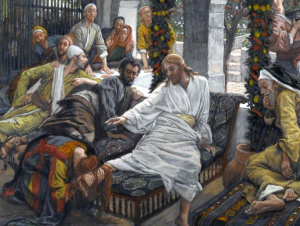
Le Parfume de Madeleine (c. 1900), by James
Tissot. This likely shows the anointing described
in Luke 7, debatably attributed to St. Mary Magda-
lene, who is often conflated with Mary of Bethany.12
g. costly ointment of pure nard/perfume of genuine, very precious spikenard | μύρου νάρδου πιστικῆς πολυτίμου [mürou nardou pistikēs polütimou]: As touched upon in note b of last week’s post, nard, or spikenard, is an essential oil derived from flowers of the genus Nardostachys, which grows in the Himalayas. What I didn’t know last week was that this is not the sole candidate for what gave this “perfume of spikenard” its primary scent. I gather, based on the usual meaning of νάρδος [nardos] and the cited cost, that oil of Nardostachys is by far the likelier, but there may be another possibility. This other is an oil derived from another set of flowers, the genus Lavandula. These plants grow around the coasts of the Mediterranean Sea and the Indian Ocean; the essential oil derived from them is (when mixed with water) an extremely effective specific for treating burns, its flowers (both fresh and, in smaller quantities, dried) can be put to a variety of culinary uses, and Lavandula nectar makes high-quality honey. Its common English name is lavender.
Also, I simply had to share: the Hebrew word for nard, as it turns out, is נֵרְדְּ [nêr’d].
h. as he had the money-box/having the money-box | τὸ γλωσσόκομον ἔχων [to glōssokomon echōn]: A hyper-literal rendering of γλωσσόκομον would be the much grosser and more alarming-sounding “tongue-box.” No, it wasn’t a box you put the torn-out tongues of your enemies in, metal though such a device might be; the “tongues” in question were the mouthpieces of wind instruments, usually variants of what was known to the Middle Ages as the shawm (an instrument ancestral to today’s oboe and bassoon). How it came to be cross-applied to a “purse” or money-box is a topic Thayer’s Lexicon was unenlightening about—except insofar as “a box,” whatever its original purpose, can be used for pretty much any other purpose.
Incidentally, although we’re used to deducing from this verse that Judas was the treasurer out of the Twelve, and that is likely the case, the text stops shy of that. The present participle ἔχων points to him having care of the tongue-box at the time here described: the thing is, we aren’t told exactly how these things were managed—it might have been a rotating duty, for instance. Then again, this passage also indicates that Judas was an embezzler, which would have been much easier to get away with in the long term if “treasurer” were a continuous office among the Apostles, and Acts 1:20-22 perhaps implies faintly that offices were fixed rather than rotational.
i. So the chief priests planned/And the high priests took counsel | ἐβουλεύσαντο δὲ οἱ ἀρχιερεῖς [ebouleusanto de hoi archiereis]: This phrasing makes me wonder whether this were an even smaller conspiracy, one to which the Pryshaya who had connived with Qayafa were not invited. However, I’m not sure.
Footnotes
1Interestingly, the third and sixth are given only this location; the other four each have their proper city (that of the fifth being of course Yrushalem). Luke informs us that the feeding of the five thousand took place in the vicinity of Beyt Tzayad, St. Philip’s hometown; it seems like a reasonable guess that the breakfast was eaten roughly around K’far-Nachum, since St. Peter seems in 21:3 to be resuming his fishing business in the short term, between the Resurrection and Pentecost.
2It is interesting that the author of John, which seems like Matthew to take a special interest in St. Peter, says nothing of Peter also walking on the sea, when the parallel account in Matthew 14:22-33 (which is clearly associated with the feeding of the five thousand) does relate this. The reason I find this interesting is, I notice that John quietly omits the name of Jesus’ Mother from the narrative of the first meal—even though her name obviously would have been known to him!—but then explicitly names St. Mary of Bethany in that of the fourth meal; and one of the typical exegetical and instructional techniques of rabbinic Judaism is to not say, or not repeat, some important detail, precisely in order to raise the question, Why isn’t such-and-such there this time? This makes me wonder whether part of the reason he mentions Peter plunging into the sea in 21:7, which obviously is in the lead-up to the narrative of the sixth meal, is as an equally subtle nod to this detail he left out when talking about the third meal.
3This temple and the lineage of priests who staffed it, which are known from Josephus, probably appeared in Egypt in the second century BC during the Seleucid persecution of Judaism and resulting Maccabean Revolt. The priests were apparently descendants of High Priest Chouniyo (Anglo-Greek Onias) III, whose position was usurped in 175 BC by his brother Jason, a collaborator with Antiochus Epiphanes. (The boys’ parents had not given him the Greek name Jason, or Ἰάσων [Iasōn]; Josephus tells us that he adopted it in place of his Hebrew name, יֵשׁוּעַ [Yêshúaȝ].)
4Normally, this would mean the Jewish son of Jewish parents. However, people converted to Judaism then as now, and sometimes there were also marriages between Jews and “God-fearers” (Gentile sympathizers with Judaism who stopped short of full conversion for whatever reason); the children of converts would presumably be brought up to practice Judaism (unless the convert apostatized), and the children of a God-fearer might be raised as Jews. Gentile ancestry was not necessarily disqualifying for membership on the Sanhedrin, but I’m not clear how far back in one’s ancestry the Gentile who gave it to you needed to be, not least because I don’t know whether Jewish descent was measured the same way in the first century that it is now. Today, Jewishness is held to be inherited matrilineally; I’ve heard that in antiquity, Jewishness was viewed as descending patrilineally, but I don’t have good sources for this.
5The discrepancy between ben and bar is that the former is Hebrew and the latter Aramaic.
6Apparently some writers theorize that Shimon ben Hillel is the Simeon of Luke 2:25-35; I find this unlikely, since Luke‘s Simeon is implied (v. 29) to be of a very advanced age, whereas, since Hillel himself reputedly died around the age of 80, Shimon ben Hillel should only have been in his late forties or early fifties.
7We know from Luke 3 that the Baptist’s ministry began in 28 or possibly 29 CE, but we don’t know exactly how long that had been going when Christ was baptized and began his own preaching. The schema I like best goes like this:
A) Allow about a year to the Baptist;
B) Follow the Synoptics in making Christ’s ministry last about three years;
C) Assign the deaths of Shammai the Elder and Shimon ben Hillel to early in the year 32 at the very latest; and
D) Assume—that is, invent—a delay of anything from several months to a few years in the accession of Gamliel I.
This would mean that when Qayafa orchestrated Yeshua’s condemnation (which on this showing should have occurred in 32 or 33), neither Shammai nor Gamliel were responsible. I believe (B) is generally accepted; however, I need to stress, I can offer no real evidence that (A), (C), or (D)—the load-bearing elements—are correct or even especially likely. To the best of my knowledge, (A) is plausible, but that’s not evidence for it. (C) is again plausible, as I for one can’t believe a stickler like Shammai could have countenanced a resolution like this, but again, plausibility isn’t proof. As for (D), it makes sense to me to assume the Gamliel I described in Acts 5 (who does seem consonant with other accounts of him) couldn’t possibly have presided over this miscarriage of justice; Qayafa does appear to be the deciding voice here, which could have been because the Nasi was absent or the position unfilled. But that could-be explanation is a distinct supposition. It needs to be recognized as such, and to be evaluated for its probability in its own right, not slipped into a theory as if it were confirmed data. Indeed, my principal reason for mentioning “the schema I like” here at all is simply to disclose to my readers a possible bias on my part.
8Sixty-nine, because we do know that at least two members of the Sanhedrin did not assent to Qayafa’s plan, as mentioned in the intro: Nikodemos, and Yosef of Ramathaim.
9Please note: Tzaduqin is my theoretical reconstruction of what the Aramaic name for the Sadducees might have been, based on such scraps of information about the relevant Aramaic and Hebrew terms as I was able to find, and undertaken only because I couldn’t seem to find a direct statement anywhere of what the Sadducees were in fact called in Aramaic. It may easily be erroneous!
10This was a pun based on the spelling of his name. קוֹף [qouf] is both the name of the Hebrew letter often transcribed as q and the word for “monkey” or “ape”; and in the Mishnah‘s sixth tractate, section four, subsection three, in a discussion of the “red heifer” ritual (used to ritually cleanse people who had had contact with corpses), Qayafa is spoken of as הַקּוֹף [haq-Qouf], “the Monkey.” (The Mishnah was compiled by Pryshaya and overwhelmingly quotes Pryshaya as its authorities, so a cold attitude to a Tzaduq, even if he was the high priest, is to be expected.)
11For reference, 1 gram is about the weight of a paperclip.
12I mention these uncertainties because, based on the texts in question, it genuinely is unclear whether the woman of Luke 7 should be regarded as St. Mary Magdalene, and unclear again whether either woman is the same as St. Mary of Bethany (Miriam of Beyt Anya in my lingo). Understanding these as one, two, or three women can all be reconciled with the texts.





 Ad-Free & Subscriber Log-In