

Patheos SR 5026. Quantum Consciousness Theology: Response to Keith Giles
The excitement over new insights into physical reality is by no means limited to our physicists in white lab coats. Bible-reading theologians are excited too.
Quantum activity at the sub-atomic level, observes Drew Rick-Miller at Science for the Church, “is filled with counterintuitive, fuzzy, and at times spooky surprises. Depending on who you are, that will either a) get you really excited, or b) make you very nonexcited.” Among those excited, we list today’s theologians.
Why does Quantum Mechanics excite theologians?
Why the theological excitement? Quantum mechanics (QM) opens a window to fresh air in the previously closed universe of Isaac Newton (1643-1727). Newton’s world is known by nicknames such as “classical physics” or the “clockwork universe.” In the world of classical physics, the universe looks like a Swiss watch or a medieval mechanical clock. Each physical cause, like every tooth in every gear, determines precisely what effect results from what cause. The clockwork universe is a closed-causal nexus.
For the theologian, this meant that God could not act in, with, or under natural processes. There is no room in a clockwork nexus of cause and effect for divine action. For God to intervene, God would have to perform a miracle. And such a miracle would suspend or abrogate a law of nature. It would break a gear, so to speak.
Yet, as each theist knows, the laws of nature have been put in place by their Creator in order to express God’s will. So, to force God to suspend his own laws of nature just to act, gives the biblical theist a severe stomachache.
QM opens up Newton’s closed causal nexus, especially when we rely on the Copenhagen interpretation of sub-atomic events. It appears that micro-physical events involving electrons and photons cannot be fully explained by conventional cause and effect. Quantum activity is indeterminate. Whether sub-atomic events look like waves or particles, they are not subject to a closed mechanism. Might this open a window through which non-interventionist or non-miraculous action?
Quantum consciousness theologian Scot English, writing for Patheos, celebrates the new day.
“Quantum physics has dismantled the Newtonian universe piece by piece. What it has left in its place is not chaos but something far more interesting — a reality that is dynamic, relational, and irreducibly participatory. At the subatomic level, nothing exists in isolation. Everything is entangled with everything else. Observation shapes outcome. The observer is never truly separate from what is observed. These are not fringe ideas. They are the settled conclusions of the most rigorously tested field of science in human history.”
Twitterpated theologians confront the measurement enigma.
Why are theologians twitterpated by physics? Maxwell Shimba explains how QM opens a window for the fresh air of consciousness to blow into God’s physical creation.
“Quantum physics, at its core, is the study of the smallest constituents of matter and energy—particles like electrons, photons, and quarks—that behave in ways that defy the logic of everyday experience. Foundational to this field is the principle of wave-particle duality, where particles behave both like discrete points and continuous waves, depending on how they are observed. This duality blurs the classical boundaries between physical categories and suggests a universe that is deeply interconnected and observer-dependent” (Shimba 2025, 10).
Of the many weird phenomena physicists observe at the sub-atomic or quantum level, the measurement problem seems especially important to the school of thought we will dub Quantum Consciousness Theology.
“The measurement problem, epitomized in the famous double-slit experiment, demonstrates that particles exist in a state of superposition—simultaneously occupying multiple states—until they are observed. The act of measurement collapses the wave function, resulting in a definite outcome. This observer effect suggests that the observer is not a passive spectator but a co-creative participant in the formation of reality. The implications are profound: if observation determines outcome, and if the physical world is contingent upon such observation, then consciousness must be regarded not as a secondary phenomenon arising from brain processes, but as a fundamental constituent of the cosmos” (Shimba, 2025, 16).
The stage is set. The drama already taking place within quantum mechanics is now wowing its theological audience.
Three Quantum Theology Models
What is revealed about the natural world redounds to theological questions such as: what is God’s relation to creation? Can Bible believers find resonance, if not consonance, between science and scripture?
Rodney Holder, Course Director of the Faraday Institute at Cambridge University, adds quantum theory to his list of theological sources. “The world revealed by quantum theory is consonant with what would be expected on the basis of Christian doctrine” (Holder 2012, 229). The key term is consonance, suggesting agreement and perhaps even harmony between what we learn from the natural sciences and what we construct as theological doctrine.
“There is,” avers Nick Spencer at Theos, “no such thing as quantum orthodoxy, there being different interpretations of what exactly is going on here.” What we see in quantum theology are multiple attempts to construct theological models of God’s creation that are consonant with what we have learned about nature from QM.
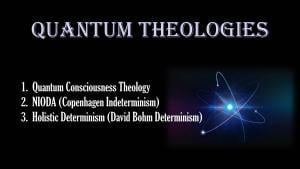
Theologians seeking consonance between divine action and quantum physics are working on at least three constructive models: (1) Quantum Consciousness Theology; (2) NIODA (Non-Interventionist Objective Divine Action) proffered by Robert John Russell; and (3) Holistic Determinism developed by Carl Peterson and, yours truly, Ted Peters. Here in this Patheos post, let’s take a look at the first: Quantum Consciousness Theology.
1 Quantum Consciousness Theology
Let’s begin with the inventive adventures of Patheos theologian Keith Giles, bursting with provocative new thoughts about reality. I dub this position Quantum Consciousness Theology, because Giles’ fundamental metaphysical move is away from materialism toward substituting consciousness as the irreducible ultimate reality. Consciousness comes first. Then, everything else.
If you are new to Keith Giles, take a look at his new edited volume, Quantum Theology: Volume One, or listen to a panel on this book at “This Is Not Church.”
Giles is particularly impressed by one phenomenon in QM, namely, the influence of experimental measurement on what is measured. It is the measurement event that determines whether a given subatomic quantum takes the form of a wave or a particle. Does this mean that the subjectivity of the scientist determines the objective existence of what gets measured? If so, this is astounding.
To my reading, Giles makes three points worth pondering. Here they are.
First, Giles says “Yes” to serious physics and serious theology. “No” to quantum spirituality.
According to Keith Giles, “the real problem, as I see it, is that the actual science and the full realization of what this fascinating theory might have to teach us will quickly become lost in the fog of quantum spirituality. To avoid taking a shortcut into quantum cultism, I think this warning means we should take the long trail through serious science and serious theological reflection. And be patient. Don’t make up your mind just yet on Quantum Theology,” Giles alerts us. “Hold loosely to what you hear. Keep processing. Understand that right now, almost no one really understands quantum science.” Note that quantum spirituality is fog. Don’t get lost in this fog, warns Giles.
Even so, Giles hears of wars and rumors of wars, and he wants to ready us with a paradigm shift in theology. Giles feels the dangers in the current global crisis deeply, watching the clouds of military self-immolation and environmental self-destruction. What the planet needs now is a second axial breakthrough, a second leap in consciousness. “Unlike the First Axial Age, this Second Axial shift is not primarily political or technological,” writes Giles. “It is a shift in consciousness. It means we need to experience a radical metanoia. It means we all need to think differently about everything. From the inward to the outward. From the individual to collective survival.
From personal autonomy to interdependence.” Might quantum consciousness theology provide the paradigm shift Giles is looking for?
I’m confused as to why Keith Giles rejects quantum spirituality. It appears to me that this is exactly what he is proposing. Giles appears to be carrying a membership card in a new age spirituality club. The positions Giles takes look a great deal like those I tracked more than three decades ago in chapter four of my book, The Cosmic Self: A Penetrating Look at Today’s New Age Movements (Peters, 1991).
Second, Consciousness is what everything is about.
According to Keith Giles’ version of quantum consciousness theology, all physical reality is dependent upon consciousness for its existence. “All reality is the result of consciousness. All consciousness is the same consciousness, shared across all conscious reality” (Giles 2026, 15).
Further, every individual physical object is dependent for its existence on being perceived by consciousness. “According to Quantum Physics, our consciousness creates reality. In the quantum reality, things only exist when we observe them…If things only exist when we observe them, then how do we exist? Perhaps because God is the ultimate and original Observer of all things. We exist because God observes us. God creates us and all reality by simply looking at us” (Giles 2026, 12,13). That is to say, what exists objectively in material reality is sustained in its being by being subjectively observed by God.
Have we heard of this position before? Let’s scratch our heads to remember. Oh, yes, we heard this position put forth by European subjective idealists. More specifically, from Bishop George Berkeley (1685-1753). The moniker of subjective idealism or immaterialism, recall, was “to be is to be perceived” (esse est percipi). We can be grateful to God for perceiving us, because that’s the condition for our very existence as creatures. God is the great perceiver of the universe. God’s subjectivity is responsible for the objective existence of the universe and everything in it.
Another quantum consciousness theologian, Oxford’s Keith Ward, tells us that “[electrons] only exist if you’re looking at them … which collapses the probability wave into a particle. But then you gotta look at it to see that. So, if you’re not looking, electrons don’t exist; only probability waves exist” (Ward 2015). Because this happens in the QM experimental laboratory, we should thank God for looking at us and all of creation. That’s why we exist.
Now, let’s ask whether it is legitimate to make this move from quantum measurement to the generalized proposition that the perception of divine consciousness is the creative principle by which the world comes into existence. Giles, it appears to me, commits the fallacy of composition. Because he witnesses the effect of the scientist’s subjectivity on the objective identity of a subatomic event, he generalizes too hastily that this applies to the composition of reality in its entirety.
A related fallacy is called register switching by Maxwell Shimba, Wilson Poon, and Tom McLeish. The highly specific definitions of terms used by the quantum physicist get switched by the quantum consciousness theologian to mean something different (Shimba 2025, 23). Writing in Zygon, Poon and McLeish observe how “many attempts to fast-track from QM to certain large theological claims rested on a flimsy foundation of linguistic sleight of hand made possible by the borrowing of everyday vocabulary for quantum jargon” (Poon and McLiesh 2023, 275).
In sum, the neo-Berkeley idealism proffered by Giles and similar quantum consciousness theologians may be methodologically weak. Nevertheless, the insight that God’s universal perception of creation is responsible for creation is a most protean theological speculation.
Third, it is specifically God’s consciousness that creates the world.
The logic of quantum consciousness theology applies to Eastern mysticism generally, not to biblical theology specifically. One author writing in Giles’ book, Mo Thomas, makes this clear. “Quantum physics whispers the secret that the mystics have shouted from the rooftops for millennia: separation is impossible (Thomas, 2026, 56). Evidently, QM supports the kind of metaphysics we find in ancient Brahmanism and contemporary Theosophy. Here, a grand comprehensive amorphous consciousness underlies all finite objects. The underlying consciousness is shapeless before taking shape. How might such a view be squared with distinctively Christian theism?
Keith Giles is most creative at this juncture. There are “huge implications” to quantum mechanics, he announces, “especially from a spiritual or theological perspective. Everything is connected. Consciousness influences reality” (Giles 2026, 9). Then Giles turns to Holy Scripture. He re-exegetes Genesis 1:1-2:4a and John 1:1-5, where the divine word is uttered and brings physical reality into existence. All of physical reality, concludes Giles, is dependent upon God’s conscious Word that speaks it into existence. Giles has, in effect, Christianized Hindu Brahmanism by making Brahman speak.
Let’s try this again. Might Giles be equivocating here between universal pre-formed consciousness, on the one hand, and the specific consciousness of the God of Israel, on the other? Might this be a theological variant of the register-switching fallacy? “What quantum science tells us is that consciousness creates reality. Nothing exists outside of consciousness. Nothing” (Giles 2026, 12). Is this Brahman, or is this God? Is this pantheism, or is this theism?
Both quantum physics and the Bible support the ontological priority of consciousness in mystic spirituality, Giles claims. “We are all One in ways that we cannot fully comprehend” (Giles 2026, 15). Have pantheism and theism become married at the altar of quantum mechanics?
Two Additional Options in Quantum Theology
I believe there are at least two other items on the quantum theology menu that tantalize our metaphysical and ontological taste buds.
2 NIODA.
The first is NIODA (Non-Interventionist Objective Divine Action) put forth by Robert John Russell at the Center for Theology and the Natural Sciences, Graduate Theological Union, in Berkeley, California. NIODA, says Russell, depends on the indeterminist interpretation of QM sponsored by the Copenhagen school, Niels Bohr and Werner Heisenberg. Because indeterminism exists at the level of sub-atomic micro-events, God is free to act at this bottom-up level without breaking any laws of nature. And God does, in fact, act providentially in every quantum event, guiding nature towards the divine end.
For Robert John Russell’s own account of NIODA, click on his post for Biologos, “Miracles and Science: A Third Way.”
3 Holistic Determinism
The third option I call Holistic Determinism. Because Russell’s NIODA depends on the Copenhagen interpretation of QM, which is indeterministic, we need to ask: what would the theologian do if a deterministic interpretation of QM were to prevail? The deterministic interpretation was first advocated by Albert Einstein and then developed further by physicist David Bohm (1917-1992).
In recent years, I have been working in concert with physicist Carl Peterson in drawing out the theological implications of Bohmian physics for divine action. Should you wish to avail yourself of our background proposal for quantum theology as holistic determinism, read Carl Peterson and Ted Peters, “Holistic Determinism and God’s Action in Nature’s World: David Bohm and Quantum Theology”
Might David Bohm’s physics support cosmic Christology?
I note in passing that some campers within the quantum consciousness theology camp also build upon David Bohm’s physics. British integral theorist Nish Dubashia, for example, has constructed what he calls the Diamond Model—a synthesis of Bohmian physics, Integral Theory, and Eastern philosophy (Dubashia, 2026, 21). Relying on David Bohm’s dialectic between the implicate order and the explicate order, Dubashia develops a protean cosmic Christology. “Jesus is not just a historical figure or doctrinal focus, but a living embodiment of the implicate order made flesh” (Dubashia, 2026, 22). Dubashia adds, “The Incarnation is not a one-time event, but an ongoing process of God enfolding creation with divine presence” (Dubashia, 2026, 32).
Alchemist Brandy Anderson gives David Bohm’s dialectic between the implicate order and the explicate order a gnostic twist. The move from the implicate order to the explicate order is like the fall from the realm of divine light into the darkness of finite matter. And, following the gnostic redeemer myth, Jesus Christ becomes the “Sophia” who enters our darkness with the embodiment of the light. What Christ teaches us is that each one of us is already divine, even if we do not realize it. “We are fractals of God. We are living expressions of the infinite woven into finite form” (Anderson 2026, 81).
Have we seen this before? Oh yes, in ancient gnosticism, long before quantum mechanics appeared in any physicist’s dream.
Anti-Quantum Theology
Now, there are anti-Quantum theology skeptics in this conversation right along with quantum theologians. One, Chris Ferrie, simply asserts that “quantum randomness and contextuality…don’t imply a divine hand.” This is a modest critique, simply rejecting those physicists who might have foreseen a religious dimension in the natural reality QM points to. This critique may apply to Keith Giles, who seems to rely on nature’s siren call to wholesome relationship if not mystical unity. “I know it doesn’t seem like it, but the Universe is always conspiring to draw humanity together. The opposing force that resists this process is our own Animal Instinct – our senses, our tribalism, and our ego.” The divisiveness we experience in nature, apparently, is due to the human fall into sin. All by itself, quantum natural processes in the universe are….what?….holy or wholesome? Really?
According to Jeffrey Koperski, “One obstacle to drawing theological lessons from quantum mechanics is the theory’s different interpretations.” Why is this an obstacle? Multiple interpretations only expand the theological options. No one in the field of systematic theology begins with a dogma on divine action and then coerces science. Quite the contrary, if theology is defined as faith seeking understanding, fides quaerens intellectum, the greater the field of options, the greater the range for the theological imagination to travel.
Conclusion

Should believers in today’s church study the sciences to enlarge their understanding of God’s creation? (Peters, 2023). Yes, especially if you follow the late hybrid physicist-theologian John Polkinghorne at Cambridge University.
“Religious people who are seeking to serve the God of truth should welcome all truth from whatever source it may come, without fear or reserve. Included in this open embrace must certainly be the truths of science….It is a search for the Logos. In consequence, I believe that ultimately the cousinly relationship that we have investigated in this book find their most profound understanding in terms of that true Theory of Everything which is trinitarian theology” (Polkinghorne 2006, 109-110).
Quantum theologians take quantum physics into their comprehensive grasp of God at work in the creation. We have introduced three models of quantum theology: (1) quantum consciousness theology; (2) NIODA relying on the Copenhagen interpretation of QM; and (3) Holistic Determinism relying on the QM interpretation of David Bohm. Our explication of the second and third has been all too brief.
If we were to rank quantum theologies by popularity, quantum consciousness theology would most likely rank on top. After all, it appeals to ancient gnosticism, mysticism, Theosophy, and new age spirituality.
Quantum theology at its most rigorous seeks to discover whether and to what degree sub-atomic activity as QM theorists describe it is consonant with divine action as biblical theists have traditionally thought. Divine action includes not only creatio ex nihilo (creation out of nothing), but also creatio continua (continuing creation) and even the promise of new creation. This investigation by theologians is ongoing. Stay tuned.
Patheos SR 5026 Quantum Consciousness Theology
“Quantum Theory, God, and Carl Peterson,”
“New Theology? Ask Ilia Delio.”
SR 5011 Robert John Russell: In Celebration
SR 5024 Are Bible and Big Bang Consonant?
Substack SR 4003 Open Science, UNESCO, and Public Theology
▓
Meet Ted Peters. Ted Peters directs traffic at the intersection of science, religion, and ethics. Ted is an emeritus professor at the Graduate Theological Union, where he co-edits the journal, Theology and Science, with Robert John Russell on behalf of the Center for Theology and the Natural Sciences, in Berkeley, California, USA. He authored Playing God? Genetic Determinism and Human Freedom? (Routledge, 2nd ed., 2002) as well as Science, Theology, and Ethics (Ashgate 2003). Along with Martinez Hewlett, Joshua Moritz, and Robert John Russell, he co-edited, Astrotheology: Science and Theology Meet Extraterrestrial Intelligence (2018). Along with Octavio Chon Torres, Joseph Seckbach, and Russell Gordon, he co-edited, Astrobiology: Science, Ethics, and Public Policy (Scrivener 2021). Along with Arvin Gouw and Brian Patrick Green, he co-edited Religious Transhumanism and Its Critics (Lexington 2022). This year Ted edited The Promise and Peril of AI and IA: New Technology Meets Religion, Theology, and Ethics (ATF 2025) and co-edited with Arvin Gouw The CRISPR Revolution in Science, Religion, and Ethics (Bloomsbury, 2025).
▓
References
Anderson, Brandy. 2026. “The Sophia of Jesus Christ.” In Quantum Theology Volume One, by Keith Giles and Editor, 77-90. Quoir.
Giles, Keith. 2026. Quantum Theology, Volume One. Quoir.
Holder, Rodney D. 2012. “Quantum Theory and Theology.” In The Blackwell Companion to Science and Christianity, by JB Stump, Alan G Padgett and editors, 220-230. Oxford: Wiley Blackwell.
Peters, Ted. 1991. The Cosmic Self: A Penetrating Look at Today’s New Age Movements. New York: Harper.
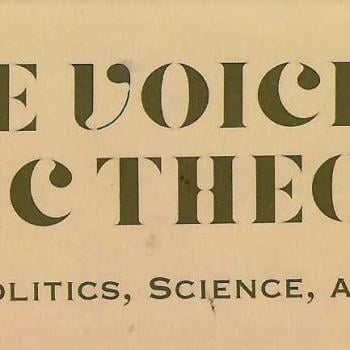
—. 2023. The Voice of Public Theology. Adelaide: ATF.
Polkinghorne, John. 2006. “Quantum Theology.” In God’s Action in Nature’s World: Essays in Honor of Robert John Russell, by eds Ted Peters and Nathan Hallanger, 137-145. Aldershot UK: Ashgate.
Poon, Wilson CK, and Tom CB McLiesh. 2023. “Is There a Distinctive Quantum Theology?” Zygon 58:1 265-284. doi: https://doi.org/10.1111/zygo.12867.
Shimba, Maxwell. 2025. Quantum Theology: How Quantum Mechanics Reveals the Mind of God. New York: Shimba.
Ward, Keith. 2015. Religion and the Quantum World. Gresham Lecture.








 Ad-Free & Subscriber Log-In