

“I was, like, ‘I guess I’m jumping in.’ I wasn’t going to let that baby die. That’s crazy.”
That’s how Lio Cundiff, 30, of Chicago described his decision to jump into Lake Michigan, in February, to rescue a baby strapped into a stroller that had been blown into the water. LGBTQNation says that Cundiff is “being hailed as a hero” for risking his life to save a stranger’s baby. It seems appropriate for him to be hailed as a hero since, you know — he jumped into freezing water where he had to tread water for several minutes while keeping a sinking stroller above the surface. That makes him a hero, whether or not people choose to hail him for it.
I want to hail him for it — to admire and praise his actions and to suggest that everyone else should admire and praise those actions too, which everyone else already does because this is just exactly the kind of thing we mean when we talk about something or someone being admirable and praiseworthy.
[Cundiff] dived into the water, with temperatures the NWS calculated to be in the mid-30s fahrenheit. He reached the baby and the stroller while they were still facing up and clutched on to both.
Cundiff fought to keep the stroller and the baby from sinking under the surface.
He [treaded] water for what he estimated to be up to four minutes, with the baby briefly dipping below the water at a couple of instances.
… Another man eventually threw his jacket down for him to grab a hold of. That second man and the baby’s mother then helped get Cundiff, the infant and the stroller on to dry land.
I love Cundiff’s response to being asked why he did it. He did it because there was a drowning baby. What else was he supposed to do? Nothing? “That’s crazy.” Impossible.
This is something a lot of actual heroes say after they do something brave and heroic to rescue a stranger. They’re just telling us — reminding us — that this is what one does because one has no other choice.*
That’s not false modesty. It may be overly generous to the rest of us, who haven’t been tested and thus haven’t passed that test, but actual heroes like Cundiff truly seem to mean it when they suggest that they just did what anyone else would do in their situation, and that anyone else would have done what they did.
Sure, maybe not anyone else. But, again, the instinct to jump in to save a stranger is such a widespread human response that we had to create a whole public safety campaign to address it:
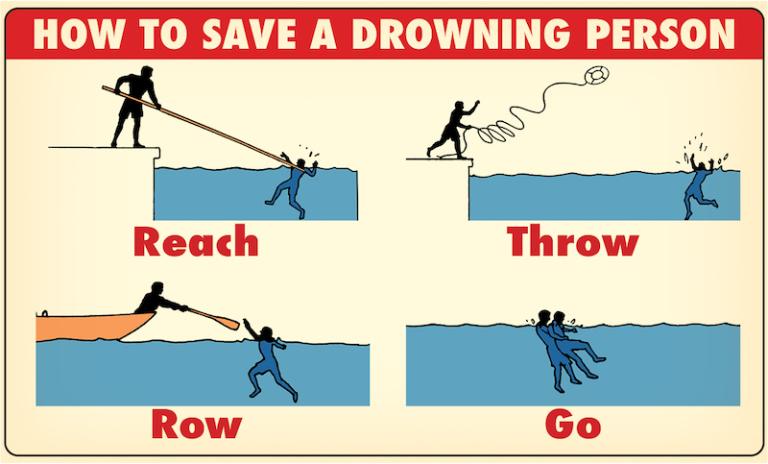
“Reach, Throw, Row, Go” is taught to lifeguards and rescue personnel and it’s posted at pools and swimming areas all over the country because one of the biggest causes of accidental drowning is people jumping in to the water in an attempt to save another person who is drowning. This happened so often that we had to create a rhyming mnemonic device to remind everyone that jumping in yourself should only be a last resort.*
It was the only resort available to Cundiff, since reaching, throwing, and rowing weren’t of much use when the drowning stranger was a baby strapped into a rapidly sinking stroller.
“I’m just a human who did the most human thing you could do,” is how Cundiff put it when interviewed by another reporter.*
That second interviewer also asked Cundiff about what it’s like living in 2026 America as a trans man. He gave pretty much the same answer: “We are human, and we’re the same as everyone else.”
“And,” Cundiff added, “We don’t deserve the hate that we’ve gotten.”
That’s the final word in that interview in The Guardian — a newspaper whose opinion pages have platformed many powerful and prominent voices arguing that Cundiff and other trans people do, somehow, deserve to be hated. I hope Ramon Antonio Vargas doesn’t get in trouble for allowing such an appeal for humanity and decency in the British press.
Both in the UK and here in America right now, trans people are drowning in hate. Their basic legal rights are being curtailed and their humanity and dignity are being denied. This is, again, exactly like a textbook case in an ethics class.
Reach. Throw. Row. Go. Do the most human thing you can do. Be a hero.
* Cundiff did have a choice, of course. Ask any ethics professor and they’ll tell you all about it, because this incident is literally a textbook case for them. (Some of them are probably rewriting those textbook scenarios now because of this story, to change their hypothetical drowning strangers into hypothetical drowning stranger babies.)
What the textbook usually says is that Cundiff’s choice was supererogatory — heroic and brave and altruistic rather than obligatory. You’re not ethically or morally obliged to risk dying in order to save a drowning stranger they say. Risking your life to save a stranger, they say, is a Good Thing, but not something that a decent person has to do.
Maybe the difference between Cundiff and those ethics professors is that Cundiff thinks he wouldn’t have been able to live with himself if he had put his own life and safety ahead of the chance to save that baby. Maybe he’s exceptionally altruistic in a way that meant he didn’t have any other choice, Maybe that baby is just lucky that it was someone like him there by the shores of Lake Michigan and not an ethics professor.
** In those newspaper accounts above, the Chicago Tribune says that Cundiff “treaded water” for several minutes while keeping the baby’s stroller afloat. The Guardian (UK), by contrast, says that Cundiff “trod water.” That doesn’t just sound British, it sounds wrong. Cundiff treaded water. Jesus trod water, which is a very different thing.













 Ad-Free & Subscriber Log-In