


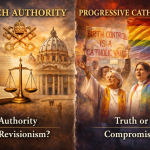
This article from frequent guest contributor Peter (Pilgrim) perfectly demonstrates what I called out in my last article, Why I Often Criticize Progressive Catholicism.
By Guest Writer: Pilgrim.
Introduction
There is something almost touching about the modern Catholic progressive’s relationship with Church authority. He submits to it; this we are assured early and often. He accepts the teaching. He upholds the Magisterium. He would simply like the record to show that the arguments for it are not very good, that the people who made them were probably prejudiced, that the whole matter bears a suspicious resemblance to the Church’s historical tolerance of slavery, and that a synodal Church ought to be willing to have this conversation, while he, for his part, remains entirely obedient. The submission, one cannot help noticing, occupies rather less space than the reservations.
Such is the situation following two pieces published at Where Peter Is. The first, by Deacon Douglas McManaman, drew on a personal anecdote about childhood anti-French prejudice to suggest that the Church’s reservation of Holy Orders to men may be similarly rooted in ancient misogyny rather than sound theology. The second, a defense of the first by managing editor Mike Lewis, insisted that asking uncomfortable questions within ecclesial bounds is not dissent but healthy inquiry, and noted, not without some force, that many of the article’s critics are themselves selective in their fidelity.
Both pieces are written with sincerity. Both raise questions that deserve a serious answer. And both, despite their formal deference, guide the reader gently but persistently toward a single impression: that the Church’s teaching on Holy Orders is, at best, theologically awkward, and at worst, an elaborate rationalization for something she will eventually regret.
It seems worth suggesting that this impression rests on a confusion, and that the confusion is not trivial.
The Doctrine Is Not an Open Question
One of the more curious features of our theological moment is the ease with which a closed question can be reopened by declaring the arguments for it unconvincing. The reasoning proceeds as follows: the Church has taught this; the arguments historically offered are weak; therefore, the matter remains open. It is a little like arguing that because a barrister performed poorly, the verdict itself is now in suspense, all while professing great respect for the court.
In Ordinatio Sacerdotalis, St John Paul II declared that “the Church has no authority whatsoever to confer priestly ordination on women and that this judgment is to be definitively held by all the Church’s faithful.” The Congregation for the Doctrine of the Faith later clarified that this teaching has been proposed infallibly by the ordinary and universal Magisterium.
This does not mean that every theological explanation offered in its defense is irreformable. It does mean that the conclusion is not provisional. Not closed in pencil, awaiting amendment. Closed.
To suggest, however gently, that the exclusion of women from priestly ordination may prove analogous to slavery is not a harmless thought experiment. Slavery was never defined as flowing from the sacramental constitution of the Church. It was tolerated in particular historical circumstances and later judged incompatible with the Gospel’s anthropology. Holy Orders, by contrast, concerns what the Church has declared she lacks the authority to change.
One may speculate about many things. But when the speculation implies that the Church may one day reverse what she has said she cannot alter, the speculation ceases to be modest.
The Weakest Arguments Are Not the Strongest Case
There is a rhetorical strategy at work that deserves attention. It consists of assembling the most culturally embarrassing arguments ever offered in support of the male priesthood, female intellectual inferiority, ritual impurity, social subordination, and then allowing their weakness to cast a shadow over the teaching itself.
This is not unfair to the bad arguments. It is unfair to the good ones.
Inter Insigniores acknowledges candidly that certain patristic and scholastic explanations were shaped by assumptions modern thought rightly rejects. The Church has already done the housecleaning. The question is what remains once the dust has settled.
What remains is not sociology, but sacramental theology.
The Church does not ground the male-only priesthood in female incapacity or social hierarchy. She grounds it in the nuptial structure of the Eucharist. That argument may be accepted or rejected, but it cannot be dismissed by rehearsing Tertullian’s least felicitous remarks.
Sacramental Ontology, Not Sociology
The priest acts in persona Christi capitis, in the person of Christ the Head and Bridegroom. This is not a functional assignment, as if the priest were an interchangeable presider. It is a sacramental sign.
The Eucharist makes present Christ’s self-gift to His Bride, the Church. The nuptial form of this mystery is not decorative language but structural. Scripture unfolds from Genesis to Revelation in nuptial imagery. Christ reveals Himself as the Bridegroom. The Church is revealed as His Bride.
Sexual difference, in this vision, is not accidental. It belongs to the grammar of creation. Christ did not become humanity in the abstract. He became a particular human, the Son, the Bridegroom. The sacramental sign must bear natural resemblance to what it signifies. Water is required for baptism because it signifies cleansing. Bread and wine are required for the Eucharist because they signify nourishment and sacrifice. The sign is not arbitrary.
In the Eucharistic act, the priest sacramentally represents Christ the Bridegroom giving Himself to His Bride. The male sex is not a decorative historical detail attached to that sign. It belongs to its intelligibility.
This is not a claim of superiority. The highest human creature in Catholic theology is not an ordained man but Mary. The Marian dimension of the Church is not consolation prize but theological primacy. The Petrine office exists in service to the Marian Church. To frame the male priesthood as institutional misogyny is rather like suggesting that in a wedding, the bride is the unfortunate party.
The difficulty here is not primarily historical. It is anthropological. If sexual difference is merely a cultural construct, mutable, fluid, expressive of power rather than of meaning, then no sacramental argument will persuade. If, however, sexual difference is ontological and revelatory, then the male priesthood is not exclusion but signification.
Slavery, Capital Punishment, and Categories
The analogy to slavery is rhetorically potent but theologically imprecise. Slavery was never proposed as a revealed element of the sacramental order. Its repudiation represents development in moral application, not reversal of sacramental doctrine.
Similarly, recent developments regarding capital punishment concern prudential judgment in historically contingent circumstances. However one evaluates them, they do not involve a declaration that the Church lacks authority to alter a sacrament instituted by Christ.
These are differences of kind, not degree. To conflate them is to blur the Church’s own careful distinctions, and, as it happens, to unsettle the very distinction on which Lewis’s own argument quietly depends.
The Whatabout, and What It Reveals
Lewis’s defense introduces what he evidently regards as a decisive observation about his critics. Many of those objecting most loudly to the McManaman article, he notes, are themselves resistant to other magisterial teachings, particularly the development on capital punishment in Fratelli Tutti and the pastoral guidance of Amoris Laetitia. They claim fidelity while practicing selectivity. This asymmetry, Lewis suggests, disqualifies them from the mantle of magisterial consistency.
It is a fair point, as far as it goes. Inconsistency is a real vice, and it is genuinely found on all sides of Catholic arguments.
But notice what Lewis’s argument requires. To place capital punishment, Amoris Laetitia, and Ordinatio Sacerdotalis in the same category of magisterial teaching, one ought to accept, is to treat them as equivalent in kind and weight. And here the argument collapses under the pressure of the Church’s own distinctions.
Ordinatio Sacerdotalis declares a teaching to be definitively held as belonging to the deposit of faith, subsequently confirmed as proposed infallibly by the ordinary and universal Magisterium. The faithful are not invited to give it the religious submission of intellect and will appropriate to authoritative but non-definitive teaching. They are told it is to be definitively held. Full stop.
Amoris Laetitia, whatever one makes of its disputed passages, contains pastoral discernment and prudential guidance on the application of moral principles in complex human situations. Reasonable people, and reasonable theologians, have debated its precise meaning and implications without thereby rejecting defined doctrine. The debate is legitimate because the document itself operates at a different level of magisterial authority.
The development on capital punishment in Fratelli Tutti concerns a prudential moral judgment about the application of principles in contingent historical circumstances. One may find it compelling or question its continuity with earlier teaching. But it does not, and does not claim to, belong to the deposit of faith, nor is it proposed as an irreformable doctrine.
To invoke these as equivalent counterweights to Ordinatio Sacerdotalis is not a demonstration of consistency. It is a category error dressed as an argument. The Church herself carefully distinguishes between definitive doctrine, authoritative teaching requiring religious submission, and prudential pastoral guidance. Lewis’s whataboutism dissolves that distinction, which is precisely the distinction that makes his own formal submission to Ordinatio Sacerdotalis meaningful in the first place.
There is also a secondary irony worth noting. Lewis accuses his critics of refusing to name their dissent, of claiming submission while quietly resisting. It is a pointed observation. But the article he defends, with its catalogue of weak arguments, its invocation of historical misogyny, its analogy to slavery, and its expressed longing for a more satisfying account, follows a similar structural pattern. The submission is clearly stated. The reservations carry the argumentative weight.
The mea culpa that frames Lewis’s defense, the nervousness about publishing, the editorial second-guessing, the rueful acknowledgement that more magisterial citations might have helped, reads less as simple contrition than as the posture of an editor caught between conviction and controversy. The beleaguered editor is a sympathetic figure. But sympathy is not an argument. And the question is not whether Lewis was brave to publish. It is whether publishing served clarity.
Authority and Understanding
Lewis writes that he submits to the Church’s authority but longs for a theological explanation he can “wholeheartedly embrace.” This is understandable. No one enjoys holding a position that feels thinly defended.
But submission that waits upon personal satisfaction is a delicate thing. If a more compelling account were produced tomorrow, would obedience thereby deepen? Or is obedience already complete because it rests not on argument but on authority?
This is not a criticism. It is a clarification. The Church’s claim in Ordinatio Sacerdotalis is not that the faithful must first find the argument persuasive. It is that the Church has received a sacramental form she cannot alter. Theology then seeks to illuminate that given form, not to renegotiate it.
The stronger theological account exists, as we have argued. The sacramental ontology of in persona Christi capitis, the nuptial structure of Eucharistic theology, the irreducibility of sexual difference in the grammar of revelation: these are not embarrassed retreats to tradition. They are serious metaphysical claims. The fact that they require more than a passing familiarity with sacramental theology to appreciate does not make them weak. It makes them demanding.
Conclusion
At one level, the entire episode may seem disproportionate: an article published, questions raised, a defense issued, responses multiplied. Theological debate is rarely serene, and never has been.
But beneath the agitation lies a simpler question: do we believe the structure of revelation includes a sacramental grammar not of our own devising?
If the male priesthood rests on prejudice, it will eventually collapse under the weight of its own incoherence. If it rests on sacramental ontology, on the nuptial mystery of Christ and His Bride, on the embodied logic of the Incarnation, then it does not depend for its survival on rhetorical framing, editorial courage, or the careful management of social media backlash.
Gold is tested in fire. But not every flicker is a furnace. Sometimes it is only smoke, made impressive by the light.
The Church does not reserve priestly ordination to men because she is nostalgic for patriarchy or embarrassed by modernity. She does so because she believes she has received something she does not own. The sacramental sign is not ours to redesign any more than water is ours to replace with sand in baptism for the sake of inclusivity.
The task of Catholic theology is not to apologies for that structure, nor to hedge it about with anxious qualification, nor to cloak hesitation in the language of submission while rehearsing its difficulties. The task is to articulate the mystery with clarity, intellectual seriousness, and the kind of confidence that does not mistake serenity for rigidity.
When that happens, controversy tends to shrink to its proper size. The argument may not be won. In the present climate, it rarely is. But the mystery is at least made visible.
And in the end, that is what theology is for.
Articles in Question
Deacon Douglas McManaman: Thoughts on the Influence of Old Prejudice, (Where Peter Is, Feb. 26 2026)
Mike Lewis: Gold is Tested in Fire, (Where Peter Is, March 2, 2025)
Thank you!
Read The Latin Right’s other writing here.
Please visit my Facebook page and IM your questions (and follow my page) or topics for articles you would like covered.









 Ad-Free & Subscriber Log-In