

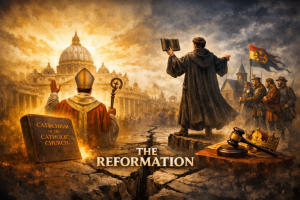
I am currently engaging multiple Protestant friends—all well-educated and informed—on the nature of binding authority within the Christian context. These friends affirm the foundational Reformation doctrine of sola scriptura and therefore recognize Scripture alone as the ultimate infallible authority in a Christian’s life.
They do offer some nuance. They reject the more extreme version—nuda scriptura—which claims that the Christian needs only “me and my Bible.” Instead, they acknowledge the role of “lesser,” fallible authorities such as creeds, confessions, and local churches to assist and edify believers.
However, these lesser authorities must themselves submit to Scripture, the ultimate infallible authority. This raises a practical question: how does the Church, as a lesser authority, bind individuals to her teaching when both the Church and the individual stand under Scripture as the highest authority?
When I press this point, I often hear the reply: “So, in your view, does binding authority require infallibility?” “Not necessarily,” I respond. “But at what point does one cease to submit? And when does that refusal to submit become a demand for universal change—as in the case of Martin Luther?”
Why invoke Martin Luther? Historians widely regard him as the Father of the Reformation, and his life brings the problem of binding authority into sharp focus. Luther was no outsider. He was a validly ordained priest who stood under the Church’s authority, not a layman on the margins. Yet he questioned that authority, rejected it, and called for the entire Church to conform to his position—while gaining powerful political support in the process.
His story highlights the central tension: once binding ecclesial authority is set aside, it does not disappear—it relocates, first to the individual and ultimately to political power.
What Does “Binding Authority” Mean?
Let’s begin by defining “binding authority” within the Catholic–Protestant debate.
The Catholic Church requires the faithful to give “religious submission of mind and will” to her teaching authority even when she does not propose a doctrine infallibly (CCC 892). She also teaches that the faithful have a duty to observe her legitimate decrees (CCC 2037). This goes beyond mere agreement. It calls for a real posture of deference to the Church’s authority, even when one struggles to understand or fully accept a teaching. In this framework, the Church sets doctrinal boundaries, defines teaching, and adjudicates disputes.
Protestants, by contrast, recognize the authority of creeds, confessions, and local churches as “lesser” authorities. However, they bind themselves to these authorities only insofar as they judge them to align with Scripture. If, like Luther, they conclude that an authority has deviated from Scripture, they no longer consider themselves bound by it. In practice, this means the Protestant remains bound until he judges otherwise.
The practical problem with this framework quickly emerges. What happens when two Protestants disagree, employ the same hermeneutic, and both appeal to the Holy Spirit for illumination, yet fail to reach a resolution? The result is not adjudication, but division—disunity and competing theological claims.
Luther as the Test Case
Martin Luther did not begin with the intention of reforming the Catholic Church. As noted above, he was an ordained priest and a member of the Order of Saint Augustine (as is the current pope, Leo XIV). What began in 1517 as a legitimate critique of indulgence abuses tied to the construction of St. Peter’s Basilica eventually developed into a full-scale theological revolt.
Over the next several years, Luther and Rome exchanged arguments, culminating in the pope’s condemnation of forty-one propositions drawn from his Ninety-Five Theses. In 1521, Luther stood before the Diet of Worms to answer for his views—either to recant or to defend them at the risk of condemnation and excommunication.
Most informed Catholics and Protestants know Luther’s final declaration, which captures the spirit of Protestantism from that point forward:
Unless I am convinced by the testimony of Scripture or by clear reason—for I do not trust either in the pope or in councils alone, since it is well known that they have often erred and contradicted themselves—I am bound by the Scriptures I have quoted, and my conscience is captive to the Word of God. I cannot and will not recant anything, since it is neither safe nor right to go against conscience.
Here, Luther refused to recant and rejected the Church’s binding authority.
This stance aligns with his earlier statement at the Leipzig Disputation in 1519, where he said of St. Augustine (and all the early Church Fathers):
Even if Augustine and all the Fathers were to see in Peter the Rock of the church, I will nevertheless oppose them—even as an isolated individual—supported by the authority of Paul and therefore by divine law.
Note the pattern. First comes a doctrinal dispute. Next comes an appeal to personal interpretation and a rejection of ecclesiastical authority. Finally, with an appeal to “the authority of Paul and therefore divine law,” comes a call for universal correction.
Who Gets to Reform the Church?
This brings us to the broader implications of Luther’s claims. On what basis can an individual demand universal change? More succinctly, why should the entire Church conform to one man’s interpretation of Scripture? Why not the Frenchman John Calvin or the Swiss reformer Ulrich Zwingli—whom Luther himself initially refused to recognize as a Christian because of his symbolic view of the Eucharist?
In appealing to Scripture alone, Luther effectively made the individual Christian the final arbiter of theological and moral truth. As Dr. Brad S. Gregory observes in The Unintended Reformation, those who affirmed sola scriptura did not intend to promote individual opinion or preference. Yet the results did not match that intention.
From the early 1520s, those who rejected Rome disagreed about what God’s word said. Therefore they disagreed about what God’s truth was, and so about what Christians were to believe and do.
Those who rejected Rome expected unity grounded in the truth of God’s revealed word. Instead, disagreements over the meaning of that truth produced fragmentation. In practice, Protestantism required something external to stabilize it and maintain any semblance of unity. It required alliances with temporal powers.
Authority Replaced by Power
Turning again to Dr. Brad S. Gregory. In Journey of Faith: Evangelicalism, Eastern Orthodoxy, Catholicism, and Anglicanism, he observes that what we call the “magisterial Reformers” (Luther, Zwingli, Calvin, and Thomas Cranmer) did not succeed by persuading the Church through Scripture alone. Rather, “Scripture as interpreted by hermeneutic authorities and backed by political authorities led to confessional Protestant states… [which] stipulated and policed their respective versions of biblical truth.” Where such political backing was absent, the result was not convergence but “a vast range of irreconcilable truth claims.”
In other words, the apparent stability of Lutheran and Reformed traditions did not arise naturally from sola scriptura. Political enforcement produced that stability. As Gregory notes, these traditions were not the norm among reform movements—they were the exceptions that endured because they secured lasting political support.
Lutheranism endured through the backing of German princes; Zwingli relied on the Zürich city council; Calvin on the Genevan city council; and Cranmer on the authority of English monarchs such as Henry VIII and Edward VI. When persuasion failed to produce unity, the magisterial Reformers achieved it through cuius regio, eius religio—“whose realm, his religion.”
Preemptive Objections
Before concluding, I will address several anticipated objections.
Objection 1: “Binding does not mean infallible.”
Response: Agreed—authority can be fallible.
However, what makes an authority finally decisive when disputes arise? In Catholicism, this authority rests in the Church. For the magisterial Reformers, it ultimately rested in the authorities with which they aligned.
Objection 2: “Luther was calling for reform, not replacing authority.”
Response: Initially true.
However, what justified his move from appeal to rejection—and ultimately to a call for universal correction?
Objection 3: “You’re reducing everything to private interpretation.”
Response: I do not deny the role of communal interpretation.
However, when interpretations conflict—whether individual or communal—what adjudicates between them?
Objection 4: “Catholics also used political power.”
Response: True, but an important distinction remains.
In Catholicism, authority precedes enforcement. In Protestantism, political power stabilizes competing interpretations.
Objection 5: “What about conscience?”
Response: Conscience matters.
However, if conscience justifies rejecting authority, what limits competing consciences?
Objection 6: “Fragmentation doesn’t disprove truth.”
Response: Agreed.
However, it raises the question of how truth is definitively resolved.
Objection 7: “Luther appealed to God, not himself.”
Response: True.
However, Scripture requires interpretation—so whose interpretation binds?
Final Thoughts: Authority and Its Consequences
To conclude, consider Luther’s trajectory—and, by extension, that of Protestantism. Luther first dissented from the Church’s binding authority, even after both he and the Church had the opportunity to present and defend their positions. As an ordained priest, he had vowed to submit to that authority, much as many Protestant ministers in the magisterial tradition still do within their own communions. Yet Luther ultimately chose his own understanding of Scripture over that of the Church (“unless I am convinced” and “supported by the authority of Paul and… divine law”).
Rather than producing unity through reliance on God’s Word alone, this approach led to fragmentation. In time, the magisterial Reformers secured political allies, and those allies enforced their respective forms of Reformation Christianity.
The Reformation did not end authority—it replaced the Church’s authority with the individual’s judgment, backed when necessary by political force.
Thank you!
Read The Latin Right’s other writing here.
Please visit my Facebook page and IM your questions (and follow my page) or topics for articles you would like covered.













 Ad-Free & Subscriber Log-In