
 Camels With Hammers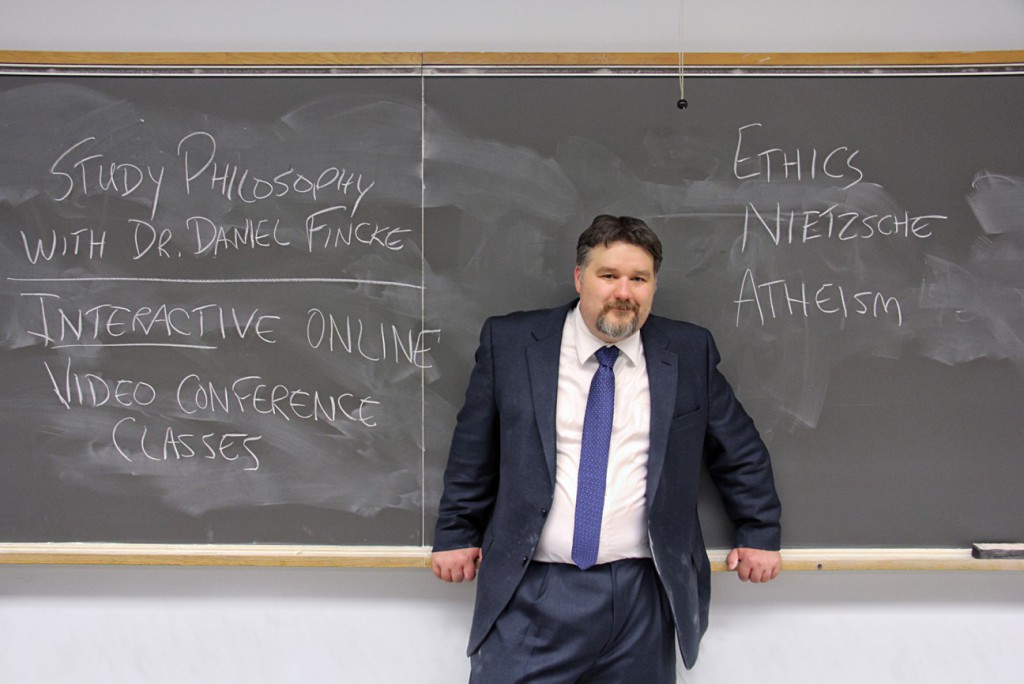
I earned my PhD in Philosophy from Fordham University. I wrote my dissertation on Ethics and Nietzsche’s philosophy. From January 2013 through December 2013, I taught 2,500 university students spread across 93 classes from 7 universities.
Since January 2013 I have been leading small group online classes of self-motivated independent learners from around the world. These highly personalized two hour weekly classes run year round and offer you live, dynamic, interactive class discussions with other students and me, held over videoconference (using Google Hangout, which downloads in just seconds). Classes are flexible enough to meet the needs of both beginners and students with existing philosophical background.
I currently have students attending classes on Sundays 9am-11am Eastern and Sundays at 11:15am-1:15pm Eastern. These are nice, interactive groups of 6-7 people each, with room for you to join us. I am very happy to add more class sections on Sundays (any time) and Mondays (after 2pm Eastern) if you need them. From Sunday October 7 through Sunday October 28, the Sundays 9am class will be exploring the two most popular approaches to ethics, consequentialism and deontology, and the Sundays 11:15am class will be exploring the political philosophy of John Locke, whose writings are seminal to the entire tradition of liberalism and had direct influence on the language of America’s Declaration of Independence. Feel free to send me your ideas for what I should teach in November and beyond.
Try out my classes for free with a no-commitment trial! Join my private Facebook group for my classes, write me at [email protected] or friend me and write to me on Facebook in order to schedule one.
For Fall 2018, I’m implementing a new system to help students get as many classmates as possible and to both increase and more sharply focus my lecture prep time in order to deliver even better class sessions. Here’s how it will work:
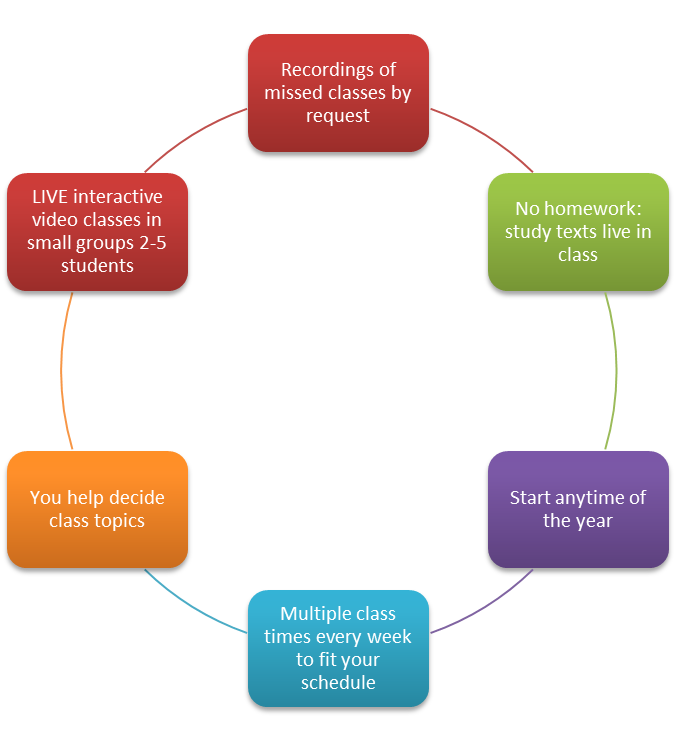
- Instead of offering a wide range of classes, each devoted to one narrow philosophical topics, I am going to offer multiple sections of one year round class called “Philosophy”, in which we explore a variety of philosophical topics, one month at a time.
- Class topics can come from the full gamut of philosophical topics, including everything that I have previously offered to cover in previous philosophy classes. Click on any of the following links to get ideas for class topics to request: Metaethics, Philosophy of Religion, Virtues, Values, and Meaning in Life, Normative Ethics, Topical Introductions to Philosophy, History of Philosophy, Contemporary Ethical and Social Controversies, Nietzsche, Moral Evolution, Psychology, and Philosophy, Philosophy of Love, Sex, and Gender, Philosophy of Mind and Language, Social and Political Philosophy, Political Philosophy for the Age of Trump, Philosophy for Atheists, Philosophy of Science, and Epistemology.
- With current and prospective students’ input, I will choose the specific topics to be covered and publicize them a full month in advance. Each month there will be two different topics that I will announce in advance and each class section’s regular students will choose which of them they want me to cover with them. Students who are outvoted are free to hop into another class section doing the other available topic. If no other class sections are covering the alternate topic, I will open up another class section for them. Students can also hop from one class to another for any other reason. I will use the private Facebook group for my current, past, and prospective online students as the forum for students to decide on which class sections will be discussing which topics. Feel free to join the group even if you are only considering attendance.
- Most weeks I spend portions of class reading aloud sections of books and articles as we look at them together on a screen share, so you don’t have to read outside of class to engage regularly with philosophical texts. As we read, we explicate and criticize the texts together and eventually wind up creatively, critically, and constructively discussing with each other our own ideas stimulated by the texts we’re reading. The texts we read together include (1) a mixture of classic and cutting edge primary sources, (2) summations of key positions from the philosophical literature written in handbooks and encyclopedias designed for professional philosophers and students alike, and (3) chapters from introductory texts written for undergraduate and graduate philosophy majors.
- Class sessions are designed to be both accessible to newcomers to philosophy getting caught up on the subject and perpetually novel enough to provide new insights to longtime philosophy student. New students should feel free to hop into classes at any time of the year without having to worry about having missed previous weeks since every month we are starting in on new topics. Classes are not structured traditional college course with a strictly limited timeframe and a distinct beginning, middle, and end where later material builds on earlier material. Instead they are modeled off rolling year round classes like yoga classes, book clubs, and Bible studies, where new people are able to seamlessly phase in at any time with little trouble and stay for as many years or as few weeks as they want. People can also conveniently take hiatuses and return without worrying about what they missed.
- If you are on a weekly subscription, when you miss class you will be given the option of (a) sitting in with another class section, (b) receiving a full refund, with no guilting and no questions asked, or (c) receiving a recording of the missed session or another recording from my archive of my favorite past classes on a wide variety of topics. All recordings are copyrighted and strictly confidential. You may not distribute or broadcast them to any others without my express written permission.
- Some busy prospective students worry that they will either inconvenience me or not keep up with the material if they have inconsistent attendance in their regular time slot. Fear of inconsistent attendance should never be the reason for not signing up to my classes. From both a pedagogical standpoint and, frankly, a business standpoint, it’s always in my own interest to make up the class time, to give you a recording or to give you a refund so that you are getting value from your money and continuing to pay me and be a part of the class when you can attend. I strive to make philosophical discussions with me and your classmates such a highly valued part of your weekly ritual that you continue to participate in classes with me year round, I look at this from a long term perspective and fully expect that it will be inevitable and healthy that eventually you will have some other weeks away (sometimes consecutively even), that you will attend to important occasions that arise, go on vacations, deal with illnesses, or just plain need to save money sometimes. My goal is to be accommodating so that whenever it works for you to join in my classes, you feel welcome and feel no guilt over the times you cannot.
- My classes require no outside reading or homework or grades–only participation in once weekly 2 hour sessions that can fit the schedules of busy people. I take it as my responsibility to catch you up to speed on the ideas we’re covering so that you are able to fully engage with the concepts for yourself without having to do work on the topics the rest of the week. Students interested in outside reading will be provided with suggestions upon request. But I find that these classes work best (and people attend most frequently) when they fit into students’ otherwise busy schedules as a once weekly source of rest, intellectual reinvigoration, and mentally stimulating social interaction, rather than as a source of extra solitary work and deadlines throughout the week.
- You may start and stop attending at any time throughout these classes. You are encouraged to inform me in advance of your topic preferences and any time limits you have in mind for how long you expect to participate in the classes, so that I can be sure to prioritize your interests while you are part of the class.
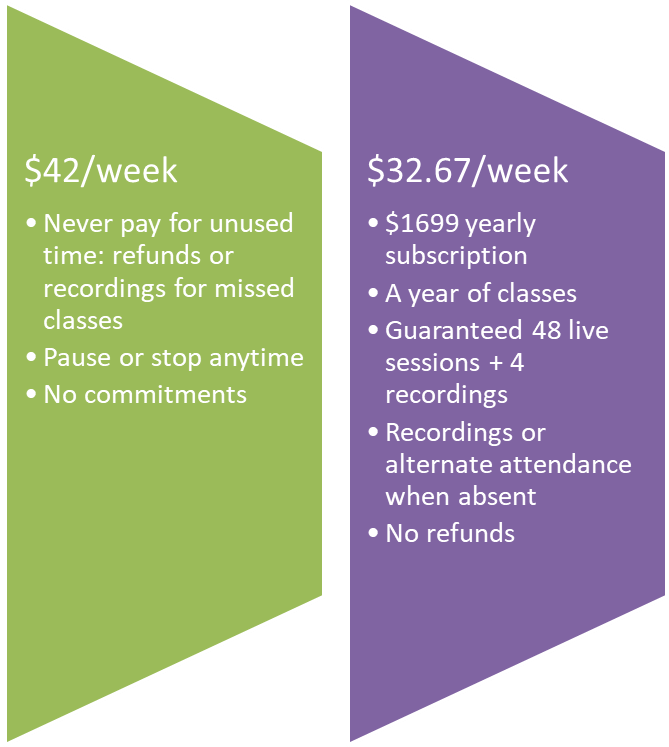
- Most students pay for classes using a Weekly Subscription. Once you subscribe, you’re self-enrolled in the class and automatically billed by PayPal for $42 weekly until whenever you want to suspend your subscription or cancel. Any time I cancel class or you are absent (for whatever reason) you are offered a recording from my archive that I think you will like or refunded if you’d rather that. Unlike with your gym membership, you will never get stuck paying for time you don’t use if you sign up for a Weekly Subscription. And when you’re ready to cancel your subscription you can self-cancel with PayPal directly or ask me to pause your subscription if you hope to come back at any point in the future.
- Students who (a) are willing to commit up front to attend class year round, (b) have the money upfront, and (c) do not mind supporting me even in the case that they are unable to attend as often as they expect, are welcome to sign up at any point for a Year Long Subscription in order to receive a guaranteed 48 live sessions and 4 recorded “best of” sessions from my archives when I go on vacation for a total of $1,699. Plus every time you miss class you are guaranteed a recording so you will certainly get 52 sessions worth of class between live attendance and recordings, even if your schedule becomes hectic at any point. That’s a rate of just $32.67/session for a savings of 22% as compared to paying for 52 weeks on a Weekly Subscription. Unused sessions within the 12 month period the subscription covers cannot be used in the next year. Students may sometimes attend more than once a week to get their 52 owed sessions. There are no refunds if students fail to attend all 52 sessions. Prorated refunds are only offered in cases where I neglect to offer or show up to 48 weeks’ worth of classes or to make adequate accommodations to make up any classes I have to cancel and neglect to produce recordings for missed weeks. Students may also defer time from their subscription if they suspend it for 1-12 months due to a personal hardship.
- People who live together are permitted to take a class together for no extra cost, if they share the same camera. Partial and full scholarships are also available for students who cannot afford the classes. Please write me at [email protected] or friend me and write to me on Facebook in order to be put on the list of potential scholarship recipients.
- Write me today at [email protected] to sign up or to ask any questions!











 Ad-Free & Subscriber Log-In