[Turing 2012] Atheism Answer #5

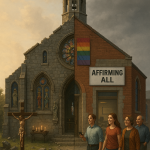
This is the fifth entry in the Atheism round of the 2012 Ideological Turing Test for Religion. In this round, the honest answers of atheists are mixed in with Christians’ best efforts to talk like atheists. It’s your job to see if you can spot the difference. The voting link appears at the end of the entry, and you can look at all entries in this round here.


When (if ever) have you deferred to your philosophical or theological system over your intuitions?

I’m very wary of doing that. When people say they are overruling their intuitions they are mostly acting on beliefs they would like to have but actually don’t.

I think the closest I come to overruling intuitions is trying to correct for some of the frighteningly many cognitive biases humans are prone to. But in practice I don’t try to pitch intuitions against abstract principles. Rather I try to build an intuition of mistrusting some other intuitions, so that I actually think of the biases when I’m likely to be affected. Once I suspect I may be wrong, figuring it out is the easy part. What’s hard is suspecting in the first place.

Another example is empathizing with people where I instinctively wouldn’t. Whatever abstract theories we might have, that is at the heart of what morality is in practice. But, while I’m talking pragmatically, that, too, is more about molding intuitions than about overruling them.

Ultimately trying to overrule intuitions with theoretical insights doesn’t work. They tend to win out before the rational mind even notices what happened. What actually works is gradually improving the intuitions so they don’t need to be overruled.


Are there people whose opinions on morality you trust more than your own? How do you recognize them? How is trusting them different than trusting someone’s opinion on physics?

To some extent other people are experts on how they are being hurt. So, for example, I need to be very careful to listen to minorities where my privilege might make it hard to see the evil myself.

And that’s not the only kind of situation where it is wise to seek out other people’s moral opinions. For example, I might be biased if I stand to win from doing something that might be bad. Then it helps to talk to someone I trust who wouldn’t share in my winnings. Or someone might previously have been in the situation I’m in at the moment. And of course many moral questions actually turn more on the relevant facts than on the moral theory, so where I don’t know the facts I might defer to someone who actually does.

However, none of this changes the fact that it’s me making the moral choice. Ultimately morality is personal and totally deferring to some authority is just one more way to chicken out of it.

And frankly, that particular way of chickening out scares me. The way humans work, the authority will always abuse the power. I think history bears that out. Moral progress actually happened by stepping past unquestionable authorities.


Can you name any works of art (interpreted pretty broadly: books, music, plays, poetry, mathematical proofs, etc) which really capture the way you see life/fill you with a sense of awe and wonder? You can give a short explanation or just list a few pieces.

Those are two very different questions, or maybe even three, because the worldview part can be interpreted more or less broadly.

Small Gods by Terry Pratchett is a hilarious novel capturing my atheism. Of course it isn’t even trying for the kind of depth that keeps people unsettled for days. And I think that’s exactly right, because atheism itself is just a negative. It’s interesting because it’s a negative so many people try to avoid, but in itself the nonexistence of gods shouldn’t make us any more teary-eyed than the nonexistence of leprechauns. It’s just not a very emotional question.

So moving on to things I do believe in, I really care about empathy. In our society one of the main questions on which religion interferes with empathy is LGBT rights. So, while it doesn’t mention atheism or religion at all, There’s a girl by the Ditty Bops is a song that gives a gut level impression of how it hurts gay people to keep on pretending they don’t exist.

For awe and wonder I would look to classical music. I’m nowhere close to being an expert so I’ll just link to two rather famous pieces. Both stir up different emotions I can’t fully verbalize.


Click here to judge this entry, and, once you’ve voted, feel free to speculate and trade theories in the comments or look at other entries in this round.


[Turing 2012] Atheist Answer #4

This is the fourth entry in the Atheism round of the 2012 Ideological Turing Test for Religion. In this round, the honest answers of atheists are mixed in with Christians’ best efforts to talk like atheists. It’s your job to see if you can spot the difference. The voting link appears at the end of the entry, and you can look at all entries in this round here.


When (if ever) have you deferred to your philosophical or theological system over your intuitions?

In addition to being an atheist, I also consider myself a rationalist, a naturalist, a skeptic, and a humanist. These labels describe many different components of my philosophical system. I very frequently defer to my philosophical systems over my intuitions, largely because my intuitions aren’t very good. Ever since I was a little kid and especially in social situations, my intuitions royally sucked. Worse, I suffer from high anxiety, intuitions run amok. For certain situations, my gut just gets it all wrong and I start attending to the irrelevant details, dwell on baseless assumptions, and fixate on improbable outcomes. I get myself all worked up and either freak out, or totally shut down. My intuitions failed me all the time and made me miserable. Fortunately, philosophical systems heavily inform my deliberative reasoning skills. As the years went on and my knowledge about the world grew, my deliberative reasoning got better and better. Not only that, but these days, some of my deliberative reasoning has been so successful and used so often that they’ve replaced many of my old faulty intuitions. As weird as it may sounds to some, atheism was the gateway to science and rationalism and thus to a healthier, happier, and more successful life.


Are there people whose opinions on morality you trust more than your own? How do you recognize them? How is trusting them different than trusting someone’s opinion on physics?

This question feels really difficult to answer because I’m getting hung up on what is meant by “morality” and “trust”. It seems like everyone defines morality and trust a little bit differently. Not only that, but people usually sneak in their own pet assumptions. Since we don’t really have a clear definition, we may waste a lot of time arguing over meanings. So while my tentative answer would be “no”, I’d like to reframe the question to something a little more specific. Perhaps we’re asking “is there a category of people whose judgments I defer to over my own and at a higher frequency than other categories?” For that question, yes, definitely. And those people are usually cognitive psychologists, because these people know a lot about how people think and make decisions. In addition to recognizing them by their resumes and the letters behind their names, you can probably pick them out by the jargon they use, the terms that are used over and over. Because I think psychology is really just high level physics (neurons are made of quarks), trusting them is often very similar to trusting someone’s opinions on physics… you either speak the language or you don’t.


Can you name any works of art (interpreted pretty broadly: books, music, plays, poetry, mathematical proofs, etc) which really capture the way you see life/fill you with a sense of awe and wonder? You can give a short explanation or just list a few pieces.

Harry Potter and the Methods of Rationality by Eliezer Yudkowsky. It has it all. It’s funny. It’s touching. Its mysteries are logically consistent. Its plot twists are inventive yet logically consistent. And it kind of speaks to my life. I usually the smartest one in my peer group and it’s rather alienating. The Harry here feels like a much more intelligent version of me. Stumbling on Happiness by Daniel Gilbert really opened up the world of joy and happiness to me. Specifically it showed me how to and how not to be happy. Jonathan Coulton songs. He writes very geeky, very nerdy, but very genuine songs. All of the quirky things we geeks love, he finds a way to capture just how they resonate with us in song that somehow has a lot of gravitas for their campy topics. And to close out, there is a scene in How to Train Your Dragon that just makes my Humanist heart sing. It’s at the end where all the kids really hone in on their strengths to take down the big bad super dragon. Stories of people transcending our limitations through effort, dedication, skill, and team work always make me misty eyed.


Click here to judge this entry, and, once you’ve voted, feel free to speculate and trade theories in the comments or look at other entries in this round.

7 Quick Takes (5/25/12)

— 1 —

I’m in Merrie Olde England!  The Atheist round of the Ideological Turing Test carries on in my absence and voting is open now,  but I will be slow to respond to email and comments since I have limited internet and time to spend on it.


— 2 —

But there’s a great way for you guys to enjoy my vacation vicariously.  Via Andrew Sullivan, a beautiful disquisition on the difference between British and American swearing:

Anglo swearing is ornate, clever, and florid; American swearing is brutal,repetitious, and earthy. There’s a reason they sell t-shirts on St. Mark’s Place that read “FUCK YOU YOU FUCKIN FUCK.” Swearing in [the British comedy series] “The Thick of It” showed control in the midst of a tantrum, like a well-placed kick in the middle of a marital arts routine. It demonstrated that the speaker was ready to just let forth a string of invective but was powerful enough to channel it into something laced with cultural references and word-games.

In America, though, swearing tends to signal the threat of violence, the moment when coarse language gets even coarser. It’s a heightener. “He’s got his eight-track playing really fuckin’ loud” would, in the Anglo incarnation, be something like “His eight-track was so fucking loud that Helen Keller could hear it four fucking blocks away” or something.


— 3 —

Before wheels-up, I went to town on the Amazon list of free Kindle books in the public domain.  I figured I should skew British, so now I’ve got a kindle full of Austen, Chesterton, Newman, and Wilde.

I like to imagine they’re all in there arguing.  Probably the one to win will be the author who first stumbles across one of the only non-British books I picked up, The Simple Sabotage Field Manual.

— 4 —

One of the things I’m most interested to visit in England is the Broad Street pump.  This is the site of a thrilling scene in epidemiological history, when Dr. John Snow traced an 1854 cholera epidemic to the contaminated pump.  Because the medical consensus believed that cholera spread through the air, the city authorities refused to act on his data.  So he grabbed a wrench and took the pump apart himself.  You can read more about this epidemiological badass in The Ghost Map by Steven Johnson.

(My enthusiasm has caused me a particular annoyance when reading and discussing Game of Thrones, which has a considerably lamer John Snow who only fights eldritch abominations, not cholera and statistical ignorance).

— 5 —

Meanwhile, I’ll have to wait til I return stateside to see the season finale of Awake, the awesome (and thus predictably cancelled) show I mentioned that asked some really cool epistemological questions and came up with interesting ways to test them.  I’m also fond of the show because it caused io9 to write the following headline: “When insanity is your superpower, reality will eventually become your Kryptonite“.

In some ways, the show has ended up reminding me of that Luhrmann book on people who talk to God, since the reality-switching cop gleans useful information, but doesn’t necessarily have a good way to calibrate his signal-to-noise filter.

— 6 —

If you’re desperately missing my posts while I’m away and are looking to fill the time, might I recommend SyFy’s Face Off? It’s a Project Runway-style reality show that has special effects makeup people competing.  The challenges are really cool; in my favorite, each team is assigned a trio of twentysomething identical triplets and needs to age one to 50, one to 75, and one to 100.

Oh, and in another episode someone makes this:


— 7 —

And finally, apropos of nothing but it’s own awesomeness, McSweeney’s has an interview with a professional safecracker.  (He only does legal work, opening the safes of dead people or safes whose combinations have been lost, etc).


For more Quick Takes, visit Conversion Diary!