


GIVES US WINGS
One of the most famous advertising slogans today belongs to Red Bull, the drink manufacturer. They claim their strongly caffeinated drink “gives you wings”. I have often wondered how they can get away with that as an advertising claim.
Certainly, I would not have approved such a claim for any medicine in my days as a pharmaceutical medical director! My job back then was in part to act as a kind of conscience for the companies I worked for, ensuring they didn’t make claims they couldn’t support with data.
Perhaps if anyone ever challenged the drinks manufacturer, they could point to the Formula One racing team they sponsor, the cars literally do have wings, as of course do the planes in the Red Bull airshows!
But I mention this slogan because of an older use of the concept. Many Christians will have heard of the following little poem that perfectly summarizes what we are talking about in this chapter about how God enables us to live for him rather than simply commanding it. God gives us his life deep in our souls in order that we can truly change.
These words perfectly sum up the idea:
“Run, John, run, the law commands
But gives us neither feet nor hands,
Far better news the gospel brings:
It bids us fly and gives us wings.”
It is also often quoted in a slightly different form:
“To run and work the law commands,
Yet gives me neither feet nor hands;
But better news the gospel brings:
It bids me fly, and gives me wings.”
Most people today cite those lines as being authored by John Bunyan, but historically there doesn’t seem to be any evidence for that.[1]
John Newton does say something strikingly similar:
“If I wanted a man to fly, I must contrive to find him wings; and thus, if I would successfully enforce moral duties, I must advance evangelical motives.”[2]
This quote is offered with no context in the introduction to Newton’s works. The concept can also be found in one of Newton’s profound sermons on the verses used in Handel’s Messiah, these were first preached in 1784-1785. Talking about the demands the gospel places on us he says,
“How truly then may it be said, that “his yoke is easy, and his burden light!” such a burden as wings are to a bird, raising the soul above the low and groveling attachments to which it was once confined. They only can rightly judge of the value of this rest who are capable of contrasting it with the distractions and miseries, the remorse and forebodings, of those who live without God in the world.”[3]
In Olney Hymns, one of those marked as being by Cowper expresses a similar thought:
“I was a groveling creature once,
And basely cleaved to earth;
I wanted spirit to renounce
The clod that gave me birth.
But God has breathed upon a worm,
And sent me, from above,
Wings, such as clothe an angel’s form,
The wings of joy and love.”[4]
These quotes are enough to make you wonder if they were somehow the source of the quote or inspired by it. It turns out that the second of these options is very likely the case, as the concept was circulating years before Newton and Cowper used it, although not in the exact wording many of us are familiar with today.
John Wesley included a similar idea in a hymn written in 1722:
“World of vanity, farewell!
Thee without regret I leave;
While, redeemed from death and hell,
Mercy doth my soul forgive,
Lends me wings from earth to fly,
Tells me I shall never die.”[5]
But the most likely earliest source of what Wesley, Cowper and Newton all said can be found in Erskine’s Gospel Sonnets which was published in 1720, and was circulating widely before John Newton began to preach:
When law and gospel kindly meet,
To serve each other both unite;
Sweet promises, and stern commands,
Do work to one-another’s hands.
The divine law demands no less
Than human perfect righteousness:
The gospel gives it this and more,
Even divine righteousness in store . . .
The law commands me to believe;
The gospel saving faith doth give:
The law enjoins me to repent;The gospel gives my tears a vent . . .
The law most perfect still remains,
And every duty full contains:
The gospel its perfection speaks,
And therefore, gives whatever it seeks.
Next, what by law I’m bound unto,
The same the gospel makes me do . . .
All that by precepts Heaven expects,
Free grace by promises effects:
To what the law by fear may move,
To that the gospel leads by love.
To run to work, the law commands;
The gospel gives me feet and hands:
The one requires that I obey;
The other does the power convey.
What in the law has duty’s place,
The gospel changes to a grace . . .
A rigid master was the law,
Demanding brick, denying straw:
But when with gospel-tongue it sings,
It bids me fly, and gives me wings.”[6]
C.H. Spurgeon says that John Berridge wrote the following version of this wonderful expression of grace, most likely around the same time Newton was preaching about Handel’s Messiah:
Run, John, and work, the law commands,
Yet finds me neither feet nor hands;
But sweeter news the gospel brings,
It bids me fly, and lends me wings.”[7]
It is easy to see why the word “lends” has been changed for “gives” to avoid the misunderstanding that we only borrow the God-given wings.
This concept of the Gospel giving us the power to do what the Law requires of us did not originate in the 1700s. It is a perfect way of summarizing the message of Scougal’s earlier book the Life of God in the Soul of Man.
But centuries before that, the great ancient theologian, Augustine of Hippo said,
“All my hope is in your great mercy. Give what you command, and command what you will.” [8]
It could be argued that this idea of the gospel giving us wings really originates in the Bible itself, and could simply be a commentary on the following verse:
“But those who trust in the LORD will find new strength. They will soar high on wings like eagles. They will run and not grow weary. They will walk and not faint.” (Isaiah 40:31, NLT)
This idea is also supported by these words from the Apostle Paul which could easily have served as the motto of John Newton’s ministry:
“My dear children, for whom I am again in the pains of childbirth until Christ is formed in you” (Galatians 4:19, NLT).
Newton said that his main goal in ministry was,
“To break a hard heart, and to heal a broken heart.”
His greatest work was to promote the life of God in the soul of man. He would sacrifice everything else. He saw the spirit of the ancient Pharisees at work among many who claimed to love the doctrines of grace. Some believers then and now stress their own doctrinal distinctives but neglect the weightier matters of unity and love. This is not what God intends us to be like.
What are the signs of the work of God in us?
Newton answers as follows:
“If any one criterion could be given of a real work of grace begun in the heart of a sinner, it would be found in his contrite spirit. The religion of a sinner, stands on two pillars; namely, what Christ did for us in his flesh, and what he performs in us by his Spirit: most errors arise from an attempt to separate these two.”[9]
Christ being formed in us. Giving us the wings to soar above the troubles of this world. What could be more encouraging than this message of God’s very life at work in the souls of man?
Read More from Adrian Warnock
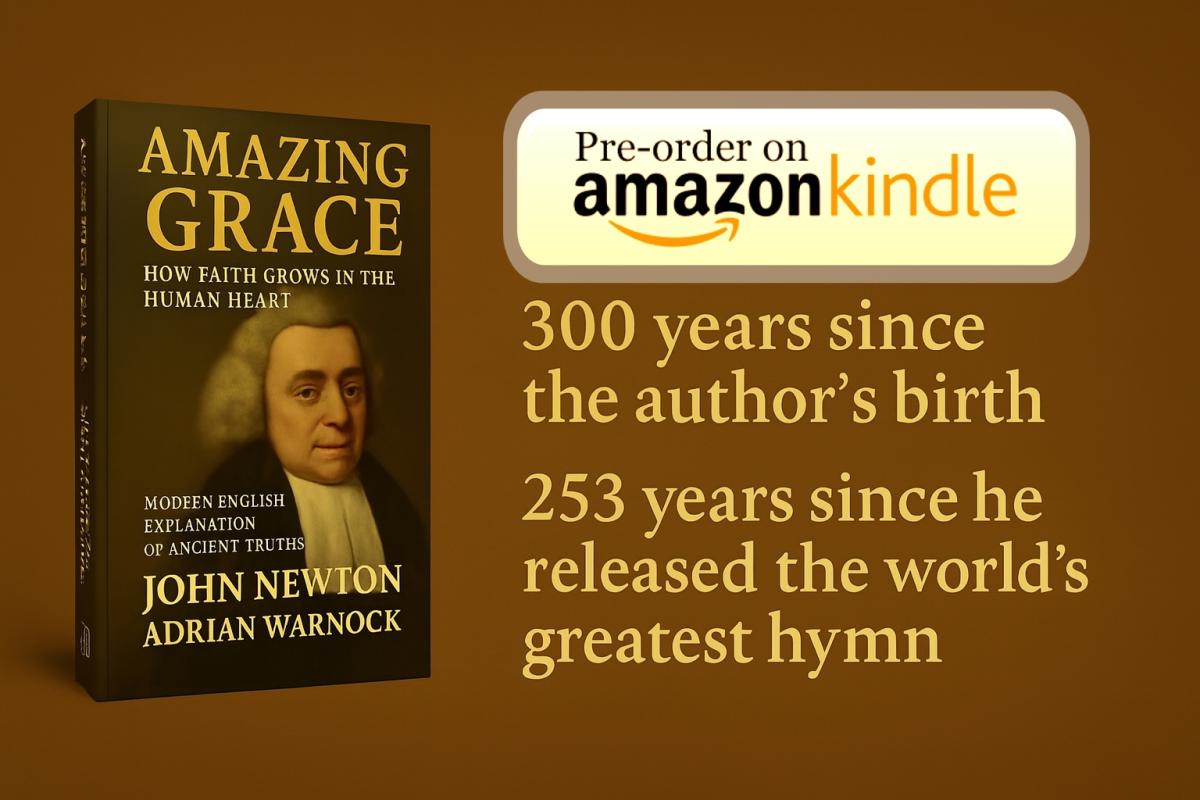
Amazing Grace: How Faith Grows in the Human Heart
Modern English Explanation of Ancient Truths.
By John Newton and Adrian Warnock
Pre-order here
Classic writings updated and a new biography.
300 years after the author’s birth
253 years after he released the world’s greatest hymn, Amazing Grace
This hymn has been recorded more often than any other song of any genre. In the same thirty-six hours which changed the world forever, his close friend William Cowper also wrote God Moves in a Mysterious Way, but then had a crushing mental breakdown from which he never fully recovered. Such powerful grace of God, but marked by terrible suffering. The echoes still reverberate today.
About Adrian Warnock
“Adrian is a first-rate communicator”—Albert Mohler Jr
About John Newton
”I look forward to meeting John Newton” — R. T. Kendall
”One of my heroes”—Tim Keller
“He says it all perfectly”— Martyn Lloyd-Jones
”The memory of his own gracious change of heart and life gave him tenderness in dealing with sinners, and it gave him hope for their restoration” — C. H. Spurgeon
”Why am I interested in this man? Because one of my great desires is to see Christians be as strong and durable as redwood trees, and as tender and fragrant as a field of clover. Oh, how rare are the Christians who speak with a tender heart and have a theological backbone of steel.” — John Piper
”If William Cowper could speak, he’d thank God for not only John Newton, but any friend who prays for and walks beside those with mental illness.” — Joni Eareckson Tada
Preview the content here:
→ I once was blind but now I see
→ Grace Within: The Inner Evidence of Faith
→ How Grace enters the Human Heart
→ Growing in Grace: When Shoots Take Root
→ A modern parable: The Traitors: Spellbound by Lies
More coming soon: subscribe by email or follow on social media
→ The 36 hours that changed the word
and much more…
Adrian Warnock presents a modern English edition of the 18th century classic writings of John Newton (1725-1807), author of Amazing Grace, the world’s greatest hymn and the most recorded song of any genre.
Think of this book as John Newton’s own explanation of his hymn Amazing Grace. His updated autobiography and devotional writings contained in this book form the perfect commentary on his lyrics, demonstrating what really is so amazing about grace.
Modern self-help is no help at all in an existential crisis. These pages contain the secret to genuine personal growth and spiritual transformation. They are simple and yet profoundly deep.
Amazing Grace appears 300 years after John Newton was born, and 253 years after he released his most famous hymn. The result is a seamless blend of Newton’s timeless wisdom with the clarity of thought and plain English that have marked Adrian Warnock’s Patheos blog for more than twenty years, and shapes his other books Raised with Christ, Hope Reborn, and The Traitor Within. Some chapters in this book are modern commentary written by Adrian.
John Newton, the former slave trader turned pastor, wrote letters that still speak to the deepest struggles of our spiritual journeys. In these pastoral devotions, Newton traces how divine grace takes root, grows, and matures in the human heart through three phases: conviction, conflict, and mature contemplation of God’s glory.
The letters in this book are chosen from the thousands preserved from Newton’s vast correspondence, a treasury mined for pastoral wisdom for more than two centuries. A skillful soul physician, Newton describes how grace changes every aspect of a Christian’s life over a lifetime of faith.
Amazing Grace also contains an updated autobiography of this great pastor, with a living interpretation of how significant his extraordinary life still is today. This material and his thoughts on entering Christian Ministry are not included in standard editions of his Works.
Newton becomes for us a vivid example of how God’s grace changes people gradually over time.We meet the rebellious and violent youth, the slave trader who oppressed thousands of innocents, was made a slave himself, and who was found by God’s grace during a storm that nearly sank his ship. This unruly man was pursued, rescued, and transformed by grace.
We learn how over time Newton became a pastor known for his compassion and kindness, most notably demonstrated by his deeply committed care towards the poet William Cowper during his mental illness. Read about how Newton was also a pastor of a whole nation, working for the abolition of the slave trade, and mentoring William Wilberforce for decades.
Newton bridged the gap between the warring denominational movements of his time, a friend of both George Whitefield and John Wesley. He turned his fervor not into the pamphlet flame wars or revival preaching, but into the tenderhearted soul care of the distressed and depressed as they struggled to find greater spiritual freedom and transformation. These pages invite readers not only to understand Newton’s insights, but to experience the living reality of grace in their own lives.
If this book makes you want to read more John Newton, and you do not mind the old English, buy the Logos Bible Software Edition of his Works or a paper version.


The Traitor Within
Understanding and Healing Our Deceitful Hearts
By Adrian Warnock with a chapter by John Newton
Pre-order here
“The human heart is the most deceitful of all things, and desperately wicked. Who really knows how bad it is?” (Jeremiah 17:9, NLT).
And yet our culture tells us to “follow your heart”. No wonder it too is now desperately sick and beyond cure. This book will explore the cultural phenomenon The Traitors as a modern parable as it unmasks the human heart.
Adrian blends his medical insights gained from his work as a doctor and psychiatrist with pastoral wisdom gathered from twenty-five years serving as part of a church leadership team. He witnessed a period of church growth from less than twenty members to thousands.
In recent years Adrian has also experienced chronic illness following his diagnosis with blood cancer, and this book reflects his passion to help others face all kinds of suffering with hope and compassion.
Preview the content here:
→ TV’s The Traitors: Spellbound by Lies
→ How Suffering Revealed What Was in My Heart
→ When Your Body Lies to You: False Messages and Appetites
→ Help when Life Hurts: dealing with specific challenges
More coming in 2026: subscribe or follow on social media
→ Healing Your Body: Practical Tools
→ Follow Your Heart? Not When Your Mind Is Lying to You
→ Healing Your Mind: Taking Every Thought Captive
→ How Lies Create Our Desperately Sick Society
→ Healing Our Broken Communites: Work, Friends, and Family
→ Our Deceitful Spirits: Without Hope and without God
→ Healing Your Spirit – Meaning and Religion
→ Forgiven in a Moment. Renewed Over a Lifetime. Glorified for Eternity.


Help When Life Hurts: Dealing with Specific Pain
These articles are a growing collection, drawing from Adrian Warnock’s medical and psychological expertise, lived experience, and Christian faith.
Please also reach out to a close friend, family member, pastor, counsellor, or health professional such as your primary care doctor or GP. And if you do not feel safe right now and are in crisis then call a crisis line.
In the USA, in an emergency, call 911. If you are in crisis or suicidal and need someone to talk to call the national Suicide & Crisis Lifeline on 988..
In the UK, in an emergency, call 999. For urgent mental health support call 111, or complete the form at https://111.nhs.uk. For the Samaritans call 116 123.
Other countries have similar crisis helplines and a list is maintained at Wikipedia.
Click the type of pain you or a loved one are facing right now
General suffering
Financial difficulties
Feeling disqualified
Chronic illness
Divorce & family pain
Depression & mental health
Bereavement & end-of-life
References
[1] Thanks to Justin Taylor, 2011 for setting me on this trail: https://www.thegospelcoalition.org/blogs/justin-taylor/run-john-run/
[2] Newton, J., Richard Cecil (1824) The works of the John Newton. London: Hamilton, Adams & Co., p. 119.
[3] Newton, J. and Cecil, R. (1824) The Works of John Newton. London: Hamilton, Adams & Co., p. 182.
[4] Newton, J. and Cecil, R. (1824) The Works of John Newton. London: Hamilton, Adams & Co., pp. 623–624.
[5] Wesley, J. and Wesley, C. (1870) The Poetical Works of John and Charles Wesley. Edited by G. Osborn. London: Wesleyan-Methodist Conference Office, p. 366.
[6] The Sermons and Practical Works of Ralph Erksine, vol. 10 (Glasgow: W. Smith and J. Bryce, 1778), 283. Cited by Justin Taylor, https://www.thegospelcoalition.org/blogs/justin-taylor/run-john-run/
[7] Spurgeon, C.H. (2009) The Salt Cellars: Being a Collection of Proverbs, Together with Homily Notes Thereon. Bellingham, WA: Logos Bible Software, p. 200.
[8] Augustine of Hippo (1984) Augustine of Hippo: Selected Writings. Edited by J. Farina. Translated by M.T. Clark. Mahwah, NJ: Paulist Press (The Classics of Western Spirituality), p. 145.
[9] Newton, J., Richard Cecil (1824) The works of the John Newton. London: Hamilton, Adams & Co., p. 121.















 Ad-Free & Subscriber Log-In