

When I sent out an invitation to authors for interviews, most of the responses given to me were from Catholic fiction authors. This makes the following interview stand out from the crowd of interviewees as he writes in the field of theological and philosophical non-fiction. Here is a young man grounded in his faith and who wants to share it with others. He is inspired by St. Pope John Paul 2, I’m happy to have a variety of Catholics from all different fields of writing contribute to this series. It gives it more variety.
So now it is time to
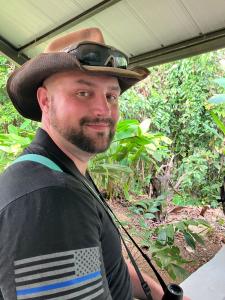
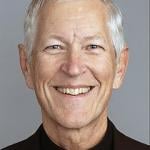
Meet the Writer Philosopher Connor Curley
1) Tell me something interesting about yourself.
Well, I usually tell people that I’m a hog farmer-turned philosopher, originally hailing from Bethune, SC. I earned my undergraduate in Liberal Arts from Magdalen College in Warner, NH and my MA in JPII studies from the John Paul II Institute out of the University of St. Thomas, Houston. I met my wife in college, and so am now a transplant to Ohio!
Philosophy degrees aside, I’ve spent much of my professional career in the military/security fields. I spent several years driving armored cars, and as an 8-year member of the National Guard I’ve deployed twice in support of the Southwest Border Mission. I spent two years assigned as a member of the Homeland Response Force, where I was blessed to train on some of the most realistic emergency scenario simulations I could have imagined.
As I mentioned, I currently reside in Ohio with my wife and our son. I enjoy playing the banjo, spending time outside as a family, and engaging in impactful discussions over an evening glass of bourbon – preferably Horse Soldier, and preferably around a fire. Our home is often the backdrop for formally hosted discussions on Tradition, Faith matters, Gender Norms, and Anthropology, to name a few.
2) What makes you a Good Catholic Writer?
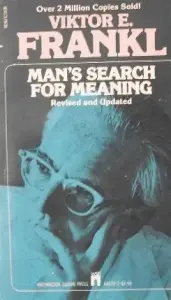
I’ve spent considerable time engaging with the world through military and security. While it is fun, you practice (and sometimes really do!) respond to the worst situations. You see people on the worst day their community has ever seen. You see poverty, danger, tragedy, and want. But you also get to see how people shine and triumph through these tribulations. It gives you first-hand experience of the freedom and dignity Viktor Frankl would write about in his book, Man’s Search for Meaning. I’ve been able to take these experiences and see them within the context of Catholic teaching. Seeing people in these kinds of straits really causes you to reflect on the nature of Man – and the concepts of solidarity/subsidiarity which is so prevalent in the writings of JPII. I like to think that I’ve been able to capture some of these reflections through my writings.
3) What do you like about being a Catholic writer?
I’m reflective by nature. Writing helps me both sort through my own reflections as well as share them with the world – and hearing what the world says back. Writing is like a conversation: sometimes someone listens, other times it falls flat. I like the opportunity to enter into conversation with people, and I am very happy to initiate those conversations by presenting a thought or two to dissect.
4) What is the Main Focus of your particular writing or what do you like to write about?
I love writing about Tradition, and Man’s place within it. Too often in our modern world, things are discarded merely because its old fashioned. Likewise, sometimes things become scrutinized unjustly simply because “that’s how its always been done.” Now, neither one of these is true tradition. Tradition is a handing on, a preservation of something that is intrinsically worthy of being handed on. That’s what makes it different from a habit, or a custom, or a routine. The medium in which a tradition is passed on might change; but the thing itself cannot be changed, or else it isn’t tradition. A correct anthropology of Man’s nature includes a recognition of tradition’s place in his life. It gives each of us a context within which we live, are influenced, and can understand ourselves. But more than that: it helps us (usually) to remember what it is that is important for the moral life – and how to apply it in an ever-changing modern landscape.
5) How does your Catholic Faith influence your writing?
Well, I just mentioned the importance of tradition for any individual; the Catholic tradition particularly influences my own writing. Catholicism, apart from being incredibly reliant on Tradition (with a large T), has a veritable wealth of writers who have considered nearly everything under the sun. Western philosophy and anthropology simply does not exist without the Christian thinkers, and everything we do or say is informed by some underlying principle. Many of these principles have been incepted into our lives through familial and environmental influences, to a point we don’t even realize they exist as an influencer. This is the power of philosophy and tradition; I like to make the unconscious influences known. In this, I like to think that I follow in the footsteps of giants.
6) What’s your favorite Article/Post/Book you’ve written?
My favorite article has to be one I published first on Catholic365, and then on my Substack, “Remembering Tomorrow.” I called it “Apocalypse Maybe,” and it explores a Catholic approach to doomsday prepping – and how to know you’ve gone too far with it. I was interviewed about this article a while back on Relevant Radio’s The Drew Mariani Show; it was a good discussion!
Don’t become so obsessed with prepping that you lose sight of the real life happening around you at this moment. God is actual, and sees every moment as a now; the only way you can encounter Him is to live now – even if you have a mind for tomorrow.
My favorite book so far is the one I have coming out later this year from New Harbor Press. It’s entitled Remembering Freedom: Man’s Interior Witness to Knowledge, Freedom, and True Happiness. I’m really excited about this one; it helps articulate a way beyond the relativistic truth barriers in discussion and forms a coherent worldview from which true discussion and freedom can stem. I have another one coming out next year, though, called Remembering Woman, so who knows? Perhaps that one will give Freedom a run for it’s money as far as favorite’s go!
7) What is your favorite subject to write about?
Honestly, I would have to say traditional family values. The modern world is simply not conducive to what are sometimes called “traditional lifestyles.” The world is too fast, too expensive, too volatile, too [insert preferred negative adjective here]. And yet, JPII says that the family is the smallest unit of society. It is the school of humanity; if we are to change the world, it starts at the family and works its way outward. So, rather than seeing traditional lifestyles as impossible ideals of a bygone age, I think they have something important to teach us – IF we can sort through caste ways of living out those traditions from the actual thing being preserved themselves. It’s a razor’s-edge line to walk, but I like to give it a good shot.
8) Favorite scripture verse.
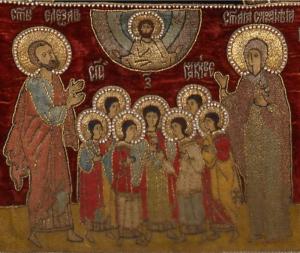
While my favorite story from the Scriptures is from Maccabees, my favorite Scripture verse itself would have to be John 16:33: “I have told you this so that you might have peace in me. In the world you will have trouble, but take courage, I have conquered the world.” My favorite STORY – the mother and her 7 sons from 2 Maccabees chapter 7 I feel illustrates and anticipates Christ’s words: each one, martyred for God, died with a sense of peace that only refuge and trust in God can bring. They definitely encountered trouble, even to their deaths. But they were courageous in the security of God. How much more so are WE to be courageous in the Christian world! Christ Himself has conquered all the tribulations around us.
9) What are you currently working on?
Well like I said, Remembering Freedom comes out later this year, but at this point it’s more them working on it that actually me. My second book, however, is still a work in progress. Remembering Woman sort of explores some of what we were just talking about: gender equality through the ages and in the modern world, and how to understand the relationship between men and women. Later on, I would like to write a follow up book which formally treats with the traditional gender norms, but I think dealing with “gender” comes before trying to fit them into intelligible “norms.” So that’s where I’m at right now. I also publish pretty frequently on my Substack, and just started a series called “Thirsty Thursdays,” a way to sort of introduce enjoying beverages in moderation to accompany some discussions.
Today, I would like to introduce you to a Bourbon-base drink: the Pan-Am. As with last week’s drink, it is perhaps a bit inaccurate to call it “Bourbon based,” as it contains equal parts Bourbon and Mezcal. But Bourbon is what I have found gives this drink substance; the Mezcal provides the flavor and depth that pairs this drink well with a steak.
The Pan-Am, like I said, pairs well with steak, with bonfires, with a cigar, or with some philosophy reading. It is not so light; it is full-bodied. Mezcal, if you have never had it, is Agave liquor that is very, very smoky. More strictly speaking, it is the genus of which “Tequila” is species. In other words: every Tequila is a type of Mezcal, but not every Mezcal is Tequila. So, be forewarned about the alcohol content, and drink – as always – in moderation.

10) Name a favorite Saint, or Catholic or some other figure who inspires your life.
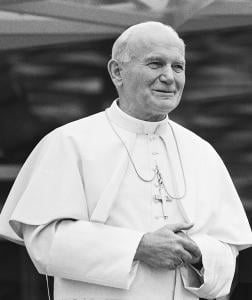
Well, on a sort of an intellectual level, I would have to say JPII. There is perhaps no figure from the 20th century more impactful to the arts, to philosophy, to theology, and to the Church as much as he was. Nearly single-handedly taking down the Iron Curtain, offering an alternative to Kant, navigating the rocky early waters of Vatican II, the list goes on.
On a more proximate and immediately level, however, I would actually have to say my dad. Maybe it’s a bit cliche for a kid to say their dad is an inspiration, but for me it’s very true. I consider his to be a success story, but not in a typical modern way. Raising a large family on a small homestead, working what jobs he had to to both keep us fed and be constantly present in our lives, I would be hard pressed to find someone who remains as impactful in my life as he has been.
11) Who is your favorite living writer?
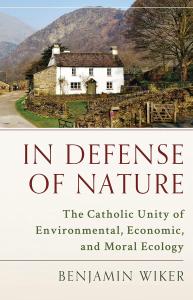
, I can honestly say it isn’t me! So, Jason Craig’s books from TAN publishing have been pretty good, dealing with some very relevant issues with the American Catholic Land Movement. Joseph Pearce, too, has been one of my favorites – especially his book Small is Still Beautiful. There are simply too many writers who are impactful and still with us to name a favorite! What is easier is for me to share my current favorite book by a currently living author. That would be In Defense of Nature: the Catholic Unity of Environmental, Economic, and Moral Ecology by Benjamin Wiker. Far and away the most relevant and enjoyably readable book I’ve picked up in a while! In it, he discusses some of the excesses of both conservation-ist mentalities as well as the excesses of the utilitarian-istic movements in the western world. He not only tracks how we got here, but how bad things are right now – and how to move forward.
12) If you could have lunch with any deceased writer, who would it be, what would you eat, and what would you talk about?
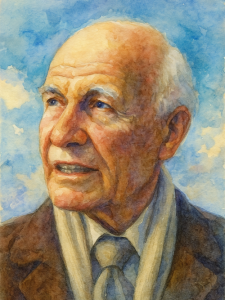
Without a doubt, Josef Pieper. I did my Junior Project on him for my undergraduate and would love a conversation with him! So it would be Pieper and I, hopefully sharing a Bourbon and steak (I have no idea if he enjoyed either one of those, but I sincerely hope he did!), and we would talk about Tradition. Tradition and memory were two strings which informed nearly the entire body of his work, and I would consider him perhaps the leading expert on the topic to this day.
13) Name a favorite movie/tv show or music you find worth sharing with others.
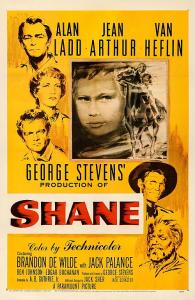
If you want a movie that could almost certainly never be remade well, Alan Ladd in the movie Shane. Homesteaders vs, ranchers, struggles of co-existing on the same land with opposing livelihoods, marital fidelity, genuine relation between male and female, immigration, satisfying conclusion that emphasizes the true future of a community and doesn’t glamorize unrealistic heroics, all found within the masterpiece that is American Western – easily one of the greatest films I’ve seen. Go watch it!
14) Can you see one of your books being made into a movie or tv series?
I really don’t anticipate a movie or tv show being made about “Remembering Freedom” – unless overnight there comes a wild demand for screen adaptations of philosophical or theological ideas. At best, maybe someone would use my work on Youtube to reach a wider audience with the ideas articulated there. That being said, many of the points I discuss in the book are illustrated by real-life stories, each of which might find their way to the screen if ever there’s a call for episodes from the life of Connor Curley! I highly doubt it, though.
15) Favorite Historical Event.
I’m guessing when my wife was born and blessed the world doesn’t count! I would say the siege of Vienna and the charge of the Winged Hussars. Not only did this event save Christendom, highlight the prowess of the Polish nation, and influence the later development of the set-upon Polish nation: it also gave us such culturally influenced things as the Charge of the Rohirrim in Peter Jackson’s production of The Two Towers. It also inspired Sabaton’s Winged Hussars song which – in spite of that genre not being my cup of tea – is a pretty fantastic song. It’s not often that a cultural event from another country has such relevance and influence in our own time. But that one does, and I love it.
This interview was published on March 10, 2026
The day these events took place
1535 – Spaniard Fray Tomás de Berlanga, the fourth Bishop of Panama, discovers the Galápagos Islands by chance on his way to Peru.
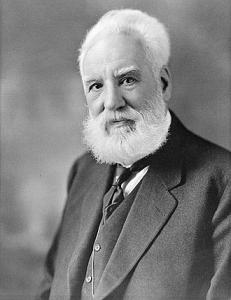
1876 – The first successful test of a telephone is made by Alexander Graham Bell,
1969 – In Memphis, Tennessee, James Earl Ray pleads guilty to assassinating Martin Luther King Jr. He later unsuccessfully attempts to recant.
16) What else do you want people to know about anything.
Go see Jesus in adoration. Nothing else really matters, if we don’t continue our journey towards Him. And, if you need some light(ish) reading while you’re there, maybe bring a copy of Remembering Freedom!
The Catholic Bard Wants To Interview You! |
Interview Questions For My Catholic Blog








 Ad-Free & Subscriber Log-In