

Study shows race, economic issues, and environment topped list of social issues for U.S. mainline preachers in 2024-25. Social issues in mainline Protestant sermons increased from 2021.
By Leah D. Schade, with Amanda Wilson Harper and Wayne Thompson
The Challenge and Necessity of Addressing Social Issues in Sermons
Preaching that addresses social issues has been a fraught challenge for each generation of ministers who seeks to educate their churches about faith and politics and speak truth to power through biblical preaching.
In the aftermath of the 2024 U.S. presidential election, ministers navigated multiple crises brought on by draconian executive orders, an administrative coup, and the enactment of Project 2025.
[See historian Heather Cox Richardson’s daily chronicle of the unraveling and dismantling of U.S. institutions and democratic infrastructure alongside the rise of Christian nationalist authoritarianism in her daily newsletter, Letters from an American.]
Taken together, these actions targeted a broad swath of the U.S. population, including immigrants, transgender persons, persons of color, women, those with disabilities, and ICE-targeted cities that face an increasingly militarized state.
Our research with mainline Protestant preachers suggests that, in the face of these crises, the majority encouraged their congregations to act on Scripture’s call to care for the most vulnerable and to work for justice.
Surveying Preachers about Social Issues
Since 2017, my team and I have been studying U.S. mainline Protestant clergy addressing social issues in their sermons.* By social issues, we mean topics that are in the realm of public debate and have some bearing on politics and public policy. These issues also affect the life of the church, its parishioners, and the local community.
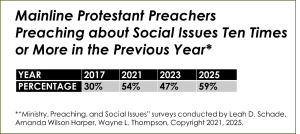
While some pastors field complaints about being “too political” when their sermons touch on contemporary topics, our results show that the percentage of preachers addressing social issues at least ten times in a year doubled from 30% in 2017 to 59% in 2025.
Social science researchers Amanda Wilson Harper (Tarleton State University) and Wayne Thompson (Concordia University) and I have surveyed thousands of preachers across four survey waves in the last eight years. We’ve collected more than 7,000 responses from clergy in all fifty states and across denominations such as ELCA Lutheran, United Methodist, Presbyterian-USA, Disciples of Christ, Episcopal, and United Church of Christ.
We recruited respondents through convenience samples by disseminating the survey to denominational leaders, seminaries, and social media platforms. The data has allowed us to track trends in topics that clergy intentionally address and avoid in their sermons.
In this article, we highlight the 2025 survey conducted in the first 100 days of the second Trump administration, comparing it to the 2021 survey at the beginning of the Biden administration.
Demographics of Respondents
Online survey waves of 2,059 mainline Protestant clergy from 2021 and 1,017 from 2025 included gender representation that leaned slightly toward females (55.5%), with 83.5% heterosexual, 91% white identity, and 88% primarily English speaking. Age distribution ranged from early twenties to 70+ (median age 53) and included those serving in ministry from less than a year to 30+ years (median 18 years). Respondents served congregations with worship attendance from less than 25 to over 1,000, from rural/small town settings to suburban and urban.
Politically, 64% identified as progressive, 29% moderate-lean progressive, 5% moderate-lean conservative, and 2% conservative.
Respondents were anonymous, so exact tracking across surveys waves was not possible. However, we triangulated patterns and topics which suggested comparable samples. Also, while there is a risk of bias with self-reporting, we did not analyze the sermon content of these preachers. Instead, our focus was on the overall trend in clergy attitudes and opinions about preaching and social issues.
Top 10 Social Issues in U.S. Mainline Protestant Sermons, 2024-25
In 2025, nearly six in ten preachers (59%) indicated that they addressed social issues more than ten times a year in their preaching, teaching, or other venues of ministry. That number increased to seven in ten (70%) for those serving diverse congregations having at least 20% racial diversity. Clergy serving in urban settings were more likely (70%) to address social issues than those serving suburban (61%) and rural (55%) settings.
Only 1% reported never preaching about social issues. Twenty percent reported 1-4 times, and 19%, 5-10 times.
In each survey, respondents indicated which contemporary issues they addressed in a sermon in the previous twelve months, choosing from a list of 20-30 topics. Issues ranged from addictions to domestic violence, interfaith relations, and mental health. Results revealed that ten topics drew attention from at least half of respondents in their 2024–25 sermons.

Attention to Social Issues Increased from 2021 to 2025
When compared with results from the 2021 survey, we note that attention to all top ten topics increased.
- Racial issues topped the list at 88% in 2025, a marked increase over 71% in 2021.
- Economic issues edged up slightly from 76% to 81%.
- Environmental issues such as climate change, pollution, and protecting nature surged from 49% to 79%.
- Hunger and food insecurity saw an increase from 62% to 76%.
- Issues around democracy and political divisions increased slightly from 62% to 64%.
- In 2021, 44% of preachers indicated they had addressed immigration. That number jumped to 62% in 2025.
- LGBTQIA+ issues increased from 44% to 56% .
- There were also increases in attention to mental health (42% to 55%) and addictions (45% to 51%).
[See: Preaching about Racism, Economics, and Environment.]
New in our 2025 survey was the topic of Christian nationalism. Nearly six in ten preachers (57%) indicated that they had spoken about Christian nationalism in a sermon in the previous year.
The Covid-19 pandemic may have contributed to the decreased attention to all other topics in 2020-21.
[What topics will preachers likely avoid in 2026? Read: Taboo Topics Mainline Preachers Will Likely Avoid in 2026.]
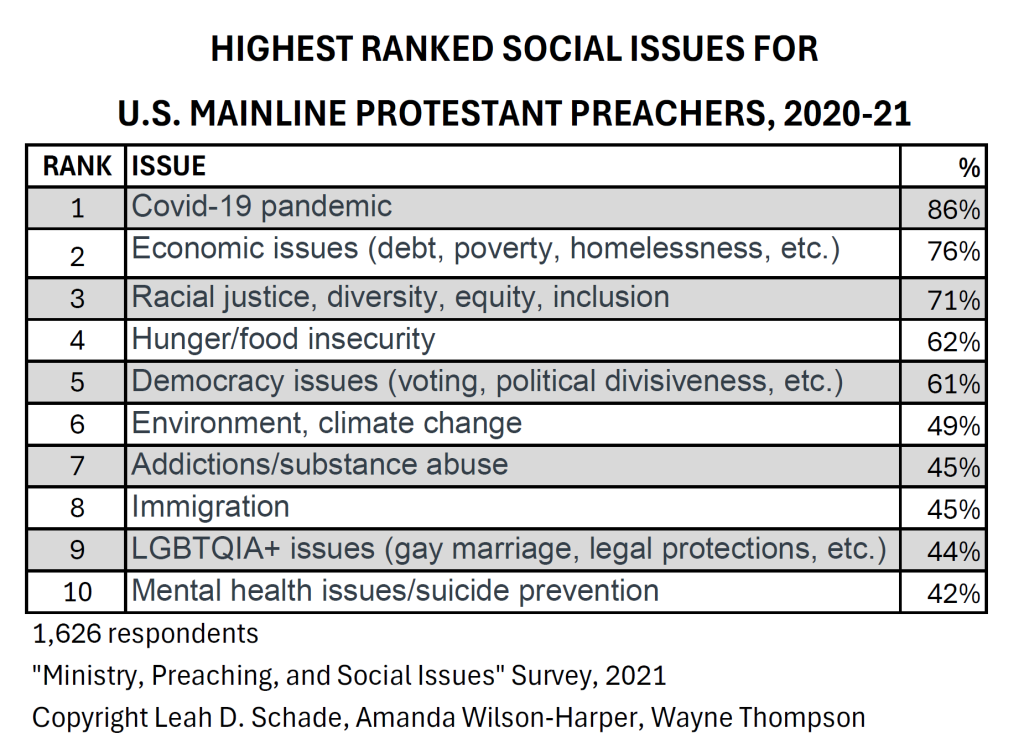
Top Ten Social Issues for U.S. Mainline Preachers, 2020-21
Variables Affecting Preachers’ Comfort Level with Addressing Social Issues
In both surveys, respondents indicated their comfort level with preaching about social issues. The percentage of those who reported that they generally have no problem engaging social issues in their preaching and teaching and feel free to do so dropped six percentage points from 63% in 2021 to 57% in 2025. At the same time, those who indicated they would like to engage social issues in their preaching/teaching but feel inhibited increased eight and a half points from 33.5% to 41%.
Factors: Gender and Race
In 2025, feelings of inhibition varied by gender and race of preachers and congregations. Females felt more inhibited (45%) than males (34%). Whites preachers in white congregations felt more hesitant (42%) than preachers of color in congregations of color (27%). However, preachers of color serving white congregations felt more hesitant (35%) than those serving racially diverse congregations (20%). In fact, preachers serving more diverse churches felt less hesitant in addressing social issues than those serving racially and culturally homogenous congregations, regardless of the preacher’s racial identity.
Heterosexual and cisgender respondents felt more hesitant (42%) than LGBTQIA (32.5%). We conjecture that this is because many LGBTQIA preachers are already in progressive congregations, so they feel freer to address social issues. Data from the 2025 survey indicated that there are more than twice as many progressives as conservatives in LGBTQIA+ preachers’ congregations compared with heterosexual preachers.
Factors: Political Leanings of Preacher and Congregation
Political leanings of the preacher and congregation also affected feelings of hesitancy in addressing social issues. Progressive preachers (42%) were more than twice as likely to report feeling hesitation than conservative preachers (17%). Progressive preachers serving mostly conservative churches (60%) were twice as likely to feel hesitant as their colleagues serving progressive churches (32%).
However, the same did not hold for conservative preachers; their hesitancy hovered around 22% regardless of whether they served progressive or conservative congregations. Yet, one-third of conservative respondents said they had no interest in addressing social issues, compared with less than 1% of progressive preachers. This may be due to conservative preachers feeling more supported and politically compatible with adherents, thus not needing to push on specific issues, or fearing negative reactions.
Even more of a factor than political leanings were the respondents’ perceptions of divisiveness. Three-fifths (60%) of those serving either very or somewhat divided congregations felt hesitant, compared with 26% of those who indicated their congregation was not very divided. Also, 44% of those whose churches were in divided local communities felt more hesitant compared to 30% who reported minimal community division.
Privilege, Vulnerability, Risk
These factors correlate with aspects of privilege, vulnerability, and risk that may affect preachers’ feelings of safety when addressing social issues. For example, one white male respondent serving as a solo pastor said, “I can preach whatever I want. They may not agree with me, but I don’t need their agreement.”
In contrast, a white female respondent in the ordination process serving as a youth and family minister said, “My biggest barrier is not feeling safe to speak what I believe about Jesus’ teachings for fear that it would come off political and be divisive. I work with youth, and all of their parents are big MAGA people right now. So, I’m afraid if I’m too vocal, they’ll pull their kids, and I won’t have any influence on their lives, and I might lose my job.”
In addition, several who served as associate or assistant ministers noted that when the senior pastor objected to addressing social topics in sermons, this tempered their prophetic voices.
Backlash
Those with direct experience of backlash to their sermons about social issues reported that it came most frequently via loss of worship attendance (21%) or from angry words, letters, or emails (19%). Other responses included people refusing to speak to them (17%), withholding financial giving (15%), leaving the congregation (15%) and loss of volunteers (14%). A smaller percentage (6%) faced calls for their resignation, left the church, or were let go because of addressing social issues.
Thirteen percent reported receiving threats or fearing for their safety. More than 120 respondents shared experiences ranging from physical and online harassment to vandalism, death threats, and violence. This suggests that ministry for some is not just stressful but also dangerous.
Prophetic Courage Despite Pushback and Risk
However, despite the many factors that might increase the discomfort or risk for preachers in addressing social issues, our findings show that most mainline clergy engaged controversial topics in 2024-25 by calling congregations to act on their faith and embody biblical values of justice, care, and flourishing for all. The number of preachers addressing social issues has increased steadily since 2017.
In Part Two of this series, we examine the intersections of preaching about racism, economics, and environment: Preaching about Racism, Economics, and Environment.
Part Three explores Preaching about Immigration, Christian Nationalism, and Democracy.
Part Four examines Preaching about LGBTQIA+ issues in relation to mental health and substance abuse.
The final installment explores the likely Top Taboo Topics for 2026.
*Note: The 2025 study was approved in a human ethics review by the Concordia University Wisconsin-Ann Arbor Institutional Review Board, #IRB-FY25-136. The 2017, 2021, and 2023 studies followed protocols for the study of human subjects.
Looking for Tools to Empower Your Prophetic Voice?
I’ve created a free, online, 5-minute assessment tool for preachers and congregations to determine whether they should take a “gentle,” “invitational,” or “robust” approach to social issues. And in my book, Preaching and Social Issues: Tools and Tactics for Empowering Your Prophetic Voice, I offer strategies based on the approach that would work best for different contexts.
Read also:
Survey Shows More Mainline Clergy Addressing Social Issues
Clergy Stress & Resilience in a Divided America: 2025 Survey
How to Handle Sermon Pushback on Social Justice Issues
8 Ways to Prepare Your Congregation for Sermons about Social Issues
The Rev. Dr. Leah D. Schade is a seminary professor and ordained minister. Her opinions are her own. Leah is the author of Preaching and Social Issues: Tools and Tactics for Empowering Your Prophetic Voice (Rowman & Littlefield, 2024), Preaching in the Purple Zone: Ministry in the Red-Blue Divide (Rowman & Littlefield, 2019) and Creation-Crisis Preaching: Ecology, Theology, and the Pulpit (Chalice Press, 2015). She is the co-editor of Rooted and Rising: Voices of Courage in a Time of Climate Crisis (Rowman & Littlefield, 2019). Her book, Introduction to Preaching: Scripture, Theology, and Sermon Preparation, was co-authored with Jerry L. Sumney and Emily Askew (Rowman & Littlefield, 2023).















 Ad-Free & Subscriber Log-In