

Genesis 12:1-4a can help us counter the ethnocentrism of Christian nationalism in Lent while supporting immigrant communities.

The Ethnocentrism of Christian Nationalism
I define Christian Nationalism as a political ideology that distorts and weaponizes Christian teachings to legitimize and advance an aggressively patriarchal, racist, and ethnocentric agenda. [Read: Resist Christian Nationalism in Lent, Matthew 4:1-11.]
In the U.S., the current administration is undergirded by Christian nationalist ideology, and ethnocentrism is a key pillar of its policies.
According to Oxford Review, “Ethnocentrism refers to the belief that one’s own ethnic group, culture, or nationality is inherently superior to others.”
Ethnocentrism in the U.S.
The current administration has been very clear that the white Euro-ethnic group is superior to all other cultures, races, and nationalities. For example, in a Dec. 9, 2025 rally, Trump ranted, “We only take people from sh*thole countries. Why can’t we have some people from Norway, Sweden, just a few? … From Denmark. Do you mind sending us a few people? Send us some nice people. But we always take people from Somalia, places that are a disaster, right? Filthy, dirty, disgusting, ridden with crime.”
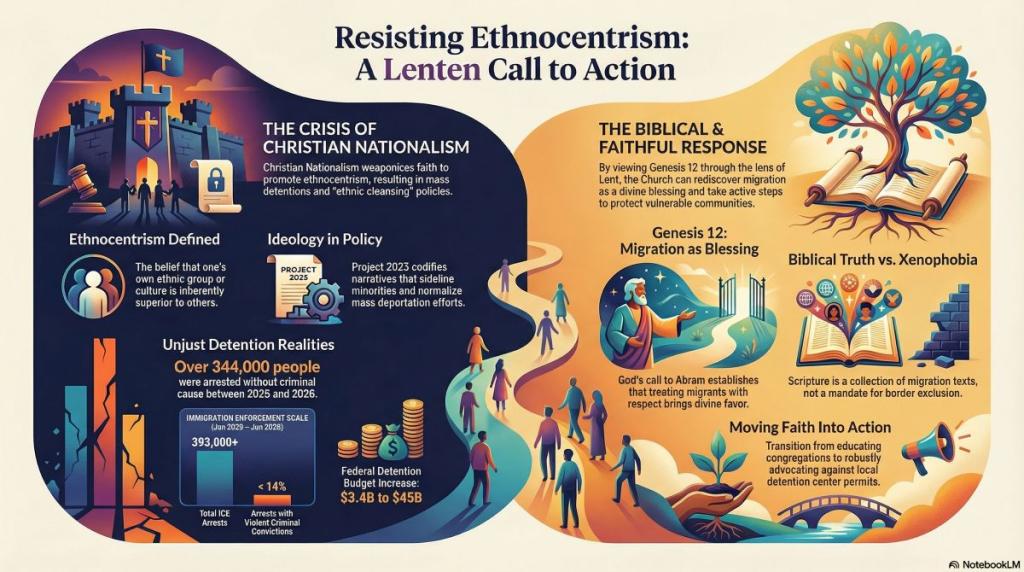
White, evangelical Christian ideology is codified in Project 2025, the policy blueprint for sidelining racial, ethnic, religious, and cultural minorities while reinforcing ethnocentric narratives. This manifests in the administration destroying DEI initiatives and banning travel and immigration from 75 countries by the end of January 2026, most of them from Africa, South America, Latin America, and the Middle East.
The plan to accomplish ethno-purity is through the exclusion and removal of all who do not fit the white Christian nationalist vision for America. In other words, the U.S. is once again engaged in ethnic cleansing.
Christian Support for Ethnocentrism
In American Idolatry: How Christian Nationalism Betrays the Gospel and Threatens the Church, Andrew Whitehead notes, “Many Americans—and many Christians as well—routinely associate immigrants and immigration with lawbreaking. One way this happens is through the labels we use. Calling undocumented immigrants ‘illegal immigrants’ suggests an inherent criminality; only through physically leaving our nation would such immigrants cease to be criminals in our eyes,” (143-144).
Yet, as Whitehead notes, being in the United States without documentation is a civil, not criminal, offense.
However, the current administration ignores this distinction to justify a policy of ethnic cleansing. Since Trump’s January 2025 inauguration, ICE had arrested more than 393,000 people by January 31, 2026, with arrests continuing to rise. However, according to CBS News, less than 14% of the nearly 400,000 immigrants arrested by ICE had charges or convictions for violent criminal offenses.
This means that ICE violated the human rights of 344,000 people by arresting them without cause or due process, often brutalizing them, and causing unimaginable trauma to their families and communities. And with eight large detention centers and 16 regional processing centers planned for 2026, the country is on the verge of unprecedented human suffering in concentration camps across the U.S.
Yes, Concentration Camps
The proper term for a place imprisoning people who have committed no criminal offense is a concentration camp. According to Merriam-Webster Dictionary, a concentration camp is a “place where large numbers of people (such as prisoners of war, political prisoners, refugees, or the members of an ethnic or religious minority) are detained or confined under armed guard.”
The American Immigration Council warns that this system is “trapping hundreds of thousands of noncitizens in an increasingly opaque world of remote jails and private prisons, where U.S. Immigration Customs Enforcement (ICE) can exert ever-greater pressure on the people it is jailing to give up, accept deportation, and forego any chance to remain in the United States.” Funding voted on by Congress in the “One Big Beautiful Bill Act” combined with ICE’s annual appropriations means that the detention budget rose to $45 billion from $3.4 billion in 2024.
As it stands, officials in the federal government and private prison industry are set to gain obscene amounts of wealth from the trafficking of nearly 100,000 human beings who have committed no crimes.
Countering the Ethnocentrism of Christian Nationalism in Lent
Many Christians, particularly within Evangelical circles, take an anti-immigrant position based on xenophobia (fear of foreigners), legal concerns, and a desire for border security. However, a biblically-informed approach to immigration can counter such attitudes that ultimately rationalize ethnocentrism and ethnic cleansing.
In their edited volume, Latinxs, the Bible, and Migration co-editors Efraín Agosto and Jacqueline M. Hidalgo assert that the Bible is “a collection of texts of and about migration” (7). Thus, scripture contains political theologies for peoples in exile, on the move, or seeking refuge. The Hebrew texts emerge from the pain and struggle of peoples forced from their homes and homelands. For immigrants then and now, the Bible can serve as a vehicle for expressing what it is like to endure violent subjugation under a conquering people.
When we examine the ethnocentrism of Christian Nationalism through the lens of Scripture in the season of Lent, we can create opportunities to educate our congregations about ethnocentrism and how to resist and debunk this sinful worldview.
Genesis 12:1-4a Defies Ethnocentrism
The first reading in the Revised Common Lectionary for the Second Sunday in Lent is Genesis 12:1-4a.
Now the Lord said to Abram, ‘Go from your country and your kindred and your father’s house to the land that I will show you. 2I will make of you a great nation, and I will bless you, and make your name great, so that you will be a blessing. 3I will bless those who bless you, and the one who curses you I will curse; and in you all the families of the earth shall be blessed.’ 4So Abram went, as the Lord had told him; and Lot went with him. Abram was seventy-five years old when he departed from Haran.
In this passage, God calls Abram to a new land, promising to “bless those who bless you,” (v. 3a). In other words, immigration is a divine directive offering ever-expanding blessings to those who treat migrating people with respect and honor.
At the same time, there are consequences for those who curse this group of beleaguered people. And the directive implies that those who migrate are to mirror God’s righteousness in their new homeland. The overarching theme, then, is one of increasing blessedness from those who are received into a new country.
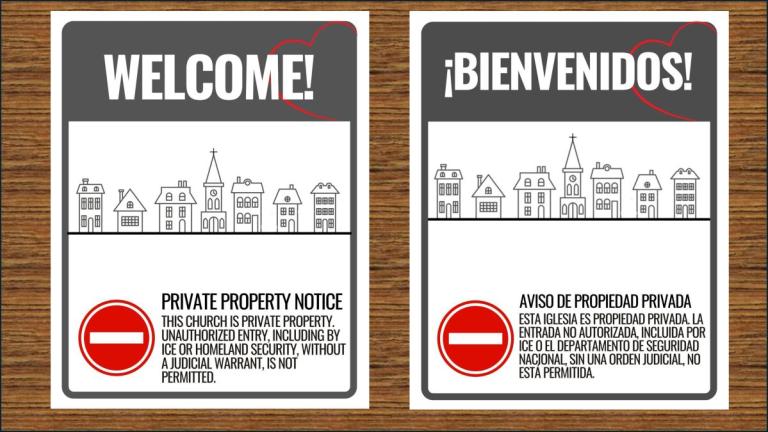
Central Question, Central Claim, Central Purpose for a Sermon on Genesis 12:1-4a
A sermon addressing ethnocentrism might ask: How can our church advocate for those who migrate from other countries? What are ways we can show compassion and affirm the gifts that immigrants bring which strengthen our communities? And how can we join in efforts to halt the concentration camps and ethnic cleansing now underway?
You can prepare for a sermon on Genesis 12:1-4a by crafting the Central Question, Central Claim, and Central Purpose. These Central Statements can help a preacher organize and provide direction for the sermon. [See: Introduction to Preaching: Scripture, Theology, and Sermon Preparation (Rowman & Littlefield, 2013).]
Here are possible Central Statements for a sermon countering Christian Nationalism based on Genesis 12:1-4a.)
Central Question. In what ways do we perpetuate fear of the foreigner and how can we affirm the blessedness of immigrants in the face of ethnocentrism and Christian Nationalism?
Central Claim. God’s blessing of Abram offers ever-expanding blessings to those who treat immigrants with respect, honor, and mutual accountability.
Central Purpose. This sermon calls out the false narratives about immigrants perpetuated by Christian Nationalism while calling for the church to help counter ethnocentrism and oppose ethnic cleansing.
Putting Faith Into Action
Calls for putting faith into action would be informed by whether the preacher would want to take a Gentle, Invitational, or Robust approach that I describe in Preaching and Social Issues. [Take the free, 5-minute Assessment Tool for Ministry and Social Issues to help you choose the best approach for your context.]
Gentle: Focus on Education and Raising Awareness
- Share stories of migrants in your community to humanize their experiences and counter negative stereotypes.
- Host workshops highlighting biblical teachings on welcoming the stranger (e.g., Leviticus 19:34, Matthew 25:35).
- Invite a speaker from the state or local refugee ministries to an adult forum or to give a brief message during worship.
Invitational: Create a Welcoming Community
- Connect with local organizations that assist newcomers with language, cultural orientation, legal resources, and basic needs.
- Encourage congregants to build relationships with migrants through mentorship or friendship programs.
- Offer space for legal clinics, ESL classes, or job training programs.
- Collect donations for migrant families in need of essentials like food, clothing, or housing assistance.
Robust: Oppose Ethnic Cleansing and Advocate for Just Immigration Policies
- Learn where concentration camps are planned closest to your church. Since many detention centers require local permits or zoning approvals, attend public meetings and hearings to voice concerns, especially from a faith perspective.
- Partner with local and national immigrant advocacy organizations to support humane immigration reforms.
- Organize letter-writing campaigns, petitions, or meetings with elected officials to promote fair treatment, pathways to citizenship, and protection for refugees and asylum seekers.
To truly resist Christian nationalism this Lent, we must transition from passive awareness to robust advocacy against the rise of ethnocentrism, ethnic cleansing, and concentration camps. God’s call of Abram assures us that migration is a source of divine blessing, urging us to build communities where every life is cherished and the vulnerable are protected.
Read also:
Resist Christian Nationalism in Lent, Matthew 4:1-11
Preaching Immigration, Christian Nationalism, and Democracy
Clergy, Prepare for ICE: Guidance from Minnesota Pastors
Latinxs, the Bible, and Migration: Book Review

The Rev. Dr. Leah D. Schade is a seminary professor, ordained minister, and co-founder of the Clergy Emergency League. Her opinions are her own.
Leah is the author of Preaching and Social Issues: Tools and Tactics for Empowering Your Prophetic Voice (Rowman & Littlefield, 2024), Preaching in the Purple Zone: Ministry in the Red-Blue Divide (Rowman & Littlefield, 2019) and Creation-Crisis Preaching: Ecology, Theology, and the Pulpit (Chalice Press, 2015). She is the co-editor of Rooted and Rising: Voices of Courage in a Time of Climate Crisis (Rowman & Littlefield, 2019). Her book, Introduction to Preaching: Scripture, Theology, and Sermon Preparation, was co-authored with Jerry L. Sumney and Emily Askew (Rowman & Littlefield, 2023).















 Ad-Free & Subscriber Log-In