

ELCA pastor attends State of the Union, offering a powerful witness on behalf of immigrants and marginalized voices.

Standing for Immigrants: Rev. Rabell at the State of the Union
Each year for the U.S. president’s State of the Union address to the Congress and Supreme Court, members of Congress are permitted to invite one guest. This year, Rep. Josh Harder, (D-9th District, California), invited the Rev. Nelson Rabell-González, a local pastor and immigrant advocate, as his guest for the annual address.
“Here in the Valley, we’re incredibly proud of our immigrant communities, and we’re made stronger by their accomplishments and contributions,” Harder said. “Despite recent attacks on our neighbors, our community has remained united around protecting valley families, and Rev. Rabell-González has been at the center of those efforts. As a faith leader in the valley for years, Rev. Rabell-González has been a trusted partner and source of warmth and acceptance during these chaotic times. I’m incredibly honored to have him as my guest and to bring these stories to Washington as we work to rein in these out of control attacks.”
A native of Puerto Rico, Rev. Rabell serves both Spanish- and English-speaking congregations: Iglesia Luterana Santa María Peregrina in Stockton and Saron Lutheran Church in Escalon. He has been a community leader in the Central Valley since 2018, especially amid recent attacks on immigrant communities. He co-founded the group A New Lodi in September 2020, which advocates for progressive causes, immigrant rights, and racial justice. Rev. Rabell is also on the Steering Committee for the Clergy Emergency League (CEL), a network of pastors in the U.S. resisting white Christian nationalism and supporting prophetic ministry.
Rev. Rabell sat down with me as the co-founder of CEL to share what his experience was like in the “lion’s den” of Republican-held power. In this conversation, he noted the surprising ways he encountered God’s presence and what message he’s taking back to his congregation and the ELCA.
[Read the full interview here. Watch the video of the interview here.]
The Funereal Witness in the House Chamber
While the United States Capitol effused an aura of military and political might on the night of the 2026 State of the Union address, Rev. Nelson Rabell stood as a witness for the vulnerable in the immigrant community. Dressed in a long black funeral cassock—a garment of profound lamentation typically reserved for funerals and Good Friday—Rev. Rabell used his liturgical vestment as a witness of resistance. He wore a silver cross that was gifted to him by his late mother, a lawyer and advocate, representing the support of the ancestors as the “great cloud of witnesses.” It also symbolized the presence of his congregation and the whole church as the “communion of saints.”
This spiritual armor was accompanied by a pointed symbol of solidarity with the immigrant community: his U.S. passport. In a climate of pervasive racial scrutiny and “replacement theory” rhetoric, the necessity of this U.S. citizen carrying proof of citizenship in the heart of his own government highlighted the absurdity and the peril of being a citizen of color. He explained that the passport served as a shield against a state that demands the marginalized constantly prove their right to exist.
The Call to the Capitol: An Invitation of Significance
The invitation to the inner sanctum of state power resulted from Rev. Rabell’s years of grassroots organizing with the marginalized in California’s Central Valley. It originated from the office of Representative Harder whose constituents increasingly endure the harsh realities of immigrant struggle under the current regime.
Rev. Rabell met the Congressman through Faith in the Valley, a faith-based community organization. Their mutual respect for each other’s advocacy for the marginalized – one in the state, one in the church – forged a common bond that accompanied them into the heart of Christian nationalist power.
Finding the Presence of God
Prior to the SOTU address, Rev. Rabell attended receptions of both Speaker Mike Johnson and Minority Leader Hakeem Jeffries. In those spaces, Rev. Rabell engaged with lawmakers whose decisions ripple through the lives of his congregants. He noted a moment of exchange with Rep. Nancy Pelosi, the former Speaker who offered a direct blessing for the Reverend’s work, as he did for hers.
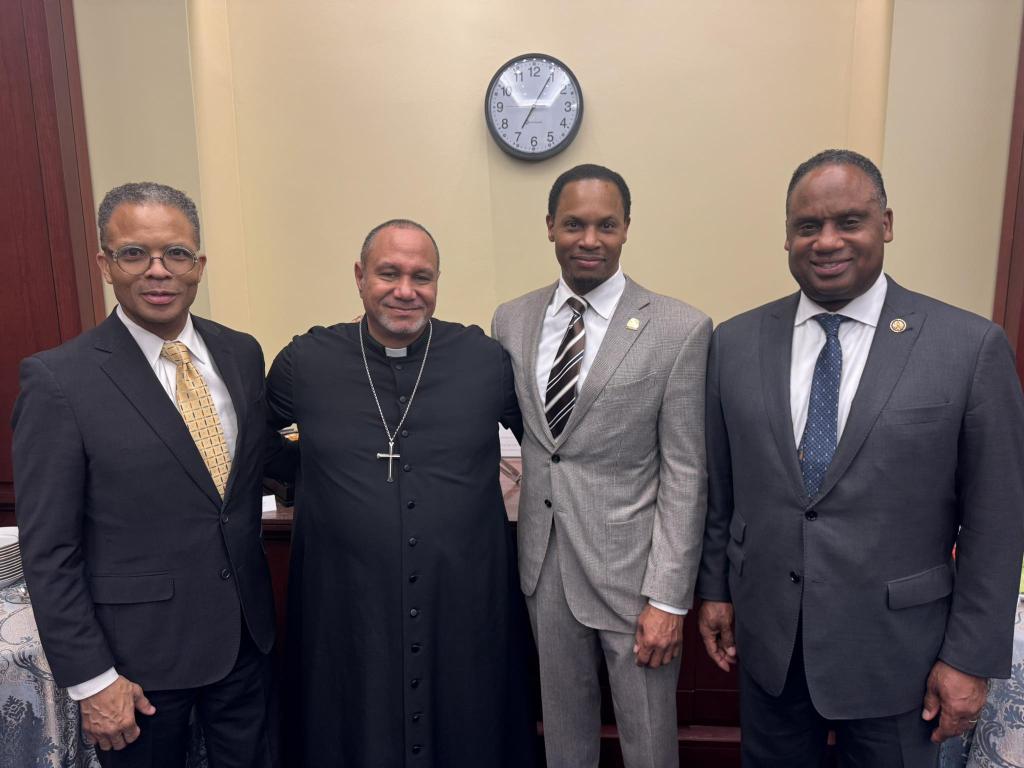
He also appreciated meeting the family of the late Rev. Jesse Jackson. He shared in their profound sadness regarding the denied request for the civil rights icon to lie in state. Speaker Johnson’s dismissal of a figure whose Rainbow Coalition fought for civil rights was in keeping with efforts to dismiss and reject African American history.
Rev. Rabell joined other clergy accompanying their Congressional leaders who represented the marginalized, including Reverend Fabian Arias of Metro New York, an ELCA colleague and noted immigrant advocate. He also met a DACA recipient and PhD in mathematics. Their collective presence served as a living counter-narrative to the looming rhetoric of the evening.
“I can tell my congregation that I met so many pastors, leaders, advocates, and migrants who were there. There was Pastor Fabian Arias on the East Coast and me from the West Coast. It was a kind of bracketing showing that God is present and has not abandoned us.”
All Is Not as It Appears: Racism Beneath the Veneer of Politeness
The evening was a study in jarring contrasts. As the President began his address, the collegiality of the receptions evaporated. The House Chamber became a cauldron of racism where Rev. Rabell witnessed a “State of the Union” that felt like a spiritual siege. He observed the xenophobic messaging with the discernment of a theologian, standing when honors were given to those in achievement, but remaining pointedly seated during rhetoric that targeted migrants or dismantled Diversity, Equity, and Inclusion (DEI) initiatives.
Rev. Rabell noted a disturbing social pathology—a literal “replacement theory” manifesting in the room when the white men seated around him in the balcony jumped to their feet to madly applaud the president’s racist rhetoric.
“The saddest moment for me was talking with somebody seated next to me who was from Minnesota, a white person who was very nice and collegial. But with the anti-DEI statement, he and others just jumped up like frogs and started clapping with joy and emotion.”
Yet this racism did not go unchallenged, such as when Representative Al Green held a sign stating “Black people are not apes”—an act of defiance that led to his removal from the Chamber. The president’s hostility also extended to women of color in Congress, such as Representative Ilhan Omar who called out his lies and policies leading to murder. To Rev. Rabell, the room felt thick with racial tension, a place where powerful white men viewed the mere existence of the “other” as an existential threat.
A Blessing and a Denouncing
I asked Rev. Rabell what he would have said to the president if he had the chance to speak with him. He said he would have offered both a blessing and a denouncement.
“I would have given a blessing in the sense of the well-being of the president as a person, the dignity he has as a human being. But also a denouncing of his behavior, his policies that say only white and powerful people should be occupying space, no one else. That is the idea of the Great Replacement Theory. They say: go back to your corner. Or, actually, they want to push you out of the margin and right off the page.”
Every Inch of Resistance Counts: The Church’s Legal Battle Against ICE
The tension in the House Chamber was a manifestation of the racial and ethnocentric aggression occurring in the Central Valley and across the country. But Rev. Rabell and his colleagues joined a lawsuit spearheaded by Democracy Forward and the ELCA’s AMMPARO advocacy group to protect churches, schools, and hospitals from ICE. In February, a preliminary injunction restored protections which the administration stripped from the ICE field manuals regarding “sensitive areas.”
“The message is that we’re not alone in this struggle,” Rev. Rabell said. “We can see that with the injunction against ICE; the congregations were a part of. It was a unanimous vote by our church council to join this lawsuit and to put themselves at risk. That courageous act may bring unwanted attention, but it’s a powerful witness.”
We noted with regret that the leadership of the ELCA refused to join a similar lawsuit to protect its congregations last year. Our hope is that the injunction will inspire denominational leadership to step up in its prophetic actions on behalf of the church.
From Exile to Vindication: The Path of Kenosis
For Rev. Rabell Gonzalez, his seat in the Capitol represents a journey from institutional exile to prophetic vindication. Four years ago, he was removed from the ELCA roster following a racist and xenophobic campaign by a former bishop. At the time, the bishop’s supporters exhibited a sycophantic arrogance, while the institutional church prioritized internal power structures over the voices of the vulnerable. After a long and grueling struggle that demonstrated his innocence against false allegations, the synod restored him to the roster, and his congregation rejoined the ELCA.
He frames his restoration through the theological lens of kenosis—the self-emptying humility of Christ. It was only through the eventual kenosis of the Synod—an acknowledgement of harm and a decision to restore his rostered status and apologize to the Latiné community—that the institutional church began to reclaim its moral center.
Rev. Rabell stressed that his presence in Washington was not a personal achievement but a testament to what happens when pastoral leaders possess the humility to listen to the marginalized and the dissenters it once sought to destroy.
“This is also an opportunity that God has given us to look back and realize, where was the voice of God present?” he reflected. “Was it in the adulation of the power or the sycophantic support of a leader who was questionable? Or was it in the voice of the vulnerable in the margins, in the voices who said, Hey, listen, there’s something off here.”
With this invitation to the State of the Union address, the secular state, recognized a ministry that the ecclesiastical structure had previously tried to humiliate and erase. “Sometimes the secular leaders or elected officials see us before the church does. So the question is, can the church be humble enough to see us as well?”
The Truth in the Margins
Returning to his congregations at Santa Maria Peregrina and Saron, Rev. Rabell brings a singular, urgent message: God’s truth is in the margins.
“This has been a great lesson for me, but I hope it can be a greater lesson for a church, which is to listen to its voices of dissent, to the voices that come from the margins, because most likely the truth is there,” he said.
Rev. Rabell’s journey serves as a prophetic denouncement of Christian nationalism and the fascist ideologies that seek to push the marginalized “off the page.” He asserts that the church must find the courage to dwell in the margins, for it is there, at the foot of the cross, where God reveals divine truth. This compels us to have hope, even in this time of racist authoritarianism
“The fulfillment of God’s promises is an assurance, even now, that God will deliver us,” Rev. Rabell insisted. “And this assurance of past vindications and the fulfillment of God’s promises is what fuels our hope and our resistance.”
Witnessing the State of the Union was a reminder that divine power is found not in the impressive chambers of the powerful, but in the resilient and persistent presence of those who refuse to be disappeared.
Read also:
Clergy, Prepare for ICE: Guidance from Minnesota Pastors
ELCA Fires Whistleblower, Rev. Nelson Rabell-González
White Fragility in the ELCA: 5 Things We Can Do About It
The ELCA Apology to Iglesia Luterana Santa María Peregrina: What Have We Learned?
Iglesia Luterana Santa Maria Peregrina Celebrates El Día de La Virgen de Guadalupe
Are you a clergy person looking to connect with other Christian leaders in the work of resisting and disrupting Christian nationalism? Check out the Clergy Emergency League.
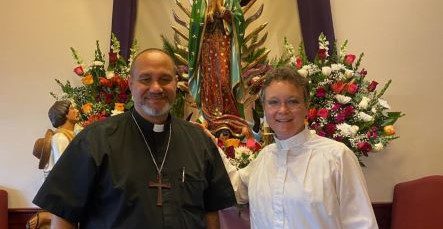
The Rev. Dr. Leah D. Schade is a seminary professor, ordained minister, and co-founder of the Clergy Emergency League. Her opinions are her own.
Leah is the author of Preaching and Social Issues: Tools and Tactics for Empowering Your Prophetic Voice (Rowman & Littlefield, 2024), Preaching in the Purple Zone: Ministry in the Red-Blue Divide (Rowman & Littlefield, 2019) and Creation-Crisis Preaching: Ecology, Theology, and the Pulpit (Chalice Press, 2015). She is the co-editor of Rooted and Rising: Voices of Courage in a Time of Climate Crisis (Rowman & Littlefield, 2019). Her book, Introduction to Preaching: Scripture, Theology, and Sermon Preparation, was co-authored with Jerry L. Sumney and Emily Askew (Rowman & Littlefield, 2023).










 Ad-Free & Subscriber Log-In