

In this interview, Reverend Nelson Rabell-González, an ELCA Lutheran pastor and immigrant advocate in the Central Valley of California, discusses his experience attending the 2026 State of the Union address.

As a guest of Representative Josh Harder (D-9th District of California), Rev. Rabell reflects on the surreal atmosphere of the House chamber and the racial and xenophobic tensions he witnessed during the event. He describes using his presence and religious attire as an act of resistance against political rhetoric that criminalizes vulnerable communities.
Hosted by the Clergy Emergency League (CEL) and interviewed by CEL co-founder, Rev. Dr. Leah D. Schade, the dialogue explores a successful legal injunction involving his congregations and others to prevent ICE enforcement on church properties. They also reflect on his surviving and being vindicated from a racist attack by a former ELCA bishop that nearly destroyed his reputation and ministry.
Ultimately, this interview highlights the intersection of faith-based activism and political engagement while affirming the presence of God’s power and truth within the marginalized community.
[Watch the video of the interview here. Read the summary of this interview here.]
This transcript has been edited for clarity.
Interview with Rev. Nelson Rabell-González
Schade
Hello and welcome to my interview with Reverend Nelson Rabell-González, who is the pastor of Iglesia Luterana Santa Maria Peregrina in Stockton and also Saron Lutheran Church in Escalon in California.
My name is Reverend Dr. Leah Schade. I am the co-founder of the Clergy Emergency League, and I am interviewing Reverend Rabell because he was a guest of his representative at the State of the Union in 2026.
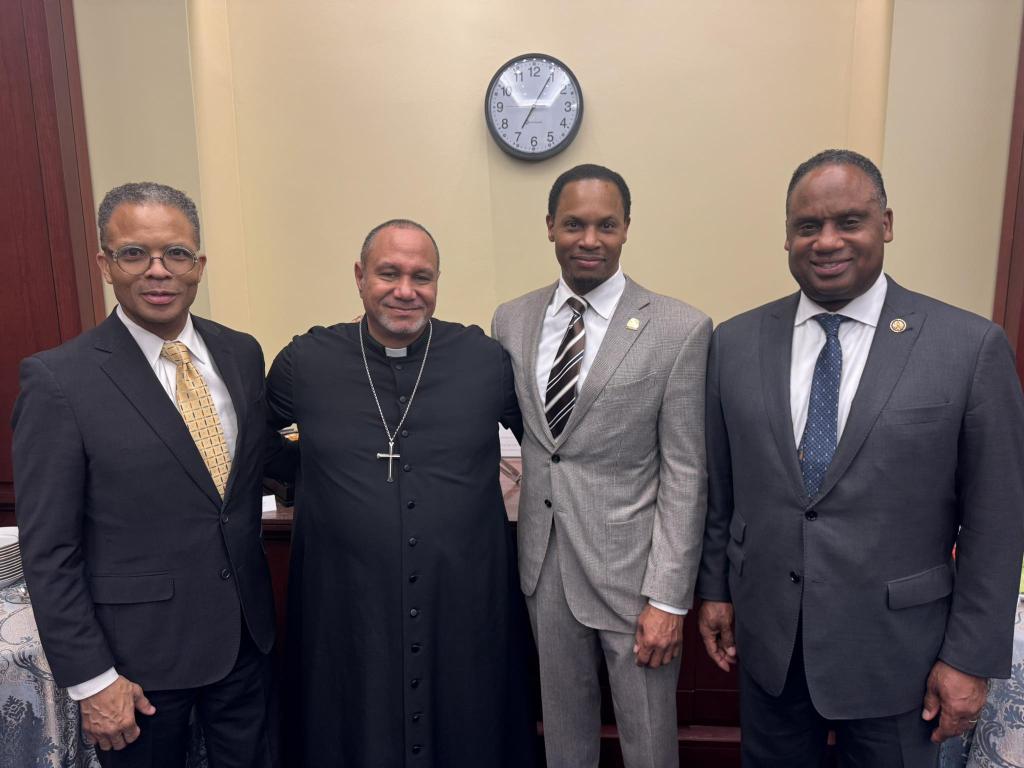
Each year for the U.S. President’s State of the Union Address to the Congress and Supreme Court, Congress people are permitted to invite one guest. And this year, Representative Josh Harder, who represents the 9th District of California, invited Reverend Nelson Rabell-González, a local pastor and immigrant advocate, as his guest for the annual joint address to Congress.
Reverend Rabell, thank you so much for coming off of this time and going right into this interview to share with us what it was like for you.
First of all, tell us, how did you receive the invitation to go to the State of the Union, how did that happen?
Rabell
Thank you, Reverend Dr. Leah Schade. Always a pleasure to be here with you, my friend. I got a phone call from the office of my representative, Josh Harder. They wanted me to be his guest to the State of the Union. What an honor! We have had this relationship for the last few years where he had been in different events that we have done with the community, town halls, and through my relationship and work with Faith in the Valley, which is a PICO California affiliate here in California, a faith-based community organizing network.
My relationship with him has been based on that work. We have always had a great relationship in terms of advocating for the migrant community. Recently, Congressman Harder actually visited a local ICE facility in Stockton, CA, just a few minutes from Lodi, where I live.
In the Belly of the Beast
Schade
You’ve been standing up for immigrant neighbors in California since 2018. Your congregation is made up of immigrants and people from different Latiné communities. Not many people get to have access to the House chamber, much less the State of the Union. Can you describe what the experience was like for you? What was the energy like? And on a spiritual level, what was the feeling like for you?
Rabell
It is overwhelming in the sense of the security and all the protocols because the president is coming to the Capitol, to this joint session of Congress. But Congressman Harder spent time with me, took me to all the different receptions prior to the State of the Union address.

We went to the reception of Speaker Mike Johnson. It was quite pleasant, I have to say. And then we went to the reception hosted by Rep. Hakeem Jeffries, the minority leader reception. There I was able to meet Nancy Pelosi. She had brought an African American Baptist pastor from her district. And she told me, God bless you for the work you do. And I said, well, Madam Speaker, thank you so much for the work you’ve done as well.
I also was able to talk with and express my condolences to Jesse Jackson’s family. His death was not mentioned in the State of the Union. There’s some sadness in the family that they denied the request for him to lie in state.
I also met a Methodist clergy that was invited by her Congressman. And I want to do mention that there was another ELCA Lutheran pastor, Reverend Fabian Arias from Metro New York, invited by his representative. He is also an advocate for the migrant community. So clergy and the migrant community were represented.
Also, Lou Correa, who’s the California representative for the Orange County area, brought a Dreamer whose name was Oscar. I will never forget his name. He has a PhD in mathematics. All of us by our very presence, in some respect, countered the narrative we heard from the president.
Schade
This created a sense of purpose and affirmed why you were there. It also affirmed the importance of your presence as an ELCA Lutheran pastor, as an advocate for immigrants, and as an Afro-Puerto Rican pastor who himself could have been targeted that night, and has been on other occasions. So just your very presence, your embodiment in the spaces of power, was an act of resistance.
Rabell
Thank you. I want to see it that way. And I just want to say that being there was also in some respect an opportunity to advocate. I was carrying my passport, for example. When I did an interview with one reporter, I told them, you know, I’m carrying my passport. I took it out. Literally, I had my cassock on and carried my passport. The image I wanted to give was of passive resistance. I was wearing a funeral outfit, the clothes I wear when I do a funeral or conduct the Good Friday service. And I wore this silver cross, which was the cross that my mother gave me. She was a lawyer and an advocate. So I had this cross, because I knew I needed all the help I can get.
Schade
Well, then you had the ancestors with you.
Rabell
Yes, amen. That’s the best way to frame it, the communion of saints were present.
Schade
The great cloud of witnesses was surrounding you in that space. So, what was it like to sit through the president’s speech?
Lo cortes no quita lo valiente.
Rabell
I stood a few times when there was recognition of certain people that had suffered or who have accomplished something. I think that’s important.
But you know, we say in Spanish, lo cortes no quita lo valiente. It means, “being polite doesn’t remove the fact that you can also be courageous.” So, at the mention of the death of DEI, or the moment where he said that migrants are criminals who are out to get you and to steal and to kill you and to make your life miserable, I sat down. And literally all the people around me were standing up.
I would say the saddest moment for me was talking with somebody who was next to me who was from Minnesota, a white person who was very nice and collegial. But when the DEI statement was made, he and others just jumped like frogs. They jumped like a rabbit and started clapping with joy and emotion.
They did the same thing when Rep. Al Green was escorted out for holding up the sign that said, “Black people are not apes.” There was this contempt from those around me. I could feel it, this tension. You could also see it directed at Representative Omar and other women of color in Congress. There was a lot of racial tension, and I was surrounded by it.
It seems like racism and xenophobia is alive and well in the United States. What is almost surreal is that you would look at them and assume they were good people. But let me put it this way. It’s like when you’re going to a soccer game or American football game and your team is squashing the other. The message was against people color, or migrants, or trans or other vulnerable people. And they cheered for it.
It was, for me, surreal in the sense that these are human beings we’re talking about, and their rights, their right to exist. There’s this sense that their existence jeopardizes the existence of others.
Schade
They’re threatened by the fact that those who are marginalized, or who are vulnerable, are demanding their rights to be respected, to simply exist.
Rabell
Exactly. It reminded me of the footage from the sixties when white people reacted to integration and the seventies with the bussing.
Schade
Yes, the screaming of the crowds, and the hostility toward children. These were human beings who were absolutely no threat to them.
So, if you could have had a private conversation with the president, after having heard this almost two-hour-long speech, what would you have wanted to say to him?
Rabell
I would say a blessing and a denouncing. A blessing in the sense of the well-being of the president as a person, the dignity he has as a human being.
But the denouncing of his behavior, his policies that say only white and powerful people should be occupying space, no one else. That is the idea beneath the Great Replacement Theory. They say: go back to your corner. Or, actually, they want to push you out of the margin and right off the page.
One Small Victory: Injunction Against ICE
Schade
As you are thinking about your sermon on Sunday, what message are you taking back to your congregation? What are you taking back to Santa Maria Peregrina and to Soren?
Rabell
The message is that we’re not alone in this struggle. We can see that with the injunction against ICE that they were a part of. Our Synod is one of the plaintiffs, and our church was an initial plaintiff before the Synod joined. We’re happy the Synod joined, but the courage that the congregation displayed of being a plaintiff before the Synod, that’s also very important.
And I do want to mention that it’s important to know, along with Pastor Bill Knezovich of his Church, Our Saviour’s Lutheran in Fresno, we were the initial congregations from the Sierra Pacific Synod who joined as plaintiffs. It was a unanimous vote by our church council to join this lawsuit and to put themselves at risk in the lawsuit.
That courageous act may bring unwanted attention, but also it’s a powerful witness. I can tell them in my sermon that I met so many pastors, leaders, advocates, and migrants who were there. There was Pastor Fabian Arias, on the East Coast and me from the West Coast. It was a kind of bracketing showing that God is present and has not abandoned us.
There are so many that truly want to make a stand and to use their power so that ICE is reined in: use cameras, and no masks or racial profiling. And to issue warrants and offer protection with less violence.
Schade
Tell us about that lawsuit, when it happened, and why.
Rabell
Back in the summer of 2025, we were approached by Democracy Forward and Mary Campbell, who is the AMPARRO director for the ELCA, to participate and join a lawsuit that would create a protection or at least preliminary injunction.
They were calling into question the removal from the field manual of ICE of what they used to refer to as sensitive areas — hospitals, schools, churches — where they are not encouraged to do any kind of immigration enforcement.
So, we did join that lawsuit, and the decision came out early in February. What’s been happening in Minneapolis and other jurisdictions likely moved the judge to make this limited protection, only for the five synods and a few other denominational churches. Starting March 1st, ICE cannot be within 100 feet of us.
Schade
I’m hoping this will set a precedent for other congregations, synods, and perhaps even the entire ELCA. The Church in three expressions, as we say: the local congregation, the synod, and the national church. Wouldn’t it be wonderful if the ELCA had joined that lawsuit, and then that protection could have been for all congregations in the ELCA? Hopefully that will be something that our ELCA leadership will be encouraged to do in the future.
Rabell
Remember that Synodically Authorized Worshipping Communities receive funding from the ELCA. They receive funding from the Synod. So, in terms of standing, they have it.
Schade
Yes, we’re all connected.
Rabell
Legally, ethically, morally, it was not good for them to say to the churches, you’re on your own. It’s not good theology on one hand, but it’s not good optics either for the church.
Schade
Correct. And it’s not good ecclesiology either.
Rabell
Oh, absolutely not.
A Journey from Exile to Vindication
Schade
So, speaking of the ELCA, four years ago, a now defrocked bishop of the ELCA had you removed from the roster of ordained ministers based on a racist and xenophobic campaign against you and your congregation. Prior to that, a church you had previously served demanded your resignation because of your outspokenness as an immigrant advocate. And now here you are, an invited guest of a Representative specifically because of your efforts on behalf of your community.
So what does it feel like for you now, given the current state of our denomination and our society?
And just to note, you have been fully restored, and the congregation has been fully restored, and you have been vindicated. But the church, the synod, and the bishop tried to eject you from the denomination for this work. So, to have your Representative actually want you with him because of this work. . . what do you make of that juxtaposition?
Rabell
I think on one hand, there’s no prophet in their own land (Luke 4:24). Sometimes the recognition comes from the outside, and support comes from the community.
And that’s exactly what happened. Four years ago, many people were siding with that bishop in a very sycophantic way. But in many Psalms of vindication they’re asking God to intervene, wondering, where are you? How long will you take? Please rise up, God, and come to my aid. But then there’s always this affirmation that because of the trust we have in God, because of what God has done for us in the past, we can look back at the promises of God. The fulfillment of God’s promises is an assurance, even now, that God will deliver us. And this assurance of past vindications and the fulfillment of God’s promises is what fuels our hope and our resistance.
I think that’s how it feels. There’s vindication, but not just for me. For the Synod, this is what humility and kenosis can do for us. They acknowledged the harm that was done, not just to me, my family and I, but most importantly to the whole community, particularly the Latiné community in the ELCA.
This is also an opportunity that God has given us to look back and realize, where was the voice of God present? Was it in the adulation of the power or the sycophantic support of a leader who was questionable? Or was it in the voice of the vulnerable in the margins, in the voices like yours, like so many who said, Hey, listen, there’s something off here.
And there’s this acknowledgement that sometimes the secular leaders or elected officials see us before the church does. So then the question is, can the church be humble enough to see us as well?
Schade
Well, let’s hope and pray that those who put a lot of effort into defaming you and destroying your ministry and your family and your community will recognize that this is a new day and a new opportunity for them to repent and to ask for forgiveness. It’s a chance for them to say, We made a mistake and we’re sorry.
Because God’s vindication is not just for you. It is for the Latiné community. It’s for the marginalized. It is for truth, for righteousness. This is for the whole church.
So, a secular governmental official recognizing the importance of the ministry that you are doing is such a powerful witness for the intersection of the church and the public square. I think there are many opportunities here for bridging gaps through our shared values of dignity and flourishing, freedom and respect for due process. There are opportunities for all people to live as full human beings contributing to the church, to society. In whatever field they are in, we recognize that dignity can be conferred both by the state and by the church.
And when we do this together, it is an incredibly powerful force.
Rabell
Absolutely. And I saw that with Rep. Harder. I cannot describe how important it has been for whatever success I have had in ministry to be able to listen to the migrant community and respect, not pretend that I know more than they do. So that has been a great lesson for me. But I hope it can be a greater lesson for the whole church, to listen to its voices of dissent, to the voices that come from the margins, because most likely the truth is there.
Schade
And that is why Santa Maria chose the peasant to convey her message to a bishop, saying, I am with these people. I am with the indigenous people. I’m with migrants, I am with those on the move. I am with the poor. That is where you will find the divine power. When we center that, we are truly following the way of Christ.
Rabell
Amen to that.
Seeing Jesus in Surprising Places
Schade
Thank you, Reverend Rabell, for this time sharing what it was like for you to go into the lion’s den, so to speak. You have come out. You have survived. And you are thriving.
Rabell
Indeed, I saw Jesus in that place!
Schade
You did. You saw the presence of the Lord in so many different ways, and you’ve shared that with us. Thank you for your witness. Thank you for your prophetic courage. And may God bless your ministry.
Rabell
Thank you. Same to you, Reverend Dr. Leah Schade. And thank you for the Clergy Emergency League for always being a voice and being in the forefront of our prophetic denouncement of Christian nationalism and ideologies of fascism.
Schade
Yes, we want ideologies of life and flourishing and compassion and integrity, all of those divine characteristics.
Rabell
That is what we want the church to be!
Read also:
Clergy, Prepare for ICE: Guidance from Minnesota Pastors
Rev. Nelson Rabell’s Church Restored to ELCA. What’s Still Needed for Justice?
ELCA is Obeying in Advance in Its Capitulation to Trump
Are you a clergy person looking to connect with other Christian leaders in the work of resisting and disrupting Christian nationalism? Check out the Clergy Emergency League.
The Rev. Dr. Leah D. Schade is a seminary professor, ordained minister, and co-founder of the Clergy Emergency League. Her opinions are her own.
Leah is the author of Preaching and Social Issues: Tools and Tactics for Empowering Your Prophetic Voice (Rowman & Littlefield, 2024), Preaching in the Purple Zone: Ministry in the Red-Blue Divide (Rowman & Littlefield, 2019) and Creation-Crisis Preaching: Ecology, Theology, and the Pulpit (Chalice Press, 2015). She is the co-editor of Rooted and Rising: Voices of Courage in a Time of Climate Crisis (Rowman & Littlefield, 2019). Her book, Introduction to Preaching: Scripture, Theology, and Sermon Preparation, was co-authored with Jerry L. Sumney and Emily Askew (Rowman & Littlefield, 2023).










 Ad-Free & Subscriber Log-In