I have always thought that those who advocate running the United States as a theocracy–whether the dominionism of the Reformed, the Seven Mountains Mandate of the Pentecostalists, or the Integralism of the Catholics–were mainly engaged in a theoretical or imaginative exercise.
Surely imposing Christian rule over a nation as secularist as the United States has become is impossible. One might picture what that would look like, but it is hardly a realistic possibility.
But I recently read an article that quotes a key thinker who wishes to bring our nation under the yoke of the pope (my characterization) who discusses his strategy for making that happen.
The author of the article is alarmed at the prospect. As a Lutheran who agrees with Luther that the church must not exercise temporal authority, I am too. But it illustrates something important about all of the various “illiberal” ideologies from both the right and the left that have come into prominence today. (“Illiberal” literally means opposed to freedom, but more broadly it opposes the tradition that gave us American constitutionalism.)
William Galston published an article for Persuasion entitled What Is Integralism?, with the deck “The Catholic movement that wants to use government power in the name of public morality.” After summarizing what integralism is (you can read about that here), he writes this:
But is this a plausible strategy in a religiously diverse country where Catholics constitute only one-fifth of the population and integralist Catholics could fit into a small auditorium? Enter Adrian Vermeule, a well-known Harvard law professor and another convert to Catholicism. New Right advocates, he says, should set aside originalism in favor of “common good constitutionalism.” This new doctrine rests on the principles that government directs individuals, associations, and society as a whole toward the common good and that “strong rule” to attain the common good is “entirely legitimate.” In practice, this means “a powerful presidency ruling over a powerful bureaucracy.” While traditional conservatives seek to deconstruct the administrative state, a common good constitutionalist will see the bureaucracy as the “strong hand of legitimate rule.”
Traditional conservatism, says Vermeule, is content to act “defensively” within the procedural rules of the liberal order. By contrast, common good constitutionalism represents an “illiberal legalism” openly willing to “legislate morality.” Forget about limited government and judicial restraint. Instead, use strong government to bring about a new religious and moral order. In a theological flourish, Vermeule suggests that “The vast bureaucracy created by liberalism … may, by the invisible hand of Providence,” be turned to new ends.
Still, the reintegration of Church and State seems like a dream without a strategy to make it real. Not so, Vermeule insists. Neo-integralists do not need anything close to a majority. Purposeful and determined integralists must come to occupy “strategic positions within the shell of the liberal order.” Their goal must be to seize the commanding heights of the administrative state. Once there, they can work with an equally purposeful and determined chief executive to bring about outcomes that majorities would not have endorsed at the ballot box.
Isn’t this coercion? Not exactly, says Vermeule, because the distinction between coercion and persuasion is “so fragile as to be nearly useless.” Soft paternalism can “nudge” whole populations in desired directions, while strategic positions can be used to “sear the liberal faith with hot irons” and turn the institutions of the old order toward the promotion of the common good, as people such as Professor Vermeule and Father Waldstein define it.
Yipes! My fear is that “searing the liberal faith with hot irons” may not be just a metaphor. The Inquisition applied that political theory to lots of crypto-Lutherans.
But all of this is to remind us that authoritarian rulers don’t need the support of a majority of their citizens.
To think they would is a “liberal” notion. In an “illiberal” regime, we have rulers and we have the ruled, who have no say in what is done to them.
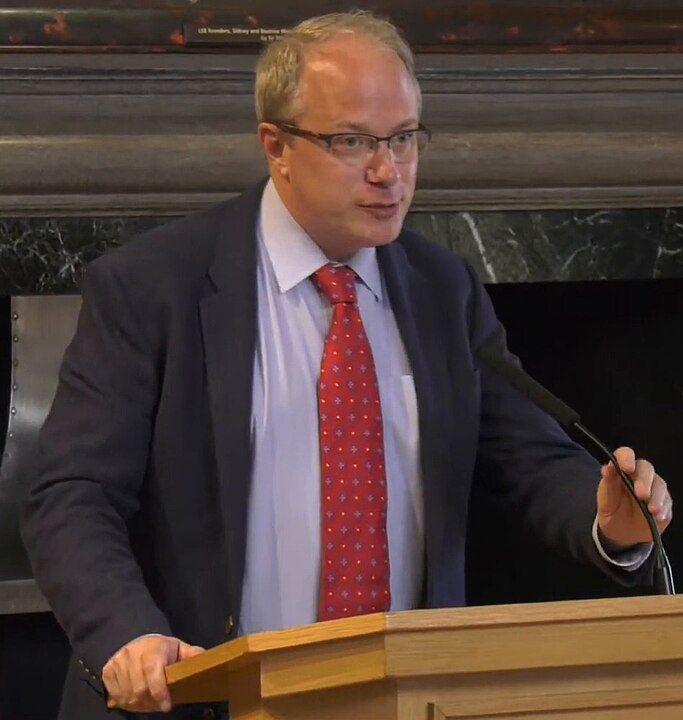
Photo: Adrian Vermeule by LSE Law – https://www.youtube.com/watch?v=6cHJsB8j5yw, CC BY 3.0, https://commons.wikimedia.org/w/index.php?curid=97674503















 Ad-Free & Subscriber Log-In