


Yesterday we discussed the curious development that key figures in the Vatican are urging that the Roman Catholic Church recognize the catholicity of the Augsburg Confession and employ that definitive Lutheran statement of faith to help overcome the divisions with Protestants and thus bring unify to the church.
Today I’d like us to consider the 28 specific articles of the Augsburg Confession to see where the agreements and disagreements lie between Catholics and Lutherans both then and now. I’d also like to consider the extent to which other Protestants then and now agree and disagree with the Augsburg Confession.
When the Lutheran princes and cities presented the Augsburg Confession as a statement of their faith to the Holy Roman Emperor, theologians from Rome were ready to tear it apart. But they didn’t tear it completely apart. Of the 28 articles, Rome approved nine of them, approved six with qualifications, and condemned thirteen.
Those judgments are recorded in the Confutatio Pontificia; that is, the Papal Confutation. Melancthon replied to its criticisms and gave additional support to each article in his Apology to the Augsburg Confession, which would be included in the Book of Concord as another official Lutheran confession.
You can go back and forth between the Confutation and the Apology to see exactly what the agreements and disagreements were. Reasoning that sorting out information from multiple sources is a good use of AI, I generated this breakdown:
Approved Without Qualification (9)
These were judged substantially orthodox and in agreement with Catholic doctrine.
-
Article I — Of God
-
Article III — Of the Son of God
-
Article IX — Of Baptism
-
Article XVI — Of Civil Affairs
-
Article XVII — Of Christ’s Return to Judgment
-
Article XVIII — Of Free Will
-
Article XIX — Of the Cause of Sin
-
Article XX — Of Good Works (though later discussion complicates this )
-
Article XXI — Of the Worship of Saints (again, accepted insofar as it affirmed honoring saints but not [as it rejects] invoking them)
Approved With Qualifications (6)
These were said to be acceptable in part, but required clarification or correction.
-
Article II — Original Sin
-
Article V — The Ministry
-
Article VI — New Obedience
-
Article VIII — What the Church Is
-
Article X — The Lord’s Supper
-
Article XIII — The Use of the Sacraments
Condemned (13)
These were rejected outright, either in doctrine or in application.
6 doctrinal articles from Part I [The “Chief Articles of Faith”]
1. Article IV — Justification
2. Article VII — The Church
3. Article XI — Confession
4. Article XII — Repentance
5. Article XIV — Church Order
6. Article XV — Church Usages
All 7 articles from Part II [The “Abuses Corrected”]
7. Article XXII — Communion in Both Kinds
8. Article XXIII — Marriage of Priests
9. Article XXIV —The Mass
10. Article XXV — Confession
11. Article XXVI — [The Distinction of] Meats
12. Article XXVII— Monastic Vows
13. Article XXVIII — Power of Bishops
I’m not sure this is a completely accurate sorting, since it would seem Article XXI On the Worship of the Saints belongs in the second category, but AI apparently felt constrained to follow the numerical breakdown from Encylopedia.com. But this gives you an idea.
Today’s Catholic Church is now fine with Article XXII Communion in Both Kinds and Article XXVI The Distinction of Meats, since Catholics no longer have to skip meat on Fridays and various Holy Days, though they are supposed to during Lent. They think they have agreement with Lutherans on Article IV Justification, though they don’t really, as I explained yesterday. I think Catholics today, even conservatives ones, are much looser on church order, church usages, and some of these other things than they used to be.
Still, there would be a long way to go before resolving most of these issues. And, frankly, the biggest problem would not be Rome accepting Lutherans, but Lutherans accepting Rome.
What about other Protestants? Melanchthon was forthright when he first wrote the confessions collected in the Book of Concord, but he later became more compromising, to the point of revising the Augsburg Confession into the so-called Variata edition. Most significantly, he toned down what it said about Christ’s presence in the Lord’s Supper to the point that John Calvin and other Reformed folks were able to sign it. (This is why confessional Lutherans make a point of subscribing to the “Unaltered Augsburg Confession,” the UAC inscribed on many old church cornerstones.)
I would think today’s typical evangelicals would have problems mainly with these:
- Article IX. Baptism
- Article X. The Lord’s Supper
- Article XI. Confession
- Article XIII. The Use of the Sacraments
- Article XIV. Order in the Church
- Article XV. Church Ceremonies
- Article XVII. Christ’s Return for Judgment
- Article XXIV (XII). The Mass
I’m thinking that the Augsburg Confession is going to remain the property of confessional Lutherans, though they themselves might be a point of unity by welcoming both Catholics who feel their need for the gospel and the Word of God and Protestants who feel their need for the sacraments, liturgy, and historical Christianity.
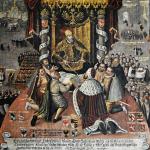
Illustration: Confutatio Augustana and Confessio Augustana (1881) via Picryl, Public Domain, with the caption: “Confutatio Augustana and Confessio Augustana presented to Charles the V in 1530, Catholic and Lutheran sides presenting documents at the Diet of Augsburg.”











 Ad-Free & Subscriber Log-In