

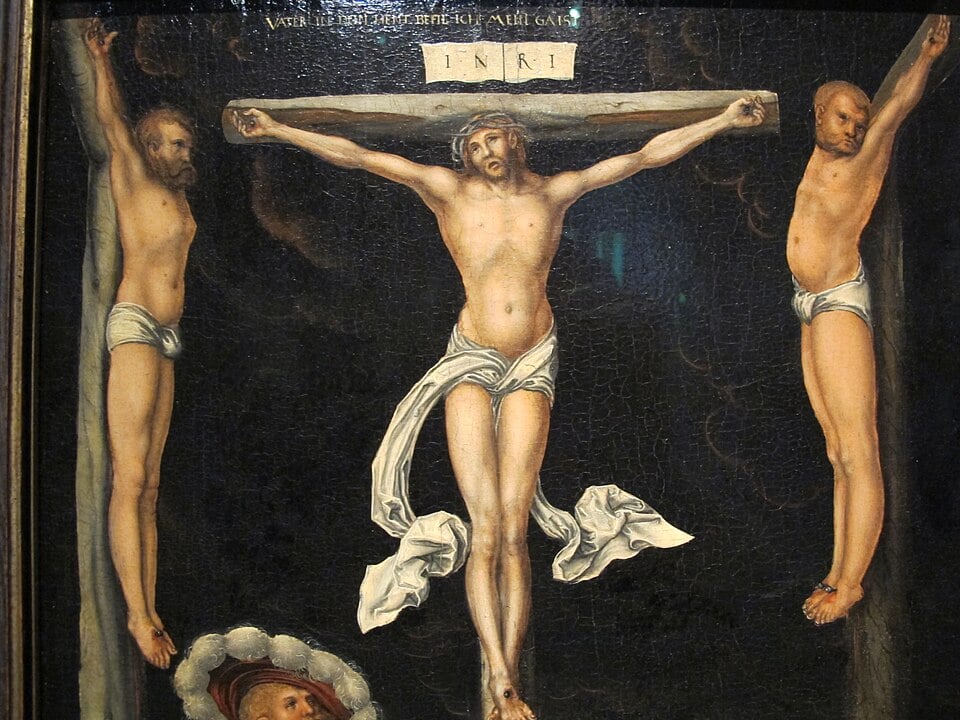
Speaking of evangelicals and their theological beliefs, were you aware that many evangelicals, particularly evangelical theologians, are rejecting the teaching that Jesus Christ bore our sins and died on the cross as our substitute, taking upon Himself the punishment that we deserve? And that God imputes to us Christ’s righteousness when we are united to Him by faith, giving us new life through His resurrection?
This is being condemned as immoral and illogical. Says one British Baptist, “The cross isn’t a form of cosmic child abuse—A vengeful Father punishing his Son for an offense he has not even committed.”
These evangelicals do not want to give up on Christ’s atonement completely. They favor other explanations, such as the cross marking Christ’s victory over sin, death, and the devil. (But how?) Or that in the cross Christ ransomed us from our ownership by the devil. (But why does the devil own us and how is Christ’s death a payment to the devil?)
They are claiming that what they describe as the “penal substitution theory” was unknown to the early church and was invented during the Reformation by John Calvin. Even though Augustine said in his Exposition of Psalm 51, “For even the Lord was subject to death, but not on account of sin: He took upon Him our punishment, and so looses our guilt.” And that the teaching is not Biblical. Despite passages like Isaiah 53:4-6:
Surely he has borne our griefs
and carried our sorrows;
yet we esteemed him stricken,
smitten by God, and afflicted.
But he was pierced for our transgressions;
he was crushed for our iniquities;
upon him was the chastisement that brought us peace,
and with his wounds we are healed.
All we like sheep have gone astray;
we have turned—every one—to his own way;
and the Lord has laid on him
the iniquity of us all.
The claim that the Atonement is “cosmic child abuse” leaves out another important doctrine of Christianity: the deity of Christ. Jesus was not some random person grabbed out of a crowd to be the victim of a human sacrifice. Nor was God’s Son a completely separate being from the Father who is being treated unjustly by his “vengeful Father.” The Son of God is God incarnate. In the cross, God is sacrificing Himself.
And what happens on the cross is not just a legal fiction, though sometimes Reformed explanations might make it seem that way.
He himself bore our sins in his body on the tree, that we might die to sin and live to righteousness. By his wounds you have been healed. (1 Peter 2:24)
For our sake he made him to be sin who knew no sin, so that in him we might become the righteousness of God. (2 Corinthians 5:21)
These are not figures of speech. We need to take this literally. Jesus bore our sins in his body. Jesus was made sin. Furthermore, when by faith we are united with Christ, we are really and actually united with Him, so that we died with Him, were buried with Him, and rose with Him. This happens, we Lutherans believe, by means of the Word, baptism, and Holy Communion, all of which we also take not figuratively but literally. As in:
We were buried therefore with him by baptism into death, in order that, just as Christ was raised from the dead by the glory of the Father, we too might walk in newness of life. (Romans 6:4)
How is this possible? I believe it was J. G. Hamann who said that our salvation through the death of Christ is a greater miracle than the creation of the universe.
Human logic can never fathom God and His works. And to presume to judge God by our human moral standards is to naively anthropomorphize Him. He has anthropomorphized Himself in His incarnation, and we really can’t go beyond that.
I like the way the Wikipedia article on Penal Substitution describes how Luther saw it:
Luther rejected the fundamentally legalistic character of Anselm’s paradigm in terms of an understanding of the Cross in the more personal terms of an actual conflict between the wrath of God at the sinner and the love of God for the same sinner. For Luther this conflict was real, personal, dynamic and not merely forensic or analogical. . . .
Luther perceived the Cross as a new Götterdammerung [a cosmic conflict in Germanic mythology in which the gods die], a dramatic, definitive struggle between the divine attributes of God’s implacable righteousness against the sinful humanity and inscrutable identification with this same helpless humanity which gave birth to a New Creation, whose undeniable reality could only be glimpsed through faith and whose invincible power worked only through love.
One cannot understand the unique character or force of Luther’s and the Lutheran understanding of the Cross apart from this dramatic character which is not readily translated into or expressed through the more rational philosophical categories of dogmatic theology, even when these categories are those of Lutheran Orthodoxy itself.
Liberal theologians, of course, have long rejected Christ’s substitutionary atonement. And, to be fair, so have some Lutheran theologians, usually of the ELCA variety, such as the “radical Lutheran” Gerhard Forde. It’s odd, though, that evangelicals–whose identity is supposedly centered in the evangel, the “good news” of the Gospel–should think this way.
To be sure, many evangelicals and most Calvinist theologians are defending penal substitutionary atonement. Christianity Today has a state-of-the-question article by Brad East entitled The Way We Debate Atonement Is a Mess that critiques both sides.
But for the evangelicals who no longer believe that Jesus paid the penalty for their sins, I wonder, what do they think the gospel is? What do they think the “good news” is in the Gospel they proclaim? What “new” thing happened on the cross?
Illustration: Lucas Cranach, The centurion Longinus among the crosses of Christ and the two thieves, photo by I, Sailko, CC BY-SA 3.0, https://commons.wikimedia.org/w/index.php?curid=15834972











 Ad-Free & Subscriber Log-In