

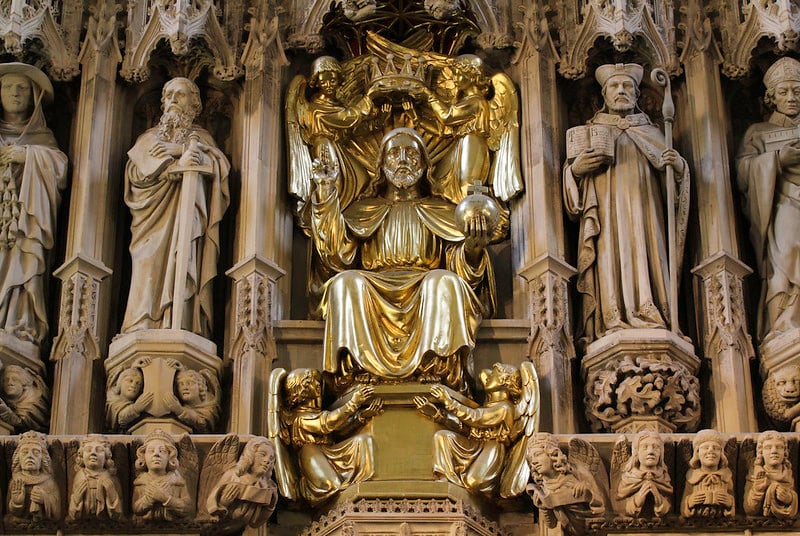
In a world that neither experiences monarchy nor understands it, should we really emphasize the kingship of Jesus? For many, kings are either historical oddities or symbols of oppression. So, wouldn’t it be wiser to foreground other metaphors—Jesus as friend, teacher, forgiver, or liberator?
I don’t think so. In fact, I’d argue the opposite: the more foreign kingship feels to modern ears, the more necessary it becomes to emphasize. The gospel is not merely that Jesus saves but that Jesus reigns. The New Testament does not introduce him as “Savior of the world” but as “Son of David,” “Messiah,” and “Lord.” All of these are royal titles. The gospel begins and ends with the declaration that Jesus is King.
This is not some secondary doctrine that we can shelve for a more convenient time. Rather, it’s the cornerstone of biblical theology, the plotline that threads from Genesis to Revelation. What’s more, it’s precisely the modern disconnection from kingship that makes the proclamation of Jesus’ kingship all the more vital, not less.
Jesus Is Not Just Lord of Your Life—He Is Lord of All
We live in a cultural moment that prizes self-determination and inner authenticity. The self is the sovereign. In this context, the claim “Jesus is King” is not merely foreign; it’s offensive. That’s the point. It confronts the modern person where they are most idolatrous: in their unacknowledged enthronement of the self.
This is why I contend that the kingship of Jesus is not a metaphor we should downplay in our evangelism or theology. It is the very heart of sin to deny Christ’s authority. It is the very shape of redemption to bow the knee. It is not incidental that Paul declares, “If you confess with your mouth that Jesus is Lord and believe in your heart that God raised him from the dead, you will be saved” (Rom. 10:9). That’s not theological ornamentation. That is the gospel.
To reduce the gospel to personal forgiveness or inner peace leaves people in the illusion that they remain in control. But no one can come to Christ while seated on their own throne.
Kingship Is a Foreign Concept—But So Was God
It’s true: kingship doesn’t resonate with modern people. But that’s a problem for modern people, not for theology. If we refuse to teach what Scripture teaches simply because it’s unfamiliar or offensive, we end up creating God in the image of our culture rather than calling our culture to bow before the God who truly is.
And let’s be honest: nearly everything central to biblical faith is alien to the modern mindset— atonement, holiness, covenant, sin, sacrifice, submission. So we don’t solve anything by swapping out one difficult concept for another. Every generation has its idols. The question is whether we will present the gospel in such a way that those idols are named, challenged, and shattered.
Besides, foreign doesn’t mean unintelligible. The ancient world didn’t have a clear concept of “grace,” but Paul didn’t avoid it. The modern world doesn’t grasp shame, yet we preach the cross. The secular West doesn’t think in terms of kings, but Scripture does. That means we have to teach people what kingship means—and more importantly, what it means that Jesus is King.
Kingship Brings Clarity to the Whole Gospel
Recognizing Jesus as King doesn’t just give you a title—it gives you a frame for the whole biblical story. Creation begins with God as sovereign ruler. Humanity is made in his image to extend that rule on earth. Sin is not merely moral misstep—it’s rebellion against his reign.
The Law is his royal charter for a covenant people. The prophets warn of judgment and proclaim a coming King. The Gospels announce the kingdom’s arrival. The cross is the enthronement of Jesus through humiliation, and the resurrection is the vindication of the true King.
The mission of the Church is to announce his rule. The Christian life is one of submission, loyalty, and allegiance. And the end of history is a coronation: every knee bowing, every tongue confessing that Jesus Christ is Lord.
Strip away kingship and the Bible falls apart. Worse, the gospel gets co-opted into self-help or moral improvement. We get Jesus as life coach, therapist, or mascot. But we do not get the Jesus who reigns.
The Missional Value of Kingship
In my years serving the underground church in China and writing on honor and shame, I saw firsthand how deeply the theme of kingship resonates across cultures, even when people don’t use the term. Every society has its systems of power, its authorities and allegiances, rulers, and rebels. They may be political, familial, spiritual, or social—but they’re there. People intuitively understand the struggle between allegiance and autonomy.
In the West, kingship may need to be re-explained, but that doesn’t make it irrelevant. Rather, it becomes an apologetic. It forces the question: Who rules your life? That’s a question we’re terrified to answer.
Preach the King
We live in a world that simultaneously distrusts authority and craves it. People want to be free but feel lost. They reject kingship but chase identity in political parties, ideologies, and online followings. Into this confusion, the gospel speaks a simple but seismic word: Jesus is King.
That is not just the truth we affirm. It is the truth we announce. And until that announcement is heard, we have not truly preached the gospel.















 Ad-Free & Subscriber Log-In