

This post contains the Epistle and Gospel for Hallowmas; go here for intro material and the Lesson.
Preliminary Housekeeping
After I had already finished my translation and commentary on these two texts, I was doing some unrelated backtracking through my own catalogue, and discovered I’d already translated them both before: appropriately enough, for Hallowmas last year. (It was sort of reassuring to see that my translations this year were nearly identical, so apparently I’m not just careening wildly from one take on the Greek to another!) I remain tolerably happy with the commentaries—the ones for I John 3 are here, the ones for Matthew 5 are here—so I just sought to ensure that the comments I made in this post were only on things about which I had something new or different to say this time around.
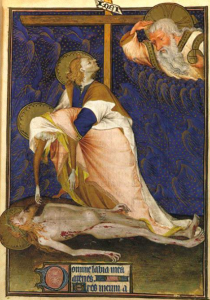
St. John trying to comfort the Virgin after
the Crucifixion (1435), by the Rohan Master.
I John 3:1-3, RSV-CE
See what lovei the Father has given us, that we should be called childrenk of God;j and so we are. The reason why the world does not know us is that it did not knowl him. Beloved, we are God’s children now; it does not yet appear what we shall be, but we know that when he appears we shall be like him, for we shall see him as he is.m And every one who thus hopes in him purifies himself as he is pure.
I John 3:1-3, my translation
Look at the kind of lovei the Father has given us, in order that we might be called—jand are—jchildrenk of God. For this [reason] the world does not know us, that it has not knownl him. Beloved, we are now God’s children, and it is not yet manifest what we will be. We know that, whenever he is manifest, we will be like him, because we will see him just as he is.m And everyone who has this hope on him sanctifies himself, just as he is sanctified.
Textual Notes
i. love | ἀγάπην [agapēn]: Lots of people are aware that Greek has four discrete terms for “love”: στοργή [storgē] or affection, φιλία [filia] or friendship, ἔρως [erōs] or romantic love, and ἀγάπη or unconditional love. But, it’s a little more complex than that, for a couple of reasons. For one thing, these were not absolute distinctions in Greek; depending on context, style, etc., some of these words could be exchanged for one another. St. Ignatius of Antioch in the second century spoke of his ἔρως for Christ, for example. Moreover, φιλέω [fileō], the verbal equivalent of the noun φιλία, was probably the most basic of the four, as it had been a frequent intruder on the senses of the other three verbs (στέργω [stergō], ἐράω [eraō], and ἀγαπάω [agapaō]) for centuries before the New Testament was composed.
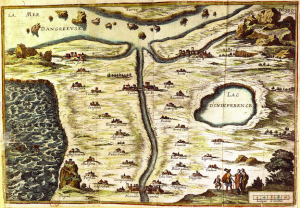
The Carte de Tendre, a “map of love” created by
the seventeenth-century French literary
movement known as the précieuses, similar to
the English movement called the euphuists.
Second, as a result of this partial jumbling, there aren’t any clean translations (or none I could think of) for ἀγάπη and φιλία, with their related complexes of words, that are both duly specific and sufficiently open-ended. “Charity” can do the work of ἀγάπη a little bit, but only among people who know already that “charity” has a technical theological sense that’s quite distinct from its meaning in phrases like “giving to charity.” It also has the disadvantage of having no verbal form, requiring circumlocutions like “to be charitable” (which again has a different meaning that needs to be excluded!).
j. ;/— … — | , [–]: Both the RSV’s semicolon and my pair of em-dashes are attempts to convey something which, in the Greek, is conveyed solely by the syntax, namely the emphasis on “we are” in this sentence.
k. children | τέκνα [tekna]: Notably, St. John does use the word “children” and not “sons” here. (Funnily enough, τέκνα is actually neuter in Greek—many Greek words for small things are, and this pattern is extended to diminutives and endearments.)
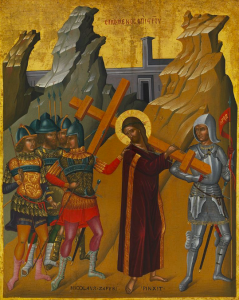
Ikon (ca. 1500) of Christ bearing the Cross,
by iconographer Nikolaos Tzafouris.
l. did not know/has not known | οὐκ ἔγνω [ouk egnō]: Here we run into a difficulty with the Greek verb form known as the aorist (pronounced “air-ist”), which doesn’t have an exact equivalent in English. The aorist is an aspect—a quality verbs have that’s often confused with tense, but is a little different. Think of it like this: take the English sentences I was running and I ran. Both are past tense, but their meanings aren’t exactly the same—in one of them, the action is an ongoing thing (you’re usually expecting more information to follow in the narrative, something like “I was running when yet another tiger leapt out in front of me”), while in the other, the action is being thought of as a coherent, complete thing (for example, it could serve as a full answer to the question “How did you escape from all those tigers?” “I ran”). That difference, between incomplete action versus complete action, is an aspectual difference, and distinctions of aspect are important parts of the structure of both Greek and Latin verbs.
The Greek aorist treats actions as single, coherent things, and is thus a little like the the perfect form of the verb (perfectives generally are discussed in footnote 4 of this post). However, unlike the Greek perfect, and a little more like the English simple past, the aorist does not need to be relevant to present circumstances; it considers acts singly regardless of when they take place. This means that it can and often does function like a simple past, but can have a good number of other uses as well. Here, because it is in fact relevant to the present circumstance of the world’s ignorance of God (and its resulting failure to understand the Church), I’ve translated it much as I would translate a perfect verb, while the RSV’s rendering is more typical of how aorists are rendered in English.
m. for we shall see him as he is/because we will see him just as he is | ὅτι ὀψόμεθα αὐτὸν καθώς ἐστιν [hoti opsometha auton kathōs estin]: I love the arc of the rhetoric of this passage: “we are now … we will be … as he is.” Its theological content—that, when we see God as he is, we shall be what he is, or rather, “we will be like him”—is of course connected with the idea and language of the Beatific Vision. I delved more into the idea that simply seeing God will be, or is, transformative to our very existence in last year’s post on this passage.
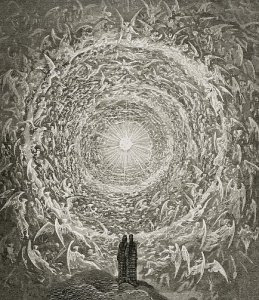
Dante and Beatrice gazing on the blessed in the
form of the Mystic Rose in Canto XXXI of
Paradiso, illustrated (ca. 1867) by Gustave Doré.
I’d also like to highlight its strange similarity to a quite different text of Scripture:
Now the serpent was more subtle than any beast of the field which the LORD God had made. And he said unto the woman, “Yea, hath God said, ‘Ye shall not eat of every tree of the garden’?”
And the woman said unto the serpent, “We may eat of the fruit of the trees of the garden: but of the fruit of the tree which is in the midst of the garden, God hath said, ‘Ye shall not eat of it, neither shall ye touch it, lest ye die.'”
And the serpent said unto the woman, “Ye shall not surely die: for God doth know that in the day ye eat thereof, then your eyes shall be opened, and ye shall be as gods, knowing good and evil.”
—Genesis 3:1-5 (italics mine)
There is something magnificent in the idea of a God who is (if you’ll pardon the metaphor) such a complete master of the material he’s working with that he can fulfill even the devil’s promises—turning what was meant to be a lie into the truth, and so shaming the Father of Lies irrevocably and utterly. It puts me strongly in mind of Tolkien’s creation myth; if you will permit me—
A Digression Into Middle-Earth
The myth is told from a more or less angelic perspective in the Ainulindalë (published in one volume with The Silmarillion). The Ainur are potent spirits, the first creations of Eru Ilúvatar. Their principal gift is music, though at first they sing only one by one or in small groups, while Eru and the rest of the Ainur listen. But eventually, their Creator gathers them to sing a grand chorus, every one together, of his devising; unbeknownst to them at the time, it is by this great Music that the universe is created. But one Ainu, Melkor, begins to diverge from the Music as prepared:1
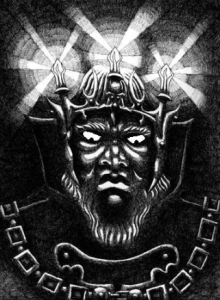
Morgoth1—The Dark Enemy (ca. 2008), by
Wikimedia contributor Outcast, used under
a CC BY-SA 3.0 license (source).
… It came into the heart of Melkor to interweave matters of his own imagining that were not in accord with the theme of Ilúvatar, for he sought therein to increase the power and glory of the part assigned to himself. To Melkor among the Ainur had been given the greatest gifts of power and knowledge, and he had a share in all the gifts of his brethren. He had gone often alone into the void places seeking the Imperishable Flame; for desire grew hot within him to bring into Being things of his own, and it seemed to him that Ilúvatar took no thought for the Void … But being alone he had begun to conceive thoughts of his own unlike those of his brethren.
Some of these thoughts he now wove into his music, and straightway discord arose about him, and many that sang nigh him grew despondent, and their thought was disturbed and their music faltered; but some began to attune their music to his rather than to the thought which they had at first. …
Then Ilúvatar arose, and the Ainur perceived that he smiled; and he lifted up his left hand, and a new theme began amid the storm … and it gathered power and had new beauty. But the discord of Melkor rose in uproar and contended with it … and Melkor had the mastery. Then again Ilúvatar arose, and the Ainur perceived that his face was stern; and he lifted up his right hand, and behold! a third theme grew amid the confusion … at first soft and sweet, a mere rippling of gentle sounds in delicate melodies; but it could not be quenched, and it took to itself power and profundity. And it seemed at last that there were two musics … utterly at variance. The one was deep and wide and beautiful, but slow and blended with an immeasurable sorrow, from which chiefly its beauty came. The other had now achieved a unity of its own; but it was loud, and vain, and endlessly repeated … as of many trumpets braying upon a few notes. And it essayed to drown the other music by the violence of its voice, but it seemed that its most triumphant notes were taken by the other and woven into its own solemn pattern.
In the midst of this strife, whereat the halls of Ilúvatar shook and a tremor ran out into the silences yet unmoved, Ilúvatar arose a third time, and his face was terrible to behold. Then he raised up both his hands, and in one chord, deeper than the Abyss, higher than the Firmament, piercing as the light in the eye of Ilúvatar, the Music ceased.
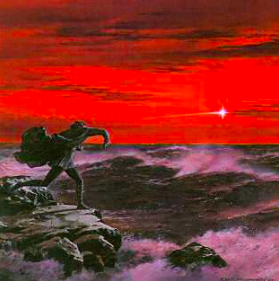
Maglor Casts a Silmaril Into the Sea (1997),
by Ted Nasmith. Image provided for
under fair use.2
Then Ilúvatar spoke, and he said: “Mighty are the Ainur, and mightiest among them is Melkor; but that he may know, and all the Ainur, that I am Ilúvatar, those things that ye have sung, I will show them forth, that ye may see what ye have done. And thou, Melkor, shalt see that no theme may be played that hath not its uttermost source in me, nor can any alter the music in my despite. For he that attempteth this shall prove but mine instrument in the devising of things more wonderful, which he himself hath not imagined.”
—J. R. R. and Christopher Tolkien, The Silmarillion, pp. 4-53
As mentioned above, the bulk of my commentary on this passage is here.
Matthew 5:1-12a, 12b, RSV-CE
Seeing the crowds, he went up on the mountain, and when he sat down his disciples came to him. And he opened his mouth and taught them, saying:
“Blessed are the poor in spirit, for theirs is the kingdom of heaven.
“Blessed are those who mourn, for they shall be comforted.
“Blessed are the meek, for they shall inherit the earth.
“Blessed are those who hunger and thirst for righteousness, for they shall be satisfied.
“Blessed are the merciful, for they shall obtain mercy.
“Blessed are the pure in heart, for they shall see God.
“Blessed are the peacemakers, for they shall be called sons of God.
“Blessed are those who are persecutedn for righteousness’ sake, for theirs is the kingdom of heaven.
“Blessed are you when men revile you and persecute you and utter all kinds of evil against you falsely on my account. Rejoice and be glad, for your rewardo is great in heaven, for so men persecuted the prophets who were before you.”
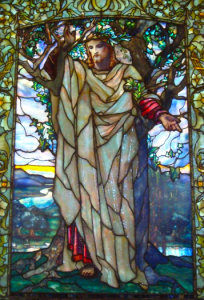
The Sermon on the Mount (ca. 1900-1930),
stained glass window by Louis Comfort
Tiffany. Photo by John Stephen Dwyer, used
under a CC BY-SA 3.0 license (source).
Matthew 5:1-12a, 12b, my translation
Looking at the crowds, he went up onto a mountain; and when he sat himself down, his students came to him; and opening his mouth, he taught them, saying:
“Blessed are the beggars in spirit, because theirs is the kingship of the heavens.
“Blessed are the mourners, because they will be encouraged.
“Blessed are the gentle, because they will inherit the land.
“Blessed are those hungry and thirsty for righteousness, because they will be stuffed.
“Blessed are the compassionate, because they will receive compassion.
“Blessed are the clean in heart, because they will see God.
“Blessed are the peacemakers, because they will be called sons of God.
“Blessed are those who are chased downn on account of righteousness, because theirs is the kingship of the heavens.
“Blessed are you whenever they disgrace you or chase you down or say every oppressive thing about you—liars—on my account. Rejoice and jump for joy, because your wageso in the heavens are much; for in this way they chased down the prophets who were before you.”
n. persecuted/chased down | οἱ δεδιωγμένοι [hoi dediōgmenoi]: The word usually rendered “to persecute” in our Bibles is more exactly “to pursue, chase, hunt”; occasionally it is translated more literally, as in I Peter 3:11, if only because “seek peace and persecute it” would be very confusing!
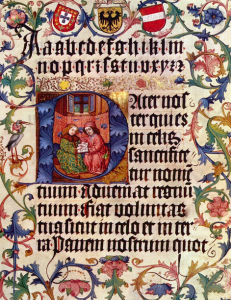
An illuminated page (ca. 1500) with an abece-
darium4 and the Our Father, created by the
Master of Textbooks of Holy Roman Emperor
Maximilian I.
o. reward/wages | ὁ μισθὸς [ho misthos]: Interestingly, this is described using a term associated not with gifts, but with payment—the kind an employer owes an employee. This and related words and ideas recur frequently throughout the New Testament. Of course, to speak of God owing anything to any creature is a little nonsensical! This is why I take this to be touching on the topic of merit—a point of doctrine not well or widely understood by most people. Here’s what the Catechism has to say on the subject:
The term “merit” refers in general to the recompense owed by a community or a society for the action of one of its members … With regard to God, there is no strict right to any merit on the part of man. Between God and us there is an immeasurable inequality, for we have received everything from him, our Creator.
The merit of man before God in the Christian life arises from the fact that God has freely chosen to associate man with the work of his grace. The fatherly action of God is first on his own initiative, and then follows man’s free acting through his collaboration, so that the merit of good works is to be attributed in the first place to the grace of God, then to the faithful. … The merits of our good works are gifts of the divine goodness.
… No one can merit the initial grace of forgiveness and justification, at the beginning of conversion. Moved by the Holy Spirit and by charity, we can then merit for ourselves and for others the graces needed for our sanctification, for the increase of grace and charity, and for the attainment of eternal life. Even temporal goods like health and friendship can be merited in accordance with God’s wisdom. These graces and goods are the object of Christian prayer. The charity of Christ is the source in us of all our merits before God.5
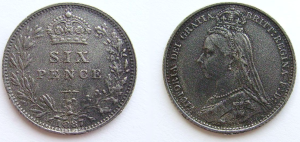
The reverse and obverse of a silver sixpence,
minted in 1887 under Queen Victoria.
Or more succinctly, as C. S. Lewis put it in Mere Christianity,
It is like a small child going to its father and saying “Daddy, give me sixpence to buy you a birthday present.” Of course the father does and he is pleased with the child’s present. It is all very nice and proper, but only an idiot would think that the father is sixpence to the good on the transaction.
Footnotes
1The italicized names and terms here, for any who are interested, are mostly in Quenya, or high-Elven; they have the following meanings (with pronunciations in brackets, according to the system detailed at this link):
• Ainulindalë [ī-nû-lēn-dä-lĕ]: “song of holy ones,” or (conventionally) “the Music of the Ainur.”
• Ainur (sg. Ainu) [ī-nûṛ, ī-nû]: “holy ones,” angel-like beings in Tolkien’s legendarium. Some of the Ainur later became the Valar [vä-läṛ] and Maiar [mī-äṛ], or “the Powers” and “the Admirable Ones,” spirits which descended into creation to help shape, cultivate, and govern the world. A few characters in The Lord of the Rings—notably Gandalf, Saruman, and Sauron—were, in origin, Maiar.
• Eru [êṛ-û]: “the One,” i.e. God.
• Ilúvatar [ē-lû-vä-täṛ]: “the All-father,” “the maker of all,” a title often paired with the term Eru or used in its place.
• Melkor [mĕł-kõṛ] (though, given Tolkien’s ultimate preference of c to k, it ought more properly to be written Melcor): “He who ariseth in might,” the greatest of the Ainur, who went on to become a Satanic figure of rebellion against Eru Ilúvatar; during the First Age, which occupies the bulk of The Silmarillion, Melkor—known later as Morgoth—was Sauron’s master.
• Morgoth [mõṛ-gõth]: “the Black Foe,” i.e. Melkor after his complete and irrevocable forsaking of goodness. This title is in Sindarin, the Elvish vernacular at the time of The Lord of the Rings; the Quenya form would be Moringotto [mõ-ṛēŋ-gõt-õ]
• Silmarillion: a clipping of I Quenta Silmarillion [ē kwĕn-tä sēł-mä-ṛē-lē-øn], “the tale of the silmarilli” [sēł-mä-ṛē-lē] or holy jewels; see footnote 2 below for more information on them. The literal meaning of silmaril [sēł-mä-ṛēł] is “radiance of pure light,” but the word was used as a proper name, partly because only three silmarilli were ever forged.
2The silmarilli—the holy jewels for which The Silmarillion is named—contained the light of the Two Trees. These were sung into existence and consecrated by the Valar, to illuminate the Blessed Realm where they dwelt. However, Melkor later mortally wounded the Two Trees; the sun and moon are the only last relicts of the Trees that the Valar were able to salvage before they died. Thereafter, the unsullied light of the Trees existed in the silmarils alone. The preciousness and sanctity of these jewels was therefore second to almost nothing in the universe.
3The typical interpretation of the Ainulindalë is that the “second theme” represents those Ainur who fought against Melkor’s influence in creation, while the third theme (the one “blended with an immeasurable sorrow”) represents the “Children of Ilúvatar,” i.e. Elves and Men.
4Quite a weird abecedarium, by the way! It has an alphabet apparently of twenty-nine characters (not counting the capital at the beginning), despite lacking both j and w (though it does distinguish u from v). One of the extra characters is ∫, or “long s“: the small form of s, which we now use exclusively, was at this time standard only at the end of words. More puzzling are what appear to be two distinct versions of both lower-case a and lower-case z; and most baffling of all is the letter, which looks like a dotted i, between r and ∫—I really don’t know what that one is. (Maybe an early experiment with j? but if so, I don’t know why it’s been moved to such a random spot.)
5Catechism of the Catholic Church, §§2006-2011, italics original.











 Ad-Free & Subscriber Log-In