

Table of Contents
i. A Fore-Foreword
ii. A Regular Foreword and Table of Contents
I. Bibliography and Additional Reading
II. Who, When, and Where: The Composition of John
…1. The Traditional View
…2. Scholarly Views
…3. My Theory
III. What: The Material of John
…1. The Wise Man and the Scribe: Influences on John
…….a. The Torah
…….b. Judaic Wisdom Literature
…….c. Hellenistic Judaism and Greek Philosophy
…2. What It Says on the Tin: John’s Relation to the Synoptics
…….a. Material Common to John and the Synoptics
…….b. Material Unique to John
…3. Now With 20% Less Agreement: Material Omitted by John
IV. Why and How: The Style and Aims of John
…1. John’s Purpose
…2. John’s Method
…….a. Recurring Motifs
……….א. Light
……….ב. Water
……….ג. Numerology: Heptads
……….ד. Numerology: Triads
……….ה. The Second Temple Judaic Liturgy
…….b. Thematic Aspects
……….א. A Clash of Æons
……….ב. Judge, That Ye Be Judged
V. An Index/Outline of the Gospel of John
iii. Postscript
This post contains most of the rest of my introduction to John, §§III-IV; I wound up splitting it again, because the post was just gargantuan (why do I never foresee this?). To read §§i-II, go here; to read the Index/Outline, go here.
III. What: The Material of John
I won’t get into the nitty-gritty here—statistical frequencies of such-and-such a word, things like that—but I’d like to sketch some of the literary context and prominent features of the book.
1. The Wise Man and the Scribe: Influences on John
a. The Torah
Whoever he was, the author surely regarded himself as a practicing Jew, so it does feel a little silly to say he was “influenced by the Torah”! I am saying it anyway, though—partly to correct a false impression I think people sometimes have about the Gospel of John—that it’s “for the world,” or “less Jewish,” or “less Judaic,”1 than the others. The only thing to be said about this is that it is not true. Matthew is perhaps an equally Jewish Gospel, but not more.
This may not be immediately obvious. It does not wade into debates over the mitzvot in quite the same way the other Gospels do. However, one thing it does is evoke key narrative portions of the Torah. If we tend to miss this, we have only ourselves to thank for not bothering to read the Torah more thoroughly and attentively.2 John makes several references to the creation mythos of Genesis, and alludes often to the post-Red Sea part of Exodus and Numbers—the construction of the Tabernacle and the forty years’ pilgrimage of the Israelites with it in the Desert of Zin.
This is more than a motif. It makes a case that Jesus of Nazareth is the “prophet like unto Moses,” which implicitly suggests that he is in a position to mediate a new covenant with Israel. Yet it is more even than that. The prologue of John (1:1-18), by calling Jesus the Λόγος [Logos] of God, suggests that he is not only the mediator of a new covenant, but the maker of a new cosmos; for God creates everything with no more than words in Genesis.
b. Judaic Wisdom Literature
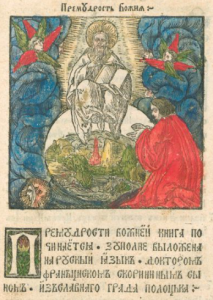
Woodblock print (1518) made for a Belarusian
edition of the Wisdom of Solomon,
by Francysk Skaryna.
Largely thanks to the importance of the Torah, the scribal class—for they were a social class in antiquity, albeit a small one—were especially prominent in Jewish society (which would have been a point of contact between their culture and Rome’s3). Reading, questioning, speculating, arguing, and commentating were (and remain) central habits and preoccupations of Jewish culture, and the Jews were prolific in the Near Eastern genre of wisdom literature. This genre’s roots lie in the Bronze Age; the genre is exemplified outside the Bible by works like the Babylonian Dialogue Between a Man and His God (a.k.a. “the Babylonian ‘Job'”) or the Egyptian Maxims of Ptah-hotep. Usual topics include the problem of unjust suffering, the inevitability of death, the crucial importance of conducting oneself with virtue (especially for kings), and, in Judaic wisdom books, the folly of worshiping idols.
Of the corpus of ancient Judaic wisdom literature, the Judaic and Protestant canons contain Psalms,4 Proverbs, Job, the Song of Songs, Lamentations, and Ecclesiastes; to these, the Catholic and Orthodox Churches add two substantial books of the same genre: Sirach, occasionally known by its old Latin title, Ecclesiasticus; and the Wisdom of Solomon. The former was written in the early second century BC (originally in Hebrew, though most extant copies are in Greek), while the latter was probably composed around the end of the first century BC (in Greek).
There are heavy parallels between Jesus’ discourses in John and the various wisdom books, especially the Wisdom of Solomon. Its nineteen chapters open as a pæan to divine wisdom personified as a woman, perhaps because σοφία [sofia], “wisdom,” is feminine, or perhaps because personified wisdom was already a woman in Proverbs It then transitions (around ch. 10) to a review of redemptive history, with a special focus on the deliverance of Israel from Egypt. The book has many purple passages addressed to, or describing, the Lady Wisdom—not a few of which sound reminiscent of various passages in the Gospels and epistles. For example:
… it is he [God] that leadeth unto wisdom,
…..and directeth the wise.
For in his hand are both we and our words:
…..all wisdom also and knowledge of workmanship …
For wisdom, which is the worker of all things, taught me:
…..for in her is an understanding spirit …
For she is the breath of the power of God,
…..and a pure influence flowing from the glory of the Almighty:
…..therefore can no undefiled thing fall into her.
For she is the brightness of the everlasting light:
…..the unspotted mirror of the power of God, and the Image of his goodness.
And being but one she can do all things:
…..and remaining in herself, she maketh all things new …
—Wisdom 7:15-16, 22, 25-27
Le “Pater Noster” [The “Our Father”] (ca.
1890) by James Tissot.
Moreover, wisdom is specifically contrasted not with foolishness (as is frequent in Proverbs), but with death:
For God created man to be immortal,
…..and made him to be an image of his own eternity.
Nevertheless through envy of the devil came death into the world:
…..and they that do hold of his side do find it.
But the souls of the righteous are in the hand of God,
…..and there shall no torment touch them …
For though they be punished in the sight of men:
…..yet is their hope full of immortality.
And having been a little chastised, they shall be greatly rewarded:
…..for God proved them, and found them worthy for himself …
And in the time of their visitation, they shall shine
…..and run to and fro, like sparks among the stubble.
They shall judge the nations,
…..and have dominion over the people,
…..and their Lord shall reign for ever.
They that put their trust in him, shall understand the truth:
…..and such as be faithful in love, shall abide with him:
for grace and mercy is to his saints,
…..and he hath care for his elect.
—Wisdom 2:23-3:1, 4-5, 7-9
Both the early chapters of the Torah and this personification of divine wisdom connect with a third, less certain, source of influence upon John.
c. Hellenistic Judaism and Greek Philosophy
That less-certain influence is Greek philosophy, which enters the conversation because of John’s famous prologue: “In the beginning was the λόγος, and the λόγος was with God, and the λόγος was God.” Usually translated “word” (though that doesn’t convey its meaning particularly well), this was a common concept in ancient academia; it played slightly different roles in different schools of thought, a little like dharma in Indic philosophical and religious discourse.5 Λόγος went as far back as the pre-Socratics of the seventh and sixth centuries BC in Ionia. The Ephesian Heraclitus often refers to “the λόγος” in surviving quotes and fragments attributed to him: in these, it seems to mean a universal order or law or structure, one inherent in all things. The term was later picked up especially by the Stoics. For them, the λόγος σπερματικός [logos spermatikos], or “fertilizing idea,” was the divine organizing principle of creation.
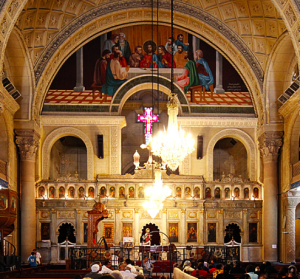
St. Mark’s Coptic Orthodox Cathedral in
Alexandria, Egypt. Photo by Roland Unger,
used via a CC BY-SA 3.0 license (source).
Now, the author of the Fourth Gospel surely saw himself as a practicing Jew; and in the first century, most Jews tended to consider Hellenistic philosophy a licit interest, but also a bit of a waste of time. Whether John’s author ever read any philosophy is therefore an open question. I don’t think there’s any definite evidence that he did. But there is an alternate source he might have gotten his use of λόγος from. He would have had more cause to read this author, as he was a pious Jew; it so happened that this specific Jewish writer was nonetheless steeped in Greek philosophy. His name was Philo of Alexandria.
Though we don’t have exact dates for him, Philo’s career occurred not long before, and may have overlapped with, the public ministry of Jesus.6 He was a rarity; very few Jews were public intellectuals in the Græco-Roman tradition. He takes the Septuagint as his first authority, so his thought does not line up neatly with any single philosophic school; he draws freely from Pythagoras, Middle Platonism, the Stoics, and so on, creating an expression of Judaism that was fully orthodox yet articulated in Hellenistic terms. In particular, he speaks of the λόγος in similar terms to those used about the figure of divine wisdom in Proverbs, Sirach, and the Wisdom of Solomon. The result can be—well, have a look:
These men, putting forward ten thousand principles and causes for the creation of the universe, every one of which is false, display a perfect ignorance of the one Creator and Father of all things; but they who have real knowledge, are properly addressed as the sons of the one God, as Moses also entitles them, where he says, “Ye are the sons of the Lord God.” … And even if there be not as yet any one who is worthy to be called a son of God, nevertheless let him labor earnestly to be adorned according to his first-born Word, the eldest of his angels, as the great archangel of many names; for he is called, the authority, and the name of God, and the Word, and man according to God’s image, and he who sees Israel. … For even if we are not yet suitable to be called the sons of God, still we may deserve to be called the children of his eternal image, of his most sacred Word; for the image of God is his most ancient Word.
—Philo of Alexandria, On the Confusion of Tongues, ch. 28
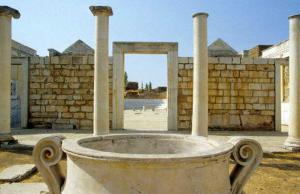
Remains of a 3rd-century synagogue from Sardis
(modern Sart, Turkey). Photo taken in 2000
by Klaus Peter Simon, used via
a CC BY-SA 3.0 license (source).
Most Jews—understandably in my opinion—developed a certain distaste for Græco-Romanity after that whole “razing the Temple and forbidding Jews to even enter Jerusalem except on Tisha b’Av” thing; Philo has never been very popular or influential among them as a result. But it is also easy to see why, although Jewish scribes rarely bothered to copy Philo’s work, Christian scribes took a keen interest in it. It’s quite possible that one such Christian was the author of John, and that he derived his use of λόγος chiefly or solely from Philo.
2. What It Says on the Tin: John’s Relation to the Synoptics
John is contrasted with the Synoptic Gospels, Matthew, Mark, and Luke; these are so named from συνοπτικός [sünoptikos], which means “seeing together, seeing all at once.” So John does not “see together with” the other three, but about what?
a. Material Common to John and the Synoptics
First, it’s worth highlighting elements (other than the Passion and Resurrection themselves) that John included in his narrative, even though the Synoptics had already covered them:
-
-
- John the Baptist’s ministry, including his baptism of Jesus (ch. 1).
- Jesus renaming Peter (ch. 1).
- Tension between Jesus and other Pharisees, notably over the Sabbath (chs. 2-11).
- Jesus feeding the five thousand (ch. 6).
- Jesus walking on water (ch. 6).
- Mary of Bethany anointing Jesus before his Passion (ch. 12).
- The Triumphal Entry (ch. 12).
- Jesus cleansing the Temple (ch. 2).
- Judas’s treachery (chs. 12, 18).
- Trials before both members of the Sanhedrin and Pontius Pilate (chs. 18-19).
- Peter’s apostasy (ch. 18).
- Joseph of Arimathea’s role in Jesus’ burial (ch. 19).
- Mary Magdalene being the first to see the tomb empty, and her role as “apostle to the Apostles” (ch. 20).
-
There are also some traits John shares with Matthew and Luke. First, it seems to align with Matthew’s conception of a New Covenant: Jesus’ “new commandment” suggests a new Torah. The Upper Room Discourse (13:31-17:26), though its timing is disputed, is clearly meant at least to evoke the final Passover he and the Apostles shared: readers of any Synoptic Gospel would therefore associate his “new commandment” with the “new covenant in my blood.”
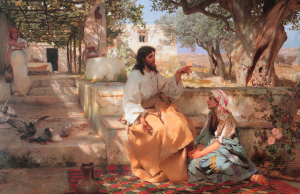
Christ in the House of Martha and Mary (1886),
by Henryk Siemiradzki.
Meanwhile, John and Luke share two conspicuous interests. One is the family group of Martha, Mary, and Lazarus of Bethany (familiar to us chiefly from Luke 11 and John 11); the other is the Mother of God. Matthew and Mark omit the former altogether, and John gives us a likely reason why in 12:10: early on, the life of Lazarus at least was in danger; the family had been known supporters of the infant Jesus movement, and lived in Bethany, a mere two miles from Jerusalem. But Luke mentions that more than one Gospel preceded his, and John (as discussed in the previous installment) was likely the last written of the four canonical ones: it seems credible that by the time these two books were penned, the family had moved or died naturally, and writing about them wouldn’t draw any dangerous attention.
As regards the Mother of God, Matthew and Mark both mention her but say little about her. Luke is generally seen as the most Marian Gospel, giving us the only direct account of the Annunciation and the fullest account of Christ’s birth and infancy. John contains no nativity account, though I suspect 7:41-42 of being included as a nod to it; John has only the statement that “the Word was made flesh and dwelt among us,” without specifics of time or place (or even manner, save that it was “of God” and not “the will of the flesh or the will of a man”). Nevertheless, it also gives us the next-most Biblical Mariology: the Theotokos bookends Jesus’ public ministry, appearing when it opens at Cana and at its close on Calvary.
b. Material Unique to John
By contrast, it is from John alone that we learn the following.
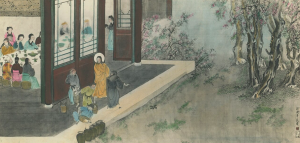
Painting of the wedding at Cana (1937)
by Xu Jihua.
-
-
- St. John the Baptist was examined by a delegation from the Sanhedrin about his identity and doctrine (ch. 1).
- Some of the Apostles had already been disciples of St. John the Baptist (ch. 1).
- Accounts of three miracles: the transmutation of water into wine, the healing of the man born blind, and the raising of Lazarus from the dead (chs. 2, 9, 11).
- The story of Nicodemus (chs. 3, 7, 19).
- The formal homilies of Jesus, lectures delivered at the Temple or in synagogues, in a style quite different from the style he employs in the countryside (chs. 3, 5, 6, 7-8, 9-10, 13-17).
- Jesus—or more precisely, the Apostles—also practiced baptism, not only after but during the time the Baptist’s ministry was in full swing (chs. 3-4).
- Jesus visited the Temple frequently for holy days, not only the big pilgrimage feasts (Pesach, Shavuot, and Sukkot), but even minor ones like Chanukkah7 (chs. 2, 5, 7, 10, 12).
- Although he doesn’t mince words about which side is theologically correct in the Zion-Gerizim dispute, Jesus had a positive reception with at least some Samaritans (ch. 4).
- Jesus explicitly used the divine Name (εἰμί [eimi], “I am” in Greek) to speak of himself, more than once (chs. 6, 8, 18).
- It was specifically Judas who made (or started) the complaint against Mary of Bethany for “wasting” oil of nard to anoint Jesus before the Passion, and he was not only the group’s treasurer but a habitual thief (ch. 12).
- Genuine faith can be based upon miracles (chs. 2, 4, 10, 11, 13, 14, 20)—John does include counterexamples, a theme far more familiar from the Synoptics, but only John spends any substantial word-count proposing belief based on miracles.
- The Apostles were given a special charism of the Holy Ghost, in a distinct event from the outpouring at Pentecost, for the ministry of forgiving sins (ch. 20).
- Of the Twelve, it was specifically Thomas (as distinct from Matthew‘s more polite “some”) who doubted the Resurrection (ch. 20).
- Peter was quasi-ceremonially reinstated as “the Rock” after the Resurrection: i.e., this was not merely a “general amnesty,” but a specific rededication of him to his office, amending his apostasy (ch. 21).
-
3. Now With 20% Less Agreement: Material Omitted by John
What about the flip-side of uniquely Johannine content, stuff that only John doesn’t have? Overt miracles are surprisingly few: counting the Resurrection itself and the miraculous catch of fish in the final chapter, a mere nine appear in the book,8 and whole categories are completely left out. Below is a list of many events, motifs, and characters which are recorded by all the other evangelists, yet conspicuous by their near or total absence in John, with references to where they can be found in the Synoptics.
-
- Christ’s temptation in the desert (Matt. 3, Mark 1, Luke 4).
- Parables, of the Synoptic type at least (there are analogies), along with almost any suggestion of the open-air talks given before huge audiences (e.g. Matt. 13, Mark 4, Luke 8).
- Any cleansing, or even mention, of leprosy (e.g. Matt. 8, Mark 1, Luke 5).
- Exorcisms: there are discussions of the devil in plenty, but the nearest we come to an exorcism is 12:31 (e.g. Matt. 4, Mark 1, Luke 8).
- Absolutions—with the arguable exception of 21:15-17 (e.g. Matt. 9, Mark 2, Luke 5).
- The “messianic secret” (e.g. Matt. 16, Mark 1, Luke 8).
- Any list of the Twelve, and four of the Twelve—both Jameses, the other Simon, and Matthew (Matt. 10, Mark 3, Luke 6).
- The mission of the Twelve (Matt. 10, Mark 6, Luke 9).
- Jesus’s rejection in Nazareth—though we come close in 1:11 and 7:3-5 (Matt. 13, Mark 6, Luke 4).
- Almost all mention of money, tax collectors, or the wealthy (e.g. Matt. 6, Mark 10, Luke 6).
- Any mention of the Herod family (e.g. Matt. 2, Mark 6, Luke 13).
- The imprisonment and fate of John the Baptist (Matt. 14, Mark 6, Luke 9).
- Peter’s confession at Cæsarea Philippi (Matt. 16, Mark 8, Luke 9).
- The Transfiguration (Matt. 17, Mark 9, Luke 9).
- The Olivet Discourse (Matt. 24-25, Mark 13, Luke 21).
- The institution of the Eucharist (Matt. 26, Mark 14, Luke 22).
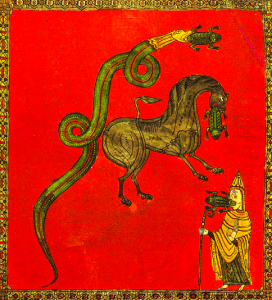
Illumination of the Dragon, the Beast, and the
False Prophet (1086) from the Cathedral of
Osma’s copy of the Commentary on the
Apocalypse by Beatus of Liébana.
Some of these, though inexplicit, are hinted at. For instance, we don’t hear what happened to John the Baptist; we hear only from his lips that “He must increase and I must decrease,” and from those of Jesus that “You were willing to rejoice in his light for a time.” Or again, some of the above “almosts” are not absolute because there is a single passing exception, like Judas’s ugly three-hundred-denarii remark and its explanation in the next verse, which I believe form literally the only mention of money in the entire Gospel.
More often, these pericopes are present in an allusive, thematic sense (in some cases, distributed widely across the book). The Last Supper springs to mind when reading or hearing the “bread of life” discourse, for example, which has a distinct effect from directly recounting the Last Supper. Similarly, the radiance of the Transfiguration arguably suffuses John from start to finish, replete as it is with imagery of light and divine sonship; but its presence is thus woven into the whole text—without seam from the top throughout—and the author clearly chose in favor of that distinctive effect.
IV. Why and How: The Style and Aims of John
1. John’s Purpose
I’ve just said “Why and How” and “The Style and Aims”; however, it does bear saying that intent is always difficult to discern, and we often do things for multiple reasons. There probably were other reasons the author of John composed it, but he does give us one aim explicitly:
Many other signs truly did Jesus in the presence of his disciples, which are not written in this book: but these are written, that ye might believe that Jesus is the Christ, the Son of God; and that believing ye might have life through his name.
—John 20:30-31
One particular element of John’s style especially drives this purpose home; we will be circling back around to it as we conclude §IV.2 below. (Incidentally, it is very appropriate that describing John’s style and structure even in outline is somewhat recursive—one of the qualities that convinces me personally that Revelation shares an author with John.)
2. John’s Method
Stylistically, the Fourth Gospel is a strange book. I did an independent study of it for my last Greek course in college; its prose is elegant, yet with an elegance that’s oddly un-Greek in a way that isn’t easy to articulate. The only comparison I can think of is that if you’ve heard a person speak English with a Nigerian accent, which has purer vowels than we’re used to hearing in so-called “neutral” accents, it’s a tiny bit like that. But let’s talk specifics.
a. Recurring Motifs
א. Light
Light is, arguably, the most important symbol in the Gospel. Greek is nicely suited to conveying this, as it has lots of words related to φῶς [fōs], “light.” These include more intuitive ones like φαίνω [fainō] (“to shed light on, show; to appear”), but also a few curveballs. Φωνή [fōnē], a word related to φῶς which also gets a lot of mileage, is a good example: it means “sound, noise; voice, cry.”
A recreation of the Menorah, crafted by
the Temple Institute.
We should also bear in mind that in antiquity, time was told primarily by the sun and stars rather than by clock. This means light and time were, in a sense, the same thing back then. So, when we find occasional time specifications in John (like 4:6 and 19:149), they may have a symbolic weight similar to an allusion to light.
It may here be worth preventing—what shall I call this … a possible error of imagination, let’s say. We’ve all grown up accustomed to a range of light sources, many of them artificial, which often means colorless or faintly blue-tinted fluorescence. Moreover, insofar as we’re influenced by sci-fi and sci-fantasy, “futuristic light” often leans toward the blue end of the spectrum, like Luke Skywalker’s light saber (contrasted with the unvarying red of the Sith). The image of light-as-a-symbol in our minds may therefore be of something cool, even clinical. But in the first century, light probably didn’t have these associations. All light was natural. Illumination in a given setting might be man-made, in the sense that olive oil lamps are not naturally-occurring objects, but the light they give off is after all firelight, which (like the sun) is yellow-tinted and not bluish. Light in the New Testament is a warm symbol, not a cool one.
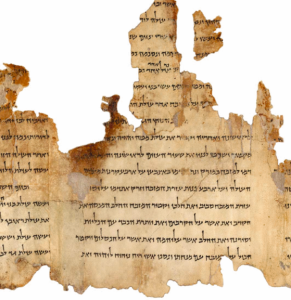
The opposite symbol, darkness, also recurs from time to time in this Gospel. This is commonplace in apocalyptic and related literature; one of the famous Dead Sea Scrolls is titled The War of the Sons of Light Against the Sons of Darkness. There are three portions of John that take place at night (even though that is “when no one can work”): I found them striking enough to note them in my outline down in §V.
ב. Water
A silver cup designed for נְטִילַת יָדַיִם [n’ṭylàth
yâdhàyim], Judaic ritual hand-washing. Photo
courtesy of the Hadad Brothers silversmiths,
used via a CC BY-SA 2.5 license (source).
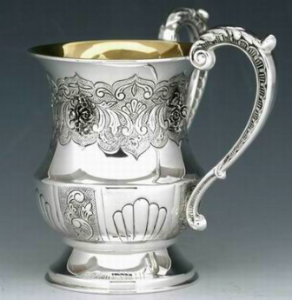
Water will probably be a major symbol in the literature of any culture native to an arid region. Not only is it necessary to all living things, rendering it a natural symbol of life; water is also the easiest and fastest way to get oneself and one’s belongings clean. That will be a major concern in dry climates—we don’t always appreciate the destructive powers of dirt, but mere sand in the wind has worn down stuff like the Pyramids—not to mention, in societies that live in close contact with animals you can’t house-train.
ג. Numerology: Heptads
Between this interest and the fact that the Beloved Disciple was “known to the high priest,” I strongly suspect that somebody in the bar-Zebedee family had been an elder on the Sanhedrin, or trained as a scribe, or something of that nature. Judaic intellectual and religious discourse in this period delighted in numerology, especially gematria (which makes a cameo in Revelation, though not the Fourth Gospel). Certain sacred numbers emerge repeatedly throughout this text; for simplicity’s sake, I’m only highlighting two of them.
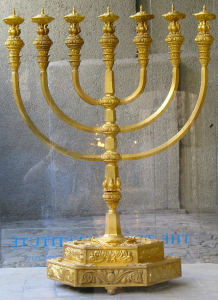
The first is seven. Seven often symbolizes perfection, a meaning suggested by the days of creation. It can also signify the divine presence, as in the branches of the Menorah and the angels said to stand in the presence of God (the former presumably symbolizes the latter). Some Johannine heptads are listed below.
-
-
-
- Faithful Apostles:
i. Andrew; ii. the Beloved Disciple; iii. Peter; iv. Philip; v. Nathanael; vi. Thomas; and vii. Jude. - Alternatively, named Apostles:
i. Andrew; ii. Peter; iii. Philip; iv. Nathanael; v. Thomas; vi. Judas; and vii. Jude. - “I am the ___” sayings:
i. living bread (ch. 6); ii. light of the world (ch. 9); iii. door of the sheep (ch. 10); iv. good shepherd (ch. 10); v. resurrection and the life (ch. 11); vi. way, the truth, and the life (ch. 14); and vii. true vine (ch. 15). - Possibly, cities Jesus visits:
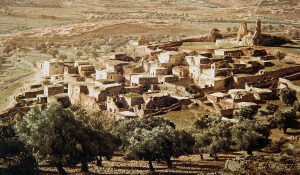
i. Bethany;11 ii. Cana; iii. Jerusalem; iv. Ænon-by-Salim; v. Sychar; vi. Capernaum; and vii. Ephraim. - Possibly, festivals noted over the course of John:
i. a first Pesach [Passover] (ch. 2); ii. one Purim? (ch. 4); iii. one Shavuot? (ch. 5);10 iv. a second Pesach (ch. 6); v. one Sukkot (chs. 7-8); vi. one Chanukkah (ch. 10); and vii. a third Pesach (chs. 12-20). - Signs (i.e., pre-Resurrection miracles):
i. turning water to wine (ch. 2); ii. healing an official’s son (ch. 4); iii. healing a paralytic (ch. 5); iv. feeding five thousand (ch. 6); v. walking on the sea (ch. 6); vi. healing a man born blind (ch. 9); and vii. raising Lazarus from the dead (ch. 11).
- Faithful Apostles:
-
-
Photograph (1890), colorized, of Al-Eizariya
(the modern Arabic name of Bethany, derived
from the name of Lazarus), taken by
Félix Bonfils.
ד. Numerology: Triads
The other number is three. This can symbolize creation as a whole, earth, sea, and sky, especially since it was on the third day of creation that these three realms were fully distinguished. Alternatively—and quite intriguingly, to my mind—at least in modern Hasidic numerology, three can actually signify unity (another motif in John, but I promised I’d only do two numbers!): in particular, it indicates a harmonious unity, one reached by reconciling opposites. This reminds me of something or other in mainstream Christian theology, I forget what.
Now, three is a number that can be applied easily to a huge range of things; I don’t want to go too wild finding triads in any text. I hope I haven’t, and will just have to gamble that I’m correct. Below are several sets of three that occur in John.
-
-
-
- Possibly, pre-Resurrection confessions that Jesus is the Son of God:
i. Nathanael’s (ch. 1); ii. Peter’s—though some mss. have “holy one,” not “son” (ch. 6); and iii. Martha’s (ch. 11). - Miraculous healings:
i. of sickness (ch. 4); ii. of paralysis (ch. 5); and iii. of blindness (ch. 9). - Appearances of Nicodemus:
i. in the first half of ch. 3; ii. at the end of ch. 7; and iii. at the end of ch. 19. - Spontaneous attempts to kill Jesus:
i. in ch. 5; ii. in ch. 8; and iii. in ch. 10. - Occurrences of Passover:
i. around the beginning of his public ministry as John depicts it (ch. 2); ii. around the middle of it (ch. 6); and, of course, at the end of it (ch. 12ff.) - Mentions that an episode or sequence happens at night:
i. when Nicodemus visits Jesus (ch. 3); ii. when Jesus sends the disciples to Capernaum and comes to join them by walking over the sea (ch. 6); and iii. immediately upon Judas’ departure (ch. 13).
- Post-resurrection appearances to the Apostles:
i. on Easter Sunday evening in the Upper Room, sans Thomas (ch. 20); ii. one week later, with Thomas (ch. 20); and iii. on the shore of the Sea of Galilee (ch. 21).12
- Possibly, pre-Resurrection confessions that Jesus is the Son of God:
-
-
EDIT: I gambled, and was incorrect at least once! I initially miscounted the number of times Christ uses the sentence ἐγώ εἰμι [egō eimi], the Greek equivalent of the meaning of the Tetragrammaton: these form, not a triad, but a tetrad in this Gospel (perhaps in imitation of the number of letters in the Name in Hebrew?) Regardless, this has now been corrected both here and in the Index/Outline. (Posted at 6:05 p.m. EST, 10th Feb. 2026.)
ה. The Second Temple Judaic Liturgy
John is crammed with allusions to the liturgies of the Second Temple period—particularly to templar ceremony itself. Some of the symbols already mentioned tie into this: Chanukkah has been the “festival of lights” since the first century,13 while the principal altar in the Temple was washed with water once a year at Sukkot, a holiday commemorating Israel’s time wandering in the desert with the Tabernacle. For the most part, I plan to explain the liturgical imagery as it comes up (both because it can get very involved, and because I have more to learn about it myself).
However, I’ve included a review of the Hebrew calendar below, as it was observed in the first century, with more important information in boldface. Month names are in small capitals; the three great festivals calling for pilgrimage to Jerusalem are underlined. Principal harvest times of the “seven species” of the Holy Land14 are in olive green.15 On the occasions for reading the Chamesh Megillot (“the Five Scrolls”), the book in question is noted in red.
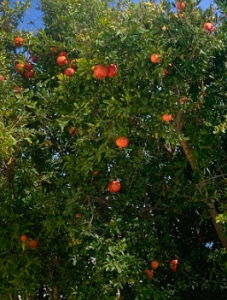
Ripe pomegranates on the branch on the island
of Santorini, Greece. Photo by Wikimedia
contributor dorkinglad, used via a CC BY-SA
4.0 license (source).
I. NISAN (March/April), 30 days | barley harvest
…14. Pesach, feast honoring Exodus
…15-21. Matzot, feast combined with Pesach | Song of Songs
…15-5 Sivan. Sefirat ha-Omer [Counting of the Sheaf], honors interval between Exodus and Sinai
II. IYAR (April/May), 29 days
III. SIVAN (May/June), 30 days | wheat harvest
…6. Shavuot, feast honoring giving of the Torah | Ruth
IV. TAMMUZ (June/July), 29 days | grape harvest; early-bearing fig harvest
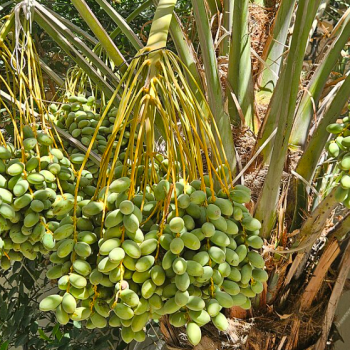
V. AV (July/August), 30 days | grape harvest continues; date harvest
…9. Tisha b-Av, fast mourning destruction of Solomon’s Temple | Lamentations
VI. ELUL (August/September), 29 days | grape harvest continues; date harvest continues; main fig harvest
VII. TISHREI (September/October), 30 days | date harvest continues; pomegranate harvest
…1. Rosh ha-Shanah, feast honoring the civic new year
…10. Yom Kippur, fast
…15-21. Sukkot, feast honoring Israel’s desert years | Ecclesiastes
…22. Shemini Atzeret, feast
VIII. CHESHVAN (October/November), 29/30 days | olive harvest
IX. KISLEV (November/December), 30/29 days
…25-2/3 Tevet. Chanukkah, feast honoring reconsecration of Temple
X. TEVET (December/January), 29 days
XI. SHEVAT (January/February), 30 days
…15. Tu bi-Sh’vat, feast honoring the “new year for trees”
XIII. ADAR A (February), 30 days—leap month (used in 7 years out of the 19-year Metonic Cycle)
XII. ADAR (February/March), 29 days—Adar B in leap years
…14. Purim, feast honoring rescue of Jews from Haman’s pogrom | Esther
b. Thematic Aspects
A lot of John’s structure consists in the patterns of seven and of three discussed above, but these overlap, and their fixtures are spaced irregularly. The Gospel does not so much rest on them like a fortress on a foundation as cling to them like a vine on a trellis. Its cycles interlock, foreshadowing and echoing one another—and I make no apology for the violently mixed metaphor, because the more you read John the more it feels like that.
א. A Clash of Æons
This in itself highlights one of John’s curious qualities: a sense of temporal dislocation. The sensation is more pronounced the better you know the Synoptics. As soon as we finish the prologue, we’re in an exchange between the Sanhedrin and the Baptist that none of the other Evangelists clearly delineated; when is this? Then comes Jesus’ baptism, back to familiar territory; next will be the tempta—wait, no, he’s calling the Twelve. Okay. Then comes a miracle we’ve … never heard of before, which is again temporally confusing; and—then we must have missed several pages, because we’re already in Holy Week, he just cleansed the Temple! What is going on?
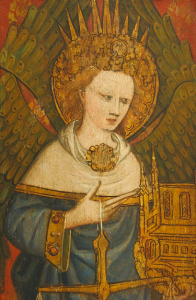
Depiction of a Throne from the rood screen of
St. Michael and All Angels, the parish church of
Barton Turf, Norfolk, UK. Photo by Martin
Harris, used via a CC BY-SA 40 license (source).
I think what’s going on is that John, like the author of Matthew, is telling parts of his story out of strictly chronological order, for a couple of reasons. One is simple: he is evoking eternity—the other, and next, αἰών [aiōn] (which can mean “world” or “age” or, as here, both at once), which is the αἰών of God. From him the Λόγος came, and to him he has returned. In the progress of the Gospel, we see that αἰών is invading this one; and to eternity, every moment within time is as accessible as every other moment.
Rank on rank, the host of heaven
Spreads its vanguard on the way
As the Light of Light descendeth
From the realms of endless day,
That the pow’rs of hell may vanish
As the darkness clears away.
ב. Judge, That Ye Be Judged
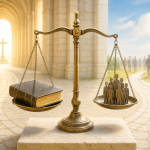
The other reason is that language and scenes of John, in the opening chapters especially, bring the atmosphere of a courtroom to mind. Witnesses, questionings, judgment seats, accusers, testimonies: John’s Gospel is another trial of Jesus—but this time, the judge is not Caiaphas, nor Pilate, nor any other member of the religious establishment, nor any part of the machine of government. Someone might protest, pointing out that it isn’t as if he’s being crucified again; and anyway, if it’s neither church nor state that’s judging him, who’s even left?
That’s perfectly simple. It’s you.
Much depends for you upon your verdict. And in the long run, while you may delay the crucial moment of decision, it is not finally possible to recuse yourself. John, as a truthful witness for the defense, exhorts you to believe him and to judge justly; but neither he nor anyone has the power to decide your verdict for you.
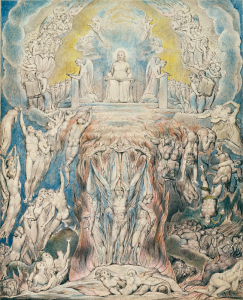
The Day of Judgment (1808), by William Blake.
Footnotes
1The distinction here between “Jewish” and “Judaic” is between the ethnicity and the religion that typically goes with the ethnicity (though the two inter-animate each other, and can only be crowbarred so far apart even for purposes of abstract analysis).
2We especially treat the book of Leviticus downright shamefully, to be frank. Casually joking about how boring it is might be one thing, if we made a point of reading Leviticus—but we seem to act as if God left it in the Christian Bible by mistake.
3The Roman concept of adult masculinity was defined not by aggression, but intellectualism (which is, really, a fundamentally more adult notion of what adulthood consists in). The Roman ideal was to be a (1) rich (2) farmer with (3) enough “staff”—probably slaves, though they didn’t have to be—to have ōtium, or leisure—but this was conceived of as leisure spent in a specific way; ōtium was a time to enrich oneself spiritually and mentally, pursuing things like music, philosophy, or poetry.
4The Psalms in general do not constitute wisdom literature, but a selection of them do. Common examples of wisdom Psalms include 1, 37, 49, and 119.
5Dharma is a key idea in Buddhism, Hinduism, Jainism, and Sikhi. In Hinduism (the oldest tradition of the four), dharma can perhaps best be rendered “law,” “righteousness,” or “duty”; Buddhist, Jain, and Sikh uses of dharma tend to mean their own creeds and codes more specifically.
6We can approximate it. We do have his own account of his participation, post-retirement, in an embassy to the Emperor Caligula from the Jews of Alexandria; the delegates went to beg him to reconsider his orders that a statue of himself be erected in the Temple, I guess because that went so well for Antiochus Epiphanes. This embassy most likely took place in the year 40, or a little before (the following year, Caligula was assassinated, and he had only come to power in 37); Philo is thought to have died within the next few years, meaning he was likely in his 60s at the time. If so, this would put Philo’s birth fairly close to the foundation of the Empire itself, typically dated to 27 BC, when the Senate gave Octavian Cæsar the title “Exalted One,” or in Latin Augustus. Thus, Philo’s birth can be (probably and roughly) dated to ca. 30-20 BC, and his death to ca. 45-55 CE.
7In strict fairness, Chanukkah was probably a bigger deal while the Second Temple was standing. Still, it was never a pilgrimage feast; going to the Temple for Chanukkah was strictly optional.
8The word “overt” is key. If we chose, we could bump John’s total miracle count up to twelve by adding the divinations of 2:19, 4:18, and 21:18. (I say “divinations” rather than “prophecies” because the knowledge displayed in ch. 4 is about the past and present, not the future.)
9It’s possible—I think, probable—that where John says “the sixth hour,” he is not so much tying the action to the time-stamp of 12:00 p.m., but using it more in the way that someone today might casually describe the interval between, say, half-past eleven and two o’clock as “noon” or “the lunch hour.”
10My reasoning for identifying chapters 4 and 5 as implicitly taking place around Purim and Shavuot is a little involved; to save a little space, I’m saving it for when I offer my translations of those chapters.
11This one is iffy; it actually refers to two distinct places on opposite sides of the Jordan River. Bethany-Beyond-Jordan is the first one referenced; in the third century, the great Biblical scholar Origen, who lived in the Holy Land, suggested that this “Bethany” east of the Jordan—which didn’t seem to exist in his day—might be an error for “Bethabara.” The other one, Bethany-of-Judæa, was a little village barely a morning’s walk from Jerusalem. I’m not certain whether to draw the conclusion that this is not a genuine heptad after all, or if, supposing both names were current at the time, perhaps John’s author chose to use “Bethany” over “Bethabara” precisely in order to have a (nominal) set of seven.
12I felt unsure about this one, too. It “works,” if you specify appearances to the Apostles; the thing is, John gives us a fourth appearance, which is chronologically the first one—his appearance outside the tomb to Mary Magdalene. On the strength of this alone, I was actually going to discard this one, until I remembered that the author himself invites the “set of three” reading in 21:14.
13Today, this name for Chanukkah is usually referred to a miracle story. In 164 BC, the Maccabean rebels reclaimed the Temple from the Seleucid Empire, and were obliged to cleanse it after its desecration by Antiochus Epiphanes. A single jar of ritually pure oil was left for use in the Menorah, which was only enough to light the Sanctuary for a single day. Nevertheless, this miraculously lasted them over the eight-day period required to prepare a new batch of acceptable oil for the Menorah. If memory serves, the Talmud preserves this story; however, it is absent from the Hebrew Bible and the books of I and II Maccabees alike, and appears to be unknown to Josephus (who offers his own speculation in his Antiquities of the Jews about why Chanukkah was called “the festival of lights,” without making any allusion to the putative miracle).
14These “seven species” are crops specially associated with Canaan in Scripture, e.g. in Deuteronomy 8:8; they are: barley, wheat, grapevine, fig, pomegranate, olive, and date—the allusion to honey in the cited verse is widely thought to be not bees’ honey, but “date honey,” a syrup obtained by boiling dates and used as a sweetener. (Four of the seven species being the fruits of trees explains something of the importance of Tu bi-Sh’vat.)
15I’m hoping, borderline praying, that the agricultural information given here is approximately accurate and hasn’t changed in twenty centuries. I mean, they are (apparently) headquartered in Israel, and I can’t think of a way that getting harvest times wrong could be used by Christians against J-nooo, there’s a way. I cannot imagine what it is, but I couldn’t even believe that sentence while I was writing it—somehow, there is a way that Christians, at least once, have used “what time of year people in the Holy Land do or don’t harvest dates” as a pretext to be awful to Jews. But hopefully this organization didn’t avail themselves of it!








 Ad-Free & Subscriber Log-In