

You can find my two-part introduction to the Gospel of John at these two links, and my index/outline for it here; for the previous installment on John 1:1-13, go here.
The Prologue, Part II (John 1:14-18)
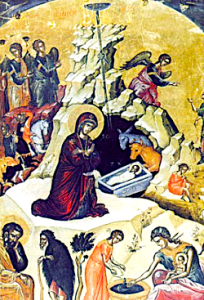
16th-c. Russian ikon of the Nativity.
The prologue now comes to a shocking climax, disclosing the means of the entry of the Logos into creation: namely, incarnation—a notion which Jews would have considered blasphemous, and which the Greeks who originated Logos-philosophy would have laughed at. Nonetheless, the evangelist insists upon it, citing his own witness and that of the Baptist, before asserting that, in the incarnate Logos—finally identified by name as Jesus—a new covenant, transcending that mediated by Moses, has been introduced, making God known to man.
To proceed to the next section (vv. 19-28), go here.
John 1:14-18, RSV-CE
And the Word became flesha and dweltb among us, full of grace and truth; we have beheld his glory,c glory as of the only Sond from the Father. (Johng bore witness to him, and cried, “This was he of whom I said, ‘He who comes after me ranks before me, for he was before me.’”e) And from his fulness have we all received, grace upon grace.f For the law was given through Moses;g grace and truth came through Jesus Christ.g No one has ever seen God; the only Son,h who is in the bosomi of the Father, he has made him known.
John 1:14-18, my translation
And the Word became flesha and dweltb among us, and we beheld his gloryc—glory as of only-begottend from his Father, full of grace and truth; Yochanang witnesses about him, and cried out saying: “This is he, of whom I said, ‘One coming behind me has come to be in front of me, because he was there before me'”;e because we all took from his fullness, and grace in place of grace;f because the law was given through Moshehg—grace and truth came to be through Yeshua the Anointed.g God, no one has ever seen; only-begotten God,h who is there in the lapi of the Father, this one has explained him.
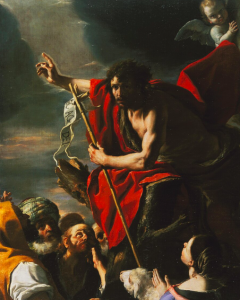
San Giovanni Batista Predicazione [St. John the
Baptist Preaching] (ca. 1665), by Mattia Preti,
a member of the Order of Knights Hospitallers.
Textual Notes
a. the Word became flesh | ὁ λόγος σὰρξ ἐγένετο [ho logos sarx egeneto]: This is the zenith of the Fourth Gospel’s prologue. This is, in part, because it is an idea so shocking, even so ridiculous, that nobody would believe it.
Let’s begin with the refined Hellenistic Gentile, one who knew all about φιλοσοφία [filosofia] (from which that term, λόγος, was drawn). He would know perfectly well, this was just the type of nonsense you got when you tried to teach it to Assyrians, or Idumæans, or whoever these people were. Whether we’re talking about the λόγος as defined by Heraclitus or Aristotle or the Stoa or whoever else’s, it simply isn’t the kind of thing that gets embodied! As the Fox puts it in Till We Have Faces, “You might as well say that the Universe itched or that the Nature of Things sometimes tippled in the wine cellar.”
More pertinent would be the critique of the devout and educated Jew. He would know a good deal about that divine wisdom which the Greeks’ love-of-wisdom aspired to. After all, she said herself that
I came forth from the mouth of the Most High …
Alone I have made the circuit of the vault of heaven
…and have walked in the depths of the abyss.
… In every people and nation I have gotten a possession.
Among all these I sought a resting place;
…I sought in whose territory I might lodge.
Then the Creator of all things gave me a commandment,
…and the one who created me assigned a place for my tent.
And he said, “Make your dwelling in Jacob,
…and in Israel receive your inheritance.”
From eternity, in the beginning, he created me,
…and for eternity I shall not cease to exist.
In the holy tabernacle I ministered before him,
…and so I was established in Zion …
…and in Jerusalem was my dominion.
—Sirach 24:3-11
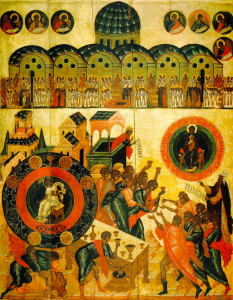
A 16th-c. Novgorodian ikon, Премудрость созда
Себе дом [Premudrost sozda Sebe dom],
“Wisdom Hath Builded Her House.”
But, I mean—this was a metaphor. Like in literature? It does those? Non-metaphorically, divine Wisdom was supremely embodied in the Torah, which means “law” but also “doctrine,” “guidance,” or “teaching.” Even while the Temple stood, Judaism was in some sense a “religion of the book.” And the Wisdom of the metaphor was a personified attribute of the Lord, not an “additional” Lord! שְׁמַע יִשְׂרָאֵל יְהוָה אֱלֹהֵינוּ יְהוָה אֶחָד [Sh’maṛ Yišrâ’êl, {TETRAGRAMMATON} ‘Èlohêynuu, {TETRAGRAMMATON} ‘êchâdh]: Hear, O Yisroel, the LORD our God, the LORD is … well, you know. Monotheism was arguably the crown of all the wisdom of Judaism. That God is real, and One, and Other: these were the central facts the Jews had been called upon by the Tetragrammaton to bear witness to. Neither the oneness nor the otherness would lightly suffer this fully-hypostatized Logos-thing, simultaneously claiming to share Its throne and yet to vulgarize Its being with crass anthropomorphism!—not because there was anything wrong with flesh (as a Greek or a Persian might fancy in their dreamily pessimistic moods), but because God is not a large man. Not only did the Torah reject the brutish idols of Babylon, Phoenicia, and Syria, but also the gracious idols of Attica, Ionia, and Italy: Jupiter and Dionysus were as inferior to the real God as were Moloch and Elagabal.
One last note about this. In order to convey something of the nuance in these eighteen densely-packed verses, we have plodded our way through what was “unto the Jews a stumbling-block, and unto the Greeks foolishness.” However, this may give a false impression of how the prologue really works. The many submerged layers of meaning and quiet allusions in it are just those things: submerged, quiet. For an audience contemporary with the book itself, no such detailed explanation would be necessary—these things would have been familiar enough, and current enough, that the author of John could treat them as shared, presumable context. And the author here does not flag: he drops this conceptual bomb, and then just carries on, describing its fallout, or better, its radiance.
b. dwelt | ἐσκήνωσεν [eskēnōsen]: This verb is related to σκηνή [skēnē] “tent.” Even without the preceding allusions to the Torah, mounting in intensity and strangeness, this word alone, ἐσκήνωσεν, evokes the idea of the Tabernacle—the place of the divine sojourning among the children of Israel, from the time they received the Torah at Mount Sinai until the completion of Solomon’s Temple (perhaps around 965 BC). In contrast to most modern associations with tents (though consistently with the usual connotations of “camping” on some place or topic), this word implies long-term, habitual residence with or among a group of people. Cf. Revelation 21:3: “Behold, the tabernacle of God is with men, and he will dwell with them, and they shall be his people, and God himself shall be with them, and be their God.”
c. glory | δόξαν [doxan]: Glory is a major concept in both the Hebrew Bible and the New Testament. The Greek word originates in the verb δοκέω [dokeō], meaning “to seem, appear”; following this semantic branch leads us to the idea of fame—though this is not quite the same thing as glory. There is an element of worthiness in glory, an objectivity, that fame does not necessarily possess; and according to Thayer’s Lexicon, this use of δόξα is not a native Greek development of the word. It appears to have taken place at least partly because, for some reason, the translators of the Septuagint selected δόξα as their preferred translation for the Hebrew כָּבוֹד [kâvoudh] (and occasionally for its synonyms הָדָר [hâdhâr], “splendor,” and הוֹד [houdh], “majesty”).
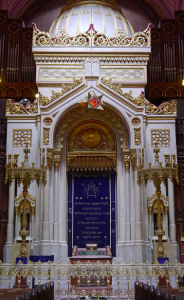
The exceptionally magnificent Torah ark of the
Great Synagogue in Budapest (the largest syna-
gogue in Europe). Photo by Zairon, used via
a CC BY-SA 3.0 license (source).
This was, at first blush, a strange choice. כָּבוֹד doesn’t mean “reputation,” nor derive from a radical that does. Rather, the radical כבד encodes meanings of weight, heaviness, being difficult to move; in the emotional sphere, its meanings lean to stoicism or grief. Yet it is at the same time a synonym of those two words above (the latter of which, usually written Hod in Roman letters, is one of the ten attributes of God in Kabbalist mysticism). We may begin to understand כָּבוֹד a little more clearly through the name of an ancient Roman value: gravitās. The obvious translation is “gravity,” but the sense is “seriousness, responsibility, sobriety; the opposite of frivolity or fecklessness.” That which has כָּבוֹד is that which is worth treating seriously—that which must be handled with solemn respect if it is to be handled at all.
d. of the only Son/of only-begotten | μονογενοῦς [monogenous]: I don’t know why the RSV renders this “only Son.” The word “son” (υἱός [huios]) is not there in the Greek; the word γένος [genos], the dictionary form underlying μονογενοῦς, doesn’t mean “son.” There are ways of translating it that amount to “son” (like “offspring” or, indeed, “begotten”), but that’s not the word’s center of gravity, so to speak.
e. He who comes after me ranks before me, for he was before me/One coming behind me has come to be in front of me, because he was there before me | Ὁ ὀπίσω μου ἐρχόμενος ἔμπροσθέν μου γέγονεν, ὅτι πρῶτός μου ἦν [Ho opisō mou erchomenos emprosthen mou gegonen, hoti prōtos mou ēn]: The clumsy English of my translation rather belies the elegance of the Greek here (which makes a case for the pleasing smoothness of the RSV!). I chose to render it as I did partly because there is no relationship, linguistically, between the two before‘s of the text. An interlinear might represent this line like this:
..Ὁ…ὀπίσω…μου.ἐρχόμενος..ἔμπροσθέν……..μου…γέγονεν,…..ὅτι..πρῶτός..μου….ἦν
The.behind.of-me.coming.in-towards-there.of-me.became,.because.first..of-me.was
The “before … before” of the RSV (my “in front of … before”) represents ἔμπροσθέν … πρῶτός.

An unusually large, ornate tabernacle at St.
Martin’s Church in the city of Kortrijk,
Belgium. Photo by Paul Hermans, used via
a CC BY-SA 3.0 license (source).
f. grace upon grace/grace in place of grace | χάριν ἀντὶ χάριτος [charin anti charitos]: This is a fascinating little enigma, because the preposition ἀντί (which gives us an English word I’m sure you can guess—that’s right, hypoallergenic) has several distinct meanings:
- against, opposite
- at the same time as
- on a level with
- in place of, instead of, rather than
- on top of, in addition to, besides
- as compared with
- in return for, in exchange for
- for, for the sake of
A corresponding contrast is perhaps the root concept here, branching out in various directions. This leaves rather ambiguous what the relationship is that it’s asserting between “the law of Moses” and “the truth of Jesus.”
However, it does positively identify both as vehicles of divine grace.1 I doubt we’re meant to understand these graces as identical or interchangeable—there wouldn’t be much point in distinguishing them at all, were that the case. But the distinction this draws between Moses and Jesus is not that one offers grace and the other doesn’t (and it isn’t necessarily that one offers more or better grace, whatever exactly “more” or “better” might mean in this context). I trouble to say this, because there are versions of what’s called covenant theology2—a framework for understanding God’s relation to his people over the course of history—which classify the Mosaic Covenant as lacking in grace; some covenant theologians even claim that the purpose of the Mosaic Covenant was to highlight the importance of grace by being entirely grace-less. (If you’ve heard of the controversy over “supersessionism,” that’s a related topic, albeit not exactly the same. I’ve expanded on this slightly in this week’s theological postscript, down below note i.)
To me, both from the Tanakh itself and from verses like this one, that claim just seems obviously wrong? The Tanakh—whether extended into the Catholic Old Testament or not—is stuffed to the gills with assertions of divine grace, y’all; it ain’t subtle! Yes, the Mosaic Covenant was absolutely a means of grace! Indeed, the only reason I say “was” instead of “is” is that I’m not really clear how to understand the operation of the Mosaic Covenant in the absence of the Temple, on either Catholic or Judaic premises.3 My grasp of Judaic theology is exceedingly limited anyway, so I choose not to make a fool of myself by guessing. And on Catholic premises—well, I know verses like this one, which assert that the Mosaic Covenant was a means of grace, and texts like Romans 11 which affirm (v. 29) that “the gifts and the call of God are irrevocable.” The, I don’t know, mechanics are what isn’t clear to me? but of course they don’t have to be. I’m not the one who has to make the machine work, am I?
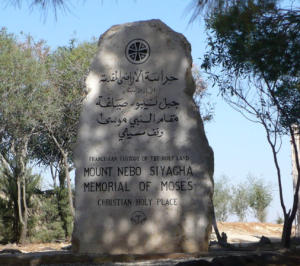
Memorial stone to Moses on Mount Nebo in the
Kingdom of Jordan. Photo taken in 2005 by Milei
Vencel, used via a CC BY-SA 3.0 license (source).
g. John … Moses … Jesus Christ/Yochanan … Mosheh … Yeshua the Anointed | Ἰωάννης … Μωϋσέως … Ἰησοῦ Χριστοῦ [Iōannēs … Mōüseōs … Iēsou Christou]: Yochanan, Mosheh, and Yeshua (pronounced yō-ḥà-nän, mō-shĕ, and yĕ-shû-à) are near approximations (adapted to English) of the Aramaic names that would have been in use for these three figures in the first century. The Classical Hebrew forms would probably have been יְהוֹחָנָן [Y’houḥânân] for John, מֹשֶׁה [Mosheh] for Moses, and יְהוֹשֻׁעַ [Y’houshûaṛ/Y’houshûa3]4 for Jesus.
h. the only Son/only-begotten God | μονογενὴς θεὸς [monogenēs theos]: Here, unlike in note d, we have a variation in manuscript traditions: some have μονογενὴς θεὸς; others have μονογενὴς υἱὸς. The former reading means “only-begotten God”—the latter, “only-begotten Son.”
As my translation suggests, I’m inclined to accept the first reading here, for a couple of reasons. The first is simply that—if I’m reading the apparatus criticus5 in my hard copy right—a majority of manuscripts have the υἱὸς reading, but the earlier manuscripts tend to have θεὸς.
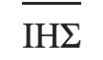
The second is that μονογενὴς υἱός went on to become a formulaic liturgical phrase. (We use it to this day whenever we sing the Gloria, which is immensely ancient: Domine Filī Ūnigenite Jēsū Christe, “O Lord, the Only-Begotten Son, Jesus Christ.”) This means it would have been very easy for a scribe to alter the less-usual μονογενὴς θεὸς to μονογενὴς υἱὸς—quite possibly without even noticing what he was doing. This would be especially true in any manuscripts in which common nomina sacra6 were in use. Scribes in the ancient and Medieval worlds employed recognized abbreviations, now known as nomina sacra, for certain common names and words in Christian literature, such as Ἰησοῦς [Iēsous] “Jesus”; this is why even today, you’ll occasionally see IHS or IHC used to represent the name of Jesus,7 descending from a nomen sacrum that looked like this:
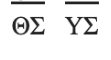
Θεός and υἱός, very frequent terms in Bibles, lectionaries, books of hours, etc., were probably some of the first words to be represented with nomina sacra. In that form, they had only a single letter’s difference between them, which would make them even easier to confuse:
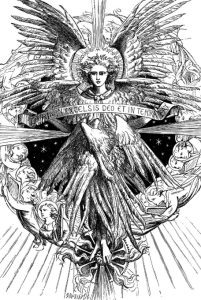
The Song of Bethlehem (1901), by the Dalziel
Bros. The banner in front of the angel reads
Gloria in excelsis Deo et in terra pax, “Glory in
the highest [places] to God and on earth peace.”
Hence, I think the balance of evidence slightly favors μονογενὴς θεὸς as the correct reading, over the reading evidently preferred by the translators of the RSV, μονογενὴς υἱὸς. The Society of Biblical Literature, whose Greek text I typically use here, apparently prefers the θεὸς reading, as do the United Bible Societies (at any rate they did as recently as 2001, when they green-lit the tenth printing of their fourth edition of the Greek New Testament).
i. bosom/lap | κόλπον [kolpon]: Here, the RSV and I are both slightly off, because we don’t have a direct equivalent for the word κόλπος—which is odd, because we haven’t ceased to have the thing it refers to. A κόλπος is, basically, the little apron-y pouch you’d make with the bottom edge of your shirt as a child to gather things in.8 (In this way, “bosom” in its archaic sense is arguably the superior rendering; however, given the, ah, semantic drift that that word has experienced in vernacular English, I didn’t find it useful!)
On the whole, I’m trying to leave my discussion of the later echoes in this passage—both thematic and linguistic—to the places where those echoes occur; but I can’t resist noting one here. Jesus the Logos is here stated to be “in the κόλπος of the Father”: and in chapter 13 at the Last Supper, the Beloved Disciple, who is the author of this Gospel, is stated to be resting in the κόλπος of Jesus.
A Theological Postscript:
Tante Corrie, Bid Voor Ons9
I have to make a few slightly technical distinctions in the next few paragraphs. These distinctions are often made due to a love of wasting other people’s time (e.g., for mere pedantry’s sake, or as a distraction from an embarrassing topic) or in a hope to explain things away. I don’t intend to explain anything away, and very much hope I haven’t done so; but there is a point I want to make here—one with moral, political, and spiritual implications—that needs a collation of light pedantry for sustenance, if it’s to be analyzed at all.

The Ten Boom Museum in Haarlem, the
Netherlands—formerly the home of the ten
Boom family. Photo by Jane Darnell,
used via a CC BY-SA 3.0 license (source).
Note f may seem very abstract to some people. It’s not. If anything, I think it’s a great example of why it’s worth it to get details that look or sound abstract right—because as far as I can see, they never never never never never stay abstract in the long run. I believe the doctrinal point made in note f is particularly worth highlighting in view of the hideous eruption of undisguised antisemitism in this country over the last several years. Now, antisemitism is not only ludicrous, but actually sacrilegious, on Christian premises; nevertheless, this abscess has not only taken on a Christian coloring in this country, but infected many Christians to varying degrees.10
Of course, that way of phrasing it might sound as though I think this is unprecedented. It is not. I’m well aware that the behavior of Christians, both individually and in Christian institutions, is a principal ingredient in modern antisemitism. (Indeed, though this might be difficult to prove, Christianity may be the only noteworthy ingredient in antisemitism between, say, the ages of Charlemagne and Queen Victoria.) The Middle Ages, though not my job, are my hobby, and nobody can read much Medieval literature—unless it has been deliberately, extensively edited—before finding out that, yes, the Middle Ages were kind of antisemitic, and that it was a problem that tended to get worse over the High and Late Medieval periods (roughly, the late eleventh to mid-fifteenth centuries).* Yet I do take the view that this ugly history is neither inherent nor necessary to Christianity. Put in ninth-grade pop quiz form, the issue here might be stated like this.
Is Christian antisemitism caused primarily by:
(a) Christianity, as an idea, inherently tending toward antisemitism?; or,
(b) Christians, as people, frequently being antisemitic (with varying degrees of awareness and intent)?
*EDIT: When I first published this, I left this sentence incomplete and, indeed, as gibberish! Sorry about that.
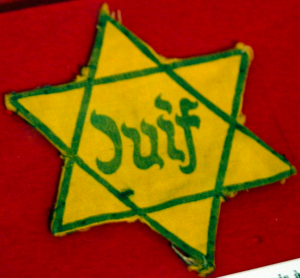
An identifying yellow badge, mandated by law
for Jews, from Nazi-occupied France (1940-1944)
—Juif is French for “Jew.” Photo by Kitkatcrazy,
used via a CC BY-SA 3.0 license (source).
I trouble to raise this issue so explicitly, because which answer is right (or at least, which is the better of the two answers) has implications that Christians are going to run into from time to time. Moreover, we have the bad luck to live in interesting times—the interest being “Wow, we really did not learn even one single thing from The Rise and Fall of the Third Reich,11 huh”—so trying to make sure that Catholics have a good, smart, united reaction to antisemitism has gotten modestly important even at a day-to-day level.
I expect, and hope, that it’s obvious why I don’t accept the view expressed in (a). But I want it to be clear that when I say “the problem is not with Christianity but with Christians,” I am not trying pretend that this was an issue of “isolated bad actors” or anything silly like that, nor that the only or chief sin of Christians against Jews has been not trying hard enough to convert them; similarly, it isn’t in order to fob my readers off with a blandly philosemitic remark, only to circle back later to the topic of history and explain Why That Stuff Didn’t Matter Really. If Christianity is in any sense true, then That Stuff very deeply Mattered, and will (at the absolute latest) be put right at the Last Day.12 I am arguing that antisemitism—while perhaps miserably predictable—is a problem with Christians rather than with Christianity, and that therefore, antisemitism is something that can and should be ripped out of anything Catholic.

Cornelia (“Corrie”) ten Boom in 1921 (photo-
grapher unknown), nineteen years prior to
the Nazi invasion of Holland.
When I was a small child—I had thought I was eight, but my mother tells me I must have been years younger than that—our family read The Hiding Place, a memoir by Corrie ten Boom. The ten Booms were a respected family of watchmakers from Haarlem, just outside Amsterdam; Casper ten Boom, its white-bearded patriarch, was a devout member of the Dutch Reformed Church, with three daughters and a son—Nollie and Willem, the younger children, had married and moved out, while the two elder daughters, Betsie and Corrie, lived at the family home with their father (which in their childhood had also been occupied by their mother, since deceased after a stroke, and two or three of their Tanten,13 or “maiden aunts”), a home which had for over a century also served as the family’s watch shop. (Corrie was the first woman in the Netherlands licensed as a watchmaker.)
When the Nazis marched in, the ten Booms quietly began working with the Dutch Resistance. They concealed Jews throughout 1942 and into 1943. The reason their work was interrupted in 1943 was that the ten Booms were betrayed by an informer, a fellow Dutchman. Casper and Betsie ten Boom paid for their compassion with their lives: Casper was deserted in Scheveningen (then a police holding facility), while his daughters were eventually taken to Ravensbrück. Corrie survived, leaving a free woman near the end of 1944. In The Hiding Place, Ten Boom does not exonerate Christians in general from the role that so many of them played in the Holocaust. Neither does she ignore the theological pretexts on which they played it. She also makes clear exactly how and why her faith and her family’s impelled them to act otherwise. She, her sister Betsie, and their father Casper have been honored among Yad Vashem‘s list of those who are חֲסִידֵי אֻמּוֹת הָעוֹלָם [Chàsydhêy ‘Ûmmouth hâ-Ṛoulâm], “Righteous Among the Nations.”
This is why, and the sense in which, I insist that antisemitism’s relationship to Christianity is that of a repulsive infection to its host—because I seriously believe what I wrote a little time ago: the Christian antisemite, by being an antisemite, is guilty of sacrilege. I do not deny that antisemitism has clung to the Church throughout most of her history; I do insist that it has clung to her as a parasite, one she ought to give it the Psalm 137 treatment. To hate or despise the Jews as a people is to blaspheme God, the Mother of God and the Myrrhbearers, the Apostles and the Evangelists. Or do you presume to take for granted the grace that is extended to you through Yeshua the Anointed? Did you acquire God’s favor through some other means than the Son of David, the Son of Abraham?
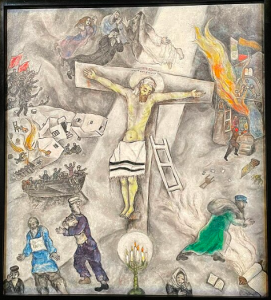
White Crucifixion (1938), by Marc Chagall.
Made available by Kunstwollen.arte via
a CC BY-SA 4.0 license (source).
Hath God cast away his people? God forbid. For I also am an Israelite, of the seed of Abraham, of the tribe of Benjamin. God hath not cast away his people which he foreknew. If thou, being a wild olive tree, wert grafted in, and with them partakest of the root and fatness of the olive tree; boast not against the branches. Thou bearest not the root, but the root thee. Thou wilt say then, “The branches were broken off, that I might be grafted in.” Well; because of unbelief they were broken off, and thou standest by faith. Be not high-minded, but fear: for if God spared not the natural branches, take heed lest he also spare not thee.
—Romans 11:1-2, 17-21
Footnotes
1It is worth taking a moment to note the theological definition of this word: “Grace is favor, the free and undeserved help that God gives us to respond to his call to become children of God, adoptive sons, partakers of the divine nature and of eternal life. Grace is a participation in the life of God. It introduces us into the intimacy of Trinitarian life … It depends entirely on God’s gratuitous initiative, for he alone can reveal and give himself. It surpasses the power of human intellect and will, as that of every other creature. The grace of Christ is the gratuitous gift that God makes to us of his own life” (Catechism of the Catholic Church §§1996-1999).
2Among Protestants (at least in the evangelical “camp”), covenant theology is most prominent among Reformed Christians; its principal alternative is Dispensationalism, which has its own approach to redemptive history, and conceptualizes the relationship between Israel and the Church in very different terms. In a rare instance of definite agreement between Rome and Geneva, using covenant theology as a framework is, so far as I can tell, standard among Catholic theologians who deal with the topic of redemptive history—but, because there isn’t exactly an alternative to it among Catholics, it isn’t exactly called anything (save perhaps in contexts where mainstream Catholic belief might be contrasted with American folk Catholic views influenced by Dispensationalism, for example).
3This situation is not wholly without precedent, of course: Judaism was also obliged to function without the templar sacrificial system during the Babylonian Exile (ca. 586-ca. 516 BCE), albeit for a far briefer period. When I say I don’t know how to understand this, I am not covertly hinting that there’s nothing to understand—I mean, with perfect sincerity, that I don’t know how to understand this.
4The 3 here represents not the numeral, but the obsolete letter yogh. The classical pronunciation of the letter ע (named, in conventional spelling, ‘ayin) is not known with certainty, but two possible candidates (both absent from English!) are: (1) a uvular trill, which is the “guttural r” familiar to us from French; or (2) a voiced velar fricative, which is the “blurred g” sound of Greek, Arabic, or some dialects of Spanish—3 represents this second sound. There are a handful of sound correspondences that can help here. For example, b : v :: g : 3, or (using the ch of the Scots “loch”), ch : 3 :: s : z.
5An apparatus criticus (“critical apparatus”) is a form of annotation, going back in its rudimentary form to Erasmus: it indicates divergent readings in the various sources of a text, generally sources predating the printing press. For a more detailed explanation of the textual sources of the New Testament, see the first part of this post (up until the heading “Jesus’ Teaching on Divorce”).
6Literally, this Latin phrase means “holy names,” though many of the terms it covers were not names in the strict sense.
7In both IHS and IHC, the H really represents the Greek letter ēta (written Η in capital form, η in lower-case). The S is slightly more adapted to the conventions of the Roman alphabet, since sigma (capital Σ, lower-case σ, or ς at the end of a word) equates with s in our script; the version with C, odd though this may seem, is more faithful to the Greek original, because there used to be a variant of Greek writing which employed a lunate sigma (lunate = moon-shaped), visually the same as the Roman letter c. (Infuriatingly, this has nothing whatsoever to do with the development of what we call “soft c” in languages like French and English—that’s just an independent sound change that also happened, coincidentally affecting the letter c.)
8Oh, you know—berries, pinecones, interesting rocks, mummified human heads, that sort of thing.
9This Dutch phrase means “Aunt Corrie, pray for us.” Its significance should become clearer momentarily.
10Disapproving of the actions of the modern state of Israel is a question unto itself. The Israeli state is a specific group of people, neither omniscient nor impeccable—but their actions don’t necessarily implicate even all Israelis, let alone all Jews.
11Written by American journalist William Shirer (who spent part of his career in Germany and Austria during the Weimar and early Nazi periods) and published in 1960, The Rise and Fall of the Third Reich was among the earliest and best-documented works of historical study on the Nazis and their time in the sun. It is of uneven quality as a textbook; among other issues, it is simply far too long, at well over 1200 pages. Shirer attempts to follow far too many historical strands at once, and handles his material with an odd zigzagging between lively (or horrifying) scenes with an intense human concern and the prose to show it, and substantial portions of declassified documents (largely from the former archives of the Reich) whose nonspecialist appeal is roughly nil. However, apart from the good bits—which are, I argue, fairly sizable and are frequently clustered near important events—Shirer deserves credit for beginning the arduous process of cataloguing and sifting these declassified documents, which are a crucial testimony to the background, progress, and conclusion of the Reich’s existence.
12There are doubtless many lessons beneath its surface that I don’t know about, but there are two fairly obvious lessons about suffering in Job that are extremely humane but which most people seem to miss, being distracted by the awful unfairness of the ostensible setup. One is that Job’s losses mattered, because he receives some kind of consolation in terms of the same things he lost, primarily wealth and children. The other, which is clearly, repeatedly asserted throughout the book, is that not all suffering is secretly deserved and that it’s revolting to say that if someone is enduring such-and-such, it might be a punishment of some kind (which is more than can be said about the approach to suffering found in some great works of literature).
13Tante for “aunt” (Tanten is the plural) is Corrie ten Boom’s own usage in her memoir, The Hiding Place. However, this book was published in 1971 and describes events from thirty, forty, fifty, even sixty years before; a cursory search suggested that in present-day Dutch, Tante tends to have a mild derisive connotation. So if, for reasons best known to yourself, this blog is your primary linguistic style guide for an upcoming trip to the Netherlands, Aruba, Belgium, Curaçao, Namibia, Sint Maarten, South Africa, or Suriname: think twice before casually addressing anyone as “Tante.”














 Ad-Free & Subscriber Log-In