

You can find my two-part introduction to the Gospel of John at these two links, and my index/outline for it here; for the previous installment on John 9:1-34, go here.
The Gospel of John: Unblinding Light, Part II (John 9:35-10:21)
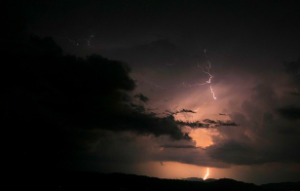
The “light of the world” reënters the narrative. He has had time to hear of the formerly-blind man’s expulsion from the synagogue, so it has apparently been at least a few days; the evangelist does not give us a very specific timeline, but, as we come to the festival of Chanukkah in 10:22 (which typically falls some time in December on the Gregorian calendar) and Sukkot normally occurs in September or October, the time is suggested to be around November—right when the storms of winter-time are setting in in the Levant.
John 9:35-10:21, RSV-CE
Jesus heard that they had cast him out, and having found hima he said, “Do you believe in the Son of man?” He answered, “And who is he, sir, that I may believe in him?” Jesus said to him, “You have seen him, and it is he who speaks to you.” He said, “Lord, I believe”; and he worshiped him.b Jesus said, “For judgment I came into this world, that those who do not see may see, and that those who see may become blind.” Some of the Pharisees near him heard this, and they said to him, “Are we also blind?” Jesus said to them, “If you were blind, you would have no guilt; but now that you say, ‘We see,’ your guilt remains.c
“Truly, truly, I say to you, he who does not enter the sheepfold by the door but climbs in by another way, that man is a thief and a robber; but he who enters by the door is the shepherd of the sheep. To him the gatekeeper opens; the sheep hear his voice,d and he calls his own sheep by name and leads them out. When he has brought out all his own, he goes before them, and the sheep follow him, for they know his voice. A stranger they will not follow, but they will flee from him, for they do not know the voice of strangers.”d This figure Jesus used with them, but they did not understand what he was saying to them.
So Jesus again said to them, “Truly, truly, I say to you, I am the door of the sheep. All who came before me are thieves and robbers;e but the sheep did not heed them. I am the door; if any one enters by me, he will be saved, and will go in and out and find pasture. The thief comes only to steal and killf and destroy; I came that they may have life, and have it abundantly. I am the good shepherd.g The good shepherd lays down his life for the sheep. He who is a hireling and not a shepherd, whose own the sheep are not, sees the wolf coming and leaves the sheep and flees; and the wolf snatches them and scatters them. He flees because he is a hireling and cares nothing for the sheep. I am the good shepherd; I know my own and my own know me, as the Father knows me and I know the Father; and I lay down my life for the sheep. And I have other sheep, that are not of this fold; I must bring them also,h and they will heed my voice. So there shall be one flock, one shepherd. For this reason the Father loves me, because I lay down my life, that I may take it again. No one takes it from me, but I lay it down of my own accord. I have power to lay it down, and I have power to take it again; this charge I have received from my Father.”
There was again a division among the Jews because of these words. Many of them said, “He has a demon, and he is mad; why listen to him?” Others said, “These are not the sayings of one who has a demon. Can a demon open the eyes of the blind?”
John 9:35-10:21, my translation
Yeshua heard that they had thrown him out, and found hima and said: “Do you have faith in the Son of Man?”
He said in response, “And who is it, sir, in order that I will have faith in him?”
Yeshua said to him, “You both have seen him, and he is the one speaking with you.”
He said, “Sir, I have faith”; and he prostrated himself to him.b
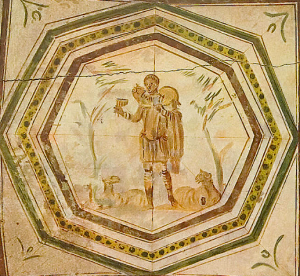
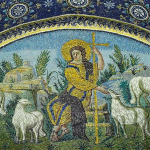
Christ the Good Shepherd, from the Catacomb of
SS. Marcellinus and Peter (3rd c.)
And Yeshua said, “For judgment I came into this world, in order that those who do not see should see and those who see should become blind.”
[Some] of the Pryshaya who were near him heard this, and they said to him, “Aren’t we blind too?”
Yeshua said to them, “If you were blind, you would not have sin; but now you are saying that ‘We see’—your sin stays.c ‘Amin, ‘amin, I say to you, he who does not come in through the door into the courtyard of the sheep, but climbs up another way, that person is a burglar and a robber; but he who comes in through the door is the shepherd of the sheep. The door-warden opens to him, and the sheep hear his voice,d and he calls his own sheep by name and leads them out. Whenever he gets all his own out, he journeys in front of them, and his sheep follow him, because they know his voice; they will not follow no alien, but will flee from him, because they don’t know the voice of aliens.”d Yeshua told them this parable; yet those people did not know what it was that he was saying to them.
So Yeshua spoke to them again: “‘Amin, ‘amin, I tell you that I am the door of the sheep. All those which came before me were burglars and robbers;e but my sheep did not hear them. I am the door: if anyone comes in through me, he will be healed and will go in and go out and will find pasture. The burglar doesn’t come except to burgle and sacrificef and destroy; I came in order that they may have life, and may have it overflowingly.
“I am the fair shepherd:g the fair shepherd sets his life aside for the sheep; he who is a wage-earner and not a shepherd—they are not his own sheep, he beholds the wolf coming and he quits the sheep and flees; and the wolf snatches or scatters them, because he is a wage-earner and does not care about the sheep. I am the fair shepherd, and I know mine, and mine know me, just as the Father knows me and I know the Father, and I set my life aside for the sheep. I also have other sheep which are not from this courtyard; it is necessary for me to lead them,h and they will hear my voice, and there will be one sheepfold, one shepherd. This is why the Father loves me, that I set my life aside, in order that I may receive it again. No one takes it away from me, but I set it aside of my own accord. I have authority to set it aside, and I have further authority to receive it; I received this charge from my Father.”
There came to be a further division among the Jews because of these words. For some of them were saying, “He has a demon and is raving; why hear him?”
Others were saying: “These are not the words of a demoniac; a demon cannot open the eyes of the blind?”
Textual Notes
a. having found him/found him | εὑρὼν αὐτὸν [heurōn auton]: This creates a subtle parallel between the pastoral parables the Lord is about to tell and the Parable of the Lost Sheep from Luke 15 (which I translated just over a year ago). This passage contains some of the few metaphors in this Gospel that resemble the parables of the Synoptics; the other especially prominent example is the beginning of John 15, expanding on the statement I am the true vine.
The ex-blind man contrasts with the ungrateful ex-paralytic of ch. 5. He is also healed on a sabbath, does not at first know where Yeshua is when asked, and is found by the Lord later; but the paralytic goes afterward to the Pryshaya, whereas the blind man is summoned by the Pryshaya and found by the Lord only after he has already been “thrown out” by them. The text also sets up some interesting similarities-and-contrasts between the blind man and the woman at the well.
- Yeshua encounters each during a journey away from Yrushalem, and rather pointedly stops for each one:
- He meets the woman when he and his students are removing themselves to the Galilee, after word reaches the Templar authorities that they have been performing baptisms at Eynan.
- He meets the man when he and his students are making their way out of Yrushalem itself after the disastrous reception of his final Sukkot sermon, and sends him to gain access to light by immersing himself in water.
- Both are from severely disadvantaged groups within first-century society (the disabled and women).
- Both are closely associated with water—she with Yaqov’s Well, he with the Pool of Shiloach.
- Both engage in theological discussions, and show at least some familiarity with and aptitude for Judaic theology.
- Both are told by him that “the one speaking to you is he”.
- Both, although they come to faith in Yeshua, are left nameless in the Fourth Gospel1—like the Beloved Disciple himself.
- Both try to share their discovery with their neighbors; however,
- The woman’s testimony is accepted, and seemingly leads to her being reintegrated into her village.
- The ex-blind man’s testimony, far from being accepted, leads to his being thrown out (and presumably disfellowshipped) by the Pryshaya who had been examining him.
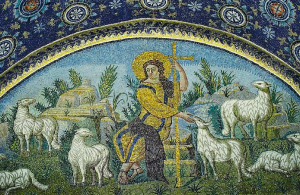
Mosaic of Christ as the Good Shepherd from
the Mausoleum of Galla Placidia (c. 425).
Photo by Petar Milošević.
Whatever else may be going on in this text, this final contrast is illustrative of how much the temperature has risen over the course of the Book of Signs. We have just passed the sixth sign: only one remains.
b. he worshiped him/he prostrated himself to him | προσεκύνησεν αὐτῷ [prosekünēsen autō]: The Greek words typically translated worship in English Bibles are the noun προσκύνησις [proskünēsis] and the verb προσκυνέω [prosküneō] (the noun being a regular derivative of the verb). At this point, they carried the meanings “prostration” and “to prostrate (oneself)”; however, the verb κυνέω, which formed the basis of προσκυνέω, meant “to kiss,” which at one time was a gesture of more varied significance, and of much more frequent liturgical use, than it is nowadays.
Interestingly, the English worship descends from a much broader term: ᚹᛖᚩᚱᚦᛋᚳᛁᛖᛈᛖ [weorthsciepe],2 “worth-ship,” meant assigning someone or something worth, i.e. honoring or dignifying them or it generally, without necessarily indicating anything specifically religious or in the highest degree. Perhaps this is why the Book of Common Prayer willingly included With my body I thee worship in the old text of the marriage service, which would otherwise be very puzzling, since the Book of Common Prayer is, you know, a monotheistic text. Worship in the strictest or most absolute sense is properly distinguished from lesser forms of honor by all monotheists—in technical jargon, this distinction is between adoration and veneration.3 According to some Catholics, the distinctive mark of worship proper is that it alone involves sacrifice, especially blood sacrifice (which in a sense still occurs in the Mass, or rather, the singular sacrifice of Christ is still made available to us in every Mass). There are some problems with this definition in the abstract, but it’s not a bad rule of thumb, though it doesn’t impinge on our text directly.
The gesture of prostration was not absolutely reserved for the adoration of deities in the ancient world—we see the Lord use it in a non-worshipful sense as a detail in the parable of the unforgiving servant (Matthew 18:26)—and it is unlikely that this is what the healed blind man meant by it, or he would have been immediately rebuked for idolatry, since v. 40 implies that other Pryshaya were in the immediate vicinity during this interaction. Prostration can be used with other meanings to this day, depending on the culture (e.g., in Japan, one might conceivably include a prostration when apologizing to a superior for a particularly serious offense). However, assigning it a religious meaning is the most common way to understand this posture: it is so interpreted by Bahá’ís,4 Christians, Hindus, Jews, Muslims, and Sikhs.4 In Western Christianity, priests still prostrate themselves when they are ordained and when celebrating the Good Friday liturgy. Outside these circumstances, however, prostration has for the most part been replaced by kneeling, a development which may have been prompted by the use of pews in Latin churches.
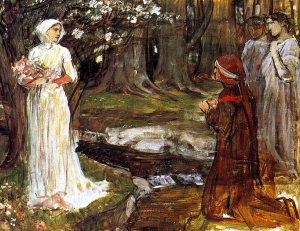
Dante and Matilda (c. 1915), by John William
Waterhouse. (Matilda is a forerunner and
companion of Beatrice in Dante’s work.)
c. If you were blind, you would have no guilt; but now that you say, ‘We see,’ your guilt remains/If you were blind, you would not have sin; but now you are saying that ‘We see’—your sin stays | Εἰ τυφλοὶ ἦτε, οὐκ ἂν εἴχετε ἁμαρτίαν· νῦν δὲ λέγετε ὅτι Βλέπομεν· ἡ ἁμαρτία ὑμῶν μένει [ei tüfloi ēte, ouk an eichete hamartian: nün de legete hoti «Blepomen»: hē hamartia hümōn menei]: This is a basis for the broader Catholic approach to judgment, exemplified in the Divine Comedy. Two-thirds of the way through, when Dante is reunited with his beloved Beatrice, the first thing she does is rail at him for dozens of lines, rebuking him for the foolish sins by which he entangled himself in the Dark Wood of the opening canto. This exchange follows; the first speaker and “she” indicates Beatrice, while the “I” is Dante.
…..“Say, say if this is true; so grave a charge
…..Requires thine own confession; therefore say.” …
…..I scarce found voice; but with what pains they might
…..My lips contrived to fashion a reply:
“Things transitory, with their false delight,”
…..Weeping I said, “enticed my steps aside,
…..Soon as your face was hidden from my sight.”
She said: “Hadst thou kept silence, or denied
…..What thou hast now confessed, thy crime would still
…..Be known; He knows, by whom the cause is tried;
But when the prisoner’s mouth is quick to spill
…..His own sin forth, then, in our court up there,
…..Backward against the edge we turn the wheel.”
—Purgatorio XXXI.5-6, 32-42 (Sayers translation)
d. the sheep hear his voice … the sheep follow him, for they know his voice. A stranger they will not follow, but they will flee from him, for they do not know the voice of strangers/the sheep hear his voice … his sheep follow him, because they know his voice; they will not follow no alien, but will flee from him, because they don’t know the voice of aliens | τὰ πρόβατα τῆς φωνῆς αὐτοῦ ἀκούει … τὰ πρόβατα αὐτῷ ἀκολουθεῖ, ὅτι οἴδασιν τὴν φωνὴν αὐτοῦ· ἀλλοτρίῳ δὲ οὐ μὴ ἀκολουθήσουσιν ἀλλὰ φεύξονται ἀπ’ αὐτοῦ, ὅτι οὐκ οἴδασι τῶν ἀλλοτρίων τὴν φωνήν [ta probata tēs fōnēs autou akouei … ta probata autō akolouthei, hoti oidasin tēn fōnēn autou: allotriō de ou mē akolouthēsousin alla feuxontai ap’ autou, hoti ouk oidasi tōn allotriōn tēn fōnēn]: This is a real phenomenon. Domesticated sheep5 are widely reputed to be extremely dumb, but … okay, yes, they’re apparently genuinely pretty dumb, but they can distinguish human voices easily, and they won’t follow a voice they’re not familiar with. (You can see this in action, with some mildly annoying commentary, in this video).
e. All who came before me are thieves and robbers/All those which came before me were burglars and robbers | πάντες ὅσοι ἦλθον πρὸ ἐμοῦ κλέπται εἰσὶν καὶ λῃσταί [pantes hosoi ēlthon pro emou kleptai eisin kai lēstai]: The words κλέπτης [kleptēs] and λῃστής [lēstēs] (the singular forms of κλέπται and λῃσταί) both indicate criminals who steal, but with a subtle contrast between them, one similar to the legal distinction English observes between burglary and robbery:
- Formally, burglary technically means what’s more often called “breaking and entering,” and implies entering a place (generally a home or business) without the owner’s permission, in order to commit theft or some other crime. This usually means that the theft is achieved at least partly by secrecy.
- Robbery, on the other hand, specifically means stealing under direct threat of violence. (“Armed robbery” is distinguished because the threat can involve a weapon, but can also just involve a person’s bare hands.) This tends to imply that the crime is done more or less “in the open.”
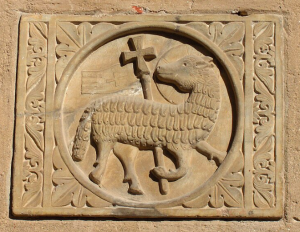
An Agnus Dei [Lamb of God] wall carving from
the Basilica of the Assumption of Mary in Poreč,
Croatia. Photo by Georges Jansoone,
used via a CC BY-SA 4.0 license (source).
As for false messiahs, the history of Judaism has known plenty of these; part of the reason public discussion of the Messiah is somewhat taboo in Judaism is that messianic claimants have a tendency to get people, and themselves, killed. (Strictly speaking, Yeshua is no exception to this, though there are other reasons his career “hits different,” as young people say.) It probably did nobody any favors that messianic expectation seems to have settled in as a standard element of Judaic doctrine not long before the hard-won independence of the Jewish state under the later Hasmoneans and early Herodians was extinguished. Throughout the first century and into the second, Judæa was a tumultuous province; it was to Rome what Northern Ireland was to the UK in the latter half of twentieth century. Notable messianic claimants roughly contemporary with Christ included:
- Possibly, Simon of Peræa, a former slave of Herod the Great, who according to Josephus claimed a crown (it’s not clear over what) and burned down the royal residence at Jericho. He was beheaded by Gratus, a commander in Herod’s army.
- Also possibly, Athrongeus, a shepherd who led an insurrection against Herod the Great’s principal heir, his son Herod Archelaus; like Judah Maccabee, he was one of five brothers, all of whom participated in the revolt. Archelaus eventually captured (and presumably executed) them.
- Judas of Gamla, a Galilean who resisted the census of Quirinius in 6 CE (the year when Archelaus was deposed for tyranny and incompetence, and Judæa was formally incorporated into Rome’s territories). His fate is unclear; Acts 5:37 informs us that “he perished, and all who followed him were scattered,” but not how the perishing came about.
- Theudas, who claimed around the year 45 that he was going to part the Jordan River, but who was promptly caught and executed by the Roman procurator, Cuspius Fadus. (This is probably not the same Theudas mentioned in Acts 5:36—among other difficulties, that Theudas is described as coming before Judas of Gamla.)
- Simon bar Kochba (שִׁמְעוֹן בַּר כּוֹכְבָא [Shim’3oun bar Koukh’va’] in Hebrew), who led the Third6 Jewish War of 132-136, which established a small Jewish state, over which he ruled, for about three years. Emperor Hadrian put down the rebellion at immense cost to the Jewish people; Bar Kochba himself was killed in the year 135 (as was the celebrated Rabbi Akiva, who had accepted Bar Kochba as the Messiah).
f. kill/sacrifice | θύσῃ [thüsē]: This verb (a form of θύω [thüō]) may be related to θυμός [thümos], which started off meaning “smoke, vapor” and later came to mean “high spirits; anger, rage.” (Incidentally, the word thurible is derived from thūs, a Latin borrowing from θύος [thüos] “burnt offering, sacrifice.”) Though we sometimes forget that animal sacrifice was a central aspect of pagan worship, the process by which θύω came to mean simply “to kill” is probably analogous to the way the English word “sacrifice” came to be synonymous with “casualty”—i.e., metaphorical use repeated to the point of cliché, and then beyond that to the point that it became a sense of the word.
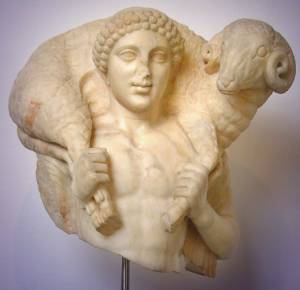
Late Roman copy of the 5th c. BC Criophorus of
Calamis. Photo by Tetraktys (?), used via
a CC BY-SA 3.0 license (source).
g. the good shepherd/the fair shepherd | ὁ ποιμὴν ὁ καλός [ho poimēn ho kalos]: I’ve availed myself of the double meaning of the English fair to use it as my go-to translation for καλός, which originally meant not “good” but “beautiful.”
This was one image which might resonate with a Gentile audience almost as well as a Jewish one. While Gentiles were perhaps a little less dependent on sheep (since they could also eat pork and shellfish), the domestication of sheep is thought to have begun between ten and thirteen thousand years ago, and selection for their remarkably useful wool7 likely began about eight thousand years ago, so they were familiar creatures throughout the Mediterranean, and the need to actively care for them was likewise familiar. The image of the krioforos or “ram-bearer” was particularly associated with Hermes: according to one myth, Hermes carried a ram on his shoulders while making a circuit around the city of Tanagra (which lies, very roughly speaking, around forty miles north-northwest of Athens) in order to protect the city from a plague.
h. And I have other sheep, that are not of this fold; I must bring them also/I also have other sheep which are not from this courtyard; it is necessary for me to lead them | καὶ ἄλλα πρόβατα ἔχω ἃ οὐκ ἔστιν ἐκ τῆς αὐλῆς ταύτης· κἀκεῖνα δεῖ με ἀγαγεῖν [kai alla probata echō ha ouk estin ek tēs aulēs tautēs: kakeina dei me agagein]: This is no doubt an allusion to the opening of the Church to Gentiles. It is interesting to note that, while Christ visits and makes converts in Samaria as early as ch. 4, and deals with a probably-Gentile resident in the Holy Land in the same chapter, it is not until this point—after the allusion to the gift of the Holy Ghost at Pentecost in 7:37-39—that he hints at the invitation God will extend to the Gentiles to be incorporated into the New Covenant.
Footnotes
1Some Christian traditions assign them the names Celidonius (for the healed blind man) and Photine (for the woman from Süchar).
2Pronounced, roughly, weh-orth-sheep-eh (but with weh-orth run together into one syllable).
3This reflects a distinction in Latin between adōrātiō and venerātiō, and in Greek between λατρεία [latreia] and δουλεία [douleia]. However, here too, the difference lies more in the usage of the terms than in their origins: the Latin word most nearly equate with the English uses of the words “awe” and “reverence” respectively, while the Greek words most literally mean “service [for pay]” and “slaving.”
4Bahá’ís, or followers of the Bahá’í faith, are disciples of a nineteenth-century Iranian prophet known as Bahá’u’lláh. It is a form of Bábism, a religion based on Shia Islam but professing a continuous series of increasingly perfect revelations by the Deity (in contrast to the orthodox Muslim belief that Muhammad was the final and supreme prophet). Some Bahá’í practices are inherited from Islam, such as a prohibition upon alcohol; others are modified: e.g., their calendar is solar rather than lunar (with a nineteen-day fast in March analogous to Ramadan). There are about eight million Bahá’ís in the world, mostly in sub-Saharan Africa, India, and Southeast Asia.
Sikhs, or disciples of Sikhi—often Anglicized as “Sikhism”—follow a religion founded in the fifteenth century in the Punjab region by Guru Nanak. The tenth Sikh guru decreed that his successor at his death (which occurred in 1708) was to be the Sikh holy book, the Guru Granth Sahib. Some Sikh ideas and practices align with Bhakti Hinduism—e.g., belief in reincarnation, belief in liberation from the present Kali Yuga through devotion to God, and use of the divine name as a mantra—while others, such as monotheism, together with a strict prohibition against participating in the worship of idols, align with Islam. There are twenty-six million Sikhs in the world, give or take, of whom the vast majority still reside on the Indian side of the Punjab. Most of the rest are members of the Punjabi diaspora; a few hundred thousand Sikhs are to be found in Canada, Great Britain, the US, Australia, and Italy.
5Unlike the aurochs—the animal from which modern cattle were domesticated, extinct as such since the seventeenth century—the mouflon (Ovis gmelini), the ancestral species to sheep, still exists. It is native to the Armenian Highlands, the Caucasus, the Taurus Mountains, and the Zagros Mountains, which collectively stretch across modern Armenia, Azerbaijan, northern Cyprus, Georgia, western Iran, northern Iraq, northern Syria, and Turkey. Mouflons look much more like goats than domestic sheep do.
6Some authorities make this the Second Jewish War, by not counting the Diaspora War of 115-117.
7In antiquity, clothing was made out of animal fibers of various sorts (e.g. mohair, wool, and silk), animal skins (usually tanned to make leather), or plant fibers (such as flax, the plant from which linen is woven, and cotton). A uniquely useful property of wool is its ability to keep the wearer warm even when wet.










 Ad-Free & Subscriber Log-In