

They didn’t burn witches in Salem. The infamous Salem witch trials resulted in 30 people being condemned as witches, and 20 of them were executed — 19 by hanging, one crushed to death. No one was ever burned at the stake.
 Burning at the stake came later — about 50 years later. And that wasn’t in Salem, it was in New York City, when months of mass hysteria left far more people dead. The “New York Conspiracy of 1741” was not a witch trial. It was a white panic over a supposed slave rebellion — an uprising that never actually happened and that the best historical evidence suggests was wholly imaginary.
In American popular culture and popular imagination, burning at the stake is still associated with witches, even though this was never the result of American panics over alleged witchcraft. Burning at the stake was, in fact, a punishment allowed and sometimes required in early American law, but not for “witches.” It was for slaves. (The official tally of official executions only in New York City during the Panic of 1741 was 34, with 21 hangings — including four white “conspirators” — and 13 burned at the stake.)
There’s a grim discussion of this in the Wikipedia article linked above involving the burning-at-the-stake of an uncertain number of slaves in New Jersey around the same time as the White Panic of 1741 was unfolding in the city. It’s not clear whether the fiery executions in Hackensack were related to the hysteria over the imagined conspiracy in New York or if they were an unconnected unfolding of, you know, just normal life here in early America. That normal life never involved burning witches at the stake but sometimes did involve doing this to slaves who did not agree to be enslaved.
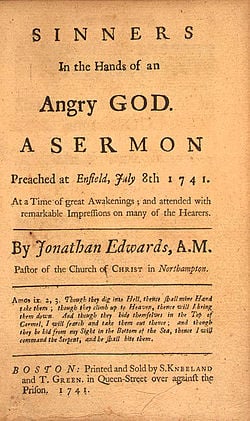
Like most Americans, I never heard anything about the “Conspiracy” of 1741 in any of my history classes or textbooks. I first read about this because I was looking for old pictures of downtown Brattleboro, Vermont, and stumbled across a quixotic amateur historian’s blog arguing that this event was linked to the one piece of history our classes did include about 1741 — Jonathan Edwards’ famous sermon “Sinners in the Hands of an Angry God.”
Edwards’ sermon came during the height of that panic. The public executions in New York had been unfolding for weeks, including a burning at the stake on the Fourth of July (35 years before 1776), just four days before he preached his sermon in Enfield, Connecticut. In those days, Enfield was a long way away from New York City, but the mass hysteria was big news throughout New England. About a week after Edwards preached “Sinners in the Hands,” a Plymouth judge named Josiah Cotton wrote a letter to a New York magistrate, mocking New Yorkers for previously having mocked New Englanders for the witch trials in Salem a generation earlier. Cotton’s letter was based on reports of the panic he’d read in Boston newspapers — reports that would certainly have reached Edwards in Enfield as well.
That sermon smolders with imagery of fire and flames. I can’t prove it, but I’m convinced that was shaped in part by the news that Edwards and everyone else in New England had been reading that summer about the pyres on the streets of New York. Even in the unlikely possibility that Edwards himself was not thinking of those fires, this was the context in which everyone in the congregation would have heard that sermon.
 The main reason I’ve remained fascinated with the actual, factual, real-true history of the White Panic of 1741 is that it seems to me to provide evidence — proof — that white Americans absolutely knew and understood that slavery was evil. And that this was widely, popularly understood by every white person, not simply by the then-exceptional dissenters like John Woolman or Benjamin Lay.
If white Americans in New York City had not fully understood that slavery was an intolerable evil, the panic would never have happened. It was not a reaction to any actual slave “rebellion,” but to an uprising that was anticipated and expected. Everybody knew such an uprising was possible. Everybody knew such an uprising was inevitable. Because everybody knew that if they were, themselves, in the position of the enslaved, that is what they would do, or attempt, or dream of attempting every day.
The mass hysteria of the trials, the torture-enforced confessions, and the executions was, in a sense, the product of a warped kind of empathy. White people beheld the situation of the enslaved people and could not help but sometimes think of what they would do if that were them. Custom and convention and training and teaching can provide all manner of devices to deflect and dismiss and diminish such thoughts, but those defenses are never entirely effective.
Thoughts of what would I do if that were me and my family are never wholly avoidable for anyone who is not a sociopath, and most people are not sociopaths.
And so white New Yorkers in 1741 understood what they would want to do that if the situation were reversed — if they were the ones whose daily labor was forced and never compensated, if they were the ones who were beaten and shackled and subjugated and sold. They knew that if that were happening to them, they would seek liberation. And vengeance. They knew that they would deserve to seek liberation and vengeance.
And so those white people lived in perpetual fear of a slave uprising — fear that in 1741, in New York City, gave rise to mass panic and mass hysteria and charred bodies in the streets.
They knew that slavery was an intolerable injustice. We know that they knew. We know this not because we have historical documents recording that they admitted or acknowledged this, but because we have historical records of their deeds — of their panicking in exactly the way that humans panic when they know this, and only when they know this.
The past is another country, but people in other countries are still people. And there is no human way to understand those humans or to regard them as humans that does not acknowledge that they knew.
I’m thinking about all this again today because I’ve just read Noah Berlatsky’s essay in the Revealer on “What We Can Learn from the Right’s Attack on ‘Toxic Empathy.'” Berlatsky has many thoughtful thoughts about the dangers of misapplied or selective empathy. He understands that the unavoidable imaginative act of thinking “what if that was me?” or “what if the shoe was on the other foot?” can just as easily lead to repression and backlash as to the Golden Rule.
Even more specifically, Berlatsky provides a passage from another Presbyterian minister, John Rankin. Rankin lived a century after Edwards and, unlike Edwards, he strenuously condemned slavery as an injustice and a great evil. But Rankin’s appeal to empathy was something that Edwards and every member of his congregation in 1741 would have fully understood. Rankin wrote:
My flighty imagination added much to the tumult of passion by persuading me, for the moment, that I myself was a slave, and with my wife and children placed under the reign of terror. I began in reality to feel for myself, my wife, and my children — the thoughts of being whipped at the pleasure of a morose and capricious master, aroused the strongest feelings of resentment; but when I fancied the cruel lash was approaching my wife and children, and my imagination depicted in lively colors, their tears, their shrieks, and bloody stripes, every indignant principle of my bloody nature was excited to the highest degree.
Berlatsky notes the way this imaginative act of empathy can serve to displace or to substitute away the actual suffering of those actually being oppressed, even in the mind of an abolitionist like Rankin. He cites Saidiya Hartman’s description of the result of this: “the attention of the self occurs at the expense of the slave’s suffering.”
We humans, being human, cannot avoid empathy. But we humans, being human, can never wholly overcome “the attention of the self … at the expense” of others. We are bound to empathize, but our empathy is always bounded. I can imagine how I would feel in someone else’s shoes, but only how I would feel, the identification is at best analogous.
But it’s still enough to understand enough that the Golden Rule is not completely beyond our ability to comprehend.
See earlier:
- “Slaves in the Hands of an Angry God“
- “Empathy turned to fear and resentment“
- “Some people punch down when they get scared. True.“
- “When we flinch at empathy, it curdles into fear and resentment“
- “What did Jonathan Edwards know and when did he know it?“













 Ad-Free & Subscriber Log-In