

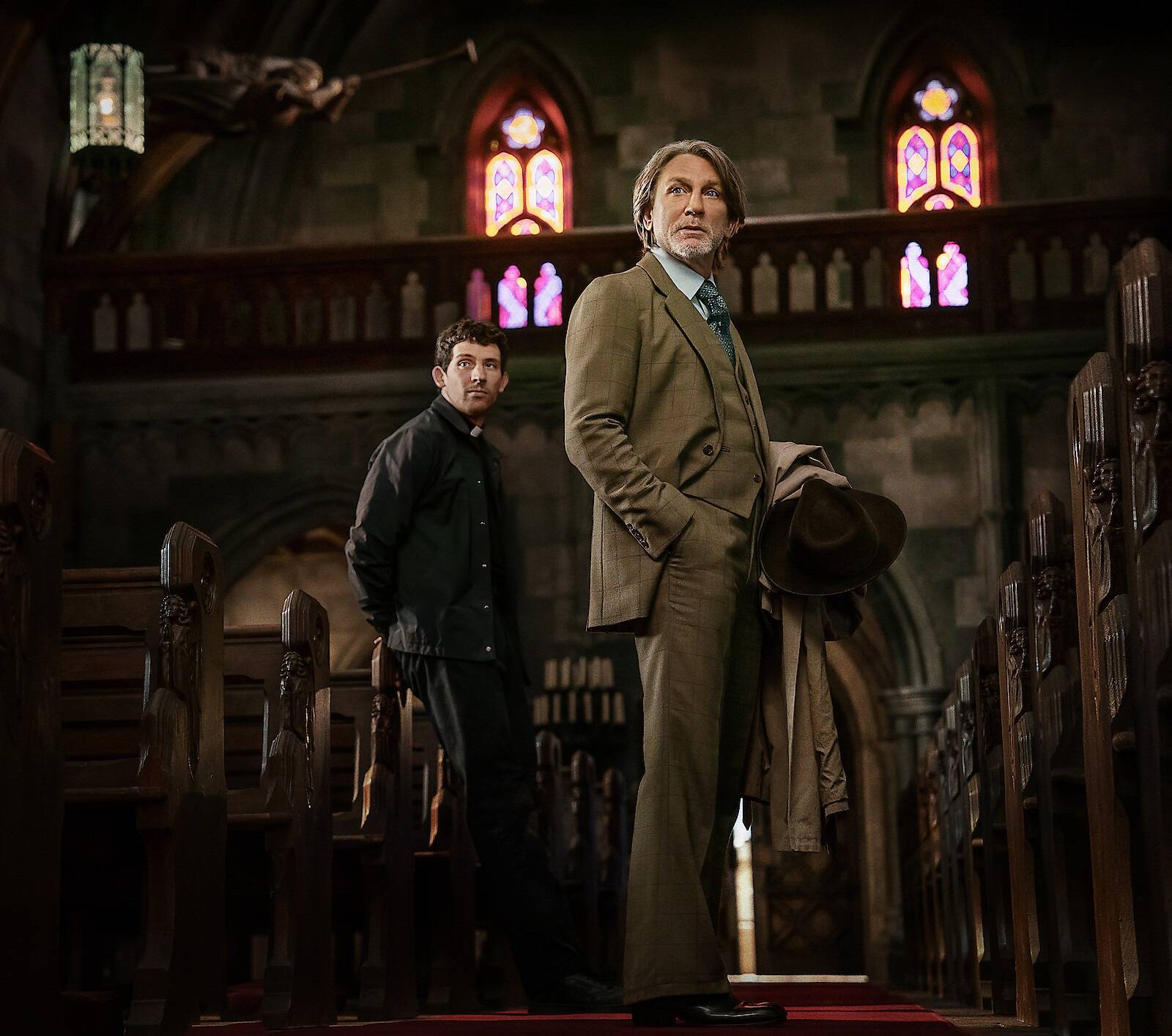
Note: This post contains spoilers for Wake Up Dead Man. “You here to take my church away from me?” It is the first question Monsignor Jefferson Wicks asks Father Jud Duplenticy when Jud arrived at Our Lady of Perpetual Fortitude. Mons. Wicks and Father Jud are the central characters in Rian Johnson’s newest Knives Out installment, Wake Up Dead Man. Johnson’s murder mystery franchise has been at the forefront of a whodunnit revival in Hollywood, due in no small part to Johnson’s ability to marry conventional mystery caper storytelling with not-so-subtle satirical social critique. From the first few scenes of Wake Up Dead Man, Johnson makes clear he’s got something to say about the function of Christianity in our current cultural moment. We’re too online, we’re too polarized, we’re too self-assured. Ours is a moment where too many are scrupulous about splinters and oblivious to logs. And Christianity has a role to play in this moment, for ill or (Johnson hopes) for good.

Mons. Wicks and Father Jud are the moral centerpieces for Johnson’s drama. They represent two opposing forces at the heart of Christianity. And the first question asked of Father Jud is telling for how the struggle between these opposing forces play out over the brief course of the two priests’ ministry at Our Lady of Perpetual Fortitude. Mons. Wicks sees his small parish as an outpost in the battle for the soul of the nation, and his pulpit is a platform to begin the work of taking back America for God. “The hour I have warned you about approached,” Wicks booms at one point, “And as you gnash your teeth in the darkness, you unfaithful devils, as you lie cold and forgotten and alone, He will rise again to reclaim what is his and strike down the wicked and raise his true son to the throne of this nation!” (Importantly, Wicks has political ambitions and plans for a media empire, so in context, it’s clear Wicks is blurring the lines between himself and Christ.)
Wicks’s homilies are scathing critiques of the world (including visitors to the church) as he rages against the loss of the traditional family, secularism, and modernity. His temper is brooding. His theology is vindictive. His self-importance is immense. In short, Mons. Wicks is a holy terror.
His arrogant and bombastic approach has shrunk the congregation down to a few loyal adherents to his brand, but he has a burgeoning audience across the US thanks to—what else?—Youtube. It’s in the online domain that Mons. Wicks has found his people, his platform to shape angry and disillusioned conservatives into soldiers in Christ’s army against “feminist, Marxist whores” and the “garbage world” that threatens to destroy the Church. In a pivotal confrontation with Father Jud, Mons. Wicks tells Jud “the world wants to destroy us…but I carry my burden. I hold the line.”
Watching Mons. Wicks, I can’t help but think of the rising influence of the very-online Christian far right. The social media landscape has proved fertile ground for carnivorous vegetation in the form of Twitter-first pastors whose flocks are small but whose online reach is vast. The “church” of the far-right isn’t primarily found in the pews of small towns but in the replies of social media threads. Wicks’s diatribe against “garbage world” made me think immediately of Christian Nationalist provocateur Andrew Isker’s Boniface Option, which pleaded with Christians to reject and fight against “Trashworld,” the “dystopian society” that wants to make you “spiritually homosexual.” Isker and others rail especially against feminism and feminized Christianity that prioritizes niceness and polite society over the demands of social purity. “Your version of love and forgiveness is a sop,” Wicks tells Jud.
But Mons. Wicks isn’t the only character pushing Jud to put away spiritual sensitivity and begin taking things “seriously.” Benoit Blanc, the genteel and ostentatious P.I. and recurring protagonist in the Knives Out films, enters to solve a murder in which Father Jud is implicated. Blanc, convinced of Jud’s innocence, enlists Jud in helping him solve the case. At one point, Blanc confronts Jud about his ambivalence in aiding in the investigation. “Now you see the enemy we’re up against,” Blanc tells Jud. “You have listened to this flock’s stories with empathy and grace, but we’re done with that now. We’ve wasted enough time.” Blanc is a bona fide nonbeliever who finds himself at points both impressed and annoyed by Father Jud’s dedication to his priestly duties even amid an ongoing murder investigation. Blanc, like Wicks, sees Jud’s careful and empathetic approach to his flawed parishioners (and Blanc’s murder suspects) as little more than sanctified politeness.
Jud’s turning point comes amid a major breakthrough in the case. He calls a construction company trying to find out who placed an order for heavy machinery and finds himself trapped in polite conversation with the administrative assistant of the company, Louise. Visibly annoyed, Jud attempts to hop off the call so he can get back to helping Blanc when Louise’s voice changes. “Hey Father, could I ask you something? Father Jud, will you pray for me? It’s my mother…” Jud stops in his tracks, suddenly reminded of where he is and who he is. He listens empathetically to Louise describe her family situation, and he prays earnestly for her, reminding her that she is not alone—the church is with her and for her. To my memory, Father Jud is the only character in Wake Up Dead Man who prays. His story is, in fact, saturated with prayer. Early in the film, to “counterbalance” Mons. Wicks’s brutality, Father Jud holds a prayer meeting with Wicks’s loyal followers. Prayer is, for Jud, “about breaking down the walls between us and Christ, us and each other, us and the world.” When Jud gets caught up in the tumult of the murder, he turns to Jesus in prayer for guidance. It is Louise’s request for prayer that awakens Jud to his calling.
Johnson’s two priests also carry their histories with them, and these histories too shape their ideals about faith and ministry. Mons. Wicks was raised in Our Lady of Perpetual Fortitude. His grandfather was a priest and a patriarch whose moral vision, focused on naming and purging sin in the body, seeped into Jefferson Wicks’s consciousness from an early age. Wicks the younger fancies himself a warrior speaking out against the world, but as far as we know he never ventured far beyond the security of the parish grounds. He blasts against the sins of others in public, all while hiding his own secrets in the dark of his heart. Father Jud, on the other hand, is an adult convert to the faith. In an earlier life, he was truly a fighter—a boxer who killed a man in the ring. Having to live with that fact profoundly shapes Jud’s understanding of the gospel and of how Christ deals with sinners. “I killed him with hate in my heart,” Jud tells Blanc. “There’s no hiding from that, there’s no solving it. God didn’t hide me or fix me. He loves me when I’m guilty. That’s what I should be doing for these people.”
You’ll remember at the beginning of my post, I spoke about Wicks and Jud as representing two forces within Christianity. Some may watch Wake Up Dead Man and assume Rian Johnson is trying to make normative claims about true Christianity and false Christianity. In this take, Wicks would be wrong about Christianity—he wrongly assumes it’s about gaining power to change the world; Father Jud—loving, gentle, forgiving, would be right. But I interpret Mons. Wicks and Father Jud rather as depicting two approaches Christians have historically taken to interpret their existence in the world. Early in the film, Benoit Blanc confesses to Father Jud his disdain for organized Christianity. “It’s built upon the empty promise of a child’s fairy tale filled with malevolence and misogyny and homophobia and its justified untold acts of violence and cruelty while all the while, and still, hiding its own shameful acts.” Jud, the pastor, doesn’t challenge Blanc on this claim. It would be hard for Jud to disagree with Blanc’s critiques, in part, because he’s witnessed the story of Christianity used by Wicks himself to justify his own malevolence, misogyny, homophobia, violence and cruelty!
As to whether the promise is empty or not, that all depends on what a person thinks coming to Christianity guarantees. Why follow Jesus? Why confess him as Savior and King?
In the gospel of Mark, as Jesus is nearing Jerusalem to be ushered in as king, John and James come to Jesus with a request. “What do you want me to do for you?” Jesus responds. “Let one of us sit at your right and the other at your left in your glory.” The request betrays several misunderstandings, but at the heart of it, James and John assume that Jesus’s rule and reign will mirror the dominion of other kings, where honor follows power. They have been with Jesus from the beginning; they’ve helped in his ministry. They’ve put in the work and now are eager to see Jesus take command, purge the world of the evil, and reap the rewards of their loyalty.
In the gospel of Luke, another disciple makes a request of Jesus. This man is a latecomer. He’s an adult convert who hasn’t done a thing to earn his keep. In fact, when he meets Jesus, the man is dying on a cross next to him as the penalty for theft. Looking at Jesus in anguish, he asks, “Jesus, remember me when you come into your kingdom.”
Mons. Wicks and his loyal audience practice a form of Christianity enamored with the question, “Who will be in charge when Jesus reigns?” Father Jud is energized by an altogether different question: “Who will be remembered?”
Jud’s ministry doesn’t get Youtube followers or zealous culture warriors, but it does serve as a balm to the contrite. It remembers the forgotten. It foregrounds those who are on the margins of the “important work.” Jud’s mercy is ultimately what even releases him of suspicion for the murder. The culprit is driven to confess to Jud. “Blessed are the merciful, for they will be shown mercy.” His mercy even humbles the proud. Benoit Blanc, a staunch nonbeliever, is so moved by Jud’s example that he forgoes his opportunity to prove his expert sleuthing skills, as he extends the same mercy to the guilty party by allowing them to confess privately rather than be performatively outed along with all the other suspects. Blanc doesn’t convert because of Jud’s Christlike example, but he does walk away different. “Live such good lives among the pagans that, though they accuse you of doing wrong, they may see your good deeds and glorify God on the day he visits us” (1 Pet. 2:12).
Johnson, who has himself deconverted from evangelical Christianity, doesn’t seem to have a vested interest in marking out true Christianity from false, but he does seem to understand on a deep level that Christianity has the power to change people. Whether that change is for better or worse all depends on which questions we want Jesus to answer, and what those questions reveal about why we think Jesus is worth following.
Wake Up Dead Man is now streaming on Netflix.










 Ad-Free & Subscriber Log-In