

I just received news early last week that Holocaust survivor, Dr. Jacob Eisenbach, passed away.
I was asked if we would like to host a visit by the 102 year old speaker mid-October and I jumped at the chance to have him tell his story. I figured that so many of the witnesses of the horrors of the Holocaust are now dead that I did not want to miss this opportunity for my students.
I believe that hearing from a living witness was important for our students. Steve Hochstadt, who helped author the book Death and Love in the Holocaust: The Story of Sonja and Kurt Messerschmidt, declares that “hearing a Holocaust story obligates the listener to do something. Holocaust stories force us to think again about life, our lives, our society’s life, humanity itself” (2).
Dr. Eisenbach spoke for about 50 minutes mostly from memory. At one point, he needed his script to remember some of the details of his narrative. Hochstadt is right. Since Dr. Eisenbach’s talk I have done a lot of thinking about life and humanity itself.
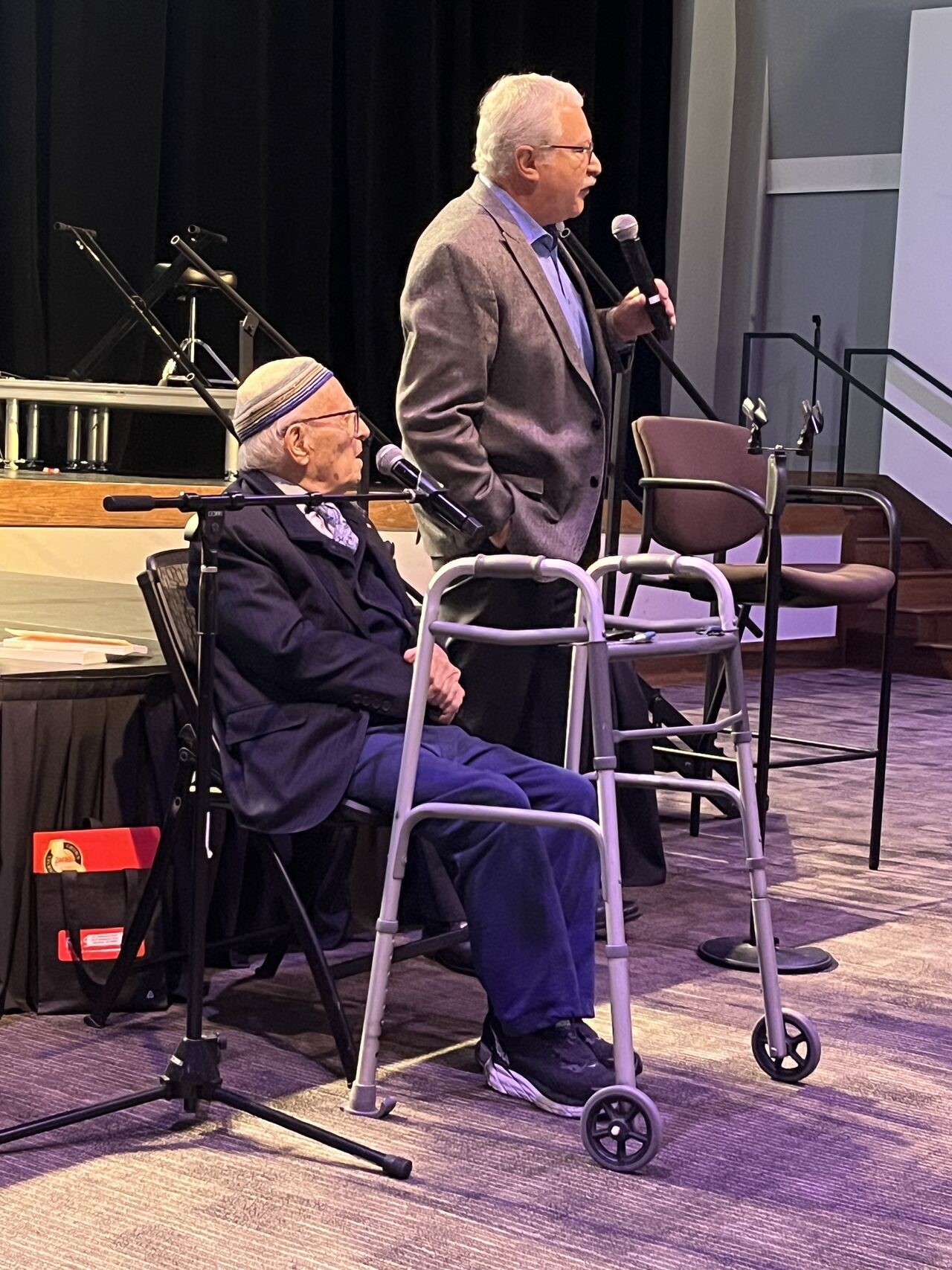
I watched his short documentary a few days after his visit to get more clarity about his story. I skimmed over the written witness of survivors Sonja and Kurt Messerschmidt that I read just prior to Dr. Eisenbach’s visit. We met up with family friends the same morning and I brought up Dr. Eisenbach’s visit. Our friend replied how important the visit was for our students. Then she told us that her husband’s grandparents were also survivors and have their testimony recorded. After looking around for their videos, I found that Dr. Eisenbach’s testimony was also recorded with the USC Shoah Foundation. Yes, there are many eyewitness testimonies of the Holocaust. Each story is unique and unforgettable.
I was so moved by Eisenbach’s talk that I decided now was the time for my two adolescent boys to watch Schindler’s List. It was easy convincing both it was important, especially since my youngest is a huge Spielberg fan. Both boys were glued to the TV throughout the entirety of the film. Their response once it finished was that they found the movie overwhelming. My thoughts exactly. And again more time thinking about life and humanity.
One of the most tragic parts of the timing of Dr. Eisenbach’s death is it happens on the heels of what could only be labeled very public forms of antisemitism littering the air—and it is everywhere. It is one thing to be horrified at how the political fringe, both Left and Right, continue pushing the envelope on how they can outdo the antisemitic rhetoric of their opponents. However, it deeply saddens me that he might have felt anxiety or even fear to share his story in public before his death.
Contemporary speakers plague online conversations with antisemitic tropes that go back centuries. I frankly do not want to link to any of the nonsense that masquerades as “dialogue” nowadays, but when we are, for example, openly debating Bonhoeffer‘s legacy then we can start to see our problem. I don’t think the problem has to do with Bonhoeffer’s ethical choice in joining the assassination plot. For instance, in the latter part of the Church Dogmatics, even his friend and mentor, Karl Barth, questioned the overall strategy.
No, the problem is there are volumes upon volumes of Bonhoeffer studies that deal with these sort of questions. Any serious conversation about Bonhoeffer should begin with at least skimming what people who have spent a lifetime studying him have to say—not to mention actually reading Bonhoeffer. This is how critical thinking and reading work.
One of the recent staging grounds of the battle between critical thinking and serious scholarship versus the sloppy skeptics questions is Holocaust studies. Nevermind, once again, the volumes of scholarship on this topic, but also the still living and recorded testimonies of the witnesses. But the skeptic has it easy since they just have to play devil’s advocate. The burden of proof lies on the witnesses.
I recently read Yehuda Bauer’s book Rethinking the Holocaust. He said something that is so profound. He suggests stop calling the Nazi behavior demonic or animalistic. No, these were sinful, human beings that committed these crimes against their fellow humans. Don’t let humans off the hook. Fallen human beings put a young Jacob Eisenbach in a Nazi camp.
When I heard the news of Dr. Eisenbach’s death I was shocked. Doesn’t make much sense since he was 102! But it was my student’s reactions that stayed with me.
At the end of Dr. Eisenbach’s talk a line of students wanted to meet him. Many were so kind and compassionate to our guest, taking selfies with him and sharing some encouraging, intimate thoughts. It was their kindness that moved me. I was the last one to leave and after thanking him and his guests for coming, he shook my hand, looked me in the eye and told me it was my job now to keep telling the truth.
Historians don’t always get everything right but we are part of a discipline that considers the best sources available to get as close to the truth as possible. In some ways it is a sacred calling especially when deceivers abound willfully spreading hate and errors.
My biggest takeaway from Dr. Eisenbach’s visit is how he still managed to promote hope in our increasing dark times. If someone who survived the Holocaust can be hopeful, what excuse do I have for being pessimistic? He lived through far darker times and still found a way to hope so shame on us if we now say hope is somehow passé.
Bauer declares that the Holocaust was a “world issue” (260). Dr. Eisenbach seems to agree with Bauer that since it was a world issue that the global lesson to learn was in spreading more empathy and love toward one another. Skim for recent interviews and you will find that Dr. Eisenbach gave speeches promoting love and tolerance to his audiences to hopefully prevent the type of violence he had the misfortune to experience. But God bless him and all the other survivors who bravely retold their stories. That could not be easy.
At Vanguard, one of our mottos is that “your story matters”. The fact that my university was the last place he publicly shared his story is a nice way to show how this phrase is not just a cliché. His message has made me think long and hard about life and humanity. And for all of us who heard his story, I pray that we are faithful to this eyewitness to continue to tell his story.











 Ad-Free & Subscriber Log-In