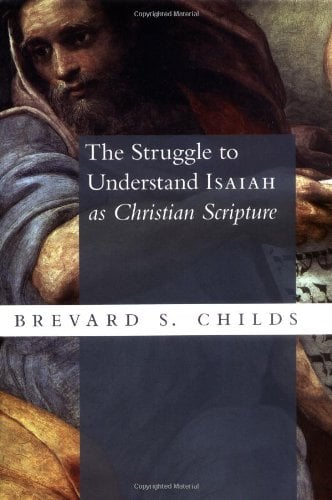
2016-02-15T10:01:32-05:00

Robert Lowth (1710-87) was a major British scholar, indeed a professor of poetry at Oxford. In 1778 he published a new translation and commentary on Isaiah, which was to become one of his two most famous works. But it necessarily followed and depended upon his 1753 publication, a detailed analysis of Hebrew poetry. Whereas previously it had been assumed that prophecy was a form of prose, Lowth, after his study of the Psalms and then Isaiah concluded it was poetry,... Read more

2016-02-07T13:27:54-05:00

AKEDAH Did he ponder Isaac Whilst hanging on the cross A last second substitution Just before all was lost? Is this why he cried out ‘My God, My God’ so loud Showing disappointment Before a hostile crowd? Where’s God’s intervention, Offering another lamb Or would He be passed over A dangling great I AM? Abandoned but begotten Left to face his fate? Would help arrive in ‘nick of time’ Or would it come too late? Where’s the lamb, asked Isaac... Read more

2016-02-15T09:57:41-05:00

One’s students often depart from the views of their professors, and this is true of C. Vitringa (1659-1722) the student of Cocceius. He sought to join together the secular and sacred history of Scripture, charting a course between Grotius and Cocceius. He wrote a large two volume Latin commentary on Isaiah between 1714 and 1720. He expresses his preference for seeing the near historical horizon as the point in which the Biblical prophecy of Isaiah was fulfilled. He therefore looks... Read more

2016-02-15T09:48:14-05:00

Johannes Cocceius (1603-1669) was a well known Reformed exegete. He had considerable linguistic skills (Latin, Greek, Hebrew, Syriac, even Arabic) and he knew rabbinic literature as well. He became a professor from 1643-69 (in later years at Leiden). Childs summarizes Cocceius’ approach by saying he focused on a careful interpretation of the meaning of words within their literary context, not happy with those who contrasted the spiritual with the literal sense. It is his Christological focus in every aspect of... Read more

2016-03-04T16:25:26-05:00

The official description of this 1 hour 48 minute film on the rottentomatoes.com website reads as follows—- “The modern mammal metropolis of Zootopia is a city like no other. Comprised of habitat neighborhoods like ritzy Sahara Square and frigid Tundratown, it’s a melting pot where animals from every environment live together-a place where no matter what you are, from the biggest elephant to the smallest shrew, you can be anything. But when rookie Officer Judy Hopps (voice of Ginnifer Goodwin)... Read more

2016-02-15T09:42:07-05:00

Child’s treatment of the history of interpretation after Calvin is necessarily much more succinct, presumably because it is more readily available and familiar to the reader. He begins with Hugo Grotius (1583-1645) and his critiquer or rebutter Abraham Calov (1612-86). Grotius was a gifted linguist and classics expert and had a very good knowledge of Hebrew and Syriac. He largely achieved his goal to provide annotations on the whole Bible, including Isaiah. Childs says his most important contribution was establishing... Read more

2016-03-03T20:48:58-05:00

Here’s a helpful article written by an Evangelical who has been an advisor to three Republican Presidents as to why no Evangelical should be voting for Donald Trump, see what you think. He rightly raises the same questions as Pope Francis raised, namely the question of character in view of Trump’s track record of adulteries, lies, defrauding students at Trump University, employing non-Green card Polish workers and paying them a third of American works to build Trump tower, and on... Read more

2016-02-15T09:24:45-05:00

In his teaching and preaching of Isaiah, Calvin starts with the Hebrew text itself and he is always focusing on a particular text and he seeks to help the audience understand the meaning of the words in that text. In his Isaiah commentary he seldom resorts to the LXX, and he often paraphrases things to help people better understand the text. The exception to the rule of not using the LXX is when the NT author for example Paul in... Read more

2016-02-15T09:23:49-05:00

As Childs point out, Calvin did not see a major difference between the intentions of the human author and the intentions of the Holy Spirit in inspiring the human author to say this or that. He acknowledges that the full personality and knowledge of the human author is in play but is guided by the Spirit. Calvin uses the principle of analogy, even literary analogy, to apply the Biblical text to his own current situation. As Childs, (following my old... Read more

2016-02-15T09:20:07-05:00

John Calvin (1509-1564) was the exegete par excellence amongst the early Protestant divines, even though in the nineteenth and twentieth centuries he has been better known for his theological institutes. Calvin’s commentating was philologically and historically oriented, like some of his predecessors, and like those of a more Antiochian orientation, he had real issues with allegorizing of the Biblical text. Perhaps here is a good point to make some distinctions. There is a difference between a straight allegory (see e.g.... Read more

Follow Us!


TAKE THE
Religious Wisdom Quiz

What Christian group is known for having monks who follow the Rule of St. Benedict?

Select your answer to see how you score.


Browse Our Archives