
And from my friends in the Lexington Lab Band by way of another southern boy, Bruce Hornsby, how our country should never be— racist! Read more

And from my friends in the Lexington Lab Band by way of another southern boy, Bruce Hornsby, how our country should never be— racist! Read more
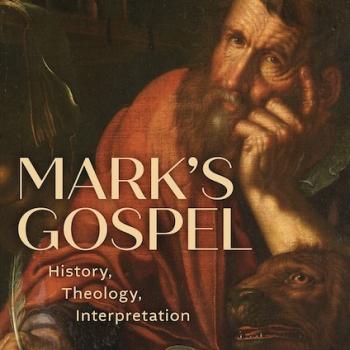
Q. I wondered about chiasms, which seem to me a visual device, but Mark’s Gospel in the main was not read by early Christians, it was heard by most of them, and it was intended to be an oral and rhetorical text, not a visual one. The reader in Mk. 13 is surely the lector who read it out to the congregation, not the audience, as Rev. 1.1-4 makes clear— noticing the distinction between the one who reads it out... Read more
Q. What do you mean by saying this Gospel has an apocalyptic character or flavor, especially in certain revelatory scenes like the one at the baptism or the Transfiguration? Is this somehow related to Mark’s famous ‘messianic secret’ motif? CCB: “Apocalypticism” is among the most misunderstood phenomena in biblical interpretation. Partly that’s because in everyday English the term often carries very narrow, constrictive connotations: “catastrophic doom” or “the world’s complete annihilation.” Literally, an apocalypse is a revelation: a “pulling... Read more
Q. Much has been made of late about Mark being an ancient biography, especially by Burridge but also by Bond. What are the ways this helps us understand the content of this Gospel, but also what are the limitations of this observation? CCB: In Hellenistic Judaism and Greco-Roman antiquity, biographies (bioi) were selective and stylized, sometimes idealized, presentations of historical subjects that intended to edify their audiences. Ancient biographies were not literary purebreds but mongrels, absorptive of other genres.... Read more
Q. Your mentor was Moody Smith at Duke. He mainly focused on the Gospel of John. What prompted you to choose to do a dissertation on Mark? CCB: It was Moody Smith who spurred me—not by intention, but in fact. In my first year of doctoral study I enrolled in a course he taught on the exegesis of Mark’s Gospel. I was gobsmacked by Mark then and have been ever since. After the spring of 1982 I knew I would... Read more

The measure of the importance of an ancient prophetic site like Klaros can be seen in some of the extra buildings, for instance in what amounted to a hostel for consultants to stay in while visiting the prophets over a period of time….. The name of said building was Katagogeion and it was a bit apart from the temples themselves…. Naturally as well, at a famous site there would be some entertainment— Greek comedies or tragedies by Sophocles or Aristophanes... Read more
A Via sacra or sacred road went right past this site, and on to Ephesos (which by the way is the Greek name of the city, with Ephesus being the Latin name). Along the road there would be kora and kore statues, idealized representations of males and females, which may be copying some of the similar statues in Egypt. The statue immediately above is of Aphrodite. Generally, the statues in the nude were of gods, goddesses, or idealized human... Read more

Seeing the lay of the land helps to explain the eventual demise of these temples. It was of course partly because in the fourth century A.D. Christianity had mostly won the battle against paganism, and these temples ceased to function, but it was also because in the case of the temples at Claros and the Artemis temple at Ephesos they were on flat ground which could be flooded and become marsh land. Consider the following pictures/ To say the least,... Read more

The story of the excavations at Claros is interesting, and here is a sign explaining it….. The Honorific columns that are part of the temple of Apollo are important. The first is the one honoring Polemos, presumably because he was a patron of the temple of Apollo… Then there is the honor column for Sextus Appuleius… But by far the most imposing of the monuments at Claros are the three 25 foot tall statues (original height), of Apollo, Leto,... Read more

One of the unique features of this site is that it has two adytons, the below ground chamber under the platform of the temple where the prophet received inspiration after drinking some of the river water. When I was there the chambers were filled with water, and the only living things in them were frogs. Here’s a picture…. Another unique feature is the sundial that was found there which has been removed. This is the likely spot where the... Read more

Select your answer to see how you score.




 Ad-Free & Subscriber Log-In