

The sermon to the Valley of Dry Bones in Ezekiel 37 preaches to the need for racial justice and reparations today.

This reflection is for the Fifth Sunday of Lent in Year A of the Revised Common Lectionary and focuses on Ezekiel 37:1-14, the story God restoring the Valley of the Dry Bones of Israel.
“Dem Bones”
Many people are familiar with the song, “Dem Bones.”
“The toe bone’s connected to the foot bone. The foot bone’s connected to the leg bone,” and so on. The verses culminate in the call for all the bones to “hear the word of the Lord.”
The prophetic vision of desiccated bones miraculously reconstituting the nation of Israel in Ezekiel 37 inspired this song. James Weldon Johnson (1871-1938), together with his brother J. Rosamond Johnson, composed the music and lyrics in 1928.
Growing up in the first Jim Crow era of the post-Civil War South, Johnson became an educator, diplomat, civil rights activist, and poet. His best-known anthology is God’s Trombones, a collection of Black-dialect sermons in verse. He and his brother also wrote the hymn that became the anthem of the Civil Rights Movement: “Lift Ev’ry Voice and Sing.”
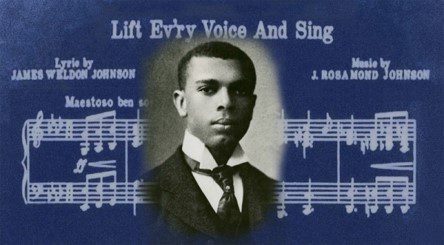
Focusing on James Weldon Johnson and Ezekiel 37 for the Fifth Sunday of Lent can help the church counter the white supremacy of Christian Nationalism.
Christian Nationalism, Racism, and White Supremacy
I define Christian Nationalism as a political ideology that distorts and weaponizes Christian teachings to legitimize and advance an aggressively patriarchal, racist, and ethnocentric agenda. [See: Countering the Temptations of Christian Nationalism: Matthew 4:1-11]
Christian Nationalism takes aim at any attempts of reconstituting the memory and history of the people who suffered and died under slavery and its aftermath. For example, the current administration forbids the teaching of “critical race theory.” In addition, the administration continues its efforts to overturn affirmative action and dismantle policies of diversity, equity and inclusion. At the same time, white supremacy groups publicly and boldly declare their agenda to “take America back” for whites. These are just some of the ways that the sin of racism continues to infect the soul of America.
Shielding white racial purity and innocence
However, as Robert Jones has documented in his book, White Too Long, the white supremacy of Christian Nationalism is not limited to virulent hate groups or conservative Evangelicals. Rather, mainline American Christianity embedded the ideology of white racial purity from its founding.
The church provided the theological rationale for savagely colonizing the indigenous peoples of the Americas. Also, they used twisted interpretations of Scripture to justify kidnapping and enslaving millions of Africans. For hundreds of years, mainline denominations upheld the structures of the U.S. racialized caste system. Even today, sermons about antiracism are often taboo in many white churches. This reinforces a code of silence. The silence serves to protect what Jones calls “an unassailable sense of religious purity that protects white racial innocence,” (20-21).
Countering the white supremacy of Christian Nationalism
Preachers and congregations can speak out against the white supremacy and racism of Christian Nationalism by bringing Ezekiel 37 into conversation with today’s context.

In Invasion of the Dead: Preaching Resurrection, Brian Blount states that human bodies shackled in chattel slavery “represent the living dead.” White Christian slave owners brutalized them for generations. And the Constitution declared them to be merely three-fifths of a person. These slaves were largely “segregated and cordoned off from polite society because they were regarded as subhuman in some important ways,” (29).
Yet with the faith of Ezekiel, African Americans foresaw a future beyond exile. They “glimpsed what resurrection beyond slavery looked like, what resurrection beyond segregation looked like, and then embodied it and preached it” (29). A sermon on Ezekiel 37 can point out that the new life God showed Ezekiel amid the valley of dry bones resonates with the way that African American slaves and their descendants envisioned and embodied resurrection.
Reconnecting “dem bones”
One way churches can help to “connect the bones” and reconstitute the Black community is by advocating for voting rights. Another is to call for the end of gerrymandering, which literally disconnects Black neighborhoods from the body politic.
Churches can also support reparation efforts. Learn about these efforts in the state of California and the city of San Francisco.
Some churches are just getting started with anti-racism efforts and understanding the roots of white supremacy. Carolyn Helsel’s Anxious to Talk About It: Helping White People to Talk Faithfully About Racism is a good place to begin.
Ezekiel’s sermon to the dry bones echoes across the millennia to our own time. It speaks to the need for restoration and reparations. God is already doing this work. Activists like James Weldon Johnson challenge us to ask: in what ways will we stand alongside Ezekiel and prophesy?
Central Question, Central Claim, Central Purpose
(The Central Question, Central Claim, and Central Purpose statements are a way to organize and provide direction for a sermon that I developed in the book Introduction to Preaching: Scripture, Theology, and Sermon Preparation (Rowman & Littlefield, 2013). Here are possible Central Statements for a sermon countering racism and white supremacy in Christian Nationalism based Ezekiel 37:1-14.)
Central Question.
How can the church help to “reconnect the bones” and reconstitute the Black community, just as Ezekiel prophesied to the valley of bones?
Central Claim.
The sermon to the Valley of Dry Bones in Ezekiel 37 echoes across the millennia to our own time urging diligent work for racial justice and reparations.
Central Purpose.
This sermon urges the congregation to take concrete actions for racial justice in the spirit of Ezekiel’s prophetic vision.
[This piece was based on an article originally written in March 2023. It has been revised and updated.]
Read also:
Preaching about Racism, Economics, and Environment
Jesus & the Woman at the Well Counter Christian Nationalism
Survey Shows More Mainline Clergy Addressing Social Issues

The Rev. Dr. Leah D. Schade is a seminary professor, ordained minister, and co-founder of the Clergy Emergency League. Her opinions are her own.
Leah is the author of Preaching and Social Issues: Tools and Tactics for Empowering Your Prophetic Voice (Rowman & Littlefield, 2024), Preaching in the Purple Zone: Ministry in the Red-Blue Divide (Rowman & Littlefield, 2019) and Creation-Crisis Preaching: Ecology, Theology, and the Pulpit (Chalice Press, 2015). She is the co-editor of Rooted and Rising: Voices of Courage in a Time of Climate Crisis (Rowman & Littlefield, 2019). Her book, Introduction to Preaching: Scripture, Theology, and Sermon Preparation, was co-authored with Jerry L. Sumney and Emily Askew (Rowman & Littlefield, 2023).













 Ad-Free & Subscriber Log-In